

The common fear about ranking new fellowship programs is overblown—but blindly ranking them highly is a mistake.
If you do the legwork and ask the right questions, ranking a new fellowship program near the top can be completely rational. If you don’t, you’re gambling your training on branding and vibes.
Let’s go straight at what you actually care about: “Is this new program going to hurt my career, my training, or my life if I rank it high?”
The Short Answer: Rank New Programs High Only If They Clear These 3 Bars
Here’s my bottom line.
It can be smart to rank a new fellowship program highly if:
- The faculty, case volume, and institutional support are clearly strong (even if the program is new).
- The fellowship director and leadership have a track record (came from established programs, clear curriculum, serious about education).
- The program fills your top priorities (geography, procedural volume, niche focus, lifestyle) better than older, “safer” programs.
It’s dumb to rank a new program highly if:
- Nobody can give you straight answers on case numbers, fellow autonomy, and didactics.
- The hospital system is unstable, or fellows are basically being hired as cheap labor to plug service gaps.
- You’re only doing it because you liked the vibe, it’s close to home, or it “might be up and coming someday.”
So let’s break this into questions you should actually be asking yourself and the program.
Question 1: Who’s Actually Training Me?
Forget the logo. Follow the people.
For a new fellowship program, the most important asset is the faculty you’ll work with daily.
Ask (and verify):
Who is the program director and what’s their background?
- Did they come from a well-known fellowship where they trained fellows before?
- Do they have a reputation in the field? Do other attendings name them with respect?
Who are the core clinical faculty?
- How many are fellowship-trained themselves?
- Are they academic, community, or a mix?
- Do they publish? Speak at national meetings? Sit on guideline committees?
Does this look like a program built around one superstar and a bunch of randoms, or a stable, deep bench?
If the director and core faculty are clearly legit—especially if they were recruited from top programs—that dramatically reduces the “new program risk.”
Red flag: faculty who can’t articulate a clear educational philosophy beyond “You’ll see a ton of cases, don’t worry.” Translation: service first, education second.
Question 2: Will I Actually Get the Right Case Volume and Breadth?
This is where a lot of new programs crash.
A shiny brochure is meaningless if the fellows aren’t doing cases.
You want numbers, not adjectives.
Ask:
- What was the case volume last year for each major category that matters in your specialty?
- Realistically, how many procedures or types of patients will a fellow get:
- Per month?
- Over the full year(s)?
- How many attendings and sites are feeding that volume?
- Is all the good stuff happening with one or two superstar attendings?
- Is there competition from residents, other fellows, or advanced APPs for key procedures?
Push for specifics: “How many STEMI calls did your last graduating fellow take solo?” “How many complex spine cases per fellow last year?” “Average endoscopy numbers per grad?”
If they dodge or keep saying “plenty” or “a lot,” that’s not a good sign.
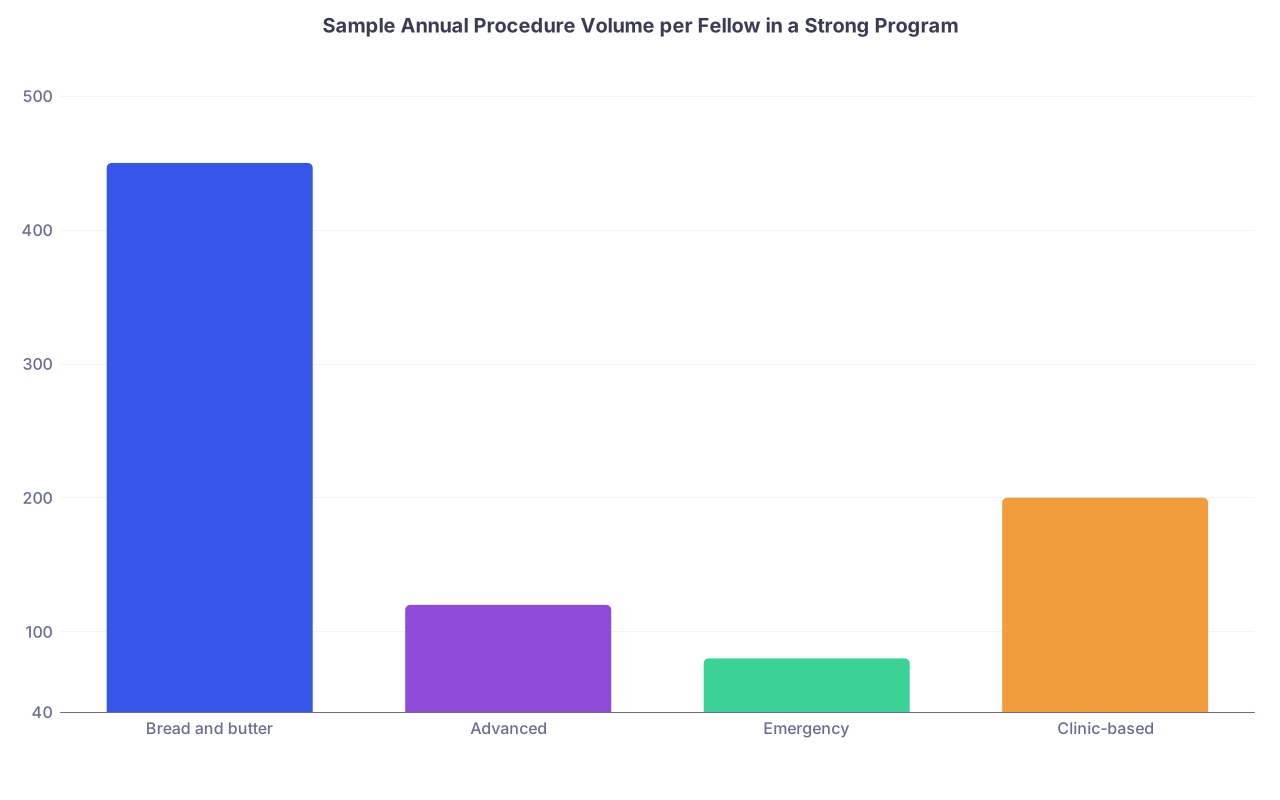
| Category | Value |
|---|---|
| Bread and butter | 450 |
| Advanced | 120 |
| Emergency | 80 |
| Clinic-based | 200 |
If they can talk about their current fellows’ numbers like this—down to categories—you’re safer, even if the fellowship is new.
Question 3: Is the Curriculum Real, or Just a PDF?
Established programs can coast on habit. New programs either build a serious curriculum…or they fake it.
You want to see evidence that someone sat down and designed your education, not just your call schedule.
Ask for:
A month-by-month rotation schedule for the entire fellowship
A written didactic schedule:
- Weekly conferences?
- Journal clubs?
- Board review?
- Multidisciplinary tumor boards / case conferences?
How much protected education time is actually protected?
- Do attendings respect conference time or constantly pull fellows back to the OR/ED/lab?
Assessment:
- How are fellows evaluated?
- How fast do they intervene if you’re under-exposed in a certain area?

| Step | Description |
|---|---|
| Step 1 | Rotations |
| Step 2 | Core Clinical Blocks |
| Step 3 | Electives |
| Step 4 | Procedural Training |
| Step 5 | Research Time |
| Step 6 | Logbook Review |
| Step 7 | Mentor Meetings |
| Step 8 | Graduation Competency |
Strong answer: “Here’s the schedule. Here are the conferences. Here’s how we track milestones. Here’s how we adjusted for our current fellows already.”
Weak answer: “We’re still building that out, but you’ll be very busy and learn a ton.”
That line usually means: you’re staffing their service, not training.
Question 4: What’s the Program’s Hidden Agenda?
Every new fellowship exists for a reason. You need to know that reason.
Common motives:
- Hospital wants 24/7 coverage for a growing service line
- Department wants academic credibility (and needs fellows to publish)
- Group wants cheap labor to expand
None of those are automatically bad. But they matter.
You want the primary driver to include at least one of these:
- “We’ve had de facto fellowship-level training for years; now we’re formalizing it.”
- “We have too much high-complexity volume for our current trainee structure.”
- “We’re a referral center and need fellows to help run a serious academic department.”
Red flags:
- Talk about “coverage” and “service needs” outweighs any talk about education.
- No clear, long-term financial or administrative support (“We’re working on more FTEs,” “We’re hoping to get more block time next year.”)
Ask directly: “Why did you start this fellowship?” and sit in the silence until you get a real answer.
Question 5: Where Have Graduates Actually Gone (Or Will They Go)?
For truly brand-new programs, this is tricky—you might be the first or second class. So you look at proxies.
Ask:
For programs with at least one graduated class:
- Where did your grads go? Academic vs community? Geographic spread?
- Did they get the jobs they wanted?
For truly new:
- Where have this faculty’s former trainees (from other places) gone?
- How plugged in is your PD with hiring networks in this specialty?
And then the key career question: are you going into a niche or a mainstream pathway?
If it’s a relatively standardized fellowship (cards, GI, pulm/crit), a new program with solid faculty and a busy hospital can absolutely launch you just fine.
If it’s highly niche (advanced structural, advanced IBD, complex spine), you want to be very sure they can actually deliver the depth and networking.
| Factor | Established Program | New Program |
|---|---|---|
| Name recognition | Usually strong | Variable, often low at first |
| Structure | Mature, sometimes rigid | Flexible, still evolving |
| Case volume | More predictable | Can be high but less proven |
| Fellow autonomy | Sometimes limited | Often higher, but riskier |
| Ability to shape | Low–moderate | High (you help build it) |
Your job is to decide: do I need maximum stability, or am I okay trading some “brand” for more hands-on, customizable training?
Question 6: What’s the Culture Really Like for Fellows?
Culture will make or break your experience way faster than the program’s age.
Specifically for new programs, watch for this dynamic:
- Are fellows guests or co-builders?
Healthy early-stage programs usually:
- Ask for real feedback and show they’ve acted on it already
- Have PDs and coordinators who know every detail of their fellows’ lives and careers
- Show genuine pride talking about “our first class” (in a good way, not a test batch way)
On interview day, ask current fellows privately:
- “What did this place promise that it actually delivered?”
- “What did they promise that hasn’t materialized?”
- “If you could go back to Match Day, would you still rank them the same?”
If they get cagey or overly positive (“It’s great! Everything is great!”) without specifics, that’s not reassuring.
Question 7: How Does This New Program Compare To Your Other Options?
This is the part nobody likes to say out loud: the right rank order is personal.
Here’s a decision framework I’ve seen work for residents every year.
You can comfortably rank a new fellowship program very high if:
- It’s in your top 1–2 locations AND
- Faculty are clearly strong, accessible, and stable AND
- Case volume is quantified and solid AND
- You’re not sacrificing key career goals (like advanced procedures, academic trajectory, or a specific niche)
You should hesitate to rank it over well-known, well-functioning programs when:
- The only reason is geography or vibes
- You have no hard data on case volume, curriculum, or outcomes
- Your gut says, “This feels like I’ll be working a ton, but I’m not sure I’ll be trained well”
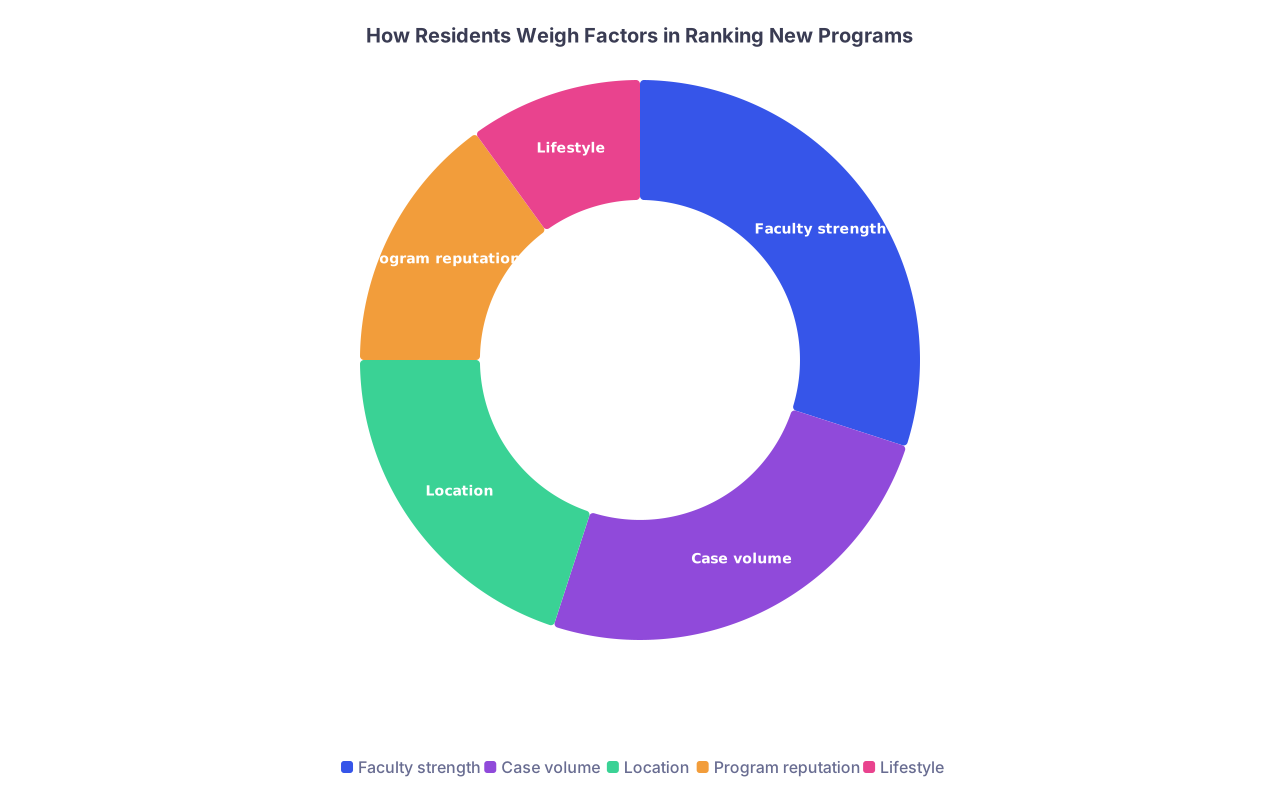
| Category | Value |
|---|---|
| Faculty strength | 30 |
| Case volume | 25 |
| Location | 20 |
| Program reputation | 15 |
| Lifestyle | 10 |
The “smart” move is not automatically avoiding new programs. It’s demanding more data from them than you might from a big-name place that’s been doing this for 20 years.
Question 8: When Is It Flat-Out Dumb to Rank a New Program Highly?
Let me just say the quiet part.
It’s a bad idea to put a new program high if:
- They can’t give you hard numbers on experience
- PD seems overextended, distracted, or disorganized
- Fellows are clearly burned out, cynical, or vague about their training
- Administration seems to be cutting corners—too few attendings, not enough support staff, talking about “growth” but not “education”
- You see obvious service dumps: fellows covering things that should be staffed by attendings or residents
Match is binding. You only get one shot at your fellowship training for this specialty. If something feels off, trust that.
FAQ: New Fellowship Programs and Ranking
1. Will doing a new fellowship program hurt my chances for future jobs or academic positions?
Usually no, if the program is at a solid institution with respected faculty and real volume. Hiring committees care more about your skills, references, and productivity than whether your fellowship is 2 vs 20 years old. The exception is ultra-elite, research-heavy careers where pedigree still matters; in those cases, a widely known academic fellowship may open more doors.
2. Is it risky to be in the first or second fellowship class?
Yes—there’s more uncertainty, less proof of concept, and more “building the plane while flying it.” But you can also get more attention, more flexibility, and a closer relationship with leadership. If you’re okay being a co-architect and the faculty are strong, this can be a net positive. If you want plug-and-play, minimal drama, consider later- or well-established programs.
3. Should I rank an established but mediocre-feeling program over an exciting new one?
If “mediocre” means safe, structured, and a bit boring—but with solid training—then yes, often that’s safer than gambling on a shaky new program. But if the new program has clearly better volume, stronger faculty, and aligns with your goals, I’d absolutely rank it above something that feels stagnant or toxic just because it’s older.
4. How much weight should I give location when comparing a new and established program?
Location matters, but it shouldn’t erase massive differences in training quality. If two programs are roughly comparable, let location be the tiebreaker. Don’t sacrifice clear deficiencies in volume, supervision, or culture just to be in your favorite city for 1–2 years. Bad training follows you for decades. Most people can tolerate a less-than-ideal city for fellowship if the training is strong.
5. What’s one concrete thing I should ask on interview day about a new fellowship?
Ask this: “Tell me one thing current fellows complained about that you’ve actually changed in the last year.” If they can’t answer, or they dodge, that tells you they’re not responsive to feedback. A new program that doesn’t listen will be painful. A new program that adapts quickly can become excellent very fast.
Open your rank list right now and circle every new program on it. For each one, write down: faculty quality, concrete case volume, curriculum, and culture in four short bullets. If you can’t fill those in with specifics, you don’t know enough yet to rank it high—fix that before you certify your list.


