

You’re post-call, scrolling through fellowship program websites, half-reading phrases like “world-class training,” “cutting-edge research,” and “mentorship culture.” Your PD keeps saying, “Any accredited fellowship will be fine.” Your co-resident swears, “You have to go big name or you’ll regret it.” You know both of those are oversimplified—and you don’t want to gamble your future career on vibes and logos.
You’re asking the right question: how do I actually evaluate whether a fellowship will set me up for the career I want—academics, private practice, niche subspecialty, whatever—rather than just add two or three more years of grind?
Here’s the framework you should be using.
Step 1: Get Uncomfortably Clear on Your Actual Career Goal
If you skip this, everything else is noise.
You do not need a 20‑year plan. You need a working hypothesis. Something like:
- Academic subspecialist at a university hospital
- High‑volume private practice with good lifestyle
- Hybrid: academic title + major clinical workload
- Niche focus (e.g., advanced HF, interventional pulm, complex IBD, etc.)
- Research‑heavy career with grants, trials, and protected time
- Community practice with procedural focus (e.g., endoscopy, cath lab, EP lite)
Write down what you think you want in 5–7 years:
- Setting (academic / community / hybrid)
- Clinical focus (generalist vs niche)
- How much research/teaching you actually want (hours per week, not vague words)
- Geographic flexibility (must live near family vs open to moving anywhere)
Then test every fellowship against one simple question:
“Does this program consistently produce the kind of attending I want to be?”
If the answer is “I don’t know” or “not really,” that’s a red flag.
Step 2: Look at Outcomes, Not Marketing
Ignore the glossy website copy. Look for receipts: where do graduates actually end up?
Ask programs directly for a 5–10 year list of graduates and current positions. If they won’t share it or it’s vague (“various academic and community jobs”), that’s not a great sign.
You want something that looks like this:
| Year | Total Fellows | Academic Jobs | Community/Private | Advanced/Niche Roles |
|---|---|---|---|---|
| 2020 | 6 | 4 | 2 | 3 |
| 2019 | 5 | 3 | 2 | 2 |
| 2018 | 6 | 2 | 4 | 1 |
Now match that to your goal:
- Want academic: do ≥50% of grads land faculty roles? At decent places?
- Want private practice: are grads getting competitive groups, not just “we finally found something”?
- Want a subspecialty niche: how many grads are doing that niche full-time (not “one clinic half-day”)?
On interview day or email, ask:
- “Can you share the last 5 years of fellow graduates and where they are now?”
- “How many in the last 5 years got [academic jobs / advanced niche roles / desired region]?”
- “If I wanted a job like X, is that something your grads have achieved before?”
If they pivot to generalities instead of giving specifics, assume the real outcomes are weaker than advertised.
Step 3: Assess Case Volume and Case Mix—Precisely
Training is not magic. It’s reps + feedback. You need enough of the right cases.
Do not accept “high volume” as an answer. Ask for numbers and logs.
For procedural or highly technical fellowships (cards, GI, pulm/crit, IR, surg onc, etc.) you want:
- Annual total case numbers
- Typical graduating fellow log ranges (not the superstar, the median)
- Breakdown by case complexity, not just raw volume
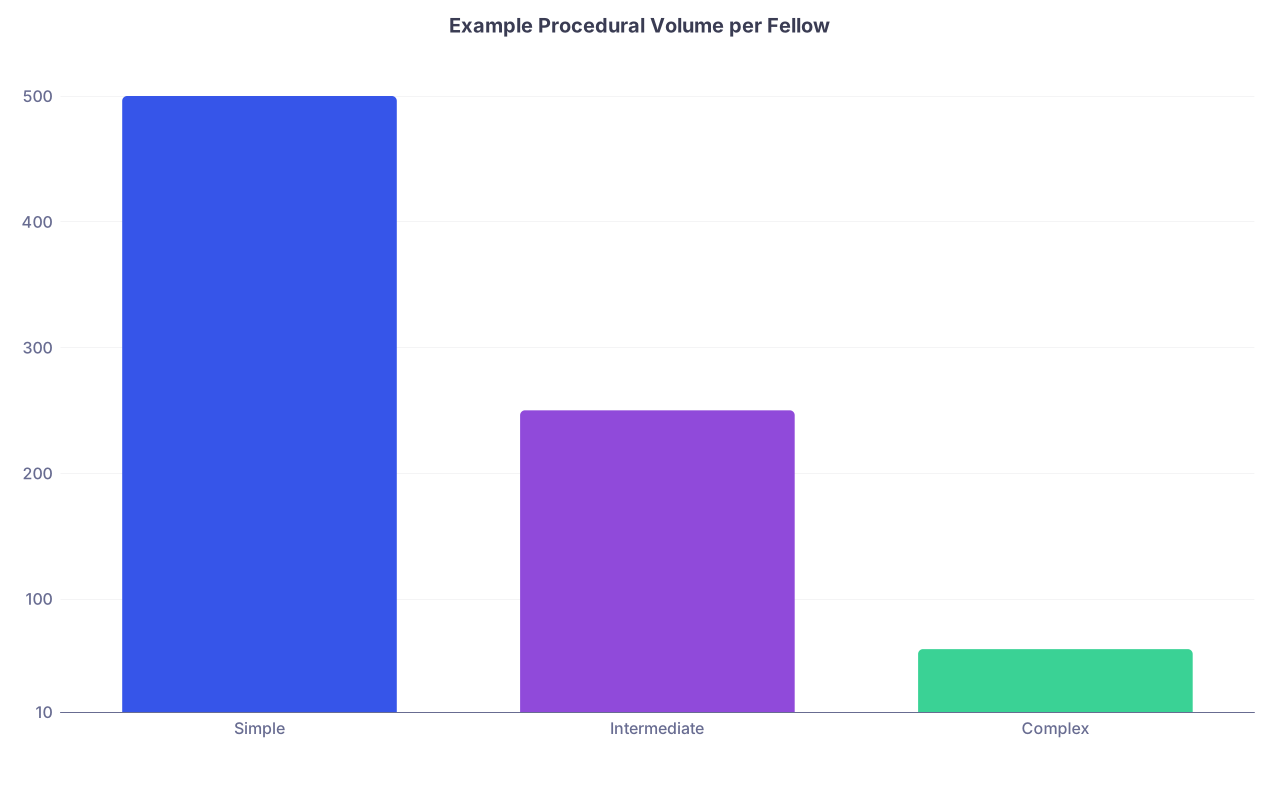
| Category | Value |
|---|---|
| Simple | 500 |
| Intermediate | 250 |
| Complex | 60 |
Questions to ask:
- “What is the average case log for graduating fellows, and what’s the range?”
- “How many truly complex [procedure/condition] cases does each fellow manage per year?”
- “Is there competition with other services or fellows that limits fellow autonomy?”
For cognitive / consult-heavy fellowships (hemonc, ID, geri, palliative, etc.), focus more on:
- Diversity of pathology (not just bread‑and‑butter)
- Exposure to different care settings (tertiary center, community sites, VA, etc.)
- Autonomy in decision-making vs endlessly presenting to attendings who micromanage
Watch for:
- Programs where attendings or advanced faculty eat all the good cases
- Too many fellows fighting for too few complex cases
- “You’ll see a little of everything” with no data to back it up
You are not just trying to survive fellowship. You are trying to graduate confident and independently competent.
Step 4: Evaluate Mentorship and Sponsorship (Not Just “Nice People”)
Everyone says they have great mentorship. That phrase is basically meaningless now.
You want to know:
- Is there someone here whose career looks like what I want?
- Do they actually mentor fellows, or are they hands-off and mostly writing grants?
- Do faculty here actively sponsor fellows for jobs, talks, and opportunities?
Key distinction:
- Mentor = gives you advice
- Sponsor = uses their capital to open doors for you (introductions, recommendation calls, pulling you into projects, nominating you for speaking or leadership)
Ask fellows directly:
- “When someone here wants an academic job, how does that usually happen?”
- “Who are the big sponsors for fellows? Can you give me an example?”
- “Who wrote the key letters for last year’s grads, and where did they end up?”
And ask faculty:
- “If I wanted to be in [your field] in an academic role, what would that path look like from your program?”
- “Do fellows get opportunities for national presentations, guideline groups, multi-center trials?”
If they talk in circles or give vague “lots of opportunities,” that usually means you’ll be on your own.
Step 5: Check the Research and Academic Infrastructure (If You Care About It)
If your future career has any academic component, infrastructure matters more than raw IQ or effort. You can be brilliant, but if there’s no IRB support, no statisticians, no database access, no mentorship, your output will stall.
Ask:
- “How many first-author publications does the average fellow graduate with?”
- “Is there dedicated protected time for scholarly work?” (Ask fellows if that protected time is real or constantly violated.)
- “Are there staff to help with IRB, stats, and data pulls?”
- “What proportion of fellows present at national meetings each year? Which meetings?”
For research-heavy careers, you want:
- Ongoing funded projects you can plug into (trials, registries, grants)
- Prior fellows who’ve gotten K awards, NIH funding, or early-career grants
- At least one faculty member who reliably produces high-quality, citable work yearly
If the program’s academic output is one or two case reports a year, it will not magically transform into a research powerhouse while you’re there.
Step 6: Consider Reputation Strategically (Not Worshipfully)
Name recognition is not everything, but pretending it doesn’t matter is naive.
Reputation matters more if:
- You want a competitive academic job
- You want a very niche subspecialty role
- You want to be geographically flexible
- You care about national leadership roles, guidelines, or major societies
What actually matters:
- Does this program have strong name recognition in your specific field, not just overall?
- Do faculty hold leadership roles in national societies, editorial boards, guideline committees?
- When you mention the program to people in your field, do they nod like “oh yeah, strong place”?
You can gut‑check this by:
- Asking attendings at your current institution, “If I want to do X, which fellowships are particularly respected?”
- Listening to which centers are referenced at conferences, on guidelines, in landmark papers
But here’s where people get it wrong: a “big name” that doesn’t produce your desired outcomes is just prestige theater. I’ve seen people go to top‑tier programs, get lost in the crowd, and graduate with fewer skills and fewer job options than someone from a mid-tier, high‑volume, well-mentored program.
Step 7: Lifestyle, Culture, and Burnout Risk—Yes, It Affects Your Future
A miserable fellow does not do their best work, make their best connections, or build their best CV.
No, fellowship should not be spa year. But there’s a difference between rigorous and toxic.
Pay attention to:
- How current fellows talk when faculty aren’t in the room
- Whether fellows have time for scholarly work or if they’re just service cogs
- Moonlighting: is it allowed, realistic, and safe—or basically impossible due to workload?
- How the program handled recent crises (COVID surges, staffing shortages, etc.)
If every fellow looks utterly wrecked and says, “You’ll be fine, you get used to it,” that program will probably chew through your reserves. And that does show up in your career—burnout, disengagement, or just less energy to push for the opportunities that matter.
Step 8: Map the Fellowship’s Strengths to Specific Career Doors
Here’s the blunt question you should keep asking yourself:
“What specific doors will this fellowship open that would otherwise be closed—or much harder to open?”
Concretely:
A strong academic program might open doors to:
- Assistant professor positions at major centers
- Early involvement in trials and societies
- Access to niche procedural or disease-focus jobs
A strong community-oriented or clinically heavy program might open doors to:
- High-paying private practice jobs
- Jobs where partners want someone “ready on day one” for full scope practice
- Specific regional markets that prioritize that program’s grads
If the answer is basically, “I’ll end up eligible for the same jobs I could get without this fellowship,” think very hard about whether the time/training is worth it.
Step 9: Use a Simple Scorecard
You’re a doctor. Make this systematic.
Create a 1–5 score for each program on:
- Outcomes in my desired career path
- Case volume and mix for my goals
- Mentorship and sponsorship strength
- Research/academic support (if relevant)
- Reputation in my niche
- Culture/lifestyle (as in: sustainable vs soul-crushing)
- Location/partner/family fit (this matters more than people admit)
Weight them. For example, if you want hardcore clinical private practice:
- Outcomes: 30%
- Case volume/mix: 30%
- Mentorship/sponsorship: 15%
- Reputation: 10%
- Research: 5%
- Culture/lifestyle: 10%
Then actually run the numbers. You’ll usually find that your initial “prestige bias” toward one program doesn’t fully match the reality of what that fellowship will do for your future.

| Step | Description |
|---|---|
| Step 1 | Define career goal |
| Step 2 | Check grad outcomes |
| Step 3 | Review case volume and mix |
| Step 4 | Deprioritize program |
| Step 5 | Assess mentorship and sponsors |
| Step 6 | Evaluate research and reputation |
| Step 7 | Consider culture and lifestyle |
| Step 8 | Score and compare programs |
| Step 9 | Rank based on best fit |
FAQs
1. Is a “big name” fellowship always worth it, even if the training seems weaker?
No. If your primary goal is hands‑on clinical skill and graduating ready to run, a mid‑tier but high‑volume, high‑autonomy program beats a name‑brand where fellows watch more than they do. The only time I’d consider a weaker clinical program is if its academic machine is so strong it clearly launches people into the exact academic niche you want. Even then, you’d better be sure you can fill your clinical gaps later.
2. How many publications do I “need” from fellowship for an academic job?
There’s no magic number, but patterns matter. In most fields, graduating with ~3–6 solid publications (a couple first‑author) and some national presentations is respectable for a junior faculty job at many academic centers. The key question: does this fellowship consistently help fellows get that, or do only the hyper‑self‑driven ones scrape it together at 2 a.m.? Ask about the average, not the superstar.
3. If I’m not sure I want academics vs private practice, how should I choose?
Pick a program that doesn’t close either door. Practically, that means: good clinical training, at least some research infrastructure, and a track record of grads going into both academics and community. Avoid places that only produce one thing: either all ivory-tower researchers who are weak clinically, or all workhorse clinicians with zero academic pipeline. Flexibility has value if you’re truly unsure.
4. Does geography during fellowship matter for my eventual job market?
More than programs admit. Many people stay in the region where they train because their network, partner’s job, and referrals are there. A fellowship in the Northeast with strong ties to local health systems will likely set you up better for jobs there than for, say, the Pacific Northwest. If you know you want to end up in a specific region, programs in or strongly connected to that region have an edge.
5. What’s one question that cuts through the fluff on interview day?
Ask current fellows privately: “If you could go back, knowing what you know now, would you choose this fellowship again—and if not, where would you go instead?” Then stay quiet. The pause, the facial expression, and the detail in their answer will tell you far more than any slide deck or sales pitch.
Today, do this: open a blank page and write a one‑paragraph description of your ideal job 5–7 years from now—setting, scope, research/teaching level, lifestyle. Then pull up the websites of your top 3 fellowship targets and ask, one by one: “Do this program’s graduates actually end up in jobs like that?” If the answer feels shaky, you’ve got more digging to do.


