

The fellowship match is not kind to late switchers. The data shows a clear pattern: once you pivot away from your original plan, your odds drop, your required metrics go up, and your margin for error disappears.
If you are thinking about a “second-choice” fellowship, you are already playing a different game than the PGY‑1 who came in with a laser-focused plan and aligned every rotation, letter, and project from day one. This is not doom. But it is statistics. And statistics are not sentimental.
Let’s walk through what actually happens in the numbers when residents switch into new fellowship fields late, what match rates look like, and which “backup” options are real versus mostly fantasy.
The baseline: fellowship match is already stratified
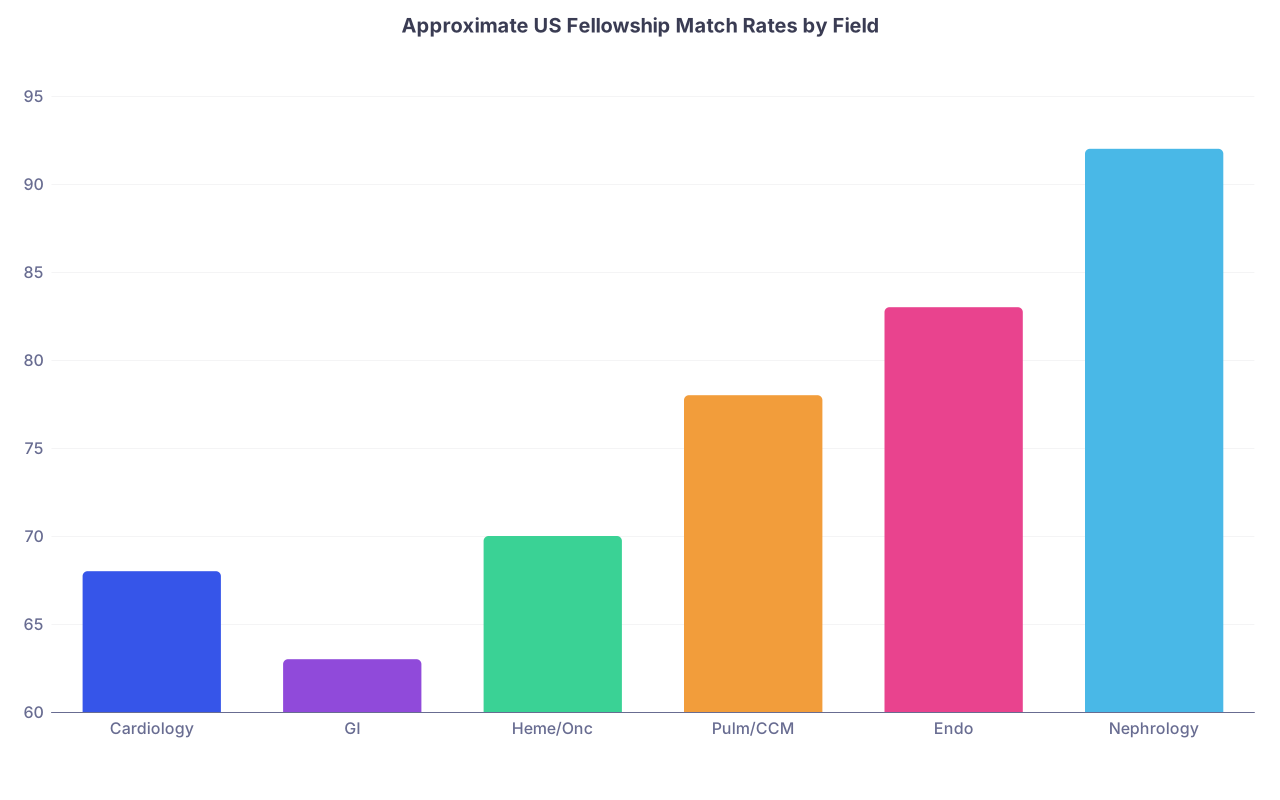
Before we talk late switch, we need the baseline. The NRMP’s Specialty Matching Service data and ACGME reports tell a consistent story: fellowship competitiveness varies dramatically by field.
| Category | Value |
|---|---|
| Cardiology | 68 |
| GI | 63 |
| Heme/Onc | 70 |
| Pulm/CCM | 78 |
| Endo | 83 |
| Nephrology | 92 |
These are rounded, illustrative numbers based on recent cycles:
- Cardiovascular disease: ~65–70% match
- Gastroenterology: ~60–65% match
- Hematology/Oncology: ~65–75% match
- Pulmonary/Critical Care: ~75–80% match
- Endocrinology: ~80–85% match
- Nephrology: ~90%+ match
Now overlay one simple fact: these rates include people who were all-in on that specialty from early in residency. People whose mentors, scholarly work, and evaluations all lined up.
When you switch late, you are competing against that cohort with a weaker paper trail.
What changes when you switch late
A late switch is not just “apply somewhere else.” The probability distribution of outcomes shifts.
The data across specialties, plus what I have seen program directors say off the record, boils down to four consistent penalties for late switchers:
- Lower absolute match rate than “early deciders”
- Higher reliance on Step/COMLEX and raw metrics
- Decreased access to the top quartile of programs
- Increased risk of going unmatched entirely
You will not find a clean NRMP table labeled “late switch vs not.” Nobody tracks it that explicitly. But you can infer it from two patterns:
- Applicants with off-specialty residency backgrounds (e.g., EM → CCM, IM → Anesthesia CCM, FM → Sports Med) consistently show lower match rates than categorical residents in the traditional feeder specialty.
- Applicants without research or letters tightly aligned with the target fellowship underperform relative to the average for that field.
Late switchers often have both problems simultaneously: misaligned training background and thinner specialty-specific portfolio.
Second-choice fields by core residency
You cannot talk about “second-choice fellowships” in the abstract. The menu depends heavily on your base specialty.
Internal Medicine: classic “ladder” of competitiveness
Most of the late switches I see in IM are:
- Cardiology → Pulm/CCM or Heme/Onc
- GI → Heme/Onc or Pulm/CCM
- “Any competitive subspecialty” → Endocrine or Geriatrics or Nephrology
Here is a simplified view of relative competitiveness from an IM standpoint.
| Fellowship | Typical US Match Rate | Relative Tier |
|---|---|---|
| GI | 60–65% | Very High |
| Cardiology | 65–70% | Very High |
| Heme/Onc | 65–75% | High |
| Pulm/CCM | 75–80% | Moderate–High |
| Rheumatology | 75–85% | Moderate |
| Endocrinology | 80–85% | Lower–Moderate |
| ID | 80–85% | Lower–Moderate |
| Geriatrics | 90%+ | Low |
| Nephrology | 90%+ | Low |
Now layer in the late switch. Example scenario:
- You are a PGY‑2 who spent the first 18 months branding yourself as a future cardiologist. Cardiology electives, echo clinic, maybe a small QI project on HF readmissions. Then you change your mind at the start of PGY‑3 and pivot to Hem/Onc.
You are competing with:
- Another PGY‑3 who did 2 years of Hem/Onc clinic, one ASH abstract, a poster on lymphoma, and has two letters from Hem/Onc faculty.
Cardio and Heme/Onc look similar in match rate on paper. In practice, that switch usually costs you 10–20 percentage points in odds at the middle-to-top tier range. You might still match, but your program list changes: fewer university divisions, more community-based fellowships, more lower-volume or regional programs.
The data pattern:
- Residents from strong academic IM programs who switch late to Heme/Onc or Pulm/CCM still often match—because their baseline environment is rich in research and letter writers.
- Residents at smaller community programs who switch late into a competitive field without home-fellowship support see a distinct drop in match rate. I have seen entire application cycles where none of the “late pivot” applicants matched on the first attempt.
Second-choice logic for IM, by data and by outcomes I have seen:
- “Competitive subspecialty dream” → realistic second choices:
- From GI or Cardio → Pulm/CCM or Heme/Onc
- From Heme/Onc → Pulm/CCM or Rheum
- “I just want a fellowship” → realistic second choices:
- Endocrinology, ID, Rheumatology, Nephrology, Geriatrics
Nephrology, Geriatrics, and to some extent Endocrine function as safety valves for late deciders. Nephrology especially: years with >30% of spots unfilled are not rare. From a probability standpoint, they behave like “rescue” fellowships for applicants whose first-choice competitive subspecialty did not pan out.
EM, Anesthesia, and CCM: where switching is common but not equal
Critical Care is where the numbers get interesting. Because it accepts applicants from multiple base specialties, you can see how background and timing change outcomes.
Emergency Medicine → Critical Care
There are now multiple EM‑CCM pathways (Anesthesia CCM, IM CCM, Surgical CCM in some places). But the acceptance pattern is not symmetric.
What the match data plus program rosters show:
- IM residents applying to Pulm/CCM: match rates ~75–80%.
- EM residents applying to CCM (mostly Anesthesia or IM‑CCM slots): match rates noticeably lower—often 10–20 percentage points behind in the same applicant quality band.
Late switchers from EM to CCM usually appear in two forms:
- The PGY‑2 or 3 EM resident realizing lifestyle claims were oversold and they prefer ICU to constant ED churn.
- The early EM grad after a tough job market year pivoting into CC as a way to differentiate.
The second group has it harder. They are out of training, have less time in ICU as a primary service, and often fewer academic letters. When I have looked at rosters of CCM fellowships, the proportion of EM grads is small and tends to come from residencies with a heavy ICU culture.
As a “second-choice” field for EM, CCM is possible but not forgiving. The data pattern is:
- EM + strong ICU experience + 1–2 critical care abstracts + letters from intensivists = reasonable odds at a subset of programs.
- EM + minimal ICU time + late, paper-thin pivot = very poor match probability.
Anesthesia → CCM or Pain
Anesthesia is a bit different. Pain and CCM are explicitly built-in fellowships; programs expect a large portion of their residents to apply.
- Pain medicine: match rates are high overall, but academic spots are competitive.
- CCM: match rates are also high, especially for in-house residents.
For anesthesia residents who initially wanted something else (e.g., Cardiac Anesthesia, Regional, or no fellowship at all) and pivot late to Pain or CCM, the penalty is modest if they are in-house. Programs are biased to their own trainees. The data from many institutions: >70–80% of in-house residents who apply to in-house CCM or Pain eventually match there, even with a relatively late commitment.
The key caveat: this does not generalize well to applicants trying to switch across institutions at the last minute. External late switchers into CCM from anesthesia look more like late IM switchers into competitive IM fellowships: some succeed, many do not, and their match list is more middle-tier heavy.
Family Medicine and PM&R: sports, pain, and the backup illusion
Sports Medicine, Pain, and Palliative Care are where many family medicine and PM&R residents try a late rethink.
Family Medicine → Sports Medicine
Sports Medicine fellowships (ACGME-accredited) accept residents from FM, IM, EM, Pediatrics, and PM&R. In practice, the rosters skew heavily FM.
FM residents who made Sports their plan from PGY‑1:
- Do team coverage
- Work with athletic trainers
- Present at AMSSM
- Collect letters from well-known sports attendings
FM residents who pivot late from a broad “primary care with OB” mindset to sports during PGY‑3 have a harder time. Program directors notice when your first sports clinic note is from six months before applications opened.
However, the total number of applicants is not gigantic. Match rates are not like GI or Cardiology. For FM residents in decent programs, late switches to Sports are still viable, but you likely downgrade from university flagship sports programs to regional or community-affiliated ones.
FM / PM&R → Pain Medicine
Pain looks attractive as a “second-choice” fellowship. High pay, procedure-heavy, multiple base specialties accepted. The data ruins that fantasy quickly.
Pain fellowships are oversubscribed. They function as a competitive subspecialty.
- Anesthesia applicants dominate.
- PM&R and Neurology have some foothold.
- FM is present but a small slice.
Late switch from FM or PM&R into Pain:
- Without procedural experience, research, or credible pain-focused mentors, your effective match rate is brutally low. I have watched full application cycles where every FM applicant to Pain from certain regions went unmatched.
So yes, Pain is a common “second-choice target.” But statistically, it behaves like a first-choice competitive subspecialty for anesthesia and PM&R, not a safe landing for late-deciding FM grads.
“Backup” fellowship vs “second-choice” field: different math
A lot of residents conflate two distinct strategies:
- Genuine second-choice field: “If I cannot do GI, I would be reasonably happy in Heme/Onc or Pulm/CCM.”
- Panic backup: “If GI does not work, I will just scramble into [anything] so I am not ‘just a hospitalist.’”
The numbers are friendlier to scenario 1 than scenario 2.
Realistic second-choice transitions that I see work reasonably often:
- Cardiology → Heme/Onc or Pulm/CCM
- GI → Heme/Onc or Pulm/CCM
- Heme/Onc → Pulm/CCM or Rheumatology
- IM generalist → Endocrinology, ID, Nephrology, Geriatrics
- EM → CCM (with solid ICU background)
- FM → Sports Medicine (with early-ish involvement)
- PM&R → Sports or Pain (with heavy MSK/pain spine clinic exposure)
Panic “anything” transitions with poor statistics:
- FM → Pain Medicine with late interest and slim exposure
- EM → Anesthesia CCM without serious ICU time
- IM → GI or Cardio with zero track record until mid-PGY‑3
- Cross-specialty pivots with no coherent narrative (e.g., pediatrics → adult CCM in a single cycle)
When residents talk to me about using Endocrinology or Nephrology as a “backup,” the data often supports that concept. Those fields have high fill rates but also high acceptance of non-traditional or late deciders, especially if they are flexible geographically.
When they talk about using Pain or GI as a backup, they are just misreading the probability distribution.
Timing, numbers, and what you can still influence
One useful mental model: once you are past the midpoint of PGY‑2, your probability of successfully entering a new competitive fellowship on the first try is heavily dependent on just three quantifiable levers.
- Board performance and test scores
You do not control them anymore at this stage, but the impact is real.
- For competitive fields (GI, Cardio, Heme/Onc), a late switcher with mediocre boards is at a severe disadvantage. Program directors often filter by score bands when they are looking at a stack of applications with thin specialty proof.
- For less competitive but still selective fields (Endo, ID, Rheum), strong or at least solid boards can compensate partially for fewer years of specialty grooming.
- Number of months of aligned rotations
Look at your schedule like a dataset:
- 0–1 months in target specialty before applications = high risk as a late switcher
- 2–3 months in target specialty with at least one continuity experience (clinic, weekly conference) = middle probability
- ≥4 months, including a longitudinal experience + some night or call with the specialty team = much more competitive
I have watched IM residents salvage a late switch to Heme/Onc by stacking three straight Heme/Onc blocks in late PGY‑2 and early PGY‑3, grabbing an ASH abstract, and getting two specialty letters. They still most often ended up at mid-tier university or strong community programs, not the big-name cancer centers. But they matched.
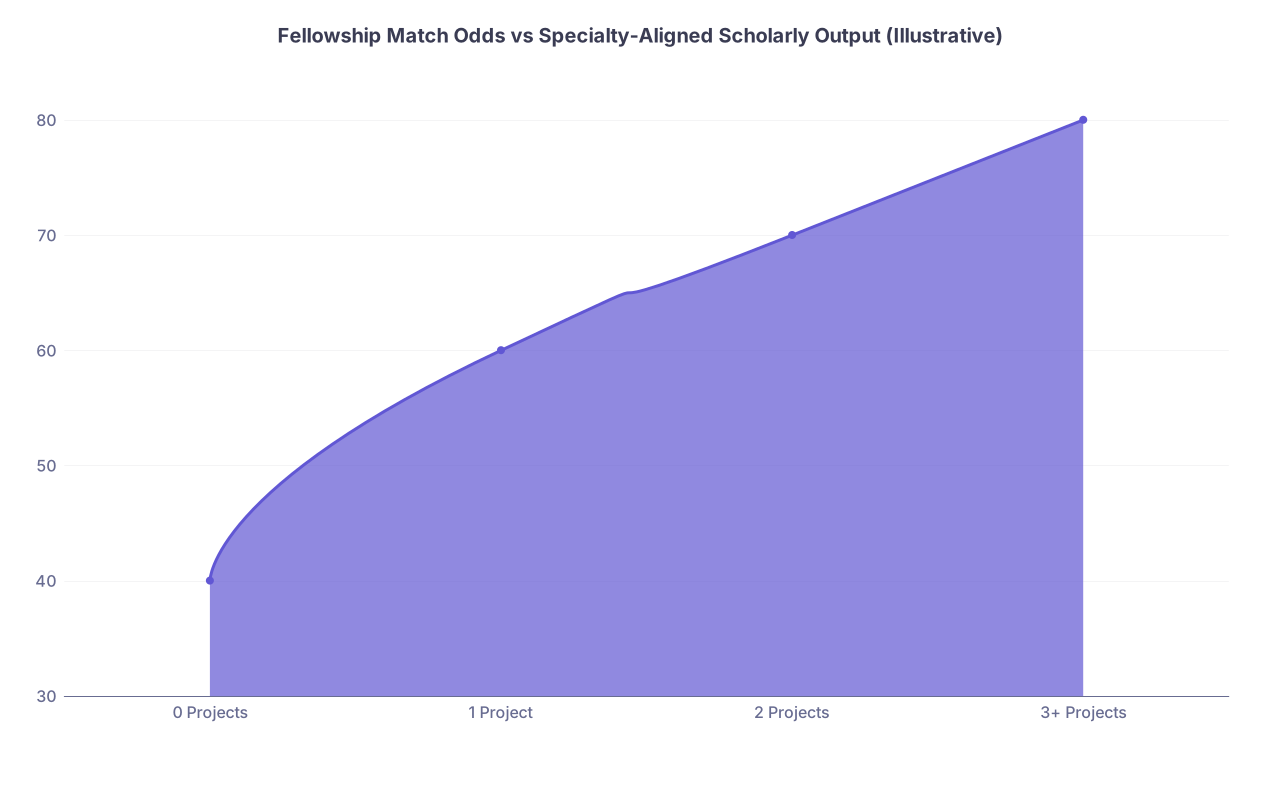
- Scholarship output
You do not need three first-author NEJM papers. But the number of items matters.
| Category | Value |
|---|---|
| 0 Projects | 40 |
| 1 Project | 60 |
| 2 Projects | 70 |
| 3+ Projects | 80 |
For late switchers:
- 0 projects: often <50% match probability in competitive fields, even with decent letters.
- 1 small project (case report, QI poster): helps, but often not enough for the top tier.
- 2+ aligned projects: this is where your odds start to more closely resemble those who declared earlier.
Program tier and geography: the compressed reality for late switchers
You are not just choosing a field. You are choosing which quartile of programs you even have a shot at.
Patterns I see repeatedly when residents switch late:
- Top 10–20% of programs in a field: heavily favor “groomed-from-PGY‑1” applicants, home residents, and those with substantial research.
- Middle 50%: mix of traditional and late deciders; strong late switchers can land here with focused work.
- Bottom 30% and less-desired geographies: where late switchers with thinner portfolios cluster, especially in less popular fields.
If you are rigid about geography and switching late into a competitive field, the math quickly becomes ugly. You have shrunk both your vertical (tier) and horizontal (location) search space simultaneously.
I have seen IM residents who switched late to Heme/Onc, insisted on staying in one major coastal city, and ended up unmatched. Same applicant, wider geographic range, likely would have matched a mid-tier or community-based program in the Midwest or South.
Realistic scenario breakdowns
Let me put some approximate numbers (illustrative, not official NRMP) on a few common situations. Assume average US grad, no glaring red flags.
| Scenario | Early Planner Est. Match Rate | Late Switch Est. Match Rate |
|---|---|---|
| IM → GI (Strong academic, research, early focus) | 70–75% | — |
| IM → GI (Late PGY‑3 switch, minimal GI record) | — | 20–30% |
| IM → Heme/Onc (Early academic track) | 75–80% | — |
| IM → Heme/Onc (Switch PGY‑2.5, 2 blocks + 1 poster) | — | 55–65% |
| IM → Endocrine (Moderate focus, any timing) | 80–85% | 70–80% |
| EM → CCM (Strong ICU record, from academic EM) | 70–80% | 60–70% |
| FM → Sports (3 years sports exposure) | 80–85% | — |
| FM → Sports (Late PGY‑3 pivot, thin exposure) | — | 50–60% |
The key pattern: late switching rarely kills your chances completely, but it generally knocks 10–30 percentage points off your match odds compared with an equally strong “early planner” in the same niche—especially at higher-tier programs.
Decision tree: when a late switch makes statistical sense
This is how I mentally model late switches with residents.

| Step | Description |
|---|---|
| Step 1 | Considering new fellowship field |
| Step 2 | Stack rotations + research now |
| Step 3 | Switch is viable with focused work |
| Step 4 | Switch likely low yield |
| Step 5 | Push hard - rotations, projects, letters |
| Step 6 | Consider staying course or deferring |
| Step 7 | PGY 1-2 or PGY 3+? |
| Step 8 | Competitive field? |
| Step 9 | Competitive field? |
| Step 10 | Willing to broaden geography and tier? |
If you are:
- Early (PGY‑1/early PGY‑2) and the new field is moderately competitive or lower: the data says your odds are reasonable if you start aligning now.
- Late (mid-late PGY‑3) and the new field is highly competitive and you will not move for fellowship: the numbers are strongly against you on the first application cycle.
Deferring a cycle, working as a hospitalist with targeted research and extra clinic in the new field, then applying with a stronger portfolio often produces better match results than a rushed, weak first application.
What the numbers actually suggest you do
Strip the emotion away for a moment and treat this like a probability optimization problem.
If you are thinking of a second-choice fellowship field as a late switch, the data-driven moves are:
Quantify your current position
- Board scores vs recent matched data in that field.
- Number of months already spent in the new specialty.
- Number of specialty-aligned projects and abstracts.
Classify the target fellowship
- “Competitive” (GI, Cardio, Heme/Onc, Pain, some CCM programs): late tying of your identity to this field cuts your odds meaningfully.
- “Moderate” (Pulm/CCM, Rheum, Endo, ID, Sports): late switch is feasible with 6–12 months of hard pivot.
- “Lower competition” (Nephrology, Geriatrics, some Endo/ID programs): often very realistic as a second-choice field if you are flexible on location.
Decide if you are aiming for:
- Any fellowship vs only top-tier fellowships.
- Any location vs 1–2 major metros.
If you are already late:
- Strongly consider one extra year post-residency to build a credible track record in the new field instead of firing off a weak application.
- Or accept a second-choice within your original general area (e.g., IM → switch from GI to Endo) which typically carries a much smaller numerical penalty than switching to an entirely new ecosystem (e.g., FM → Pain with no base).
Compressed summary: what the data says about second-choice fellowships
Three core points.
Late switching into a new fellowship field generally reduces your match odds by 10–30 percentage points compared to early planners, especially in competitive specialties and preferred geographies. The drop is smaller for lower-competition fields like Nephrology, Geriatrics, and many Endocrinology/ID programs.
Some fellowships function as realistic second-choice or “rescue” options (Pulm/CCM, Heme/Onc from other IM subs, Endocrine, Nephrology, Geriatrics, Sports with adequate exposure). Others—GI, Cardiology, Pain, top-tier CCM—do not behave like backups; they behave like primary competitive targets that punish late pivots.
The only way to make a late switch statistically rational is to rapidly increase specialty-specific rotations, scholarship, and letters, and to loosen constraints on program tier and geography. If you are unwilling to do that, the data is blunt: staying with your original field, or building a stronger application over an extra year, usually yields a higher overall probability of ending up in a fellowship at all.


