

It’s 11:47 p.m. You’ve finished sign-out, your pager is finally quiet, and you’re staring at your email drafts folder. One draft to the program director at your dream fellowship. Another to a faculty friend who “knows people.” Your group chat is blowing up with:
“Do I email the PD or is that desperate?”
“Should I tell them they’re my #1?”
“Does anyone actually care about the official ‘signals’?”
Let me tell you exactly what is happening on the other side of that screen. In the PD meetings. In the Zoom rank list sessions. In the side comments when your name comes up with: “Oh yeah, that one emailed me three times” vs. “This person clearly really wants us.”
There are rules. They are not written anywhere. But faculty and program leadership follow them, consciously or not.
This is the playbook they’re using—and the one nobody ever really gives you.
First Reality Check: What “Interest” Actually Means to Programs
Most residents completely misunderstand what “interest” looks like from the fellowship side. You think it’s:
“I’ll just say they’re my top choice and done.”
That’s not how they read it.
To a program, “interest” is a pattern, not a single act. They’re asking:
- Has this person consistently shown up on our radar?
- Can we reasonably believe they would actually come here?
- Are they chasing us, or just mass-emailing the entire country?
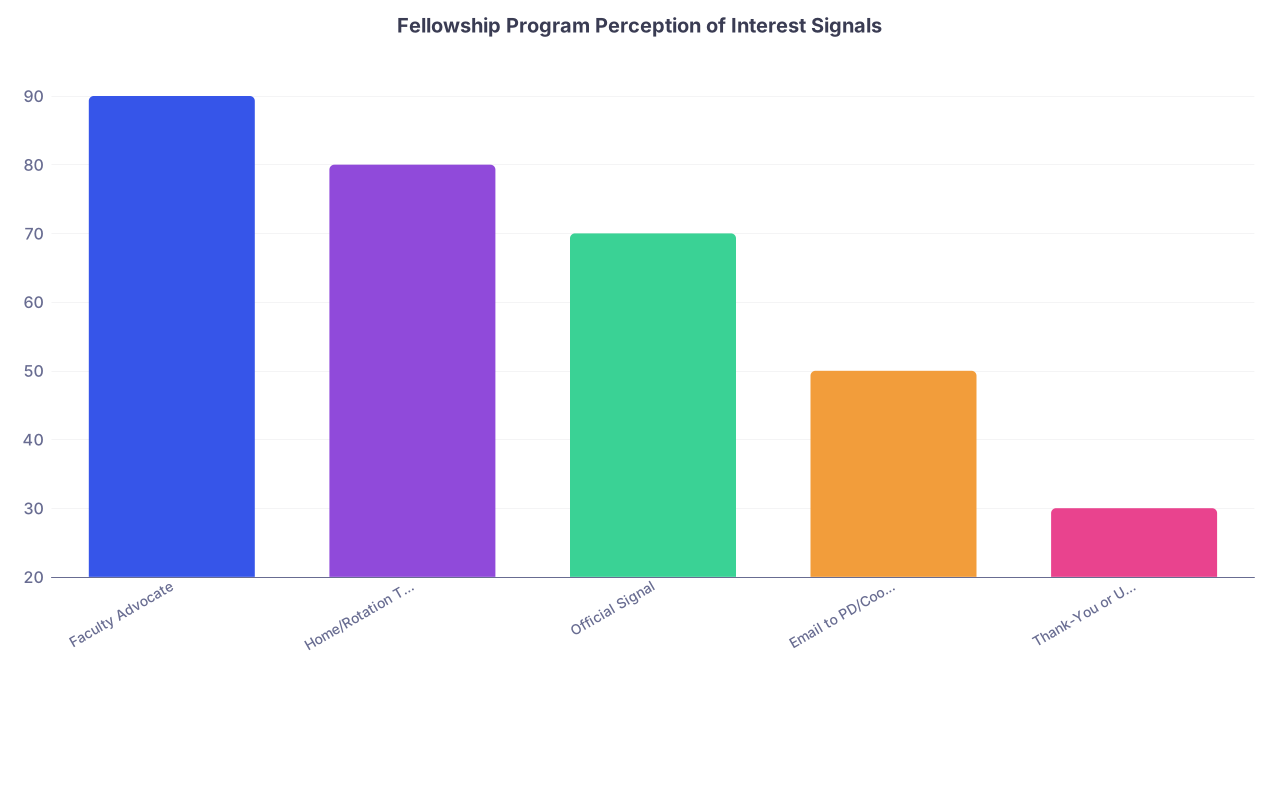
Here’s what they weigh way more than they admit:
| Category | Value |
|---|---|
| Faculty Advocate | 90 |
| Home/Rotation Ties | 80 |
| Official Signal | 70 |
| Email to PD/Coordinator | 50 |
| Thank-You or Update Note | 30 |
Those numbers aren’t from a study. They’re from watching PDs and selection committees for years and seeing what they actually react to.
If you remember nothing else: a trusted faculty advocate beats any email you could ever write.
The Hidden Hierarchy of “Interest” Signals
Programs won’t tell you this, but they rank your interest signals. Some carry real weight; some are noise; some backfire.

Let me walk through the real hierarchy.
1. The Faculty Phone Call or Email (Top Tier Signal)
This is the nuclear option—in a good way.
When a respected attending emails the PD and says:
“I just want you to know, this person is deeply interested in your program and would be an excellent fit,”
that moves you from “good candidate” to “we should look closely.”
Here’s what matters behind the scenes:
- The sender’s reputation. A well-known name in the field? Even better. But even a solid regional faculty member can help.
- The tone. Short, honest, not overblown. PDs instantly smell exaggerated or transactional letters.
- Scarcity. If that faculty member emails for 2–3 people a year, it matters. If they email for everyone, it’s white noise.
I’ve watched PDs scroll through a spreadsheet, see a name, and say: “Oh, that’s Dr. X’s person. Let’s make sure we interview them.”
That’s it. That’s the entire impact. No drama. Just a nudge that gets you on the list.
You cannot fake this. You earn it with years of working well, showing up, and asking strategically, not desperately.
2. Home Program / Rotation Ties (Quiet but Powerful)
You rotating at a site is a constant background signal of interest—even if you never send a formal “I love you” email.
Selection discussions literally sound like this:
- “They did an away rotation with us; they know what we are and still applied.”
- “They’re a resident at our affiliate hospital; they understand our system.”
Programs are more cautious about taking people who have no existing tie and no clear signal. Not because they don’t like you—but because they don’t want to waste an interview on someone who’s going to rank all the ‘big names’ ahead of them.
So if you have any connection—away rotation, research collaboration, regional tie—and you don’t highlight it, you’re leaving interest points on the table.
3. Official Signaling (ERAS/NRMP “Preference Signaling”)
Where this exists (cardiology, GI, some competitive fellowships) it matters. But not how you think.
Here’s the insider truth:
Programs look at signals to solve one problem—
“Of the people with reasonable stats who applied to us, who actually might come here?”
They don’t say: “No signal → reject.”
They say: “Signal + solid file → let’s probably invite.”
The internal behavior is usually:
- Signals help you at the margin. You become “easier yes” for an interview if you’re already competitive.
- Signals will not save a weak application. No PD is saying: “220 Step, no research, but they signaled—let’s go.”
- “Oversignaled” programs (big name places) get flooded with signals. Your marginal advantage is smaller there but still better than nothing.
You want a rule? Here it is:
Use official signals on programs where you are borderline-competitive but realistic, and where you’d actually be happy to go.
Not “flex” signals to the absolute top program where you’re a long shot just so you can say you did.
Direct Emails to Programs: The Line Between Smart and Thirsty
This is where most residents screw it up.
| Email Type | Common PD Reaction |
|---|---|
| Personalized, specific interest note | Mild positive |
| Generic mass-looking email | Ignored |
| Repeated “any update?” before invites | Annoyance |
| Post-interview, one thoughtful update | Slight positive/neutral |
| “You’re my #1” to multiple programs | Ethically risky if known |
What a Good Pre-Interview Email Looks Like
You send this type of email when:
- You have a legitimate tie (region, spouse job, family, prior rotation, research fit)
- You are a realistic, not absurd, candidate
- The program isn’t so hyper-elite that your email is drowned in 300 others
A strong email to the PD or APD is:
- Short (5–8 sentences)
- Specific (names, reasons, program features)
- Grounded (no “lifelong dream” nonsense)
Something like:
Dear Dr. Smith,
I’m a PGY-3 in internal medicine at [X], applying to cardiology this cycle. I wanted to briefly express my strong interest in [Program Name]. I grew up in [Region] and my family is still in [Nearby City], and I plan to practice here long term.
I’ve been following your program’s work in [specific lab/initiative/clinic—name it], especially the recent [paper/project] by Dr. [Faculty Name], which aligns closely with my current research on [2–5 words]. My mentor, Dr. [Your Faculty], suggested your program would be an excellent fit given my interest in [subfield].
I know you receive many strong applications, but I wanted you to know that [Program Name] is one of the few places where I can realistically see myself training and staying long term. Thank you for your time and consideration.
Best,
[Name, PGY level, Institution, ERAS AAMC ID]
That reads as: mature, specific, not frantic.
Behind closed doors, what happens?
Best case: “Oh, this one emailed and seems legitimately interested. Let’s make sure we take a look.”
Worst case: Mildly ignored. No harm done.
What a Bad Email Looks Like
Common errors:
- Copy-paste template with no real detail (“strong clinical training, excellent research, diverse patient population”). Every program has that.
- Over-sharing (“My fiancé and I are really struggling to find a place that fits us both…”). This isn’t therapy.
- Asking for something explicitly (“Can you tell me my chances?” “Can you move my file up?”). No.
- Emotional tone (“I would be devastated not to interview at your program”). Now you’ve made it weird.
Programs remember extremes. The excessively pushy or emotionally loaded emails get talked about—in a bad way.
The Follow-Up Trap
Pre-interview: If you emailed once and heard nothing—leave it. Repeating asks before interviews go out makes you look needy and unaware of boundaries.
Post-interview: One thoughtful thank-you or update is fine. Two is pushing it. Three is memorable, and not how you want.
Telling a Program They Are “Your Top Choice”
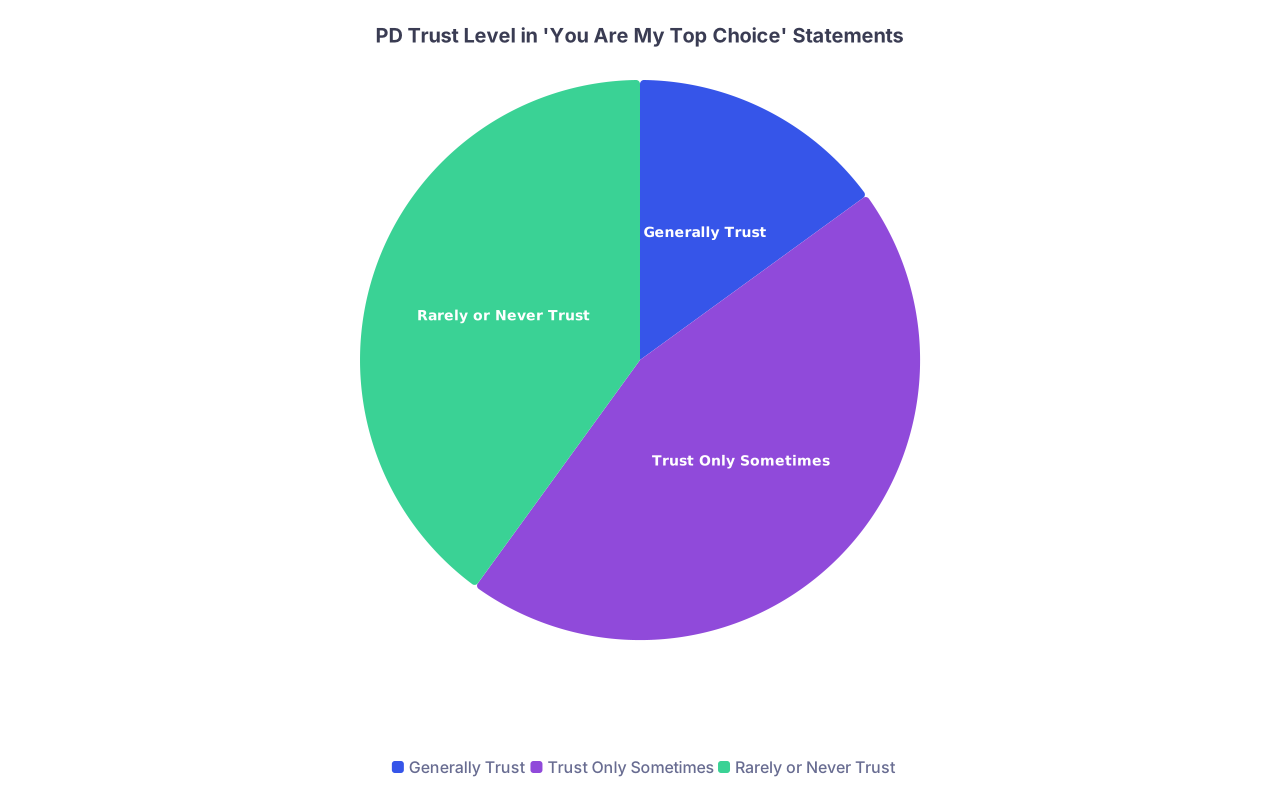
Here’s the dirty little secret: PDs hear “you are my top choice” constantly. They do not believe all of it. And some of them now quietly discount it entirely.
| Category | Value |
|---|---|
| Generally Trust | 15 |
| Trust Only Sometimes | 45 |
| Rarely or Never Trust | 40 |
The ethics and strategy here are tricky.
If You Truly Have a #1
If there is a single program you would absolutely rank first, regardless of everything—then telling them can help. Slightly. It frames how they interpret your other signals.
The right way to say it:
I wanted to share that after all of my interviews, [Program Name] is the place where I most clearly see myself training. If given the opportunity, I plan to rank [Program Name] first.
Notice the careful wording. That’s honest, future-oriented, and not manipulative.
Do not say this to multiple programs. PDs talk. Fellows talk. Faculty move institutions and compare notes. Getting caught lying about this will not just hurt you—it will stain your home program’s reputation.
If You Have a Top Tier, Not a Single #1
Then do not use the phrase “rank #1.” You can honestly say:
- “I will be ranking your program very highly.”
- “Your program remains among my very top choices.”
That’s truthful and still signals sincere interest without lying.
Programs understand that language. They are reading between those exact lines.
Interest vs. Desperation: The Invisible Line
Residents ask me: “How do I show them I really want it without looking desperate?”
Here’s how faculty subconsciously differentiate the two.
Interest looks like:
- You did an away rotation there and worked your tail off.
- You presented with their faculty at a conference.
- You have one clean, well-written email highlighting a few real reasons you like them.
- A mentor quietly reaches out on your behalf.
- Your rank-list-style language is consistent and realistic.
Desperation looks like:
- Multiple emails before interviews go out: “Just checking on the status of my application.”
- Overly emotional or personal pleas.
- CC’ing multiple people in leadership to “make sure they see it.”
- Hinting you need special consideration.
- Fishing for inside info: “Do you know where I stand on your list?”
Programs aren’t attracted to desperation. They’re wary of it. They worry you’ll be difficult, high-maintenance, or unrealistic about feedback.
Social Media, Conferences, and “Casual” Signals
You’re underestimating how often PDs, APDs, and faculty quietly clock what you do outside of ERAS.

Conferences and Meetings
When you walk up after a session and say, “Dr. Patel, I’ve really enjoyed your group’s work on mechanical circulatory support—I’m applying to HF this cycle and was excited to see your program on my list,” that’s a soft signal.
They might not remember your exact name. But when your application hits their screen later and your face looks vaguely familiar, that’s enough for a small boost.
The residents who get the most out of conferences:
- Know which faculty are actually decision-makers back home.
- Introduce themselves briefly, don’t latch on.
- Follow up with a single, short email: “Nice meeting you at [Conference]; I’ll be applying to [Program].”
Social Media
No, you should not DM program accounts your CV. You’ll be a screenshot in a group text.
But:
- Liking or retweeting program or faculty research posts.
- Commenting something intelligent (not sycophantic) once in a while.
- Sharing your own work where they might naturally see it.
It all slowly builds presence. Rarely decisive, but in a tie, presence wins over anonymity.
The Things That Matter More Than Interest (Harsh but True)
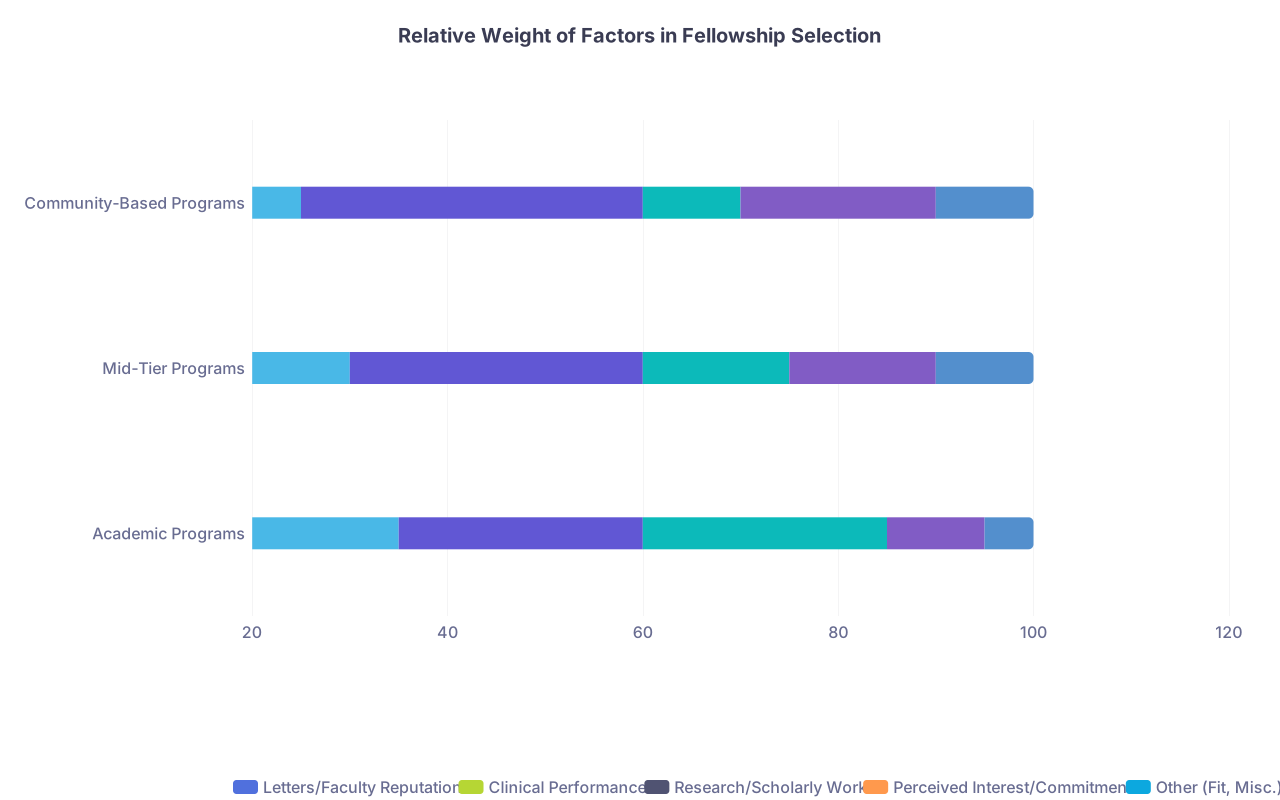
Let me be blunt. Interest is not the main driver of fellowship decisions. It’s a tiebreaker. A shaper. A context.
These are still king:
| Category | [Letters/Faculty Reputation](https://residencyadvisor.com/resources/fellowship-application-guide/what-your-program-director-really-writes-in-supportive-letters) | Clinical Performance | Research/Scholarly Work | Perceived Interest/Commitment | Other (Fit, Misc.) |
|---|---|---|---|---|---|
| Academic Programs | 35 | 25 | 25 | 10 | 5 |
| Mid-Tier Programs | 30 | 30 | 15 | 15 | 10 |
| Community-Based Programs | 25 | 35 | 10 | 20 | 10 |
You cannot interest-signal your way out of:
- Chronically poor evaluations
- Major professionalism flags
- Completely absent scholarship in a research-heavy field
But between two roughly similar applicants? The one who seems likely to show up, be committed, and stay is the safer bet. That’s where interest signals quietly move the needle.
A Clean Strategy for Signaling Interest (Without Self-Sabotage)
Let me pull this all into something you can actually implement without losing your mind.

| Step | Description |
|---|---|
| Step 1 | Make Program List |
| Step 2 | Pick Realistic Top Targets |
| Step 3 | Skip to Faculty Support |
| Step 4 | Assign Signals to Realistic Programs |
| Step 5 | Ask Faculty Advocates |
| Step 6 | Send 3 to 7 Thoughtful Emails |
| Step 7 | One Post Interview Update Max |
| Step 8 | Official Signals Allowed |
Decide your honest top tier. Not fantasy. Realistic places where your profile fits.
Use official signals on programs in that tier where you’d actually be happy to match.
Identify 2–4 faculty who know you well and are reasonably connected. Ask them:
“If you genuinely feel comfortable, would you be willing to reach out to 1–2 programs where you think I’d be a particularly good fit? I don’t want mass emails—just where you really believe it.”
Send individualized, concrete pre-interview emails only to programs where:
- You have a real tie or rationale, and
- You wouldn’t be embarrassed to match.
After interviews, send:
- One thank-you/update to your highest tier programs.
- One honest “you are my #1” email only if that’s actually true.
- No begging. No repeated “just checking” messages.
That’s it. That’s more than what most applicants do. And appreciably less annoying than what the worst ones do.
FAQs: The Unspoken Rules, Distilled
1. Should I email a program if I have not heard about an interview and others have?
Only if you have a very specific connection or update. For example: new major publication accepted, new grant, or a genuine life event that makes that region particularly necessary. A generic “just checking on my status” before they’ve obviously finished sending invites makes you look anxious, not desirable.
2. Is it worth doing an away rotation just to show interest?
Yes—if you’re going to crush it. An away rotation is a massive interest signal and performance audition rolled into one. But if you’re burned out, disorganized, or half-in, an away where you’re average or worse will hurt more than help. Programs absolutely remember weak rotators.
3. Do programs really penalize people for not sending thank-you notes?
No. Some faculty like them for ego reasons, but I’ve sat through many rank meetings where no one mentioned thank-you emails once. At best, a good note slightly reinforces a positive impression. At worst, a bad or overeager series of emails hurts you.
4. How many programs can I honestly say are my “top choice”?
One. That phrase is singular. If you play word games with multiple programs and get caught, your reputation—and your home program’s—takes a hit. If you have several places you’d be happy, use “ranking very highly” or “among my top choices” for the others.
5. My mentor offered to email several PDs for me. Should I accept?
Only if they’re selective. Tell them directly: “I’d be grateful for any support, but I’d prefer you only reach out where you genuinely think I’m a particularly good fit. I don’t want your name on a blast list.” PDs know who mass-emails for every applicant. Those emails carry very little weight.
You’re in the part of training where games start to feel more subtle, and the stakes feel higher. You’re not just trying to “match somewhere” anymore—you’re trying to shape a career you actually want to live.
Now you know how the interest game is really played: who PDs actually listen to, which signals mean something, and where people quietly roll their eyes and move on.
With this foundation in place, you can stop obsessing over every email draft and start focusing on what still matters most—being the kind of fellow they’ll be glad they chose, not just the one who signaled the loudest. The next step is using your last months of residency to build the experiences and relationships that make those signals honest and undeniable. But that’s a conversation for another night.


