

It’s late. You’re in the resident workroom, half-charting, half-refreshing your email. Someone casually says, “Oh yeah, I just finished my ERAS for cards. Sent to [Your Dream Program].”
Your stomach drops.
Because you’re also applying. To that exact program. Maybe you already told your attending it’s your #1. Maybe you even used the same mentor. Now all you can think is:
Did I just sign up to compete directly against my co-resident?
Are we going to destroy each other’s chances?
Let’s talk about that, because this specific flavor of anxiety is way more common than anyone admits out loud.
Reality Check: Competing With Co-Residents Is Normal, But It Feels Awful
Here’s the part nobody says clearly: multiple people from the same residency applying to the same fellowship program is not weird. It’s expected.
Programs know:
- Big residencies will send several applicants to the same specialties.
- Good applicants cluster. Strong residents often have similar interests.
- The same “hot” fellowships (cards, GI, heme/onc, critical care) get hit with repeat names from the same institution every cycle.
They’re not sitting there saying, “We can only take one from [Your Hospital] this year.” That’s not how it works.
But I get why it feels terrible. Because your brain goes:
- “If they’re better than me, I’m done.”
- “If they get an interview and I don’t, that’s humiliating.”
- “If we both interview, it’ll be weird and awkward.”
- “What if I’m the only one who doesn’t match?”
And the worst:
“What if my PD has to choose between us and I’m the expendable one?”
You’re not crazy for thinking like this. It is uncomfortable. It is weird territory. But weird doesn’t equal doomed.
How Programs Actually See Multiple Applicants From One Institution
Let me be blunt: you’re overestimating how central this drama is to anyone outside your residency.
From the fellowship program’s side, what they see is basically a list. Names. Scores. Letters. PD comments. That’s it.
They think things like:
- “Huh, three applicants from [X] this year. Must be a strong cards culture there.”
- “Which of these fits our program needs best?”
- “Did their PD write something different about each of them?”
They’re not thinking, “Oh no, we can’t possibly interview more than one from that program.”
Here’s roughly how it tends to break down:
| Situation | Common Program Response |
|---|---|
| 2–3 strong applicants from same residency | Interview 2–3, rank based on fit |
| 1 standout, 1–2 borderline from same place | Interview standout, maybe 1 other |
| All equally strong | Interview all, rank separately |
| PD letter strongly favors one | That person usually gets priority |
None of this screams, “You’re automatically screwed if your co-resident applies.”
Sometimes the opposite happens: seeing multiple strong applicants from your program actually raises the program’s perception of your training environment.
The Awkward Part: Internal Politics & Letters
This is the part you’re truly worried about: not just the external competition, but the internal dynamics.
Fear #1: “My PD will obviously choose them over me”
Your PD doesn’t technically have to “choose” one of you. They can support multiple people strongly. But yes, the PD evaluation/letter often creates a subtle internal ranking.
Reality:
- Some PDs write equally strong, individualized letters for several residents.
- Some PDs clearly have favorites. And everyone can tell.
- Some PDs are conflict-avoidant and try to be “nice” to everyone, which helps no one.
What matters for you:
Ask directly (in a calm, professional way) what support looks like if multiple people from your program apply to the same place. Something like:
“Several of us are applying to [X specialty], and likely some to the same programs. How do you usually handle letters and communication in that situation?”
You’re not asking, “Who do you like more?” You’re asking about process. That’s safer. And useful.
Fear #2: “Shared letter writers will sabotage me”
You and your co-resident both asking Dr. Big Name to write a letter. Feels like a competition, right?
Here’s what usually happens:
- If they genuinely think you’re both strong, they write two strong letters with different emphasis.
- If they think one is substantially stronger, that will show up. Subtly. Or not so subtly.
- If they don’t think they can support you strongly, the good ones will tell you “I can write you a letter, but it may not be as strong as you’d like.” That’s code. Believe it.
If you’re terrified your letter writer favors your co-resident, that’s actually useful information. It pushes you to diversify your letter set instead of stacking all your eggs in one basket.
Worst-Case Scenarios (And What Actually Happens)
Let’s walk through the nightmares your brain is spinning and reality-check each one.
Scenario 1: They get interviews at places you don’t
This sucks. It stings. You’ll hear, “Oh I got [Dream Program]!” and your inbox is quiet.
What it means:
- Programs saw differences between you. That might be a fit issue, scores, letters, research, or PD comments.
- It doesn’t automatically mean you’re “worse.” It means something about your file didn’t line up with what they prioritized.
What usually happens:
- It hurts for about 1–2 weeks.
- You re-anchor on the interviews you do have.
- By the time rank lists are due, half of those early rejections don’t matter.
Is it personal? It feels that way. But from the program angle, it really isn’t. You’re not in the room. They’re not roasting you. They’re just picking fits from hundreds of files.
Scenario 2: You both interview at the same place, same day
Honestly? Common. And awkward. And survivable.
You’re probably imagining:
- Sitting in the same waiting room.
- Accidentally hearing them crush the “tell me about your research” question.
- Them connecting with the PD over some shared interest you don’t have.
Here’s how you handle it:
- Accept the weirdness. Don’t pretend it’s not awkward.
- Decide in advance: are you going to coordinate travel? Or keep things separate? Both options are fine.
- During the interview, do not make your entire personality “I’m friends with [Co-resident].” You’re your own person.
Programs expect some overlap. They’re not comparing you side-by-side in real time like, “Who smiled more at lunch?” They evaluate you individually.
Scenario 3: They match at your top choice. You don’t.
This is the one that really keeps people up at night.
Someone else living the life you imagined for yourself. In the city you wanted. At the program you’ve been obsessing over for a year.
What I’ve seen happen in real life:
- People say all the polite congratulations.
- You go home and it feels like a punch to the gut.
- A few months into fellowship, your life is busy enough that the sting fades.
- Two years later, no one cares who matched where. They care who’s a good fellow, who’s happy, who got the job they wanted after.
Is it unfair? Sometimes. Yes. Fellowship is not a pure meritocracy. Timing, staffing, random ranking noise, a slightly grumpier interviewer—any of that can tilt things.
But it’s not a referendum on your worth as a physician.
What You Can Actually Control (So You Don’t Lose Your Mind)
You can’t control who else in your residency loves cards or GI or heme/onc. You can’t control where they apply.
Here’s what you can control:
Your story
Not the made-up “personal brand” nonsense. I mean: a coherent narrative that explains why this field, why now, and what you actually want to do with it. You need to sound like a human, not a brochure.Your letters mix
Don’t mirror your co-resident’s letter strategy 1:1. If they go PD + same specialist + same researcher, try to bring in someone who knows you in a different way—ICU director, QI mentor, clinic attending.Your program list
If your co-resident is shotgun-applying to every top-10 fellowship, that doesn’t mean you have to copy them. Build a list that makes sense for you: geography, fit, realistic competitiveness, and yes, some reaches. But not only reaches.Communication with your PD
Have an actual, honest conversation. Let them know what you’re aiming for. Ask what they see as your strengths and weak points. Don’t make them guess your priorities.
Strategy If Several People From Your Program Are Applying Together
You’re in heme/onc, and 4 seniors are applying. All from the same smallish residency. It feels like the Hunger Games.
Here’s a more strategic way to think about it:
- Be aware of overlap, but don’t obsess. You don’t need to “claim” programs like territory.
- It’s okay for you all to apply to some of the same places—especially bigger fellowship programs.
- Where your profiles are dramatically different (research, visa status, geography), your “competition” is less direct than you think.
Sometimes it helps to map things mentally:
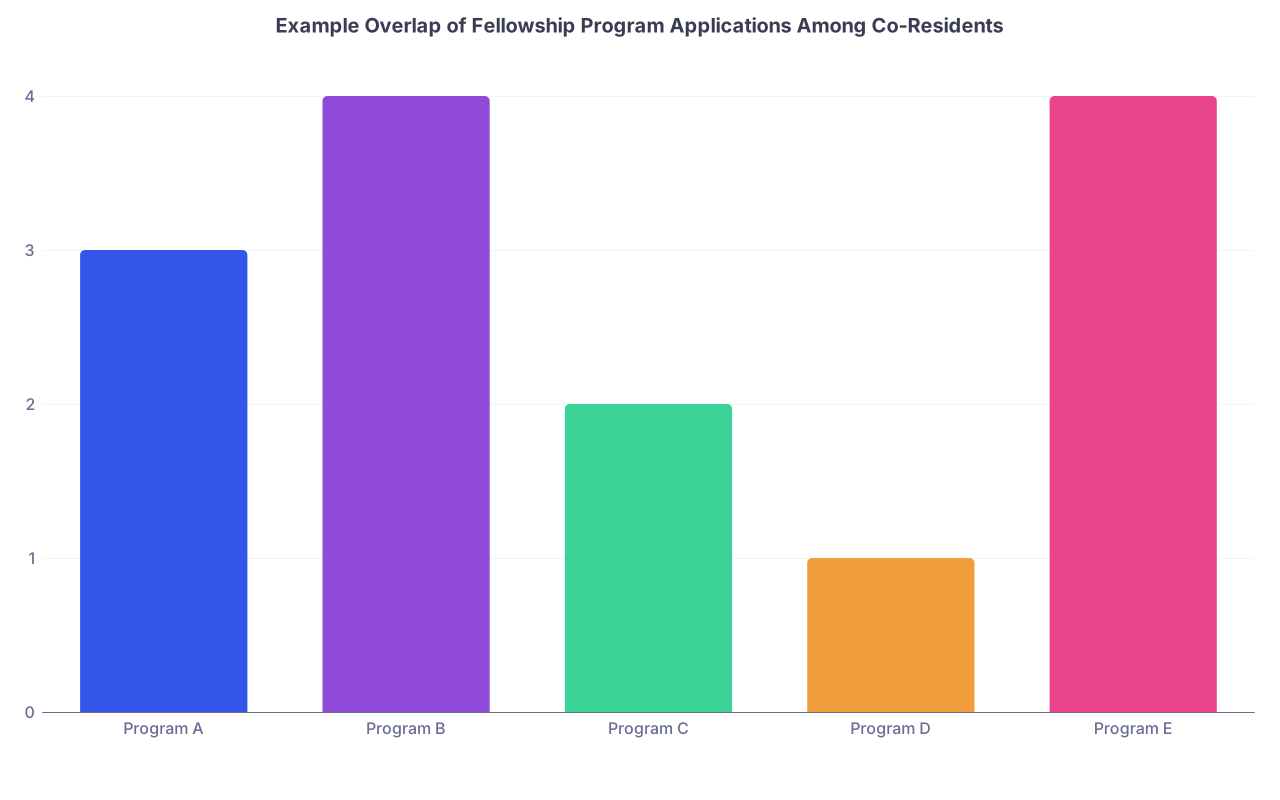
| Category | Value |
|---|---|
| Program A | 3 |
| Program B | 4 |
| Program C | 2 |
| Program D | 1 |
| Program E | 4 |
Even if three or four of you apply to the same place, the fellowship isn’t going, “We must pick exactly one from this group.” They’re ranking everyone against an entire national pool.
If you want to be less anxious:
- Don’t compare your program list line-by-line. Protect your peace a little.
- Don’t constantly ask, “Did you hear from X yet?” It just keeps both of you on edge.
- If your co-resident needs that constant compare-notes energy, you can opt out. Politely.
Managing The Day-to-Day Emotional Fallout
The actual hardest part isn’t strategy. It’s surviving the waiting and the side-by-side comparisons.
A few hard-earned rules:
- You don’t have to share everything. You can keep some application details private.
- You can set boundaries—“Hey, this stuff is stressing me out, can we not compare programs every day?”
- You’re allowed to be both happy for them and sad for yourself. Those emotions can coexist. You’re not a bad person.
And if the whole process is getting under your skin, you’re also allowed to reach out to someone who isn’t part of the internal drama: a mentor at another institution, an old med school advisor, a therapist. You don’t get extra points for white-knuckling it alone.
Quick Mermaid View: What Actually Decides Your Outcome

| Step | Description |
|---|---|
| Step 1 | Applicant Pool |
| Step 2 | Filter by Eligibility |
| Step 3 | Review Applications |
| Step 4 | Rejection |
| Step 5 | Interview Day |
| Step 6 | Committee Discussion |
| Step 7 | Rank List |
| Step 8 | Match Algorithm |
| Step 9 | Final Outcome |
| Step 10 | Invited to Interview |
Notice what’s not on there: “Compare directly against co-resident in same program.” You’re being compared against a national pool, filtered through program needs, vibes, and randomness.
FAQ (Exactly 5 Questions)
1. Will fellowship programs avoid taking more than one fellow from the same residency in a given year?
No hard rule. Some programs like having variety and may not want 3/4 of their class from one place, but taking two from the same residency in a single year absolutely happens. It’s more common in big specialties and strong pipelines. There isn’t a universal “only one per institution” cap.
2. Should I avoid applying to a program if a stronger co-resident is applying there too?
Generally no. Don’t self-eliminate based only on internal comparison. The exception: if your PD or a trusted mentor tells you very clearly that your application is much weaker and that particular program is an extreme reach, then maybe that’s not the best place to spend your energy. But “they’re stronger than me” alone is not a reason to bail.
3. Do fellowship programs ask PDs to rank applicants from the same residency?
Sometimes, yes. It’s not always formal, but programs absolutely call PDs and say, “We have apps from A, B, and C from your place—any thoughts?” That doesn’t mean your PD destroys your chances; it means their off-the-record comments become part of the bigger picture. Another reason to actually talk to your PD early instead of guessing where you stand.
4. Is it weird if my co-resident and I both match at the same fellowship program?
Honestly? It can be a little weird before you get there. People might say, “Wow, [Your Residency] really cleaned up.” But day-to-day, once you start fellowship, you’re just two fellows in the class. It can actually be nice to have someone around who already knows your quirks and work style. The social weirdness fades fast.
5. What if I end up being the only one in my class who doesn’t match?
It feels catastrophic. It’s not career-ending. Every year, people SOAP into one-year positions, do hospitalist time, or get a research year and come back much stronger. Programs know how common this is. It’s embarrassing for about five minutes, then it becomes a story you tell as part of your resilience arc. It hurts, but it’s not the end.
Key points to hold onto:
- Multiple co-residents applying to the same programs is normal; it doesn’t automatically tank your chances.
- Your fate isn’t decided by internal rivalries—it’s decided by the total picture: your story, letters, fit, and some randomness.
- Protect your sanity: set boundaries, control what you can, and stop using your co-residents as the yardstick for your entire future.


