

The way most people “take a gap” before residency is sloppy and expensive. A two-year gap without a plan does not give you freedom; it quietly wrecks your momentum and your application.
You can absolutely take two years off and come back stronger. But only if you treat those 24 months like a project with phases, deadlines, and non‑negotiables.
You’re asking: how do I design a two-year gap plan that keeps me competitive for residency and doesn’t let everything rust?
Here’s the timeline. Month by month, quarter by quarter. At each point, what you should be doing, deciding, and documenting.
First: Define the End Date and Target Match Year (Week 0–1)
At this point you should stop thinking in “years off” and start thinking in match cycles.
You must answer two questions in the first week:
What Match year am I targeting?
- Example: You graduate June 2024, you want a two-year gap → you’re aiming for Match 2027 (to start residency July 2027).
- That means ERAS opens around June 2026, Match Day March 2027.
What specialty(ies) am I realistically targeting?
- “Probably something competitive like derm or ortho” is not a plan.
- You can have a primary and a backup, but you need names now, even if they change.
Write this down on paper or in a doc:
- “I am planning for: Match 20XX”
- “Primary specialty: ___; backup: ___”
- “Core priorities during gap: [clinical experience / research / exams / personal]”
From here, everything slots into those dates.
High-Level 24-Month Structure
Think of your two years in 4 phases:
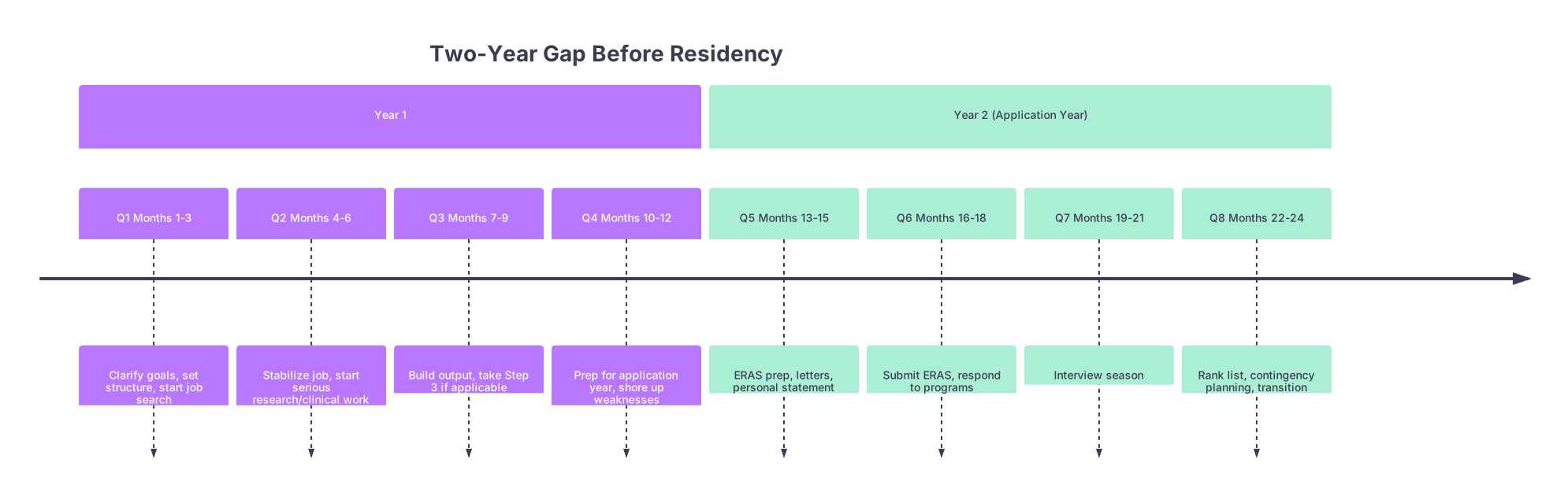
| Period | Event |
|---|---|
| Year 1 - Q1 Months 1-3 | Clarify goals, set structure, start job search |
| Year 1 - Q2 Months 4-6 | Stabilize job, start serious research/clinical work |
| Year 1 - Q3 Months 7-9 | Build output, take Step 3 if applicable |
| Year 1 - Q4 Months 10-12 | Prep for application year, shore up weaknesses |
| Year 2 (Application Year) - Q5 Months 13-15 | ERAS prep, letters, personal statement |
| Year 2 (Application Year) - Q6 Months 16-18 | Submit ERAS, respond to programs |
| Year 2 (Application Year) - Q7 Months 19-21 | Interview season |
| Year 2 (Application Year) - Q8 Months 22-24 | Rank list, contingency planning, transition |
Now let’s zoom in phase by phase.
Months 1–3: Stabilize, Choose a Primary Track, Build Structure
At this point you should be ruthlessly honest with yourself about why you’re taking two years:
- Burnout?
- Visa issues?
- Need for money?
- Weak application (scores, grades, no research, late decision on specialty)?
- Personal factors (family, health, partner, kids)?
Your why drives your track. Most two-year plans end up centered on one of these:
- Research-heavy track – aiming at competitive specialties or bolstering academic CV.
- Clinical-heavy track – need US clinical experience (USCE) or recent hands-on work (esp. IMGs).
- Exam-recovery track – weak Step scores/COMLEX, need Step 3, or re-taking OET, etc.
- Life-and-stability track – debt, caregiving, mental health while keeping minimum clinical connection.
By the end of Month 3 you should have:
A primary role or job lined up starting by Month 4 at the latest.
Examples:- Full-time research assistant at an academic center.
- Clinical research coordinator in your target specialty.
- Hospitalist scribe, MA, or clinical assistant role (where allowed).
- For IMGs: observerships pipeline, paid/non-paid research post, or clinical fellow roles.
Baseline schedule template (this is where most people fail).
Decide now:
- What hours are for work (job)?
- What hours are for:
- Studying (if any exams left)
- CV projects (posters, QI, teaching)
- Application prep (later)
If you don’t block this, your three months evaporate into “I’ll start next week.”
Contact list of 3–5 potential mentors
- Email faculty you’ve worked with or want to work with.
- Aim for at least:
- 1 in your desired specialty
- 1 who is known for mentoring residents/med students
- 1 who actually gets things published or funded
Initial Week-by-Week (Months 1–3):
Week 1–2
- Decide Match year and specialty.
- Draft a one-page CV (yes, it’s rough; that’s fine).
- Start listing programs where you might want to do research or work.
Week 3–4
- Send 10–20 targeted emails for research/clinical positions.
- Apply to posted jobs weekly (don’t wait for faculty replies).
- Sketch out a weekly schedule: work, study, personal.
Weeks 5–8
- Accept a realistic job, not an imaginary perfect one.
- Confirm start date.
- Start cold outreach for observerships/USCE if you need them.
Weeks 9–12
- Begin role.
- Document everything: role description, supervisors, potential projects.
- Have a “6-month goals” chat with your supervisor/PI.
Months 4–6: Lock In Role, Start Building Output
At this point you should be:
- In a stable role (or a clear sequence, like overlapping observerships).
- Learning the system.
- Positioning yourself for letters and tangible achievements.
Your goals by the end of Month 6:
Be indispensable to at least one person with a title.
Someone who will one day start their letter with “X rapidly became one of the most reliable people in our group…”Have 1–2 clearly defined projects.
- A chart review.
- A QI project on readmissions.
- A case series or at least 1–2 case reports.
- A curriculum or teaching initiative.
Know your weak points for the upcoming application.
- Low Step 1/2?
- No home specialty department?
- No recent clinical letters?
- IMG with no US publications?
Weekly Checklist (Months 4–6)
- Show up, on time, consistently. Yes, that still matters.
- Every week, ask: “What can I move forward this week?”
- Draft intro for a paper.
- Build a patient list for a project.
- Gather data in REDCap.
- Schedule 1–2 informal check‑ins with potential letter writers by Month 6:
- “I’m considering applying to [specialty] next year and would love your thoughts.”
If applicable, sketch your Step 3/COMLEX 3 timing here: usually late in Year 1 (Months 7–9) so score is back before ERAS.
Months 7–9: Produce, Don’t Just Participate
At this point you should stop being just “a helper.” You need things with your name on them.
Targets by the end of Month 9:
At least one of:
- Manuscript submitted.
- Abstract submitted to a conference.
- QI project with measurable impact and documentation.
- Formal teaching role (small-group facilitator, online course, etc.) with proof.
One primary letter-writer 80% “locked.”
Meaning:- They know you well.
- They’ve seen your work over months.
- You’ve had at least two 1:1 conversations about your goals.
For exam-heavy folks:
- Step 3 scheduled and taken around Month 8–9 if licensed/eligible.
- That way scores return well before ERAS season.
Month 7–9: Mini-Timeline
Month 7
- List all ongoing projects; assign realistic timelines.
- With your PI/supervisor: “Which of these can be finished in 3–6 months?”
Month 8
- Push one project to submission-ready.
- Start documenting teaching/leadership (slides, feedback emails, attendance logs).
Month 9
- Submit at least one abstract/manuscript.
- Take Step 3 (if doing it).
- Have a structured career talk with your main mentor:
- Are my targets realistic?
- How many programs should I plan to apply to?
- What can I credibly achieve in the next 9 months?
Months 10–12: Build the Application Foundation Before It’s “Application Season”
At this point you should be turning your experience into narrative and structure. Not yet clicking “submit,” but laying tracks.
Your goals by the end of Year 1:
Draft ERAS-style CV and experiences list.
- Convert everything to ERAS language: roles, dates, supervisors, hours.
- Flag “strong” experiences that will anchor your personal statement.
Clarify your specialty strategy.
- Single specialty vs dual apply.
- Which tier of programs (community vs academic, geographic focus).
Decide Year 2 schedule: balance between work and application tasks.
- Some people scale down to 0.8 FTE in Year 2.
- Others keep full-time but build ERAS work into evenings/weekends.
If your gap will be questioned (“Why two years?”), script the answer.
One sentence:- “I chose to take two structured years to deepen my experience in X and Y before residency.”
Year 2, Months 13–15: Pre‑ERAS Offensive (Personal Statement, Letters, Program List)
Now you’re in the application year. This is where most people start scrambling. You won’t.
At this point you should be:
- Still actively engaged in your work.
- Already known by letter writers.
- Turning the last 12 months into a cohesive story.
By the end of Month 15 (usually around March–April before ERAS opens):
Personal statement: solid second draft.
- Not a brainstorm. An actual draft someone has read.
- Built around 2–3 anchor experiences from your gap and med school.
Program list draft.
- Spreadsheet with:
- Program name.
- Location.
- Type (community/academic).
- Your “tier guess.”
- Aim for a realistic target count for your specialty and competitiveness.
- Spreadsheet with:
Letters of recommendation: explicit conversations.
You’re not “hoping they remember.” You’re asking.Script:
- “I’m applying to [specialty] this upcoming Match and would be honored if you’d consider writing a strong letter of recommendation on my behalf.”
You want:
- 2–3 letters in your specialty.
- 1 additional letter (medicine, surgery, research, etc.), depending on specialty norms.
Update your project list.
- Which papers are under review?
- Which abstracts accepted?
- What can realistically be finished by ERAS submission?
Months 16–18: ERAS Build and Submission
This is the critical application window.
At this point you should be treating your gap work as your main selling point, not an apology.
Month 16 (ERAS opens month)
Start entering everything into ERAS.
- Experiences, publications, presentations, volunteer work, employment.
- Make sure each gap-month is covered: no long unexplained blank stretches.
Finalize personal statement.
- Get it read by:
- One mentor.
- One peer who writes well.
- Someone not in medicine for clarity.
- Get it read by:
Confirm letters are requested.
- Monitor ERAS for uploads.
- Send your letter writers:
- Your CV.
- Your personal statement.
- A short paragraph reminding them what you’ve done with them.
Month 17
Submit ERAS early.
Don’t kid yourself that waiting will add magical new accomplishments. Earlier is better, assuming quality is high.Continue your work.
- Don’t shut down your projects the minute you submit.
- Interviewers will ask what you’re doing now. You want a real answer.
Email select programs (tactfully) if you have a strong tie.
- Program where you are working.
- Geographic or family tie.
- Keep it brief and specific.
Month 18
- Monitor invites.
- Keep a simple tracking sheet:
- Date invite received.
- Date of interview.
- Thank-you sent (yes, still do it).
- Start pre‑emptive planning if invites are sparse (we’ll come back to this).
- Keep a simple tracking sheet:
Months 19–21: Interview Season Without Losing Your Day Job
At this point you should be juggling interviews and ongoing work without becoming unreliable in either.
Your goals here:
Present a cohesive story at every interview about:
- Why this specialty.
- Why you took two years.
- What you did with those two years.
- What you’ll bring to their program on Day 1.
Keep at least one ongoing responsibility so you aren’t “waiting for interviews” for 4 months.
Practical structure (Months 19–21)
Coordinate with your supervisor early.
- “Interview season is usually between X and Y; can we plan for some flexible days or remote work those months?”
Batch interviews when possible.
- Try to cluster interviews geographically or by week.
- Keep an updated calendar with:
- Interview dates.
- Pre‑interview socials.
- Time zone differences.
Refine your “two-year story.”
In every answer, the gap should sound like a deliberate investment, not a detour.Rough structure:
- “I graduated in 20XX and chose to spend two years doing X.”
- “In that time I worked on [clinical/research/teaching] with [types of patients or teams].”
- “This made me certain I want a residency in [specialty] because…”
- “I’m coming to residency with [specific skills and perspective] I wouldn’t have had otherwise.”
Months 22–24: Rank, Contingency, and Landing the Next Step
At this point you should face the uncomfortable reality: not everyone matches, especially with a gap. Smart planning means assuming both possibilities.
Month 22: Rank List Building
- Build your list based on:
- How you felt on interview day.
- Training quality.
- Location and support.
- Where your two-year background seemed most valued.
Don’t rank programs you’d be miserable attending. But also don’t play fantasy matching. Rank every program where you could actually show up on July 1.
Month 23: Parallel Plan if Match Goes Sideways
You should have a contingency template ready before Match Day. Not because you expect to fail, but because it’s easier to think clearly now.
Include:
If I do not match:
- Which mentors do I email in Week 1 after the results?
- What can I extend or start (research contract, new clinical role)?
- How will I strengthen my file in 6–12 months (more USCE, additional specialty, new exam score, publication push)?
If I match:
- How will I wind down my current role responsibly?
- What do I need to do for licensing, visa, housing over the next 3–4 months?
Month 24: Transition
Whether you matched or not, the last month of your two-year gap should not be wasted.
If matched:
- Wrap up projects; try to get last‑minute acceptances or submissions (they still count).
- Ask mentors explicitly:
- “Is there anything I should review before starting intern year here?”
- Get copies of:
- Final CV.
- Letters (if shared).
- Any teaching evaluations.
If unmatched:
- Meet with 2–3 honest advisors.
- Ask for brutal, specific feedback on your application.
- Decide quickly:
- Re‑apply same specialty with bolstered profile?
- Re‑target to a different specialty?
- Extend your clinical/research role or shift to a higher-yield one?
Use Month 24 to start the next chapter, not to wallow.
Avoiding the Big Momentum Killers
A two-year gap does not ruin you. But these common mistakes do:
| Mistake | Better Alternative |
|---|---|
| “I’ll figure it out as I go” | Decide Match year, specialty, and rough track in Month 1 |
| Unstructured part-time work | Defined full-time role with projects and supervisor |
| No ongoing clinical exposure | At least 1 consistent clinical or patient-facing activity |
| Waiting until ERAS opens to write PS | Have second draft PS by Month 15 |
| One weak letter writer | 2–3 solid letter writers with >6 months experience with you |
Visual: How Your Effort Should Shift Over 24 Months
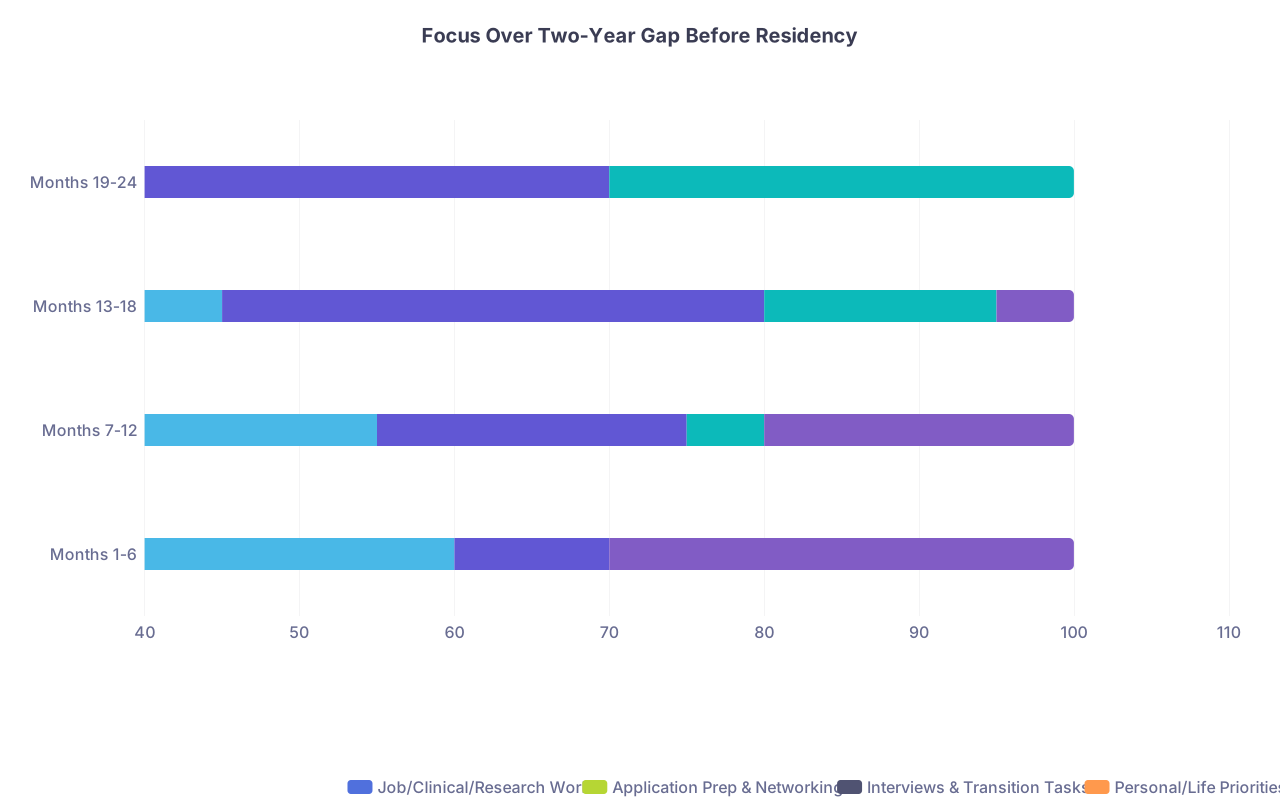
| Category | Job/Clinical/Research Work | Application Prep & Networking | Interviews & Transition Tasks | Personal/Life Priorities |
|---|---|---|---|---|
| Months 1-6 | 60 | 10 | 0 | 30 |
| Months 7-12 | 55 | 20 | 5 | 20 |
| Months 13-18 | 45 | 35 | 15 | 5 |
| Months 19-24 | 40 | 30 | 30 | 0 |
Percentages are rough, but you get the idea: early heavy on stable work, later gradually shifting into application and transition.
Quick Daily and Weekly Anchors So You Don’t Drift
At this point you should anchor your life with a few small, boring habits. They matter more than motivation.
Daily (15–30 minutes):
- Log what you did that day in a simple doc or note:
- “Seen 12 patients with Dr. X; started data extraction for project Y.”
- Read something in your specialty: one article, one guideline section, one case.
Weekly (60–90 minutes):
- Update your “gap CV” with:
- New tasks.
- Skills learned.
- People met.
- Send one email or message that “moves the ball”:
- Follow-up to a mentor.
- Idea for a small project.
- Thank-you to someone who helped you.
Monthly (2–3 hours):
- Reassess:
- Are your activities still aligned with your target specialty?
- Are you on track with letters, projects, and study?
- Do you need to course-correct now, not six months from now?
A Simple Visual to Keep You Honest
Print something like this and tape it above your desk:

Final Move: Start Today’s 30-Minute Planning Sprint
Do not “think about this later.” Open a blank document or notebook now and:
- Write your target Match year at the top.
- Under it, write:
- Primary specialty:
- Backup specialty:
- Add three bullet points:
- “My main gap-year track will be: ___”
- “By the end of Month 3, I will have: ___”
- “My #1 potential letter writer in this gap is: ___”
Then set a 30-minute timer and list every contact, job lead, PI, or supervisor who could fit into this two-year plan.
That’s your first concrete step. Start that list right now.


