
The belief that “dual applying guarantees a match” is one of the most dangerous security blankets in modern residency applications. It feels safe. The data says otherwise.
Dual applying is not a magic parachute. For a lot of applicants, it’s a very expensive illusion that doesn’t fix the real problem: being a weak applicant to both specialties instead of a strong applicant to one.
Let’s pull the numbers apart and stop hand-waving.
What “Dual Applying” Actually Looks Like In The Real World
I’m not talking about the fantasy version where you calmly submit a perfectly tailored application to two closely related fields and glide into March with multiple offers.
I mean the real version I’ve seen over and over:
You’re a borderline applicant for a competitive specialty—say dermatology, orthopedics, ENT, EM in the post-DO/MD merge, or even radiology for some cohorts. Panic sets in. Someone on Reddit or a senior resident says, “Just dual apply. You’ll be fine. Everyone does it.”
So you:
- Slam together a “backup” application to internal medicine, prelim medicine, family medicine, or transitional year programs.
- Reuse most of your personal statement.
- Get one or two generic letters you pretend work for both fields.
- Don’t really rotate in the backup specialty.
- Tell yourself: “If I don’t match in my dream field, I’ll definitely match in my backup. Look at the fill rates. They always need people.”
Then February comes, rank lists are in, and somehow you’re still worried you’ll go unmatched.
There’s a reason for that. The “dual applying = safety” logic breaks at three separate levels: statistics, program behavior, and applicant behavior.
The Numbers: Dual Applying Helps Some People—But Not The Way You Think
Let me be very precise here: dual applying can improve your overall chance of matching. But it does not guarantee a match, and the advantage is heavily dependent on your underlying profile and how seriously you commit to the second specialty.
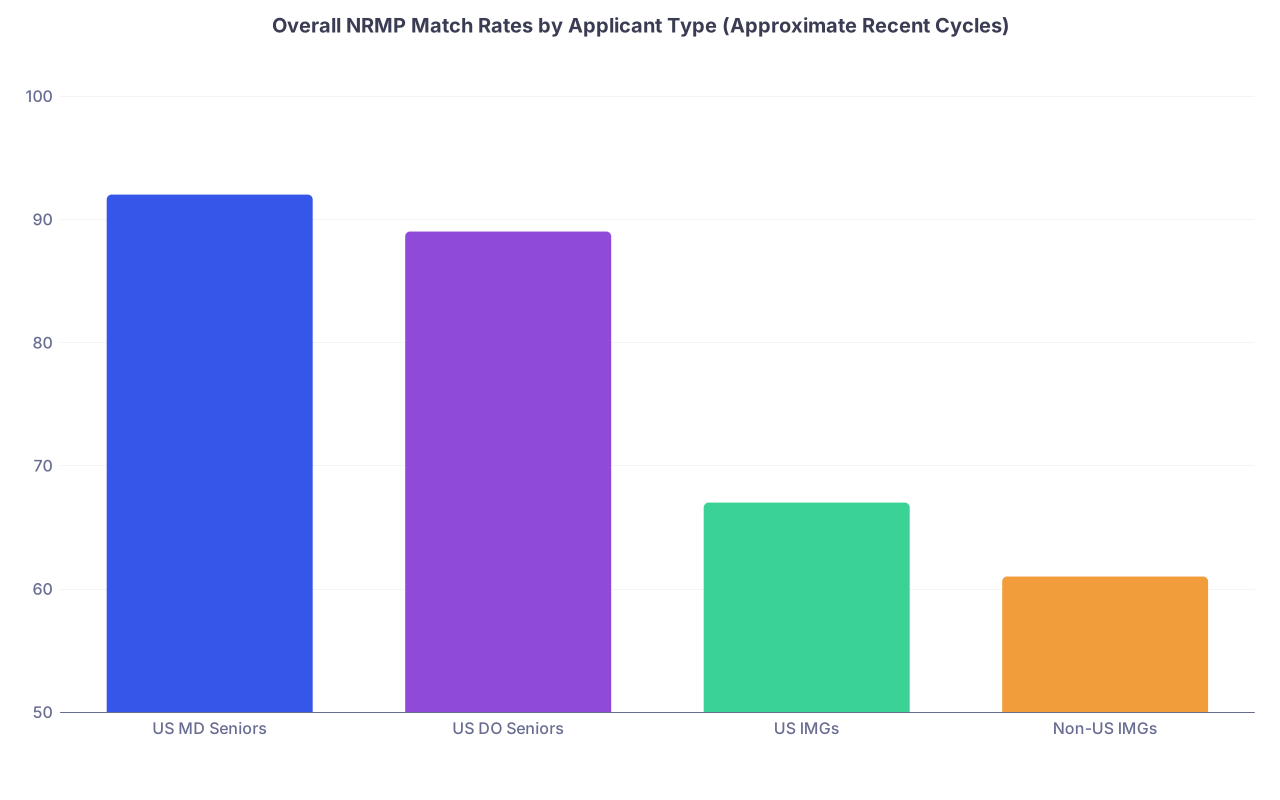
Look at macro trends first.
| Category | Value |
|---|---|
| US MD Seniors | 92 |
| US DO Seniors | 89 |
| US IMGs | 67 |
| Non-US IMGs | 61 |
If you’re a US MD senior, your baseline odds of matching somewhere are already over 90%—even when many of you are shooting for competitive specialties. That’s before any backup shenanigans.
Now look at specialty-specific fill rates. Competitive fields (derm, neurosurgery, plastics, ortho, ENT, etc.) have fill rates dominated by US MD seniors. Backup specialties like internal medicine and family medicine also fill at very high rates. The “tons of open spots” myth is dead.
Programs in “backup” fields are flooded with applicants who have no demonstrated interest in their specialty. They’ve learned to sniff it out.
Here’s where the numbers betray the dual-apply fantasy: when you examine unmatched applicants, a large fraction actually did apply to more than one specialty. They still went unmatched, because their second application was weak, unfocused, or obviously “I don’t actually want you.”
NRMP has published data showing that unmatched US seniors commonly apply more broadly and to more programs than matched peers. Volume alone, or duality alone, doesn’t rescue a weak application.
Why Programs Don’t Love Being Your “Backup Plan”
Programs have gotten very good at spotting backup applicants. Better than you think.
I’ve watched PDs scroll through app lists during recruitment and literally say out loud: “Radiology primary. They’re just hedging. Pass.” This isn’t subtle.
Let’s be blunt about what programs see when you dual apply sloppily:
- A personal statement saying: “I fell in love with dermatology early in medical school…” and then your “backup” PS: “I have always been passionate about primary care…” in the same ERAS packet, same dates, same school, same everything. Yes, they notice.
- LORs addressed to the wrong specialty or clearly written for another field (“she will be an excellent orthopedic surgeon” in an internal medicine app—seen it; not theoretical).
- Zero sub-I or away rotation in the backup specialty.
- A rank list from prior years showing that the program historically gets students who clearly wanted them as Plan B. PDs talk. A lot.
So what happens? Many programs in the so-called “backup” fields quietly raise their standards or selectively filter out obvious tourists.
For example, internal medicine and family medicine:
- They still take some dual applicants, especially those who sell a coherent narrative: switched interests mid-MS4, have real experiences, real letters, and a believable story.
- They are less likely to rank you highly if your whole application screams “I’m really an unmatched orthopedic applicant in exile.”
If your “backup” is competitive (like EM + anesthesiology, radiology + IM, or ENT + general surgery), now you’re just competing in two serious arenas without being optimized for either. That’s not a safety net. That’s doubling your risk surface.
The Statistical Illusion: Why “More Specialties” ≠ “Guaranteed Match”
People intuitively think of dual applying like two independent coin flips: if you fail in one, you’ll probably succeed in the other. That’s not how this works.
Your competitiveness is correlated across specialties.
If:
- Your Step/COMLEX scores are weak,
- You have mediocre clinical evaluations,
- Your letters are lukewarm,
- You have professionalism flags or red flags,
- You interviewed poorly,
those problems follow you into both specialties. Dual applying doesn’t remove your weaknesses; it copies and pastes them.
There’s another nasty trap: time and attention. When you dual apply, you suddenly:
- Need two convincing personal statements.
- Need enough letters targeted to each specialty.
- Need research or experiences that at least sort of match both fields.
- Have to prep for two sets of interview questions with different cultures and expectations.
Most students do not magically double their application effort. They split it. The result is predictable: two half-baked applications instead of one strong one.

I’ve seen plenty of cases where, if the applicant had focused and built a coherent story for one field, they would have matched. Instead they sprayed and prayed in two and came up short in both.
Where Dual Applying Actually Makes Sense (And Where It Really Doesn’t)
Let me be fair. Dual applying isn’t inherently stupid. It’s just misused.
There are situations where it’s rational:
You’re going for a truly hyper-competitive specialty with limited spots (derm, neurosurgery, plastics, ENT, ortho) and
your record is borderline for that field but solid overall.You have genuine interest in the second specialty. As in: rotations, a mentor, maybe a longitudinal clinic, real letters. Not “I shadowed a guy once in PGY-1.”
You have time to produce two authentic, well-supported narratives. That means dedicated letters, targeted PS, and interviews where you don’t look like you’re lying through your teeth.
In those cases, dual applying can increase your expected match probability because at least one of your applications is truly strong, and the other is at least coherent.
Where dual applying is usually a bad idea:
- You’re already a strong candidate for a mid-competitive or noncompetitive specialty and are just “anxious.” There, the second application mostly adds cost and distraction without much gain.
- Your second specialty is actually not dramatically less competitive, just different (EM + anesthesia; radiology + gas; IM + neuro if you’re borderline across the board).
- You’re using a backup specialty you’d honestly hate, with zero track record of interest. Programs sense that, and you risk matching somewhere that burns you out.
The Program Director Perspective: How They Read Dual Applicants
Here’s how PDs break you down when you dual apply:
Is this person actually serious about our field?
They look at rotations, research, LORs, PS content, and what you’ve done over multiple years. A single throwaway line about “I value continuity of care” doesn’t cut it.Does this person make sense as a resident here for 3+ years?
If you scream “flight risk” who will re-apply to your primary dream specialty in a year, you drop down their rank list. Hard.Are their academic metrics and professionalism acceptable to our usual standards?
Backup doesn’t mean “dumping ground.” IM, FM, peds, psych, and prelim programs have raised their filters because of the intense match climate.
So if you go into dual applying thinking: “They’ll be grateful I applied,” you’ve misread the power dynamics. They can see your entire story. They aren’t blind.
| Applicant Pattern | Program Interpretation |
|---|---|
| Strong history in both fields | Legit dual interest, consider |
| Strong in one, weak in other | Tourist in weak field |
| No clear focus, scattered CV | Directionless, lower on rank list |
| Backup specialty has generic PS | Not committed, potential flight |
The Cost Problem: Money, Time, and Interview Dilution
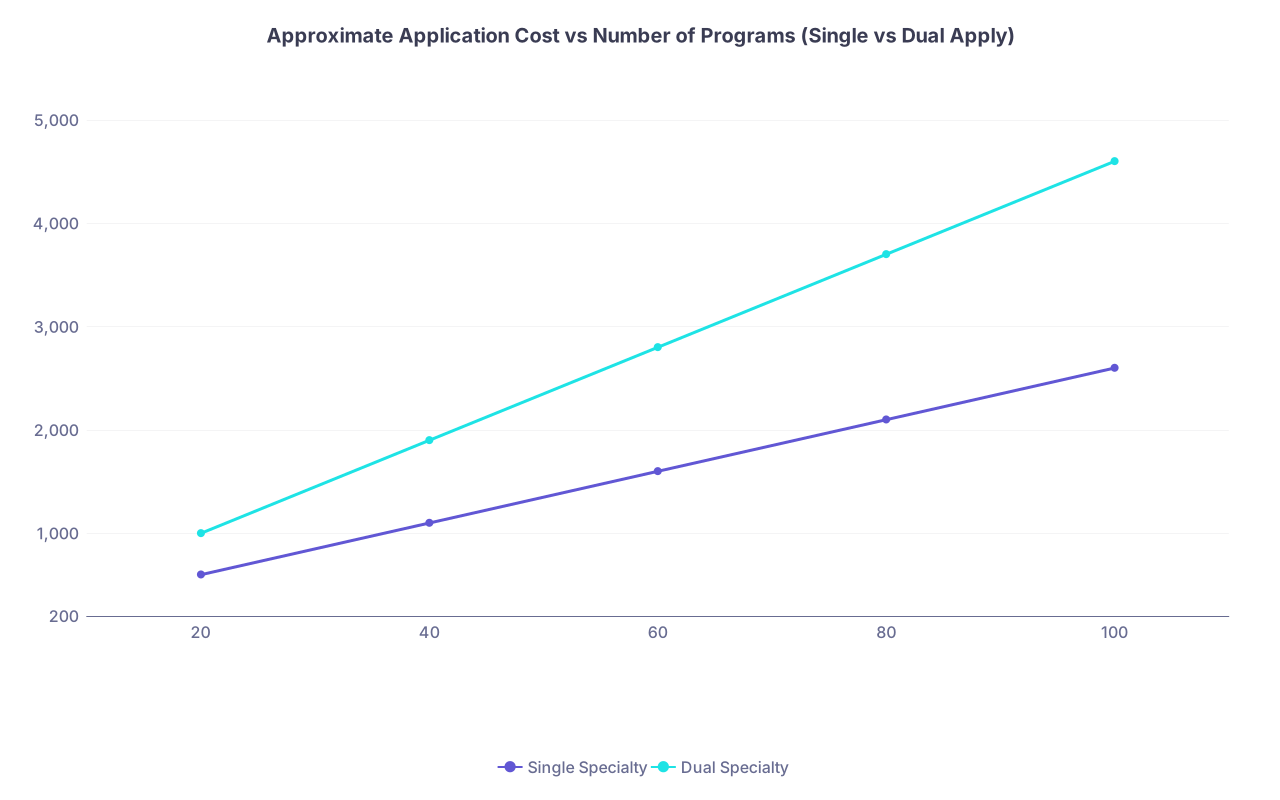
Everyone talks about match probability. Fewer talk about the cost curve.
Dual applying almost always means:
- More ERAS fees (and they ramp quickly with program count).
- More supplemental applications.
- More interview travel or virtual interview time blocks.
- More days off rotations for interviews, sometimes burned on a field you’re not even sure about.
| Category | Single Specialty | Dual Specialty |
|---|---|---|
| 20 | 600 | 1000 |
| 40 | 1100 | 1900 |
| 60 | 1600 | 2800 |
| 80 | 2100 | 3700 |
| 100 | 2600 | 4600 |
Those are rough numbers, but the shape is real: it gets expensive and time-consuming fast.
More dangerous than the money is interview dilution. You only have so many days you can reasonably miss from clerkships or sub-Is without tanking evaluations. If you chase 10–15 interviews in each of two specialties, something suffers:
- You start cancelling late.
- You show up exhausted, underslept, and underprepared.
- Your enthusiasm looks fake because it often is.
Programs can tell when they are your “backup interview day.” It’s not subtle.
The Real Lever: Targeted Volume, Not Blind Duality
The myth you should kill is: “If I’m worried, I should just dual apply.” The healthier mental model is:
“I should right-size my application volume and strategy to my actual competitiveness—and decide clearly if a second specialty is one I’d be genuinely happy in.”
For many applicants, that means:
- Applying to more programs in one specialty instead of fewer in two.
- Doing honest self-assessment: Step/COMLEX, class rank, AOA status, red flags, school reputation, letters.
- Strategically mixing tiers within a single field—safety, middle, and reach programs.
Dual applying often shows up as a substitute for uncomfortable self-honesty. “I’ll just hedge” sounds easier than “I might need a research year” or “maybe this hyper-competitive field is not realistic for me.”

| Step | Description |
|---|---|
| Step 1 | Assess Competitiveness |
| Step 2 | Single apply, broad range of programs |
| Step 3 | True dual apply with real investment |
| Step 4 | Improve profile or adjust specialty |
| Step 5 | Target specialty realistic |
| Step 6 | Backup field acceptable life |
The only sane reason to dual apply is if you can land in either field and have a decent life and career. If one of them would feel like punishment, stop lying to yourself: you’re not dual applying, you’re gambling.
So, Does Dual Applying “Guarantee” A Match?
No. And anyone telling you it does either hasn’t looked at the data, or is trying to calm you down cheaply.
Here’s what the numbers actually show, stripped of Reddit noise:
- Overall match rates for US seniors are already high. Dual applying is not the main driver of who matches; underlying competitiveness and well-constructed, coherent applications are.
- Many unmatched applicants dual applied. A sloppy second specialty doesn’t fix systemic weaknesses and often telegraphs “I don’t really want you” to programs.
- Dual applying helps when—and only when—you are a plausible, convincing candidate for both fields and willing to put in the work to build two real narratives. Otherwise, it’s just a more expensive way to be unfocused.
If you’re going to dual apply, do it with clear eyes: no, it does not guarantee anything. It simply changes the probability curve a bit—if you do it well. And if you are not willing to do it well, you’re usually better off tightening your aim, not widening it.