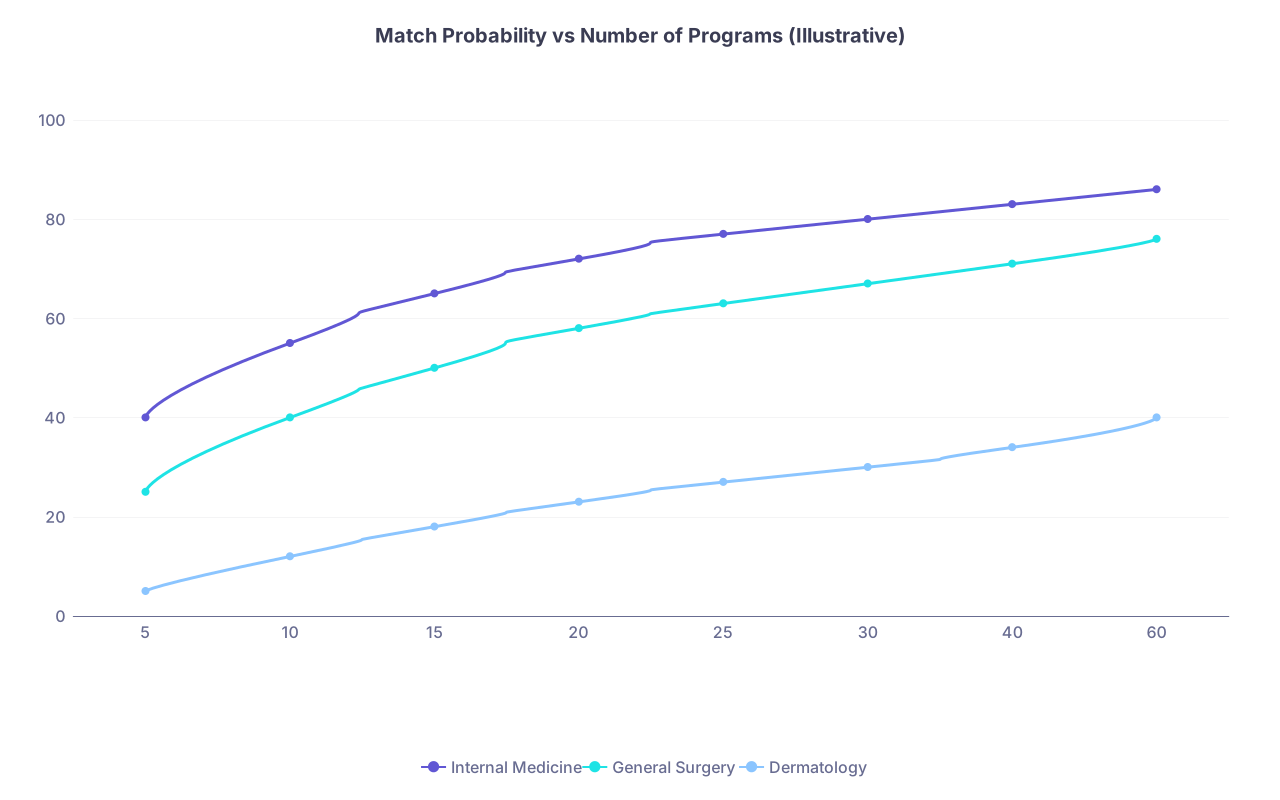
| Category | Internal Medicine | General Surgery | Dermatology |
|---|---|---|---|
| 5 | 40 | 25 | 5 |
| 10 | 55 | 40 | 12 |
| 15 | 65 | 50 | 18 |
| 20 | 72 | 58 | 23 |
| 25 | 77 | 63 | 27 |
| 30 | 80 | 67 | 30 |
| 40 | 83 | 71 | 34 |
| 60 | 86 | 76 | 40 |
Most applicants are applying to the wrong number of programs—and the NRMP data proves it.
Not “a little off.” In several specialties, applicants are either wasting thousands of dollars chasing marginal gains, or quietly killing their odds by under‑applying. The problem is simple: people talk about “apply broadly” or “be targeted”, but almost nobody quantifies what another 5, 10, or 20 applications actually buys you in match probability.
Let me fix that.
Below, I will walk through what the numbers show about program count vs match probability for several core specialties, then convert that into concrete application strategies by competitiveness band (Step scores, class rank, DO/IMG status, etc.). This is based primarily on NRMP Charting Outcomes, the NRMP Program Director Survey, and historical SOAP/match rate patterns. Where the data are sparse, I will say so and infer conservatively.
1. The Core Pattern: Diminishing Returns Is Real
First principle: the relationship between number of applications and probability of matching is not linear. The first 10–20 programs radically change your risk profile. The 60th program usually does not.
If you strip the noise away, you see a fairly consistent “S‑curve”:
- Steep gain from 0 → ~15 programs
- Moderately steep from ~15 → 30
- Flattening beyond ~40 for most core specialties
- Subspecialties (derm, plastics, ENT) shift the whole curve right—more programs for the same match odds
To make this concrete, let us anchor on a few representative specialties and an “average” US MD senior (roughly middle‑third board scores, no major red flags).
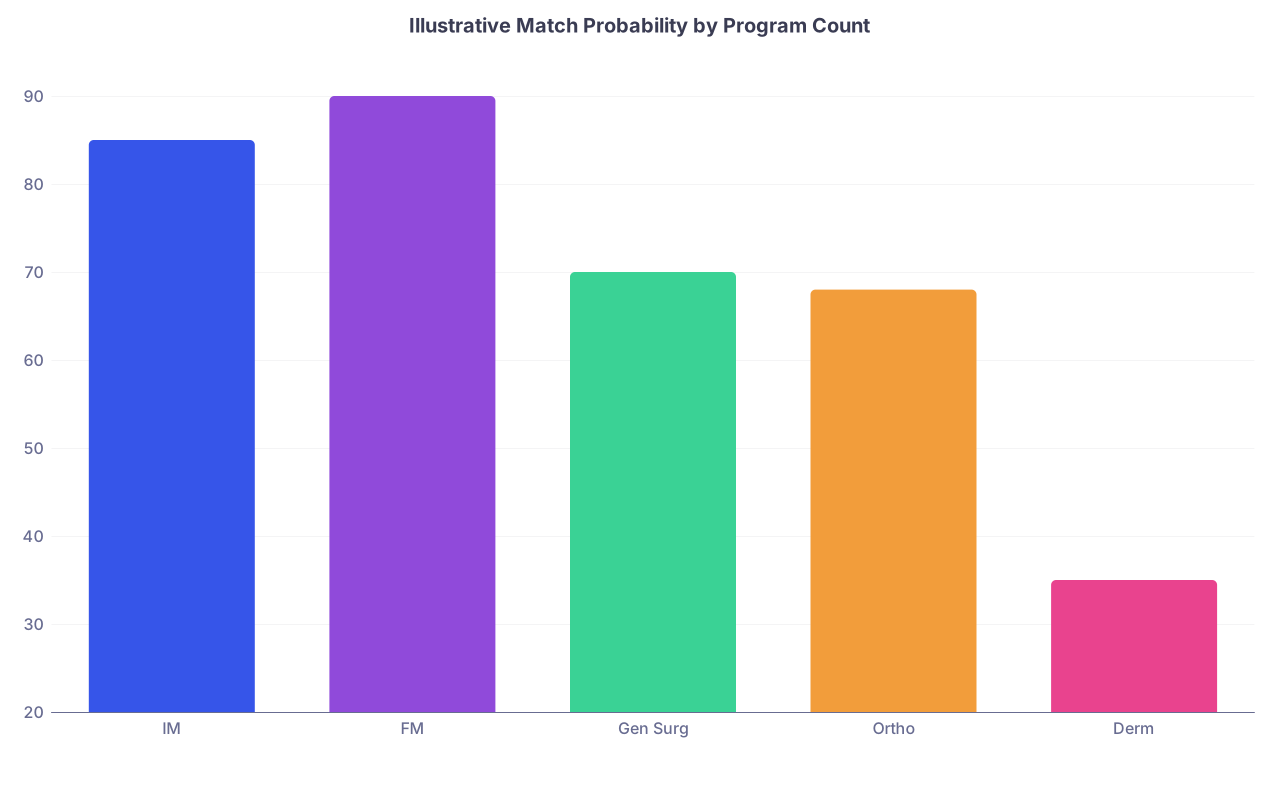
| Category | Value |
|---|---|
| IM | 85 |
| FM | 90 |
| Gen Surg | 70 |
| Ortho | 68 |
| Derm | 35 |
Interpretation (at roughly “typical” program counts):
- Internal Medicine (categorical): ~85%+ match if you apply sensibly
- Family Medicine: ~90%+ match
- General Surgery: ~65–75% depending on profile
- Orthopaedic Surgery: ~60–70%
- Dermatology: ~35–45% even with heavy application volume
The key is how these odds move as you add programs.
2. Internal Medicine, Family Medicine: Where Over‑Applying Is Rampant
For IM and FM, the data are brutal in how they expose over‑application.
Take US MD seniors (no significant red flags):
- National IM categorical match rate: typically ~94–96% for US MDs
- National FM match rate: similar or higher for US MDs
When you look at match vs number of contiguous ranks in NRMP tables, you see that most US MDs who submit a rank list with ≥12–15 categorical IM programs hit ≥90–95% match probability, even after controlling for Step scores.
Reasonable approximation (US MD, middle‑third scores, no red flags):
| Specialty | 10 ranks | 15 ranks | 20 ranks | 30 ranks |
|---|---|---|---|---|
| IM Cat | ~88% | ~93% | ~96% | ~98% |
| FM | ~90% | ~95% | ~97% | ~99% |
Note: contiguous ranks ≈ programs you interviewed at. To get 15 ranks, you probably apply to 25–35 programs, depending on your interview rate.
What this means in practice:
- A solid US MD going into IM who applies to 60 programs is chasing maybe a 2–3 percentage point bump over applying to 30–35.
- For FM, the diminishing returns kick in even earlier.
For DOs and IMGs, the curve shifts right, but the shape is similar:
- US DO in IM often needs ~30–40 ranks to hit the same ≥90% range
- IMGs may need 40–50+ ranks for comparable odds, depending on geography and visa needs
Even then, going from 50 → 80 programs rarely changes the outcome as much as improving Step 2, getting stronger letters, or targeting more IMG‑friendly programs would.
If you are asking “Should I apply to 70 IM programs?” and you are a US MD without red flags, the data says no. You are paying for noise.
3. General Surgery, OB/GYN, EM: The “Middle‑Competitiveness” Group
This is where program count starts to seriously change your risk. Not as brutal as derm or ortho, but absolutely not IM.
For US MD seniors:
- General Surgery match rate: typically around 75–80%
- OB/GYN: around 80–85%
- Emergency Medicine: historically ~93–95% for US MDs, but recent volatility and contraction in spots has made this less stable
The NRMP’s match probability by number of contiguous ranks for these specialties usually shows a sweet spot around 12–20 ranks, after which the curve flattens, but not as sharply as IM.
Approximate pattern for a mid‑tier US MD:
| Ranks | Gen Surg | OB/GYN |
|---|---|---|
| 5 | ~40% | ~55% |
| 10 | ~60% | ~75% |
| 15 | ~72% | ~85% |
| 20 | ~78% | ~90% |
So, for a reasonably competitive US MD:
- 5 ranked programs in general surgery is reckless
- 10 is livable if your application is strong and geographically flexible
- 15–20 ranks gets you into the 70–80%+ zone, which is where most people start to sleep at night
To translate this to applications:
Assume:
- 1 in 3–4 applications yields an interview in these fields for a mid‑tier applicant
- To get 15 ranks, you may need 45–60 applications
- To get 20 ranks, you might be at 60–70+ applications
This is where “60 applications” makes sense. Not because more is always better. Because you are buying a move from, say, 60–65% up toward 75–80%.
For DOs and IMGs, shift the whole picture right:
- US DO in general surgery: you might target ≥20 ranks to be comfortable → 60–80 applications is not crazy
- IMGs: matching in general surgery is sufficiently difficult that application volume matters, but strategy (IMG‑friendly programs, less desired locations) matters more
Emergency Medicine is now a separate beast. With recent reductions in positions, instability in interview offers, and some programs not filling, historic curves are less predictive. The data from the last couple of cycles suggest:
- Under‑applying (<30–35 programs) is dangerous even for strong candidates
- 40–50 applications often needed for a robust interview portfolio
- Beyond ~60, you begin to see diminishing returns unless you have geographic constraints or notable red flags
4. Ortho, Derm, ENT, Plastics: Where “More” Really Can Matter
This is the top of the competitiveness pyramid. Here, you are not choosing between 85% and 95% match probability. You are choosing between 20% and 50%.
For these specialties, NRMP tables repeatedly show:
- A very shallow rise in match probability at low rank numbers (0–5)
- Moderate growth from 5–15 ranks
- Continued, but slower, increases beyond 15–20 ranks
Let us ballpark a few, again for a “typical” US MD who is competitive enough to plausibly be in the applicant pool (honors, strong letters, good Step 2, etc.):
| Ranks | Derm | Ortho | ENT |
|---|---|---|---|
| 3 | ~10% | ~20% | ~18% |
| 5 | ~18% | ~30% | ~28% |
| 10 | ~30% | ~45% | ~42% |
| 15 | ~38% | ~55% | ~50% |
| 20 | ~43% | ~60% | ~55% |
These are approximate, but the pattern is consistent: every 5 programs in your rank list can move your probability by 5–10 percentage points, even at higher counts. The diminishing returns are slower here.
Translate to applications:
- Interview rates are much lower. Some applicants send 60–80 derm applications and get 4–8 interviews.
- To achieve 10–15 ranks, you may need 60–80+ applications in derm, ortho, ENT, plastics.
- For applicants without a home program, without a research year, or with borderline scores, 80–100 applications may not be overkill—it may be survival.
The trap: many marginal applicants assume they can “out‑volume” a weak profile in these specialties. The data argues otherwise. Below a certain competitiveness threshold, you can apply to 100 derm programs and still end up with 0–1 interviews. Volume does not fix a fundamentally non‑competitive application; it just increases cost.
I have seen multiple applicants apply to 80+ ortho or ENT programs with 1–2 interviews. Their regret isn’t “I should have applied to 20 more.” It is “I should have had a parallel plan.”
5. Parallel Planning: Dual Applications and Risk Management
The “how many programs” question is incomplete unless you address another variable: are you applying to a backup specialty?
This matters quantitatively.
Imagine you are a US MD applying dermatology + internal medicine prelim/categorical as a backup.
You might:
- Apply to 70 derm programs
- Apply to 25–30 IM programs
From a match probability perspective:
- Your derm probability might be 30–40% depending on interviews
- Your IM probability at 25–30 well‑selected programs is >90%
Net effect: your chance of not matching anywhere becomes roughly:
- P(no match) ≈ (1 – P(match derm)) × (1 – P(match IM))
- If derm = 35%, IM = 92%, then
P(no match) ≈ (1 – 0.35) × (1 – 0.92) = 0.65 × 0.08 ≈ 5.2%
You just moved from likely <40% match odds (if you applied to derm alone with a borderline profile) to ~95% odds of matching somewhere with a dual strategy. That is a very different risk profile for only ~25–30 extra applications.
This kind of math is commonly ignored, yet it is the core risk equation for:
- Ortho + general surgery or prelim surgery
- ENT + prelim surgery
- IR‑integrated + diagnostic radiology
- Competitive fields + IM/FM as backup
Risk‑averse applicants with strong geographic or specialty preferences often do worse because they do not quantify this. They “feel” like dual applications compromise their commitment story. Program directors know the game; they mostly care that your story is internally coherent for them.
6. US MD vs DO vs IMG: How Far Right Does the Curve Move?
If you are not a US MD senior, your risk curve shifts. How far depends heavily on specialty.
General patterns from NRMP data:
- DOs
- Very strong representation in FM, IM, EM, some surgical prelims
- Moderate but rising presence in OB/GYN, general surgery, psych, anesthesia
- Still significant barriers in certain hyper‑competitive fields and at some “prestige” programs
- IMGs
- Heavily represented in IM (especially community and some university‑affiliated programs), FM, pediatrics, neurology
- Markedly low match rates in derm, ortho, ENT, plastics, urology, some surgical subspecialties
So, what does that mean for program count?
For an average or slightly below‑average DO or IMG in core specialties like IM/FM:
- IM (DO/IMG)
- Safer target: 40–60 applications
- Likely requires 15–25 ranked programs to approach >80–90% match odds
- FM (DO/IMG)
- 30–40 applications is usually sufficient for a strong candidate
- 15–20 ranks often pushes you into very high match probability
For DOs/IMGs in mid‑competitive specialties (OB/GYN, gen surg, anesthesia, EM):
- 50–80 applications is not excessive, particularly without a home program
- Many successful DO/IMG candidates I have seen in these fields rank 20–30+ programs
- Your probability curve simply starts to flatten later
For DOs/IMGs in hyper‑competitive specialties (derm, ortho, ENT, plastics):
- The honest statement: number of applications helps, but structural barriers and program biases dominate
- You may need 70–100+ applications just to generate a viable number of interviews
- Even then, global match probability remains low unless you are truly exceptional (research, home program, connections, high Step 2 score)
If you are a DO or IMG targeting a high‑risk specialty, your primary lever is not application volume. It is profile upgrade (research year, US clinical experience, away rotations, networking) plus a serious parallel plan.
7. Cost, Time, and Interview Management: The Hidden Side of Over‑Applying
The data on match probability is only half the story. The other half is opportunity cost.
Each additional program:
- Adds ERAS fees (which escalate quickly at high application counts)
- Generates incremental admin work (program‑specific questions, tracking, communications)
- Can produce interviews you cannot actually attend, especially in overlapping dates or remote locations (for in‑person cycles)
You can model this roughly.
Assume:
- Applicant A applies to 40 programs, receives 12 interviews, ranks 12.
- Applicant B applies to 80 programs, receives 16 interviews, ranks 14 (because of schedule constraints).
What did Applicant B buy with 40 extra programs?
- 4 extra interviews
- 2 extra rankings actually used
- A move from (for example) ~80% to maybe ~88–90% match probability in a mid‑competitive specialty
Is that worth an extra $1,000–$2,000 in fees plus time? For some, yes. For others, especially in low‑risk fields like IM/FM for US MDs, it is a poor trade.
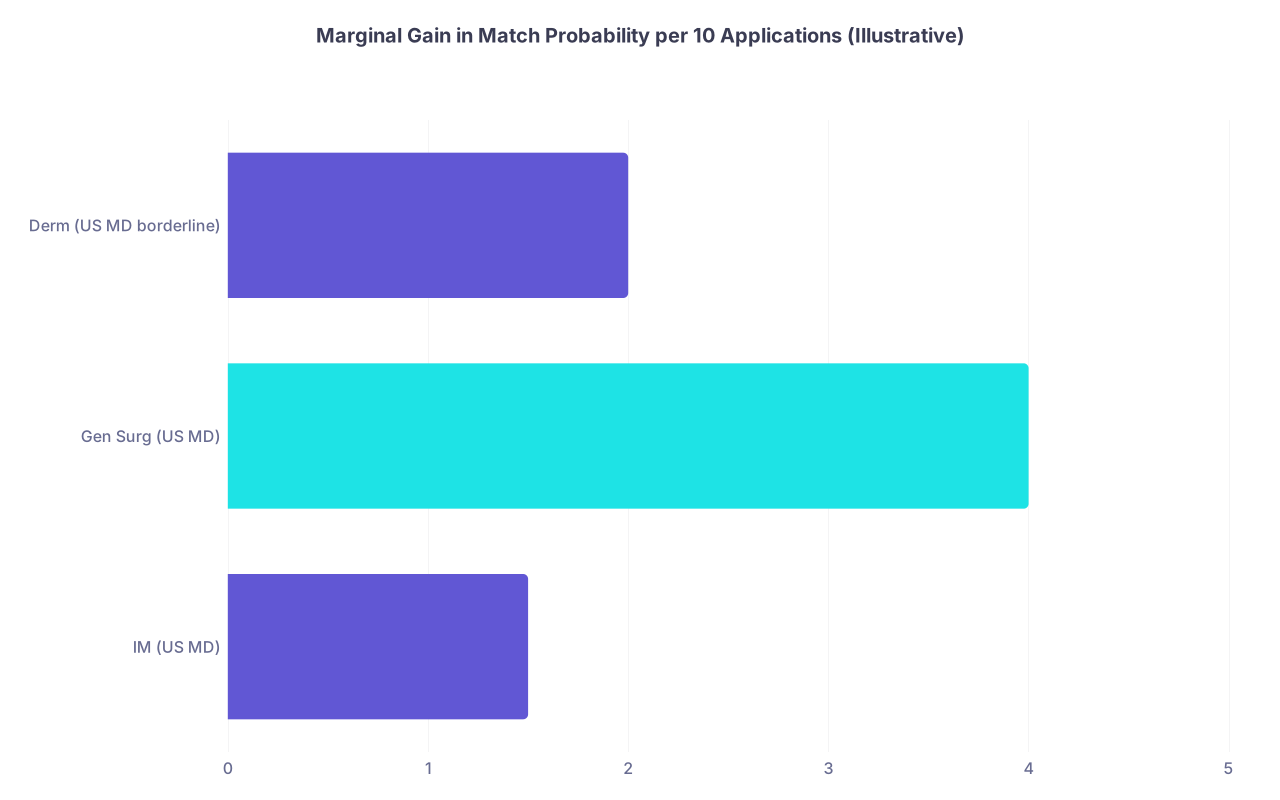
| Category | Value |
|---|---|
| IM (US MD) | 1.5 |
| Gen Surg (US MD) | 4 |
| Derm (US MD borderline) | 2 |
Interpretation:
- In IM, once you get beyond a reasonable baseline, you may be gaining <2 percentage points per 10 additional applications.
- In general surgery, those same 10 applications can be worth 3–5 points, especially going from under‑ to adequately‑represented rank lists.
- In borderline derm applicants, 10 more programs might only yield a couple of percent change—or nothing if your profile is fundamentally uncompetitive.
8. Practical Targets by Specialty and Profile
No generic “just apply to 60 programs” nonsense. Here is a more data‑aligned framework. Assume you are geographically flexible unless stated otherwise.
Internal Medicine (Categorical)
- Strong US MD (high Step 2, AOA, solid research):
- 20–25 programs
- Average US MD:
- 25–35 programs
- US DO / strong IMG:
- 40–60 programs
- Weaker IMG, visa‑needing:
- 60–80, but with highly targeted selection
Family Medicine
- Strong US MD/DO:
- 15–25 programs
- Average US MD/DO:
- 20–30 programs
- IMG:
- 30–40, more if geographically restricted
General Surgery (Categorical)
- Strong US MD (honors, strong letters, high Step 2):
- 35–50 programs
- Average US MD:
- 50–70 programs
- US DO / IMG:
- 60–90 programs, sharply targeted to DO/IMG‑friendly and less competitive regions
OB/GYN
- Strong US MD:
- 30–45 programs
- Average US MD:
- 45–60 programs
- DO / IMG:
- 60–80+ programs depending on signals and away rotations
Emergency Medicine
Market is shifting; be conservative.
- Strong US MD/DO with solid SLOEs:
- 35–45 programs
- Average US MD/DO:
- 45–60 programs
- IMG:
- Often 60+, but EM remains difficult for IMGs in many regions
Orthopaedic Surgery, ENT, Plastics, Dermatology
Assuming you are legitimately competitive enough to be in the pool.
- Strong US MD (research, high Step 2, strong home program support):
- 50–70 programs
- Borderline US MD, strong DO with heavy ortho/ENT research:
- 70–90 programs
- IMG:
- These fields are extremely low probability; 80–100+ applications may still yield very few interviews. A robust parallel plan is mandatory.
9. How to Decide Your Number in 30 Minutes
Skip the hand‑waving. Run through this checklist:
- Identify your specialty’s baseline competitiveness (use NRMP fill rates and Charting Outcomes).
- Place yourself honestly in the distribution: top, middle, or bottom tier for that specialty. Include Step 2, clerkship honors, research, home program, and any red flags.
- Decide if you are dual‑applying.
- Set a target number of interviews you want:
- Low‑risk specialties (IM/FM): 10–12 solid interviews is usually enough
- Mid‑competitive (gen surg, OB/GYN, EM, anesthesia): 12–15+
- Hyper‑competitive (derm, ortho, ENT, plastics): 10–15+, but even that may not guarantee anything
- Estimate your interview yield per 10 applications based on your profile and prior cycles’ anecdotal data from your school:
- Strong applicant: maybe 1 interview per 3–4 applications
- Average: 1 per 4–6
- Weak: 1 per 8–10 or worse
- Back‑calculate:
- If you want 12 interviews and you reasonably expect 1 per 5 apps → 60 applications.
- If you want 15 interviews at 1 per 4 apps → 60 again.
- Check against your specialty‑specific norms from the guidelines above. If you are wildly outside the reasonable range, reassess your assumptions.
This approach forces you to anchor program count to expected interviews and match probability, not anxiety.
Final Takeaways
- The data is clear: match probability vs program count follows a steep‑then‑flat curve for most specialties. Past a certain point, extra applications buy you very little.
- For mid‑ and high‑competitiveness specialties, the sweet spot shifts right, and 50–80 applications can be rational—but only if your profile is realistically competitive.
- Parallel planning and targeted strategy change your risk profile far more efficiently than blindly adding 20 more programs. Use the numbers, not your anxiety, to decide how far to push.