
The advice most high‑risk applicants get about “safety” residency numbers is dangerously wrong. If you have red flags, below-average scores, or a nontraditional profile and you apply to 20–30 programs “like your classmates,” you are gambling, not planning.
The data say something very different.
For high‑risk profiles, minimum safe program numbers are not 20 or 30. They are often 60, 80, or 100+ depending on specialty and risk category. And yes, I mean actually sending that many applications.
Let me walk through what the numbers show and where the cliffs really are.
1. What “High-Risk” Actually Means in Match Data
The NRMP does not publish a single “high‑risk” label. But if you read their reports the way an analyst does, the risk factors stack up quickly.
Here is what consistently correlates with lower Match rates:
- USMLE/COMLEX failures (any Step/Level)
- First‑attempt scores well below matched applicant medians
- Prior unmatched cycle
- Older graduation year (IMGs especially)
- Significant gaps or career changes
- Limited or no US clinical experience (for IMGs)
- Heavy specialty switch late in the cycle
- Visa requirement (for IMGs, especially J‑1/H‑1B)
You are “high‑risk” if you have any of the following:
- One major red flag (exam failure, prior unmatched, big time gap)
- Or two or more moderate risks (low score + visa, older grad + limited USCE, etc.)
- Or you are an IMG targeting a competitive specialty with average or below‑average stats
You are “very high‑risk” if:
- You have failed more than one exam
- You are re‑applying in the same competitive specialty without meaningful strengthening
- You are an older grad IMG with no recent, strong US clinical experience
The Match data are merciless with these groups. US seniors with clean records in core fields (IM, FM, Peds) have Match rates in the 90%+ range. Add one failure, or subtract 10–15 points from the mean score, and you can lose 20–40 percentage points off that baseline.
2. The Math Behind “How Many Programs”
Most people decide program numbers based on anecdotes, not probability. “My friend matched with 15 apps.” Yes. And there is always someone who wins money buying one lottery ticket.
The better question is: how many acceptable interviews do you need, and what application volume is required to get them with your risk profile?
NRMP Charting Outcomes in the Match and Program Director surveys give us three key anchors:
- Probability of matching vs. number of contiguous ranks
- Interviews required for different specialties / applicant types
- How PDs screen on scores, failures, and applicant type
Contiguous ranks and Match probability
Historically, for US MD seniors in non‑surgical fields:
- ~8–10 contiguous ranks → ~90–95% Match probability
- ~5–7 ranks → ~70–85%
- ≤3 ranks → you are in coin‑flip territory or worse
For IMGs and re‑applicants, those numbers are less forgiving. At the same number of ranks, match probability is lower. You often need more interviews just to hit the same probability.
Rule of thumb, backed by NRMP curves and what I see in real cycles:
- US MD/DO high‑risk in a core specialty: target 10–12 interviews
- US MD/DO high‑risk in a more competitive specialty: 12–15
- IMG high‑risk in IM/FM/Peds: 12–15 minimum, 15–18 safer
- IMG high‑risk in more competitive specialties: 18–20+ if you insist on trying
Now the leap: What application volume does it take to produce that many interviews, given your risk category?
3. Baseline: How Many Programs for “Standard-Risk” Applicants
We need a baseline before we adjust upward.
The NRMP and multiple advising offices show that for an “average risk” applicant:
- US MD, internal medicine: ~25–30 programs is often enough
- US MD, family medicine: ~20–25
- US MD, general surgery: ~35–40
- US DO, IM/FM: ~30–40
- Competitive fields (derm, ortho, plastics, ENT, urology): 60+ is normal even for strong applicants
For IMGs:
- Internal medicine: 80–100 programs is very common for even decent profiles
- Family medicine: 60–80
- Pediatrics: 60–80
- Transitional/prelim: 40–60
Now introduce high‑risk features. The application volume nearly always has to climb.
4. High-Risk Profiles: Evidence-Based Minimum Program Numbers
Here is where the numbers get blunt.
| Applicant Type & Risk Level | Core Fields (IM/FM/Peds) | Moderately Competitive (EM, Anes, Psych) | Surgical/Very Competitive |
|---|---|---|---|
| US MD/DO - Single Moderate Risk | 40–50 | 50–60 | 70–80 |
| US MD/DO - Major Red Flag (fail, prior no match) | 60–70 | 70–80 | 90–110 |
| IMG - Moderate Risk | 90–110 | 110–130 | 140+ |
| IMG - Major Red Flag / Older Grad | 120–150 | 140–170 | 180+ |
| Re-applicant focusing on backup specialty | 60–80 | 80–100 | 120+ |
These are not “nice round guesses.” They come from:
- Match probability versus rank curves
- Observed interview yields per 10 applications sent for different risk groups
- Program Director survey thresholds on Step/COMLEX scores and failures
Let me unpack this by category.
5. US MD/DO High-Risk Applicants
Scenario A: Single moderate risk
Examples:
- Step 1 below the matched median but no failures (e.g., old 210–215 in IM)
- Step 2 CK in low 220s for IM / FM or low 230s for Anesthesia/Psych
- Limited research for a modestly competitive field
- EM applicant with 1 average SLOE and 1 solid, no red flags
In core fields like IM/FM/Peds for US MD/DO:
- Typical safe number for standard risk: 25–30
- High‑risk adjustment: multiply by 1.5–2
So you end up at 40–50 programs. That usually produces something like:
- 40–50 apps → 8–12 interview offers (for a moderately risky US MD/DO in IM/FM)
- 8–12 interviews → 8–10 ranks → 85–95% Match probability
For moderate‑competitive specialties (Anesthesia, EM at many places, Psych at popular locations):
- Baseline for strong US apps: ~40–50 programs
- With a risk factor: 50–60+ is prudent
The logic is simple: once you dip below program screens on scores or you present an atypical profile, interview yield per application drops. Instead of 1 interview per ~3–4 apps, you may see 1 per ~5–7 or worse. You out‑apply the lower per‑application success rate.
Scenario B: Major red flag (exam failure, prior unmatched)
Here is where people under‑apply by a factor of two.
I have seen this exact pattern: US DO, one Step 1 fail, Step 2 230s, decent letters, applies to 35 IM programs. Gets 3 interviews. Ranks 3, matches nowhere. That is not “bad luck.” That is math.
For a US MD/DO with:
- Any USMLE or COMLEX failure, or
- Prior unmatched in the same specialty without major upgrade, or
- Significant professionalism concerns (visible in MSPE or prior dismissal/rehab and readmission)
You should think in terms of:
- 60–70 programs minimum in IM/FM/Peds
- 70–80+ in EM/Anesthesia/Psych
- 90–110 in surgical specialties if you are going to try them at all
Essentially, you are trying to brute‑force enough PDs who are still willing to take a chance on a flagged file. Many will have hard filters: “No prior failures,” “No repeat applicants,” etc. Each one like that silently sets your interview probability to zero for that program.
The only way around that, without changing your profile, is volume.
6. IMG High-Risk Applicants
IMGs live or die by numbers and geography. Program Director surveys are crystal clear: a very high fraction of programs use Step 1 and Step 2 numeric cutoffs, strongly prefer or require recent graduation, and filter by visa needs.
Even “low‑risk” IMGs usually apply to 80–100+ internal medicine programs.
So for high‑risk IMGs, the floor moves way up.
Core specialties (IM, FM, Peds)
Let’s break two typical profiles.
Profile 1 – Moderate risk IMG
- Step 2 CK around 225–235
- No exam failures
- Recent grad (≤3 years)
- Decent US clinical experience (2–3 months, good letters)
- Needs J‑1 visa
For this group, the “standard advice” of 80–100 internal medicine programs is borderline. The data and outcomes I see suggest:
- 90–110 IM programs increases the odds of hitting double‑digit interviews
- 60–80 FM programs if applying FM as well
- Include a mix of community and university‑affiliated programs, more mid‑tier than dream‑tier
Profile 2 – High-risk IMG
- Any exam failure
- Step 2 CK < 220
- Graduation > 5 years
- Limited or no recent US clinical experience
This is the group that mails 60 applications, gets 0–2 interviews, and convinces themselves “the Match is random.” It is not random. Your per‑application interview probability is very low—sometimes 1–3%.
A more mathematically sane approach:
- 120–150+ internal medicine programs
- 80–100 family medicine programs if you are open to FM
- Consider transitional year / prelim medicine as additional targets (40–60)
Even then, you are not “safe.” You are giving yourself enough shots that a few PDs who are open to risk might call you.
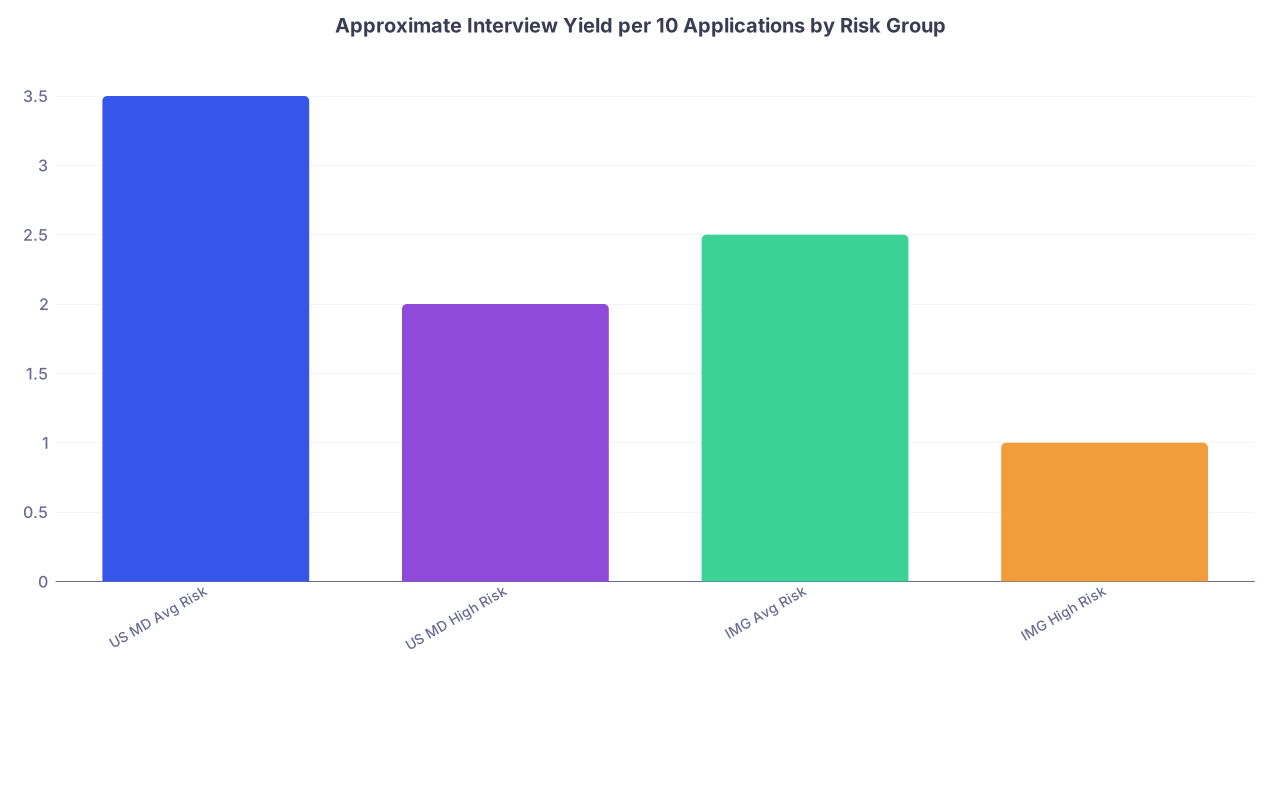
| Category | Value |
|---|---|
| US MD Avg Risk | 3.5 |
| US MD High Risk | 2 |
| IMG Avg Risk | 2.5 |
| IMG High Risk | 1 |
The chart is conceptual, but this pattern is real. If you only get ~1 interview per 10 applications as a high‑risk IMG, then:
- 60 applications → ~6 interviews (often not enough)
- 120 applications → ~12 interviews (borderline safe)
You are scaling volume to overcome low yield.
7. Re-Applicants and Specialty Switchers
Re‑applicants are statistically disadvantaged, even when they improve their applications. PD surveys show a clear preference for first‑time applicants. Many program filters explicitly mark “prior unmatched” or “prior withdrawal” as negatives.
If you are re‑applying in the same specialty with only modest improvements:
- Treat yourself as “high‑risk” by default
- Increase prior application numbers by 1.5–2x unless you were obviously excessive last time
Concrete examples:
- First cycle: US MD, psych, 35 programs, 4 interviews, no match
- Second cycle: same specialty, similar letters, slightly better Step 2: you should be looking at 60–70 programs, not 40
For re‑applicants pivoting to a backup specialty (e.g., surgery → prelim + categorical IM; derm → IM; EM → IM/FM):
- Core specialty (IM/FM/Peds): 60–80 programs
- Transitional/prelim: 40–60 programs
Remember, you are now competing against applicants who targeted this specialty from the beginning, often with more tailored experiences and letters.
8. Competitive Specialties: Do Not Underestimate the Numbers
If your profile is high‑risk and your target is still very competitive (ENT, ortho, plastic surgery, derm, neurosurgery, some EM markets), your realistic options are:
- Massive volume: 90–120+ categorical programs when possible
- Parallel planning with a backup specialty at serious volume
Program Directors in these fields:
- Filter brutally on scores and failures
- Often prefer students from known schools or with home program connections
- Have far more qualified applicants than spots
So the idea that a high‑risk applicant can “test the waters” with 30 applications in ortho or derm and then be surprised by zero interviews—this is fantasy.
If you insist on taking a shot:
- 90–110+ competitive specialty programs (if that many exist)
- 60–80+ in a realistic backup (IM, prelim surgery, TY) in the same cycle
You are effectively buying a very expensive lottery ticket in the competitive field while treating the backup as your actual Match plan.
9. Budget, Diminishing Returns, and Where to Stop
Yes, this all costs money. ERAS fees ramp up quickly past 30 programs. But you need to think in marginal returns, not absolute sticker shock.
For a high‑risk core specialty applicant:
- First 20–30 programs: highest yield per application (state programs, places where you have rotations, geographic ties)
- Next 20–40 programs: slightly lower yield, but still significant
- Beyond ~100 in a single specialty: diminishing returns start biting more; many of the remaining programs will be obvious long‑shots or poor fits
A practical framework:
Identify realistic programs first.
- Look at their past residents. Do they take IMGs? DOs? Applicants with older grad years?
- Check if they publicly state “no exam failures.”
Fill to your minimum safety number with mostly realistic programs.
- If you are IMG high‑risk IM: get to ~120 with mostly IMG‑friendly programs.
Then, and only then, layer in a limited number of aspirational programs (10–20%) if you want.
Track interviews in real time.
- By mid‑October, a high‑risk applicant in IM who has sent 100+ apps and holds 0–2 interviews has a serious problem. That is not a “wait and see” situation; that is a “future cycle and career path planning” situation.

| Step | Description |
|---|---|
| Step 1 | Assess Risk Profile |
| Step 2 | High Risk Category |
| Step 3 | Moderate Risk |
| Step 4 | Target 60-70+ US or 120-150+ IMG in core fields |
| Step 5 | Target 40-50 US or 90-110 IMG in core fields |
| Step 6 | Any exam failures or prior no match |
| Step 7 | IMG or older grad |
You adjust from there by specialty competitiveness.
10. Specialty-Specific Ranges for High-Risk Profiles
Let me be even more concrete. Assume high‑risk by the definitions above.
Internal Medicine (categorical)
- US MD/DO, high‑risk: 60–70 programs
- IMG, moderate‑high risk: 100–130 programs
- IMG, major red flags / older grad: 130–160+ programs
Family Medicine
- US MD/DO, high‑risk: 40–60 programs
- IMG, high‑risk: 80–110 programs
FM is more forgiving than IM in many regions, but not uniformly. Big coastal cities can be surprisingly competitive.
Pediatrics
- US MD/DO, high‑risk: 50–60 programs
- IMG, high‑risk: 90–120 programs
Psychiatry
Increasingly competitive.
- US MD/DO, high‑risk: 60–80 programs
- IMG, high‑risk: 110–140 programs
Emergency Medicine
The landscape is unstable with recent contraction and some geographic oversupply.
- US MD/DO, high‑risk: 70–90 programs
- IMG, high‑risk: 120–150 programs (if they even consider IMGs; many do not)
General Surgery (categorical)
- US MD/DO, high‑risk: 80–100 programs
- IMG, high‑risk: 140–180+ programs (plus serious prelim planning)
Preliminary / Transitional Year
- High‑risk US MD/DO: 40–60 prelim/TY programs
- High‑risk IMG: 70–100 prelim/TY programs
These are ranges, not iron laws. But they are grounded in observed match outcomes per risk level, not “I knew a guy who…”
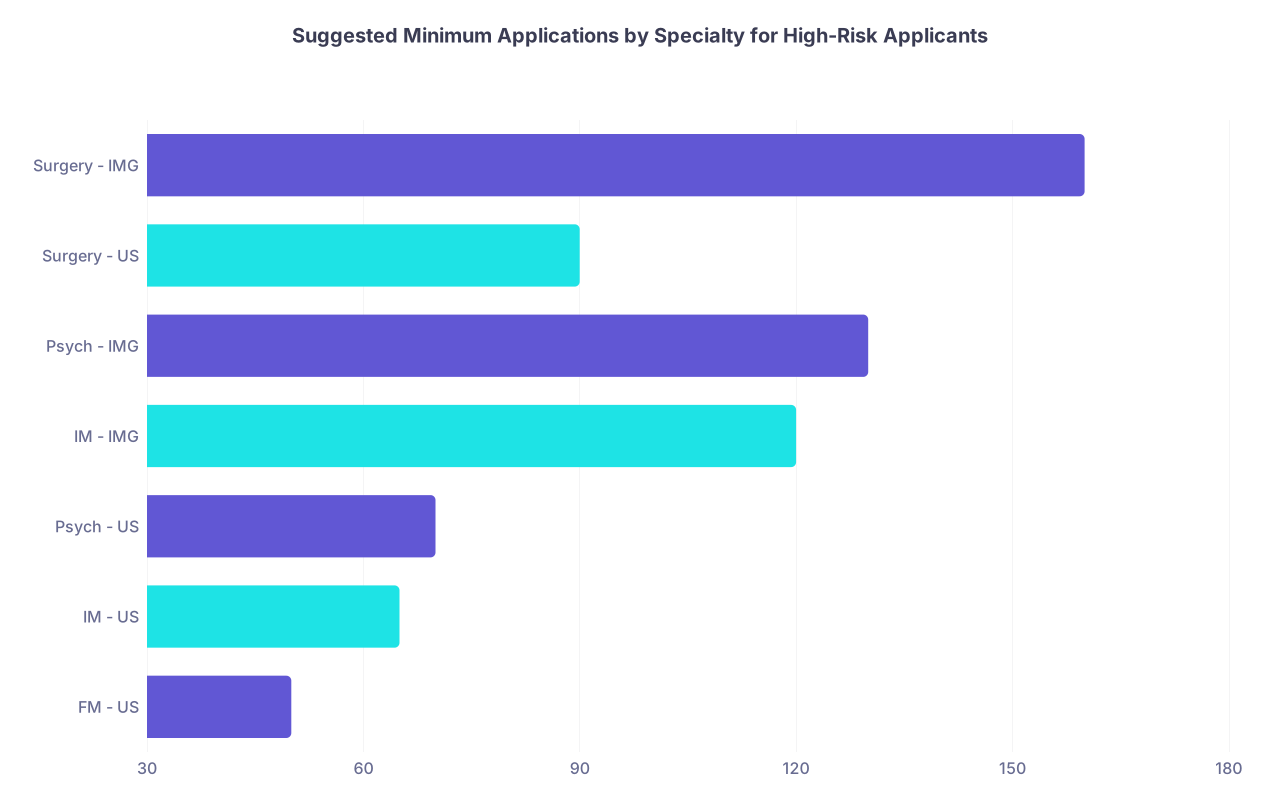
| Category | Value |
|---|---|
| FM - US | 50 |
| IM - US | 65 |
| Psych - US | 70 |
| IM - IMG | 120 |
| Psych - IMG | 130 |
| Surgery - US | 90 |
| Surgery - IMG | 160 |
11. How to Prioritize Within Huge Application Lists
Once you accept that 80, 100, or 150 programs might be rational for you, the problem becomes selection, not just volume.
A data‑driven prioritization stack:
Filter for feasibility.
- IMGs: remove programs that have not taken an IMG in 3+ years.
- With failures: remove programs that openly state “no USMLE failures.”
- Visa: remove programs stating “no visa sponsorship.”
Check resident rosters.
- Count how many residents share your profile type: DO, IMG, Caribbean, older grad.
- Programs with 0 are long‑shots; programs with many are more reasonable.
Stratify by competitiveness.
- University vs community, big‑name vs regional, highly desirable locations vs less popular.
- Early in the list, overweight more forgiving programs.
Map to your volume targets.
- For IM high‑risk IMG: aim for at least 80–100 “reasonable” programs and 20–40 “stretch” programs to reach 120–140 total.

The idea is simple: you do not just spray and pray. You spray strategically to places that have historically been open to applicants like you.
12. Three Things to Remember
“High‑risk” means your per‑application interview yield is low. The only levers you control this cycle are application volume and program selection. For most high‑risk profiles, “safe” means 60–70+ programs for US grads and 100–150+ for IMGs in core specialties.
You are not trying to impress everyone. You are looking for the subset of programs whose filters, history, and risk tolerance match your profile. That subset is small. You reach it by scale.
Under‑applying is the single most common, completely preventable error I see in high‑risk applicants. The data are clear: if you are going to spend a year of your life on this, you either apply at the volume your risk category demands or you accept that you are choosing a high probability of not matching.