
The mythology around “just one more interview” is wrong. Your residency match odds are not a mystery; they are quantifiable. And past a certain point, the data shows that hoarding interviews gives you diminishing returns.
You want to know one thing: How many interviews do you need to reach a given probability of matching, and how many programs should you apply to get there? Let’s walk through that like a statistician, not like a panicked MS4 on Reddit.
1. What the NRMP Data Actually Says About Interviews and Match Odds
The NRMP has already done about 80% of the work for you. The “Charting Outcomes in the Match” and “NRMP Program Director Survey” give hard numbers on match probability by number of contiguous ranks (which, in practice, tracks very closely with number of interviews attended).
You can argue with anecdotes. You cannot argue with this curve: as you add more programs to your rank list, your chance of matching climbs steeply at first, then flattens.
Here is an approximate summary of historical NRMP data for US MD seniors in several key specialties, where “interviews” ≈ “programs ranked” (because almost nobody ranks a program they did not interview at).
| Specialty | ~5 Interviews | ~8 Interviews | ~10 Interviews | ~12 Interviews |
|---|---|---|---|---|
| Internal Med | ~85% | ~95% | ~97–98% | ~99% |
| Family Med | ~90% | ~96–97% | ~98–99% | ~99% |
| Pediatrics | ~88% | ~95–96% | ~98% | ~99% |
| General Surgery | ~70–75% | ~85–88% | ~90–93% | ~94–96% |
| EM | ~75–80% | ~88–90% | ~92–94% | ~95–96% |
For competitive specialties (derm, ortho, ENT, plastics, neurosurgery), the same basic shape holds, but shifted rightward: you often do not cross 80–90% until the low-teens of interviews.
To make the pattern more visual:
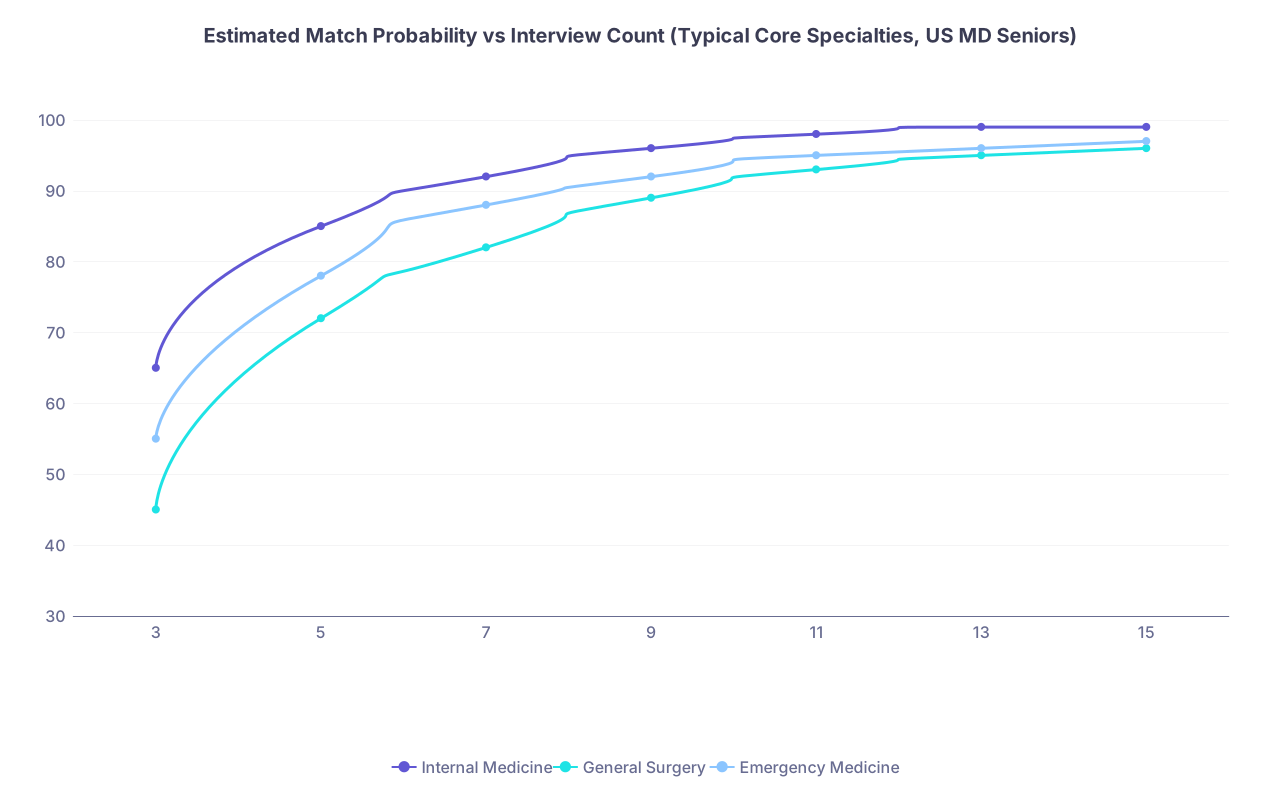
| Category | Internal Medicine | General Surgery | Emergency Medicine |
|---|---|---|---|
| 3 | 65 | 45 | 55 |
| 5 | 85 | 72 | 78 |
| 7 | 92 | 82 | 88 |
| 9 | 96 | 89 | 92 |
| 11 | 98 | 93 | 95 |
| 13 | 99 | 95 | 96 |
| 15 | 99 | 96 | 97 |
You can see the pattern:
- The steepest gain is between about 3 and 10 interviews.
- After ~12–15 interviews, you are buying very small increments of additional safety.
So if you are asking “Do I need 20 interviews?”, the raw answer for most core specialties is: no, not to match at all; yes, maybe, if your application is weak and you want to protect against downside risk.
2. Translating “Match Odds” into Interview Targets
You are not really asking “How many interviews?” You are asking:
“What number of interviews gives me roughly a 70%, 80%, 90%, 95% chance of matching?”
We can approximate this by specialty category. The exact numbers wiggle year to year, but the pattern is stable.
Core non-surgical specialties (Internal Med, Family Med, Peds, Psych, Neurology)
For US MD seniors with reasonably aligned applications:
- ~4–5 interviews → ~80–85% match chance
- ~7–8 interviews → ~90–95%
- ~10–12 interviews → 95–99% (this is where the curve flattens)
For US DO seniors, the same general shape, but shifted right by about 2–3 interviews for many academic-heavy fields. Community-heavy fields (FM, Psych) can be closer to MD curves if you apply broadly.
For IMGs, everything shifts further right, and the curve is flatter. You may need well into the low-teens of interviews to get above 80–90% in many specialties.
Core surgical / moderately competitive specialties (General Surgery, EM, OB/GYN, Anesthesiology)
Typical US MD pattern:
- ~5–6 interviews → ~70–80%
- ~8–10 interviews → ~85–92%
- ~11–14 interviews → ~92–97%
I have watched plenty of EM applicants relax dramatically after they locked in 10–12 interviews. For Gen Surg, people start breathing more normally around 11–13.
Highly competitive specialties (Derm, Ortho, ENT, Plastics, Neurosurgery, IR independent, etc.)
These fields are their own universe. The variance is huge, but you can summarize:
- Below 5–6 interviews: risk of not matching is substantial.
- Around 8–10 interviews: you are in a decent but not bulletproof position.
- 12+ interviews: historically, match odds often crack 85–90% for strong US MDs, depending on specialty.
This is where dual applying becomes common. People use a backup specialty to push their total contiguous ranks into the safer zone.
3. From Interviews Backwards to “How Many Programs Should I Apply To?”
You do not control interview count directly. You control how many programs you apply to and how well your application matches what they want.
We can think in probabilities. Let:
- N = number of programs you apply to
- p = probability any given program invites you to interview
- Then expected interviews E = N × p
You want E to be at or above your target number of interviews for your desired match probability.
Let us anchor this with some realistic p values. These are not official NRMP numbers, but reasonable ballpark estimates from real cycles:
- Strong, well-aligned US MD applying to a non-competitive field: p might be 0.25–0.35
- Mid-tier candidate in a decently competitive field: p ~ 0.10–0.20
- Borderline candidate or IMG in a competitive field: p may be 0.03–0.08
Now run the math. Suppose you are aiming for 10 interviews.
| Per-Program Interview Probability (p) | Expected Interviews Formula | Programs Needed (N) |
|---|---|---|
| 0.33 (1 in 3) | 10 = N × 0.33 | ~30 |
| 0.25 (1 in 4) | 10 = N × 0.25 | 40 |
| 0.20 (1 in 5) | 10 = N × 0.20 | 50 |
| 0.10 (1 in 10) | 10 = N × 0.10 | 100 |
| 0.05 (1 in 20) | 10 = N × 0.05 | 200 |
That is the cold math behind those Reddit posts where IMGs are applying to 150–200 programs. With p ~0.05, you need that volume to reach a double-digit interview count.
Let me make this concrete with a chart:
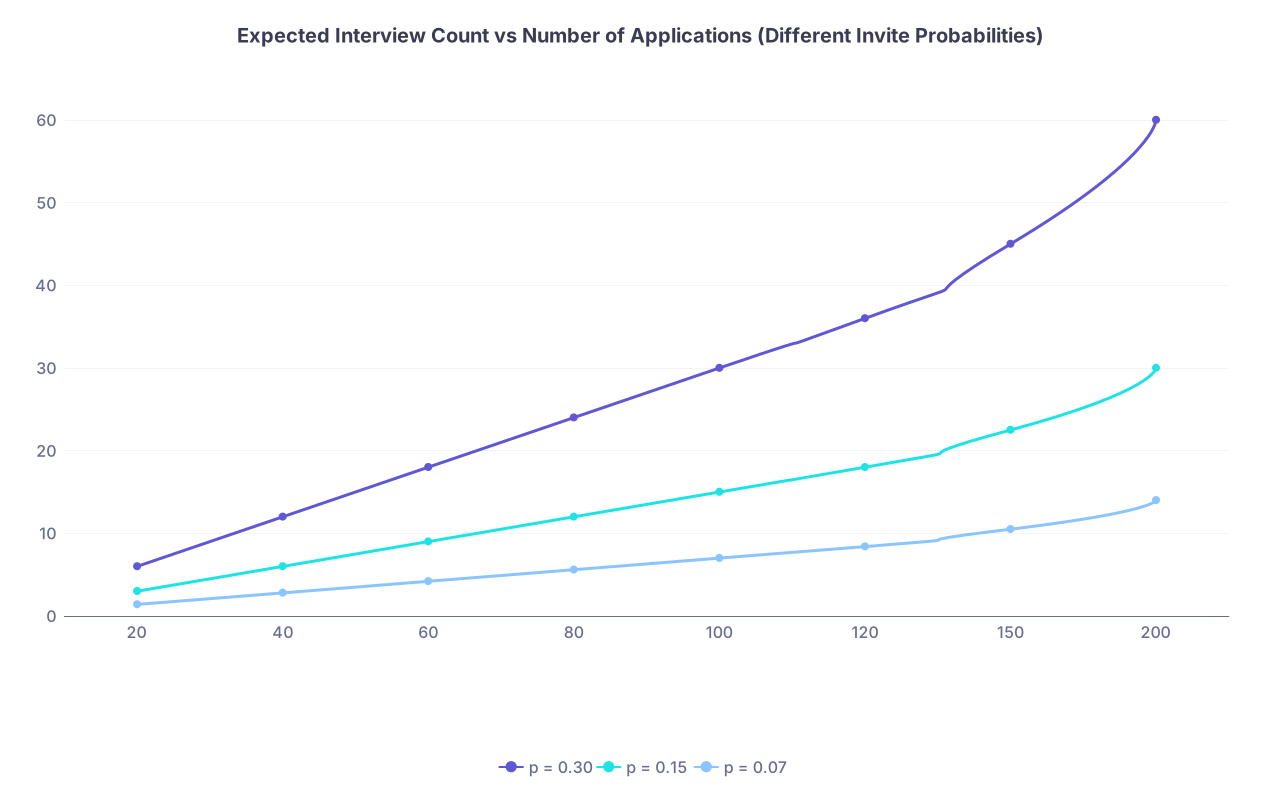
| Category | p = 0.30 | p = 0.15 | p = 0.07 |
|---|---|---|---|
| 20 | 6 | 3 | 1.4 |
| 40 | 12 | 6 | 2.8 |
| 60 | 18 | 9 | 4.2 |
| 80 | 24 | 12 | 5.6 |
| 100 | 30 | 15 | 7 |
| 120 | 36 | 18 | 8.4 |
| 150 | 45 | 22.5 | 10.5 |
| 200 | 60 | 30 | 14 |
That is the entire game, right there. The lower your realistic per-program probability, the more programs you must load into the system to hit your target interview count.
4. Estimating Your Per-Program Invite Probability (p)
You are not a national average. You have a personal p, determined roughly by:
- US MD vs DO vs IMG
- Step 2 / COMLEX scores and clinical grades
- Research output (mainly for academic or competitive specialties)
- Red flags (gaps, failures, professionalism issues)
- How well your experiences and geography align with the programs you are applying to
Nobody can compute your exact p, but you can make a reasoned bracket.
Let’s build a rough decision frame. This is not perfect, but it tracks what I have seen sitting with applicants and back-checking their later interview counts.
| Applicant Profile (Single Specialty Strategy) | Rough p Range |
|---|---|
| Strong US MD, non-competitive field, good letters, no red flags | 0.25–0.35 |
| Avg US MD, non-competitive, okay but not stellar metrics | 0.18–0.25 |
| US MD, moderately competitive field, solid but not standout | 0.12–0.20 |
| US DO, non-competitive field, solid metrics, broad geographic list | 0.12–0.22 |
| US DO, competitive field or narrow region focus | 0.06–0.12 |
| IMG, non-competitive field, strong scores, some USCE | 0.05–0.12 |
| IMG, competitive field or limited USCE | 0.02–0.06 |
Now, pick a realistic p bracket and back-calculate your application volume for your target number of interviews:
- Want ~10 interviews with p ≈ 0.20? Apply to about 50 programs.
- Want ~12 interviews with p ≈ 0.10? Apply to about 120 programs.
- Want ~15 interviews with p ≈ 0.07? Apply to about 215 programs.
You do not need a Monte Carlo simulation. Middle school algebra gets you 90% of the way.
5. Where Diminishing Returns Actually Kick In
People misuse the phrase “diminishing returns.” They say it when they are tired of writing personal statements. The data tells a more precise story.
Look again at the approximate curves for US MDs in core specialties:
- 1–3 interviews: volatile, high risk.
- 4–7 interviews: each additional interview gives a big jump in match odds.
- 8–12 interviews: still valuable, but each extra one adds a smaller marginal gain.
- Beyond ~12–15: returns are real but small.
To illustrate the diminishing marginal benefit, imagine a simplified Internal Medicine curve:
- 3 interviews → ~70%
- 5 interviews → ~85%
- 7 interviews → ~92%
- 9 interviews → ~95%
- 11 interviews → ~97%
- 13 interviews → ~98–99%
That jump from 3 to 5 interviews? +15 percentage points. From 11 to 13? Maybe +1–2 points.
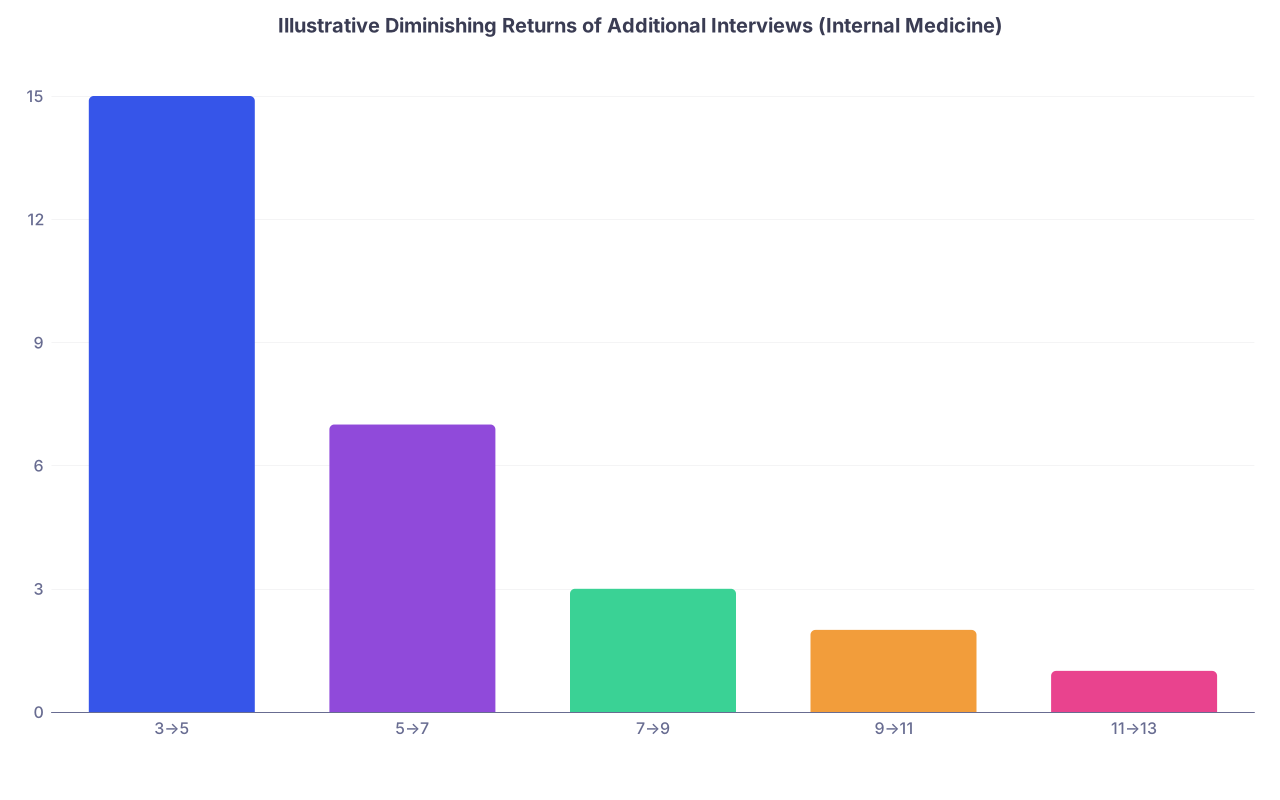
| Category | Value |
|---|---|
| 3→5 | 15 |
| 5→7 | 7 |
| 7→9 | 3 |
| 9→11 | 2 |
| 11→13 | 1 |
And yet, every year, I watch people with 14 interviews still panic-apply to 30 more programs in December. That is emotion, not math.
There are exceptions:
- If you have red flags, the shape of your individual curve may be different. Some programs will never rank you, but the ones that do may still give linear value.
- In hyper-competitive fields, you might not even get onto the steep part of the curve until 6–8 interviews.
But for a typical core specialty? Once you are above roughly 10–12 interviews, you are in “fine-tuning” territory, not “life or death” territory.
6. Dual Applying and Composite Match Odds
Now the ugly question: what happens if you dual apply?
The logic is straightforward: you are basically running two parallel match lotteries. If we oversimplify and assume the two match processes are independent (they are not, but this is close enough to reason with), then:
- Let P₁ = probability of matching in specialty 1
- Let P₂ = probability of matching in specialty 2
- Then probability of matching in at least one = 1 − (1 − P₁)(1 − P₂)
Concrete examples:
- You are aiming for a competitive field (P₁ ~ 40%) and have a safe backup (P₂ ~ 80%):
- Combined = 1 − (0.6 × 0.2) = 1 − 0.12 = 88% chance of matching somewhere.
- Slightly stronger primary (P₁ ~ 60%) and reasonable backup (P₂ ~ 75%):
- Combined = 1 − (0.4 × 0.25) = 1 − 0.10 = 90% overall.
This is why many derm / ortho / ENT applicants sleep at night only after they have a solid IM or prelim/TY or alternative field interview set.
But, crucial point: dual applying does not double your bandwidth. You still have to:
- Craft competitive materials for both specialties
- Go on a feasible number of interviews (there are only so many days in November–January)
- Manage the rank list such that you do not sabotage your primary field accidentally
From a data standpoint, dual applying is about raising your cumulative number of rankable programs across all lists to get into that 10–15 “total ranks” safety band, not about spraying chaos.
7. Practical Targets by Profile: How Many Interviews and Programs
Let me stop speaking abstractly and give you some concrete, data-grounded targets. These are not guarantees; they are rational goals.
Scenario A: US MD, Internal Medicine, decent app, no red flags
- Target match probability: 95–99%
- Needed interviews: 8–10+
- Realistic p: around 0.25 (1 in 4)
Then N ≈ 10 / 0.25 = 40 programs.
If you have any doubts about your competitiveness, stretch that to 50–60 programs, not 15.
Scenario B: US DO, Family Medicine, solid scores, broad geography
- Desired match probability: 95%+
- Needed interviews: 7–9+ (FM curves are generous)
- p maybe ~0.18–0.22 if you apply broadly
Let’s use p = 0.20.
N ≈ 9 / 0.20 = 45 programs.
If you are anxious: push to ~60 programs.
Scenario C: US MD, EM, mid-tier metrics
- Target: 90–95%
- Needed interviews: 10–12
- p perhaps ~0.15
N ≈ 12 / 0.15 = 80 programs.
That is why EM applicants often end up in the 60–100 application range now, not the 30–40 of a decade ago.
Scenario D: IMG, Internal Medicine, 240s+, some USCE
- Target: 80–90% (realistically)
- Needed interviews: 10–12
- p often around 0.05–0.10 depending on region and visa issues
Let’s be conservative with p = 0.06.
N ≈ 12 / 0.06 = 200 programs.
Harsh, but this matches real cycles: the IMGs with ~12–15 interviews usually applied in the 150–250 range.
Scenario E: US MD, General Surgery, average metrics
- Target: 90–95%
- Needed interviews: 11–13
- p maybe 0.12–0.18
Take mid p = 0.15.
N ≈ 12 / 0.15 = 80 programs.
If you are borderline (low Step 2, no research, or weak letters), assume p ~0.10 and apply to ~120 programs.
8. When to Stop Applying and Start Optimizing
Here is the honest threshold I use when advising applicants:
Before ERAS opens: use the p × N math to set an initial application volume.
After about 4–6 weeks of interview season, review your actual numbers:
- If you are on track to hit your target interview count (based on invites + historical timing for your specialty), you can stop adding programs.
- If you are lagging badly, consider adding programs more aggressively, or leaning harder on a backup specialty.
I have seen this pattern repeatedly:
- Applicant A: applied to 110 programs, got 8 interviews by mid-Nov, then panic-applied to 40 more in late November. Net benefit? Maybe 1 extra interview.
- Applicant B: applied smartly to 70 well-chosen programs, hit 10 interviews by mid-Nov, applied to zero additional programs, matched comfortably.
Past a certain point, improving the quality of each application (program-specific signals, well-aligned PS, targeted email updates, networking) will increase p more effectively than just adding 30 more random programs.
9. The Bottom Line: Matching Your Risk Tolerance to the Data
Let me distill the whole thing down.
Match odds track interview count, not just your Step score.
For most US MDs in core specialties:
- 5 interviews: you are “probably okay but vulnerable.”
- 8–10 interviews: you are in the 90%+ range.
- 12+ interviews: you are in very safe territory, barring major red flags.
The number of programs you should apply to is a direct function of your estimated per-program invite probability:
- Strong non-competitive candidate: 30–60 programs is often enough.
- Mid candidate in a competitive field: 60–100+.
- IMG or high-risk applicant: 150–250 may be the rational range.
Diminishing returns are real:
- Going from 3 to 7 interviews is often the difference between coin-flip and strong favorite.
- Going from 12 to 16 interviews usually buys you a few percentage points, not salvation.
Dual applying is a math problem, not a moral failing:
- You are trying to push your total number of rankable programs into the safer zone, often 10–15+.
- Use combined probabilities to see how much security your backup actually provides.
If you treat this like a numbers problem instead of a superstition problem, you will make saner decisions. That means fewer 2 a.m. ERAS edits, fewer panicked December applications, and a much clearer sense of when you have “enough” interviews to trust the process.
You have one more step after this: turning those interviews into high ranks, and high ranks into an actual match. That is a different dataset—one that lives in performance, prep, and program fit. With your interview targets set rationally, you are finally in a position to focus on that next phase.