
The advice most international grads get about “apply to 200 programs” is lazy and usually wrong. The data shows you probably need fewer—or more—depending on your specific risk profile, not your passport.
You asked the right question: how many programs should you apply to, as a US grad vs an international grad, backed by data instead of fear. Let’s quantify it.
1. What the Data Actually Says About Program Counts
NRMP and AAMC data are very clear on one point: probability of matching rises quickly with the first chunk of applications, then flattens, then plateaus. That curve looks different for:
- US MD
- US DO
- US-IMG (US citizen international medical graduates)
- Non-US IMG
And it looks different by competitiveness of specialty.
The two most useful data streams:
NRMP Charting Outcomes & Program Director Surveys
These show how many programs applicants rank and how that correlates with match probability.AAMC/AAMC-ERAS data
These show number of applications sent per applicant by specialty and applicant type.
Put bluntly:
- A strong US MD applicant in Internal Medicine might hit a 90–95% match probability around 20–25 applications.
- A similar US-IMG might need 60–80+.
- A non-US IMG with weaker scores may not hit 70% even at 120+.
So “how many” is not a single number. It is a function of:
- Applicant type (US vs IMG)
- Specialty competitiveness
- Applicant strength (scores, class rank, research, red flags)
But we can put realistic benchmarks on the table.
2. Baseline Benchmarks: US vs International, by Specialty Tier
Think in tiers, not in individual program names. The data and PD behavior are driven by competitiveness bands.
For simplicity, I will use three tiers:
- Tier 1 – Very competitive: Derm, Plastics, Ortho, ENT, Neurosurgery, Integrated PRS/Vascular, some Optho/Urology analogs
- Tier 2 – Moderately competitive: EM, Anesthesiology, General Surgery, OB/GYN, Radiology
- Tier 3 – Less competitive: Internal Medicine, Family Medicine, Pediatrics, Psychiatry, Pathology, Neurology (varies by year but you get the idea)
Here is a synthesized benchmark table based on NRMP data trends and observed behavior over the last several cycles.
| Applicant Type | Tier 1 (Very Competitive) | Tier 2 (Moderately Competitive) | Tier 3 (Less Competitive) |
|---|---|---|---|
| US MD Strong | 40–60 | 25–40 | 15–25 |
| US MD Average | 60–80 | 35–50 | 20–30 |
| US DO Strong | 60–90 | 40–60 | 25–35 |
| US DO Average | 80–120 | 50–70 | 30–45 |
| US-IMG Strong | 90–140 | 70–110 | 50–80 |
| US-IMG Average | 120–180 | 90–130 | 70–110 |
| Non-US IMG Strong | 120–200 | 90–140 | 80–120 |
| Non-US IMG Average | 160–220 | 110–160 | 90–140 |
Are these exact? No. But they align closely with the ranges where match probability starts plateauing in NRMP curves.
The pattern is the point:
- Going from 20 to 60 applications as an IMG in Internal Medicine meaningfully changes your odds.
- Going from 100 to 180 in the same scenario moves the needle much less, while burning money and time.
3. Diminishing Returns: The Match Probability Curve
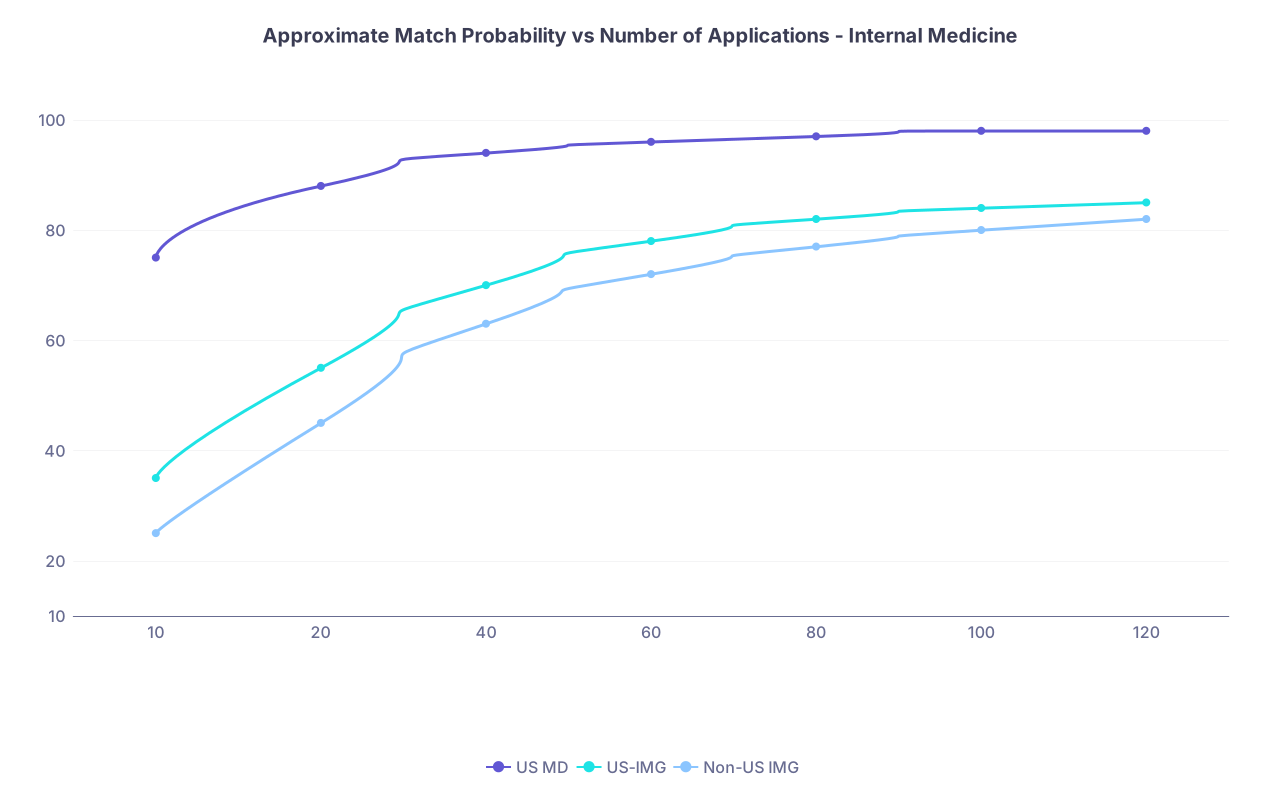
The match curve is not linear. The first 20–40 applications buy you more probability gain per program than the last 80.
For a visual: think steep rise, then a slow flattening. Here is a stylized example for Internal Medicine, using approximated behavior from NRMP trends.
| Category | US MD | US-IMG | Non-US IMG |
|---|---|---|---|
| 10 | 75 | 35 | 25 |
| 20 | 88 | 55 | 45 |
| 40 | 94 | 70 | 63 |
| 60 | 96 | 78 | 72 |
| 80 | 97 | 82 | 77 |
| 100 | 98 | 84 | 80 |
| 120 | 98 | 85 | 82 |
Interpretation, not math jargon:
- US MD: after ~30–40 well-chosen applications in IM, you are in diminishing returns territory unless you have red flags.
- US-IMG: real, meaningful gains continue until about 70–90 applications. After that, each extra 10 programs might move the needle only a few percentage points.
- Non-US IMG: similar shape, shifted down and right; plateau later, at a higher program count.
This is why “apply to every program in the country” is not a strategy. It is panic spending.
4. US Grads: Data-Backed Ranges and When to Scale Up
4.1 US MD Applicants
US MDs have systemic advantages: PD trust in curriculum, better advising, often better home support. That reflects in match probabilities.
Tier 3 (IM, FM, Peds, Psych)
Strong (no failures, solid LORs, decent geographic flexibility, Step 1 pass, Step 2 CK ≥ 240–245 range):
Data trend: match probability high even with moderate application numbers.
Benchmark: 15–25 programs.Average (Step 2 CK ~225–240, limited research, ordinary letters):
Benchmark: 20–30 programs.
If you have geographic constraints (only coasts, specific cities), push toward the upper end.
Apply to 50+ in this scenario, and your marginal benefit drops sharply. You are mostly paying to be auto-screened out at places that will not interview you over geography or fit.
Tier 2 (Anesthesia, EM, Gen Surg, OB/GYN, Rads)
- Strong: 25–40 programs.
- Average: 35–50 programs.
Most US MDs over-apply here. I have seen EM applicants send 80+ applications with a Step 2 CK of 250 and strong SLOEs. The data does not justify that. Once you cross roughly 35–40 well-chosen programs, your incremental probability gain per added program is tiny.
Tier 1 (Derm, Ortho, ENT, etc.)
Here, even US MDs cannot be casual.
- Strong (high scores, strong research, home/away rotations, powerful letters): 40–60 programs.
- Average or late to the game: 60–80 programs, and seriously consider a parallel plan (prelim year, backup specialty).
Do not fall for the myth that 100+ applications will “overwhelm” the competitiveness. PDs know exactly what they are looking for.
4.2 US DO Applicants
For DOs, the closing of the separate AOA match and the single accreditation system changed the math. You are competing head-to-head more often with MDs.
Patterns from recent cycles:
- DOs matching well in IM/FM/Peds/Psych with 25–40 applications if strong.
- In moderately competitive specialties (EM, Anesthesia, Gen Surg, OB/GYN), the plateau happens later—more like 40–60 if strong, 50–70+ if average.
So the earlier benchmark table holds. One key nuance: prestige-obsessed programs and some hyper-academic centers are effectively off the table, no matter how many times you click “apply.” Trim them out instead of inflating your program count.
5. International Grads: Why Your Benchmarks Are Higher
Here is where the fear kicks in, and where the data needs to cut through the noise.
For IMGs, three structural disadvantages show up in the numbers:
- Many programs filter IMGs out automatically (country of school, visa, accreditation).
- PDs often prioritize US clinical experience and US letters.
- Sponsoring visas is an administrative and financial hassle.
So IMGs do not just start lower on the match-probability curve. They also need more “shots on goal” because the true, IMG-friendly program pool is smaller than the number of programs you click in ERAS.
5.1 US-IMG vs Non-US IMG
US-IMGs (US citizens who graduated abroad) tend to outperform non-US IMGs slightly:
- Easier communication and networking.
- Often more US clinical experience.
- No need for visa sponsorship, which instantly increases the number of programs that might consider them.
But the application volume they need is still dramatically higher than US MD/DOs.
For a concrete, residency-level view, here is a stylized comparison for Internal Medicine:
| Applicant Type | ~50 Apps | ~80 Apps | ~120 Apps |
|---|---|---|---|
| US MD | ~96–98% | ~98–99% | ~99%+ |
| US-IMG | ~70–75% | ~80–85% | ~85–88% |
| Non-US IMG | ~60–65% | ~72–78% | ~80–83% |
If you are an IMG, you feel this in real life:
- You apply to 120+ IM programs.
- Half never open your file because of filters.
- You end up with 8–12 interviews if you are reasonably competitive.
That might still be enough to match—but only because you cast such a wide net.
5.2 Tier 3 (IM, FM, Peds, Psych) – IMG Benchmarks
For less competitive specialties where IMGs are common, real-world patterns line up roughly like this:
US-IMG Strong (Step 2 CK ≥ 240–245, no failures, USCE, good LORs)
Benchmark: 50–80 programs IM; 40–70 FM/Psych/Peds.
If you restrict geography (only big coastal cities), push to the upper end or beyond.US-IMG Average (Step 2 CK ~225–239, or minor red flag)
Benchmark: 70–110 programs IM; 60–100 FM/Psych/Peds.Non-US IMG Strong
Benchmark: 80–120 programs IM; 70–110 FM/Psych/Peds.Non-US IMG Average
Benchmark: 90–140+ programs IM; 80–130 FM/Psych/Peds.
In every IMG-heavy applicant pool I have reviewed, candidates who sent ~30–40 IM applications and then complained about “bad luck” were not unlucky. They were under-sampled. You cannot fight systemic filters with boutique-level application counts.
6. Competitive Specialties as an IMG: Brutal Arithmetic
Here is where optimism dies quickly if you look at actual data.
The fraction of spots in Derm, Ortho, ENT, Neurosurgery, Integrated PRS filled by IMGs is extremely low. Often in the low single digits percentage-wise. Many programs do not even consider IMGs.
That means two things:
Your effective program pool is tiny.
If 80% of programs are essentially impossible, and you do not know exactly which 20% are IMG-friendly, sending 120 applications does not create 120 reasonable opportunities.You probably need a parallel plan.
A prelim IM year, a backup specialty (FM, IM, Psych), or a two-cycle strategy with research in the US.
Realistically:
- Strong US-IMG applying to Anesthesia/EM/Gen Surg: 70–110 programs plus seriously consider backup IM/FM.
- Non-US IMG in the same: 90–140+ programs, and be ready for a low match probability even then.
For true Tier 1 like Derm/Ortho/ENT as an IMG, the number of applications is not your main limiting factor. It is structural access. If you insist on trying, treat it as a lottery ticket and put sincere effort into your backup.
7. Cost, Time, and the “Efficiency Frontier”
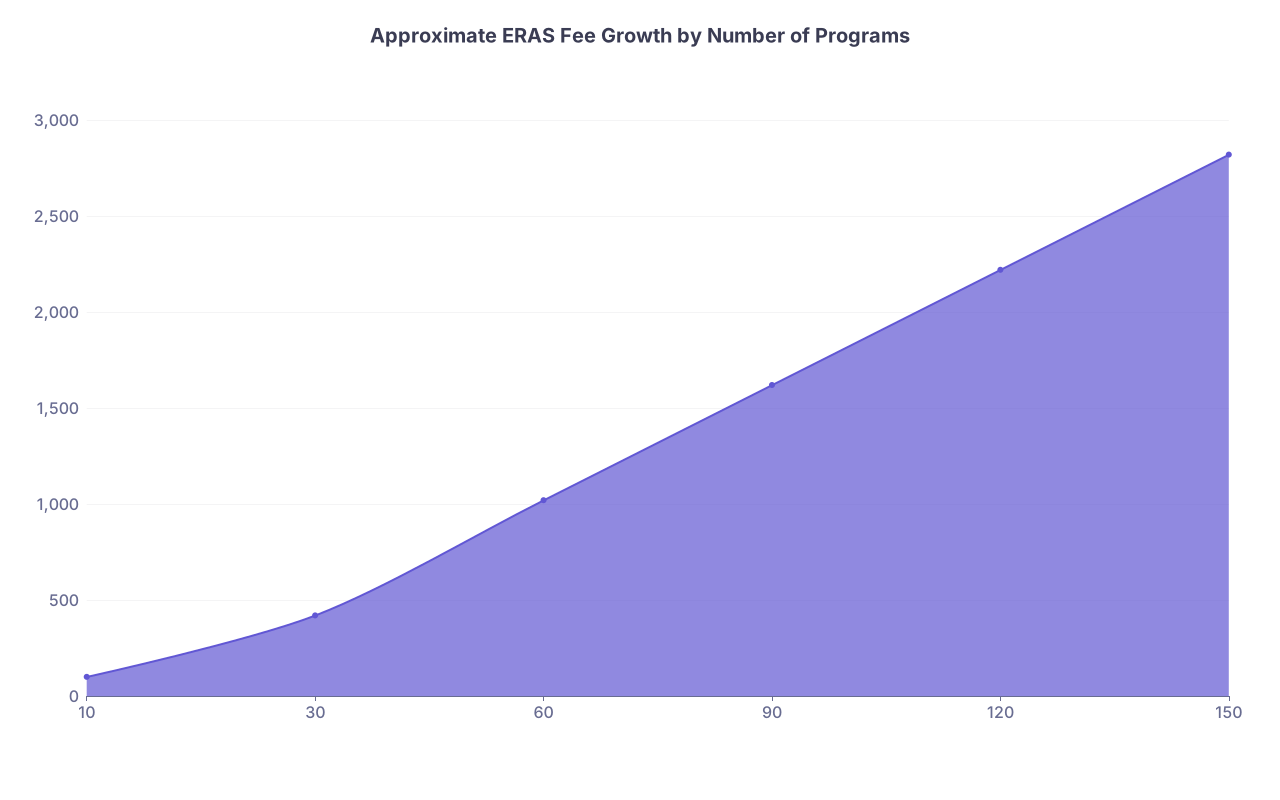
Application numbers are not free. ERAS fees escalate aggressively:
- The first 30 programs in a specialty are relatively cheap.
- Beyond that, the marginal cost per program jumps.
If you apply to, say, 120 programs in one specialty and 40 in another, you can easily cross several thousand dollars in fees before travel.
| Category | Value |
|---|---|
| 10 | 99 |
| 30 | 419 |
| 60 | 1019 |
| 90 | 1619 |
| 120 | 2219 |
| 150 | 2819 |
(Values are illustrative but directionally correct: fees climb fast.)
The efficiency question is: where is your probability-per-dollar peak?
- For a US MD applying IM, that peak is probably somewhere between 20–30 programs.
- For a US-IMG applying IM, it might be between 60–90.
- For a Non-US IMG, maybe 80–120.
Past that, every extra dollar is buying very little additional safety.
If you are an IMG with limited funds, the data-driven move is usually:
- Prioritize program research (IMG-friendliness, visa sponsorship history, step cutoffs).
- Apply heavily to those realistic options.
- Resist the urge to spray 40 extra applications at elite, historically non-IMG programs “just in case.” Those are low-probability, high-cost shots.
8. How to Adjust Your Personal Number Using a Risk Score
You can estimate your personal application target with a simple mental model. Not perfect, but better than vibes.
Start with a base for your group and specialty tier (from the benchmarks). Then adjust up or down by “risk points.”
Sample framework for Tier 3 (IM/FM/Peds/Psych):
- Base:
- US MD strong: 20 programs
- US MD average: 25
- US-IMG strong: 60
- US-IMG average: 80
- Non-US IMG strong: 80
- Non-US IMG average: 100
Then add:
- +10 programs for each failed Step or COMLEX attempt
- +10–15 programs if Step 2 CK < 230 (US) or < 240 (IMG)
- +10–20 programs if you have strict geographic limitation (family, spouse job, etc.)
- +10–15 if no home program / no strong US letters in that field (especially critical for competitive specialties)
- +10–20 if switching specialties late or with a major story shift
Cap your final number where the curves plateau hard (again, use the ranges in the earlier table). Do not just apply this blindly; this is a structured way to avoid extreme under- or over-shooting.
9. A Quick Reality Check: Common Bad Strategies
I’ve seen the same three mistakes every cycle.
The US MD who applies to 80+ IM programs “to be safe.”
The data: with a pass Step 1 and a 240+ Step 2 CK, you are likely >95% match probability with 20–25 well-selected IM programs. The extra 50+ applications are mostly to places that either will not interview you for fit reasons or you would not rank highly anyway.The US-IMG who applies to 35 IM programs, mostly big-name university programs, then blames bias.
Bias exists, but the math is obvious: they aimed half their limited shots at programs that rarely rank IMGs, and they undershot the total volume needed to break through filters.The non-US IMG who sprays 200+ applications without checking visa status or IMG history.
Half or more of those programs may auto-filter non-US IMGs or not sponsor visas. Their “200 applications” is functionally more like 80–100 real, reviewable files.
You do not need to be perfect. You just need to avoid being wildly inefficient.
10. Key Takeaways
US vs International status massively shifts the optimal application number.
A strong US MD in IM might be safe around 20–25 programs; a comparable non-US IMG may need 80–120 to reach a similar probability band.Diminishing returns are real and steep.
Match probability rises fast with the first few dozen realistic applications, then the curve flattens. Beyond that plateau, each additional 10–20 programs buys only a few percentage points at best.Program count is not a substitute for strategy.
Targeted applications to programs that historically interview and rank people like you, at a volume appropriate for your risk profile, will outperform blind “apply to everything” every cycle.