
The average applicant is guessing about program list size. The data says you do not have to.
Most people pick a number because an attending said “Just apply to 60,” or a co-resident warned, “Derm people apply to 100+ now.” That is not strategy. That is folklore. We have actual historical match data, and if you treat it the way an analyst would—by building simple predictive models—you can get within a very narrow, rational range of how many programs you should apply to.
This is not about chasing a magic number. It is about using probability, prior outcomes, and your own profile to set a list size that is aggressive enough to protect you, but not so bloated that you are lighting money and time on fire.
Let’s walk through the logic the way I would if I were advising you in front of an Excel sheet.
1. The Core Question: What Are You Optimizing?
You are not optimizing “how many applications can I afford.” You are optimizing:
- Probability of getting at least one interview
- Probability that your interview count translates to a match
- Cost (money + time + burnout) of marginal extra applications
The data shows something very consistent across specialties:
- Interview count is the actual driver of match probability.
- Number of programs applied to is only a proxy for interviews.
- Beyond a certain point, extra applications produce sharply diminishing returns in additional interviews.
So the real question is: How many programs do you need to apply to in order to reach a target interview count that gives you a high match probability, given your profile?
That is what a predictive model can approximate.
2. What the Historical NRMP Data Tells You
You do not have to guess. The NRMP publishes two key sources:
- “Charting Outcomes in the Match”
- “Results and Data: Main Residency Match”
From these, you can extract three things:
- Average number of applications and interviews by specialty.
- Match probability as a function of number of contiguous ranks on the rank list.
- How applicant characteristics (US MD vs DO vs IMG, Step scores, AOA, research, etc.) affect match odds.
Here is a simplified snapshot that summarizes typical “safe” interview counts for a high match probability within major buckets:
| Specialty Group | Example Specialties | Interviews for ~90–95% Match Probability* |
|---|---|---|
| Ultra-competitive | Derm, Plastics, ENT | 15–20+ |
| High-competitive | Ortho, Rad Onc, NeuroSx | 12–16 |
| Moderately competitive | EM, Anesth, Gen Surg | 10–12 |
| Less competitive | IM, Peds, FM, Psych | 8–10 |
*Assumes US MD/DO with reasonably aligned metrics and no major red flags. IMGs or lower-score applicants usually need more.
Then layer in this well-validated pattern: match probability rises steeply with the first ~8–12 ranks, then flattens. In most specialties:
- Going from 0 → 5 ranks: huge jump in match probability
- 5 → 10: still meaningful
- 10 → 15: marginal
- 15 → 25+: insurance, not efficiency
So you target a rank list length that gives you good odds (say 10–15 programs), then back-calculate the interview count you need, then back-calculate how many applications typically yield that interview count for someone like you.
This is where predictive modeling comes in.
3. A Simple Predictive Model: From Applications to Match Probability
You can build an extremely useful model with three functional relationships:
- Applications → Expected interviews
- Interviews → Expected ranks (almost a 1:1 for most applicants)
- Ranks → Match probability (from NRMP curves)
3.1 Applications → Interviews: Diminishing Returns
Empirically, interview yield per application is not constant. The first 20–30 applications often produce more interviews per program than the 50th–100th, because:
- There are limited interview slots per applicant (you cannot attend 40 interviews).
- Programs converge on similar applicant pools.
- Weaker applications spam more programs, driving down average yield.
Conceptually, a simple form is:
Interviews = a × (1 − e^(−b × Applications))
Where:
a= maximum number of interviews you are likely to get if you applied everywhereb= how “responsive” your applications are (higher for strong candidates)
You do not need to compute this explicitly to understand it: each extra 10 applications yields fewer and fewer extra interviews.
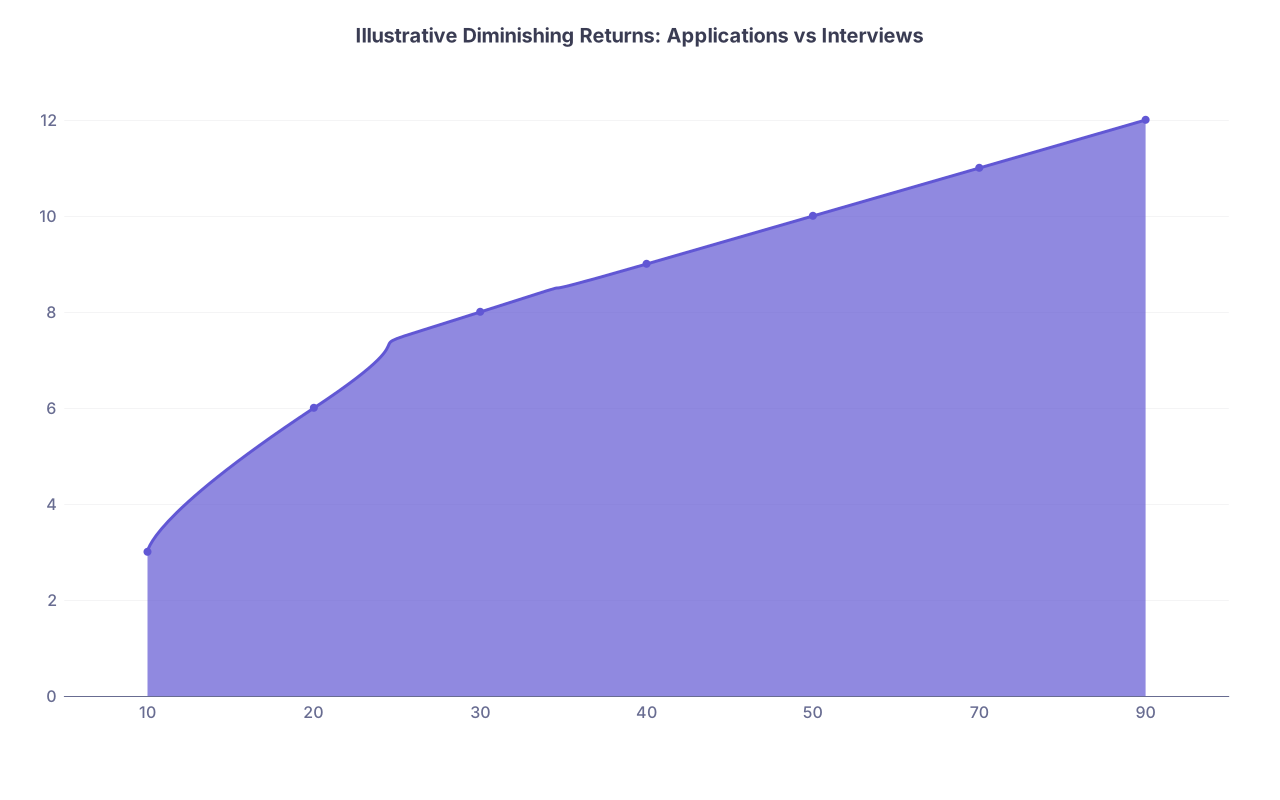
| Category | Value |
|---|---|
| 10 | 3 |
| 20 | 6 |
| 30 | 8 |
| 40 | 9 |
| 50 | 10 |
| 70 | 11 |
| 90 | 12 |
Interpretation: The first 20 programs got you roughly 6 interviews. Increasing to 90 programs only got you to 12 interviews. The last 70 applications added 6 interviews versus 6 from the first 20.
3.2 Interviews → Match Probability
NRMP data across multiple cycles shows a common pattern: once you have about 10–12 ranked programs, match probability is high for most fields (with exceptions for the ultra-competitive ones).
A rough generic approximation for many specialties:
- 3–4 ranks: 50–70%
- 6–8 ranks: 80–90%
- 10–12 ranks: 90–97%
- 15+ ranks: >95%, often “maxed out”
So if your model predicts that 40 applications yield ~8 interviews, and 60 applications yield ~10–11 interviews, the incremental 20 programs materially increase your odds from maybe 85–90% to 90–95%. That is a meaningful bump. But going from 80 to 120 applications to jump from 12 to 14 interviews might increase your match odds by 2–3 percentage points. You decide if that trade-off is worth the money and time.
4. Step-by-Step: Using Past Match Data For Your Situation
Let’s turn this into an actionable process. You can literally do this in a spreadsheet.
Step 1: Classify Yourself
You need to place yourself into a “response curve” bucket:
- Applicant type: US MD, US DO, US-IMG, Non-US IMG
- Specialty competitiveness
- Performance:
- Step 2 / COMLEX scores vs specialty averages
- Class rank / AOA / honors
- Research for research-heavy specialties
- Any red flags (fails, leaves of absence, professionalism issues)
These characteristics change both:
- Your interview yield per application (bigger for stronger applicants)
- Your baseline maximum interview number
a(how many programs find you attractive enough to invite if you applied widely)
A US MD with Step 2 = 250 applying to Internal Medicine is on a different curve than a non-US IMG with Step 2 = 220 applying to the same field.
Step 2: Pull Anchors from Data, Not Anecdotes
You want actual numbers to anchor your estimates. Use:
- Charting Outcomes:
- Look at your specialty.
- Look at match rates for applicants with Step scores in your range and your applicant type.
- Program director surveys and prior year applicant reports (forums, class group data) to estimate typical:
- Interviews per 10–20 applications for people like you
- Number of ranks for matched vs unmatched in that specialty
You do not need perfect precision. You need a realistic ballpark.
Example anchor for a mid-competitive US MD in Internal Medicine:
- Average matched applicant:
- ~30–40 applications, ~10–12 interviews, rank list ~10–12 programs.
- Average unmatched applicant:
- ~20–25 applications, ~4–6 interviews.
From that, your rough “interview yield” might be around 1 interview per 3–4 applications early on, then falling as you saturate.
Step 3: Translate Risk Tolerance into a Target Interview Count
Now decide: how risk-averse are you?
- Very risk-averse: aim for interview count clearly above the threshold where match odds flatten (e.g., 12–15 in a moderate-competitive specialty).
- Moderate risk tolerance: aim around the plateau start (e.g., 10–12).
- Aggressive but confident: you might be comfortable with 8–10 if you have strong geographic flexibility and backup specialties.
For each specialty, set a target interview count.
Example target table for a US MD with “average” metrics:
| Specialty Type | Example | Target Interviews (Risk-Moderate) |
|---|---|---|
| Ultra-competitive | Derm | 18–20+ |
| High-competitive | Ortho | 14–16 |
| Moderate | EM | 10–12 |
| Less competitive | IM | 8–10 |
Step 4: Build a Quick-and-Dirty Interview Yield Model
Take your anchors and back out a simple relationship:
Suppose you are applying to Anesthesiology, US DO, slightly above-average scores.
From peers and data, you infer:
- Around 40 applications → ~10 interviews for people at your level.
- Around 60 applications → ~12–13 interviews.
- Around 80 applications → ~13–14 interviews (you are hitting diminishing returns hard).
You can fit a mental curve:
- First 30 applications: ~1 interview per 3 apps → ~10 interviews (this is a bit optimistic, but that is fine for demonstration).
- Next 20 applications: 1 per 7–8 apps → +3 interviews.
- Next 30 applications: 1 per 15 apps → +2 interviews.
The exact function is less important than the pattern:
- Low-to-moderate count: good yield.
- High count: poor marginal yield.
Step 5: Solve Backward For “How Many Programs?”
Now match your target interview count to the model.
If your risk-moderate target is 10–12 interviews:
- You expect to reach 10 interviews around 40–45 applications.
- You might reach 12 around 55–60 applications.
- Going to 80 applications may only add 1–2 interviews.
So your rational application range is probably 45–60 programs, not 25, and not 120. You might choose:
- 50 if you accept a bit more risk
- 60 if you want a buffer
The model gives you a range; your risk tolerance and budget pick the point.
5. Specialty-Specific Patterns: Not All Curves Are Equal
Let me be blunt: if you try to use a single “apply to X programs” rule across specialties, you are doing it wrong. The curves differ a lot.
5.1 Less Competitive Fields (FM, IM, Peds, Psych)
For US MDs without major red flags, the data consistently shows:
- Match rates >90% even with ~7–10 contiguous ranks.
- Interview yields are relatively high per application.
So you can often hit safe interview targets with moderate list sizes.
Example rough mapping for a US MD in FM:
- 15–20 applications → 8–10 interviews
- 25–30 applications → 10–12+ interviews
In this zone, applying to 60 programs is often unnecessary unless you have big geographic constraints or clear weaknesses.
5.2 Moderately Competitive (EM, Anesth, Gen Surg)
Here the model matters more. Variance is higher, and small differences in your metrics and letters have a big effect on interview yield.
For an average US MD EM applicant:
- 30–40 applications → 8–10 interviews
- 45–55 applications → 10–12 interviews
- 60–70 applications → maybe 12–13 interviews
If EM is your only specialty and you have no backup, pushing into that 50–60 range is usually rational. But applying to 90+ often buys you marginal benefit at high cost.
5.3 Highly / Ultra-Competitive (Derm, Ortho, Plastics, ENT, NSG, Rad Onc)
Different game. The conversion from application → interview is brutal, especially for IMGs and DOs in some of these fields.
Illustrative pattern for a mid-tier US MD derm applicant:
- 40–50 applications → 4–6 interviews
- 70–80 applications → 7–9 interviews
- 90–100+ applications → 9–11 interviews
If your target for safety is 15–20 interviews, and you are not a top-of-the-pile candidate, the math might force you into large list sizes. That is where you either:
- Accept a massive application number; and/or
- Add a backup specialty with its own model and list size.
6. Costs, Trade-offs, and When Extra Applications Stop Making Sense
The data is clear that after a point, additional programs add very little in terms of match probability. But the costs rise linearly:
- ERAS fees
- Time for program-specific questions and signals
- Cognitive overload in tracking programs
You should think in terms of marginal benefit per 10 additional programs:
- If an extra 10 programs are likely to yield +2 interviews, and you are at 6 interviews total → probably worth it.
- If an extra 10 programs are likely to yield +0.5 interviews (one more interview per 20–30 programs), and you are already at 12 interviews → probably not worth it unless your risk aversion is extreme.
A reasonable heuristic:
- Below your target interview count by ≥3: keep adding applications in meaningful chunks (10–15) if you can.
- Within 1–2 interviews of target, and curves show diminishing returns: shifting energy to improving your application (better personal statement, better prep for interviews) often yields more benefit than spamming more programs.
7. How to Actually Implement This in Practice
Here is a stripped-down workflow you can use, ideally with last year’s data and your advising office’s aggregate outcomes.

| Step | Description |
|---|---|
| Step 1 | Choose Specialty |
| Step 2 | Classify Applicant Strength |
| Step 3 | Set Target Interview Count |
| Step 4 | Estimate Interview Yield from Past Data |
| Step 5 | Calculate Application Range |
| Step 6 | Increase List Size or Add Backup |
| Step 7 | Finalize Program List |
| Step 8 | Risk vs Cost Check |
If your school tracks outcomes, you can do this quantitatively:
- Build a simple regression of interviews vs applications, controlling for Step score, applicant type, and specialty.
- Predict expected interviews for different application counts for “you”.
- Overlay NRMP match probability curves vs ranks.
You will see a band of application counts where your predicted match probability climbs from, say, 85% to 95%. That is your decision band.
If you do not have that infrastructure, approximate:
Talk to 3–5 graduates in your specialty from the last 1–2 years. Get their actual numbers:
- Applications sent
- Interviews offered
- Ranks
- Outcome
Place yourself on the spectrum: weaker / similar / stronger.
Scale their numbers accordingly.
It is not perfect, but it is miles better than “my attending told me to apply to 80.”
8. A Concrete Example: Putting Numbers to a Single Applicant
Let’s build a fictional but realistic scenario and run it through the model.
Applicant:
- US DO, Step 2 = 243, no fails, solid letters.
- Specialty: Anesthesiology (moderately competitive).
- Geography: Flexible.
Past local data shows for similar DO applicants:
- 40 applications → mean 8 interviews (range 6–10)
- 60 applications → mean 11 interviews (range 9–13)
- 80 applications → mean 12 interviews (range 10–14)
An NRMP-based approximation for Anesth shows:
- 8 ranks → ~85–88% match rate
- 10–12 ranks → ~92–95%
- 14+ ranks → ~95–97%
This applicant is moderately risk-averse and wants ≥92–93% odds, so target = 10–12 interviews.
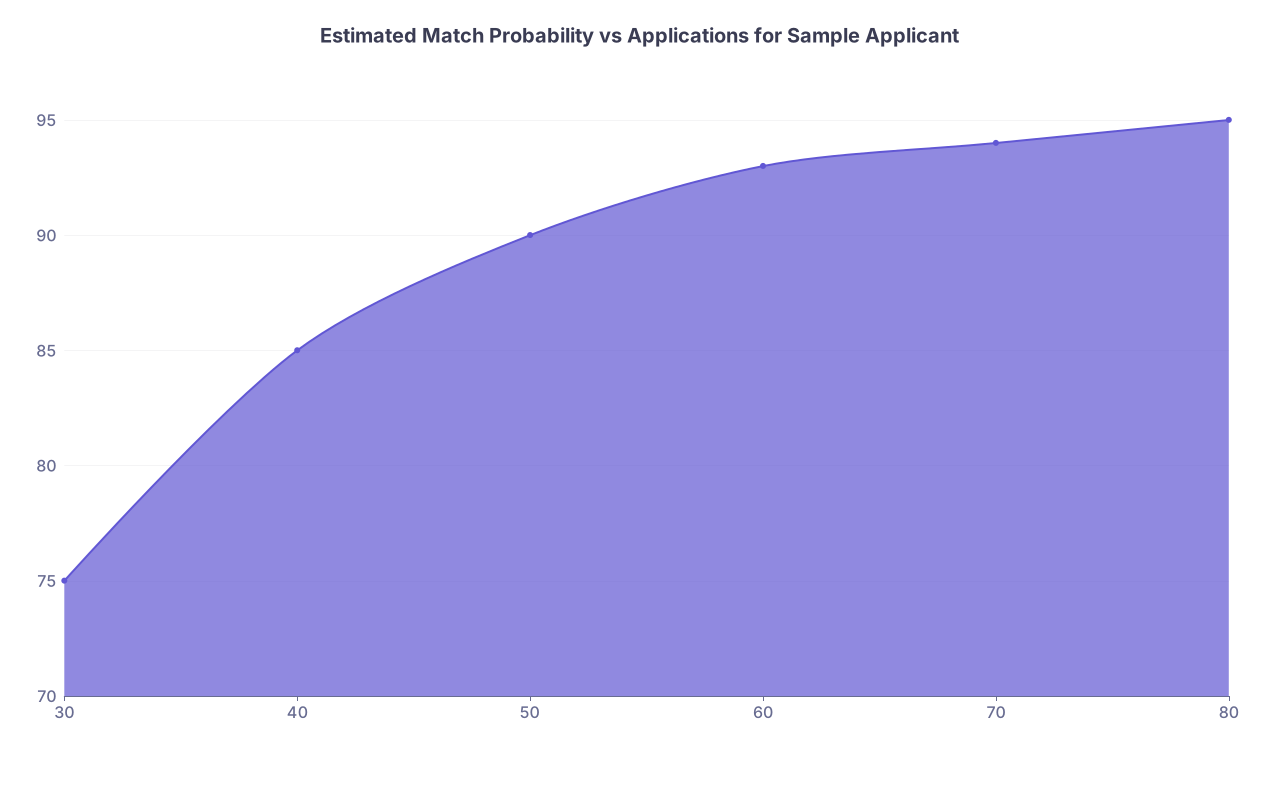
We can visualize the relationship:
| Category | Value |
|---|---|
| 30 | 75 |
| 40 | 85 |
| 50 | 90 |
| 60 | 93 |
| 70 | 94 |
| 80 | 95 |
Interpretation:
- Jumping from 40 → 60 applications moves estimated match probability from ~85% to ~93%. That is a substantial gain.
- Jumping from 60 → 80 moves ~93% → ~95%. That is a 2-point gain for 20 extra applications.
Rational range:
- Minimum: ~50 applications (expects around 9–10 interviews)
- Preferred: ~60 applications (expects 10–12 interviews)
- Only if very anxious or with hidden weaknesses: 70–80
So the most data-aligned decision is 55–65 programs. Not 30. Not 100.
9. Reality Check: Limitations and How to Not Abuse the Model
Predictive models are tools, not oracles.
Where they work well:
- You are in the “mainstream” of applicant types your school routinely graduates.
- Your specialty has stable competitiveness and well-described NRMP patterns.
- You are honest about your relative standing.
Where they are noisy:
- Very small fields (neuro IR, some combined programs) where N is tiny.
- New shifts in competitiveness (e.g., sudden surge in certain specialties).
- Unusual applicants (major red flags, career changes, very nontraditional pathways).
So you use the model as:
- A way to narrow the range (e.g., “for you, 35–50 is logical in IM, not 15 and not 80”).
- A way to understand trade-offs (what does +10 applications actually buy you in expected interviews and match probability?).
You do not:
- Use it to argue that “applying to 55 instead of 60 gives me exactly 1.3% less chance.” That level of false precision is the fastest way to misuse statistics.
10. Final Takeaways
Three points, and then you can go build your spreadsheet:
- Interview count, not raw applications, is what actually correlates with matching. Use past match data to estimate how applications convert to interviews for someone like you in your specialty.
- NRMP curves show clear plateaus. Once you reach roughly 10–12 ranked programs in most fields (more for ultra-competitive specialties), your incremental gains in match probability are small. Your program list size should be built to hit that target interview range, not to chase arbitrary high application numbers.
- Past data from your own institution plus NRMP publications give you enough information to build a simple, rational model. Use it to narrow your application range and understand what each extra 10 programs is buying you—in probability, not in anxiety.