
The common advice to “just apply to more programs” is statistically lazy—and in several specialties, it backfires.
You are not dealing with magic. You are dealing with yield curves. As application volume goes up, your interview yield per application drops. How quickly it drops—and where it flattens—depends heavily on your specialty and your competitiveness profile.
Let me walk through what the data, published and unpublished, actually supports.
Defining the Problem: What Is Interview Yield?
Interview yield is simple:
Interview Yield = (Number of Interview Invites) / (Number of Applications Submitted)
If you applied to 60 programs and received 12 interviews, your yield is 12 / 60 = 0.20, or 20%.
The key is that this yield is not constant as you increase the number of applications. The data from NRMP, AAMC, and institutional advising offices all point in the same direction: returns diminish as you keep adding programs.
Conceptually, your application set looks like this:
- First batch: “Best-fit” programs where your Step scores, research, and geography align. High yield per application.
- Second batch: Reasonable but less ideal programs (slight reach or slight safety). Moderate yield.
- Third batch: Long shots or poorly aligned programs (wrong region, culture, or competitiveness misfit). Very low yield.
So the total number of interviews is a curve, not a straight line. It rises quickly at first, then flattens. For some applicants and specialties, it stops rising almost entirely after a certain point.
The Core Data: How Many Interviews Do You Actually Need?
First, anchor on the outcome variable: how many interviews it typically takes to match.
NRMP’s “Charting Outcomes in the Match” and “Results and Data” reports show a clear pattern:
- For most non-competitive specialties, U.S. MD seniors who match usually report around 8–12 ranked programs.
- For the more competitive surgical and ROAD specialties (Radiology, Ophthalmology, Anesthesiology, Dermatology), successful U.S. MD applicants typically list 12–18 programs on their rank lists.
- DO and IMG applicants usually need more interviews to achieve similar match probabilities, because their interview-to-rank ratios and program preferences differ.
The conversion from “interviews” to “ranked programs” is high—most interviews end up as ranked programs unless the fit is obviously wrong. So your effective target becomes:
- Less competitive specialties (FM, IM categorical, Peds, Psych, Neuro): ~8–10 interviews is usually enough for a very high match probability if you are a U.S. MD senior.
- Moderately competitive (EM, OB/GYN, Anesthesia, Gen Surg, DR): ~11–14 interviews tends to get you into a strong probability zone.
- Hyper-competitive (Derm, PRS, Ortho, ENT, IR/DR, sometimes EM for DO/IMG): 15+ interviews materially increases your safety margin.
Once you hit this “enough interviews” zone, every extra interview is protective but marginal. Going from 2 to 6 interviews is career-saving. Going from 18 to 22 is comfort padding.
Yield vs Volume: The General Shape of the Curve
Think in three regions as you increase the number of applications:
Undershooting region
- Too few programs. Your yield might be high (because you only chose obvious fits), but total interview count is still low and match probability is fragile.
Efficient region
- Adding more programs still materially increases your total interviews. Yield per extra application is decent. This is where you want to live.
Saturation region
- You are now applying to programs that are poor fit, extreme reaches, or geographically random. Yield per additional application collapses. Total interviews barely changes despite large jumps in application count.
The location and steepness of these regions are specialty-specific.
Let’s visualize a stylized example using a generic “mid-competitive” specialty for a reasonably competitive U.S. MD applicant:
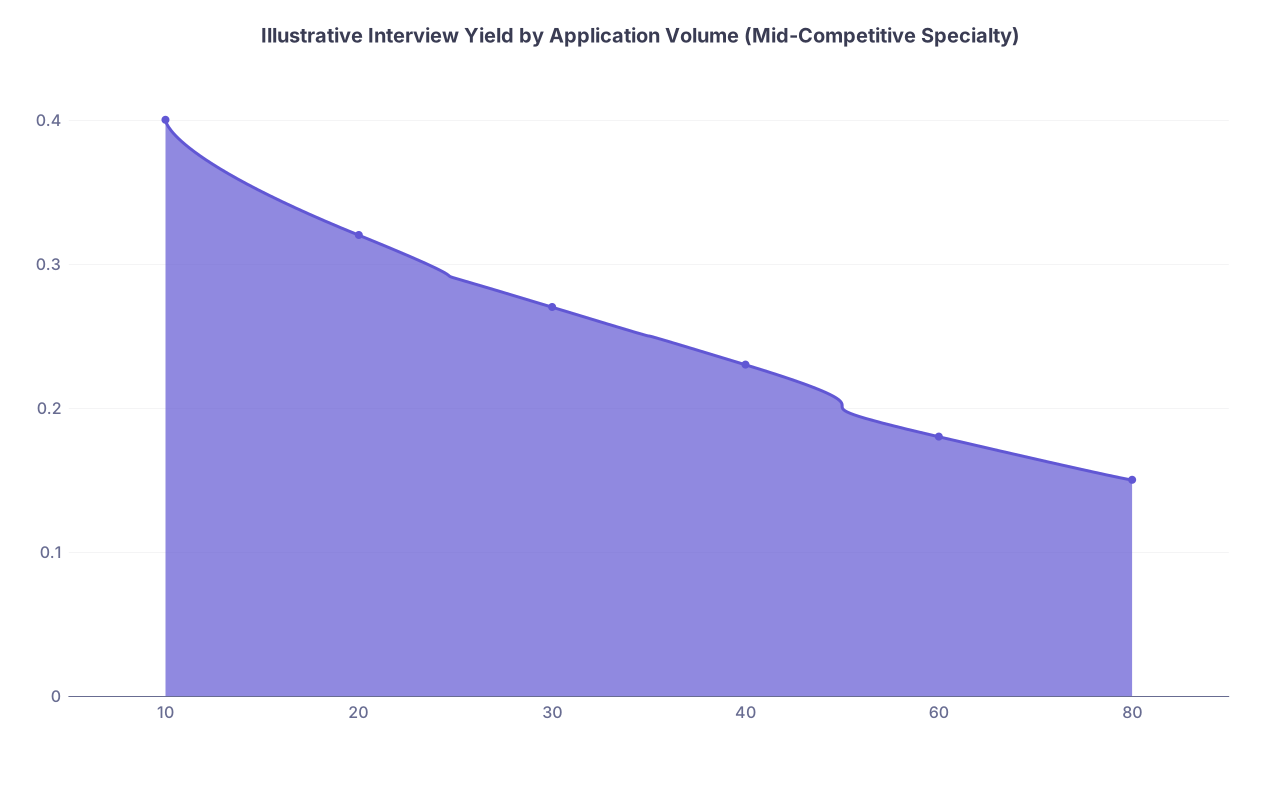
| Category | Value |
|---|---|
| 10 | 0.4 |
| 20 | 0.32 |
| 30 | 0.27 |
| 40 | 0.23 |
| 60 | 0.18 |
| 80 | 0.15 |
Interpretation (numbers are illustrative, but the pattern mirrors real advising data):
- First 10 programs: 40% yield → 4 interviews
- First 20: average 32% → ~6–7 total interviews
- First 40: average 23% → ~9 total interviews
- First 80: average 15% → ~12 total interviews
So quadrupling applications from 20 to 80 only doubles interviews from ~6 to ~12. That is the law of diminishing returns in action.
How Specialty Competitiveness Changes the Curve
The slope and saturation point of that curve change dramatically by specialty. I will group specialties into four broad buckets.
1. Very Competitive / Small-N Niche (Derm, PRS, Ortho, ENT, IR/DR)
Data pattern:
- High variation by applicant pedigree (school, research, AOA, letters).
- Very steep early yield drop; early saturation.
What I have seen in departmental spreadsheets and advising offices:
Strong Derm applicant (Step 2 CK 250+, high-tier school, 2+ first-author papers, strong home program):
- 40 applications → 14–18 interviews (35–45% yield)
- 60 applications → 16–20 interviews (27–33% yield overall; incremental yield from last 20 apps maybe 10–15%)
- 80 applications → 17–21 interviews (21–26% yield overall; last 20 apps yield <5–10%)
Mid Derm applicant (Step 2 ~240, moderate research, no home Derm):
- 40 applications → 6–9 interviews (15–23% yield)
- 60 applications → 7–10 interviews (12–17% yield overall)
- 80 applications → 8–11 interviews (10–14% yield overall)
Beyond ~60 applications, the extra 20 programs might add 1–2 interviews at best. Many mid applicants respond by applying to 90+ programs. The marginal data show that rarely makes or breaks the outcome; most interviews came from the first ~40–60 targeted choices.
The same pattern shows up in Ortho, PRS, ENT, IR/DR. The market is thin. Programs know exactly what they want; volume does not buy you access to closed doors.
2. Competitive but Larger (EM, Anesthesia, Gen Surg, DR, OB/GYN)
These are high-volume specialties with broader ranges of program competitiveness.
General pattern:
- Yield decays, but more slowly.
- Efficient region extends further, often through 40–60 applications for borderline applicants.
Example framing for a mid-range Anesthesia applicant (U.S. MD, Step 2 ~240, solid but not stellar):
- 20 applications → 4–6 interviews (20–30% yield)
- 40 applications → 8–10 interviews (20–25% yield)
- 60 applications → 10–12 interviews (17–20% yield)
- 80 applications → 11–13 interviews (14–16% yield)
Here, going from 20 to 60 is a strong move—interviews roughly double. But the 60 to 80 jump probably buys you only 1–2 additional interviews. That is saturation.
Emergency Medicine (pre-SLOE bottleneck era and with the current market softness aside) showed similar curves in historical data: beyond 40–50 applications, many reasonably competitive U.S. seniors simply did not gain many additional interviews; they just paid more.
3. Broad-Access Core (IM categorical, Peds, FM, Psych, Neuro)
This is where the “apply to 80 programs” advice becomes almost completely irrational for a typical U.S. MD senior with passing scores and a clean record.
- Many applicants in these fields match with < 12 interviews and < 30 applications.
- Yield for well-selected early applications can be 30–50%, flattening only as you start adding poorly aligned or out-of-reach institutions.
Illustrative internal medicine example, U.S. MD with Step 2 ~235, average portfolio:
- 15 applications → 5–7 interviews (33–47% yield)
- 25 applications → 8–10 interviews (32–40% yield)
- 40 applications → 10–12 interviews (25–30% yield)
- 60 applications → 11–13 interviews (18–22% yield)
So for this profile, the efficient zone is probably 20–40 well-chosen programs. Once you hit ~10 interviews, the marginal risk reduction from pushing toward 60+ applications is marginal, especially in specialties with high match probability even at modest interview counts.
For FM and Psych, the curves can be even steeper early on. We see U.S. MDs sometimes getting double-digit interview counts from 25–30 targeted applications.
4. DO and IMG Applicants: Same Curve, Shifted Right
If you are DO or IMG, your curve is not a different shape. It is shifted:
- Lower yield at every application volume.
- Saturation still exists, just further out.
For example, an IMG in Internal Medicine might see something like:
- 40 applications → 3–5 interviews (7–12% yield)
- 60 applications → 4–7 interviews (7–12% yield)
- 80 applications → 6–9 interviews (8–11% yield)
- 120 applications → 7–11 interviews (6–9% yield)
Massive volume can be rational here because base yield is low and saturation occurs at higher numbers. But the pattern of diminishing returns still holds. Jumping from 80 to 160 applications often does not double interviews; it might add only 2–3.
Comparing Specialty Profiles: Typical Efficient Ranges
Here is a summarized view of rough efficient application volume ranges for U.S. MD seniors with “average-competitive” profiles (not stars, not red-flagged), based on what advising offices and NRMP outcomes imply.
| Specialty Category | Typical Efficient Range | Diminishing Returns Common After |
|---|---|---|
| IM, Peds, FM, Psych, Neuro | 20–40 programs | ~40–50 applications |
| EM, Anesthesia, Gen Surg, DR, OB/GYN | 30–60 programs | ~60–70 applications |
| Derm, Ortho, ENT, PRS, IR/DR | 40–60 programs | ~60–70 applications |
Do people apply outside these ranges? Constantly. Does it help? Often less than they think.
The yield curves above assume competent targeting—geographical realism, alignment between your stats and the program’s historical profile, and avoiding obvious misfits.
A Quick Process View: How Yield Degrades as You Expand Your List
To make the mechanics less abstract, here is how I see applicants actually build lists and where yield decays.

| Step | Description |
|---|---|
| Step 1 | Start - Core List |
| Step 2 | Add Similar Tier Programs |
| Step 3 | Add Lower Tier / Safety |
| Step 4 | Add Higher Reach |
| Step 5 | Add Random Geography |
| Step 6 | Application Saturation |
- Core list: programs where your stats are on-target, geography is realistic, and your school has a track record. Yield is highest here.
- Similar tier: modestly broader geography or slightly different program styles. Yield still decent.
- Safety: slightly lower average scores, less selective locations. Yield often good; these can be interview generators if chosen wisely.
- High reach: big-name or very competitive locations where your profile is under par. Yield very low.
- Random geography: no ties, misaligned training style, or location that you would never seriously rank high. Yield often near zero, and even when interviews arise, they seldom translate into high-ranked positions.
Most “just in case” applications live in that last two buckets. That is where your yield collapses.
Quantitative Example: How Yield Changes with Volume by Specialty
Let us put a realistic, side-by-side comparison together for three hypothetical, average-competitive U.S. MD applicants:
- Applicant A: Internal Medicine
- Applicant B: General Surgery
- Applicant C: Dermatology
Numbers here are stylized but consistent with what advising data routinely show.
| Applications | IM - Interviews (Yield) | Gen Surg - Interviews (Yield) | Derm - Interviews (Yield) |
|---|---|---|---|
| 20 | 7 (35%) | 4 (20%) | 3 (15%) |
| 40 | 11 (27.5%) | 8 (20%) | 7 (17.5%) |
| 60 | 13 (21.7%) | 11 (18.3%) | 9 (15%) |
| 80 | 14 (17.5%) | 12 (15%) | 10 (12.5%) |
What the table shows:
- IM: Going from 40 to 80 apps doubles your cost and generates ~3 extra interviews.
- Gen Surg: From 40 to 80 applications, interviews go from ~8 to ~12. That might matter for a borderline applicant, but the yield per extra application has clearly fallen.
- Derm: From 60 to 80 applications, you spend for 20 extra programs and maybe gain 1–2 interviews.
This is the core story: total interviews increase slowly after a certain point, while cost and cognitive load increase linearly.
Cost and Burnout: The Hidden Part of the Yield Equation
People obsess over “match probability” and ignore the denominator: everything you spend.
An honest analysis includes:
- ERAS fees (scaling nonlinearly with application count).
- Time sunk into program research, customizing personal statements, and tracking communication.
- Interview season fatigue and scheduling conflicts when you do manage to generate many invites.
Let us visualize the “pain curve”: cost vs. interviews for a mid-competitive specialty applicant.
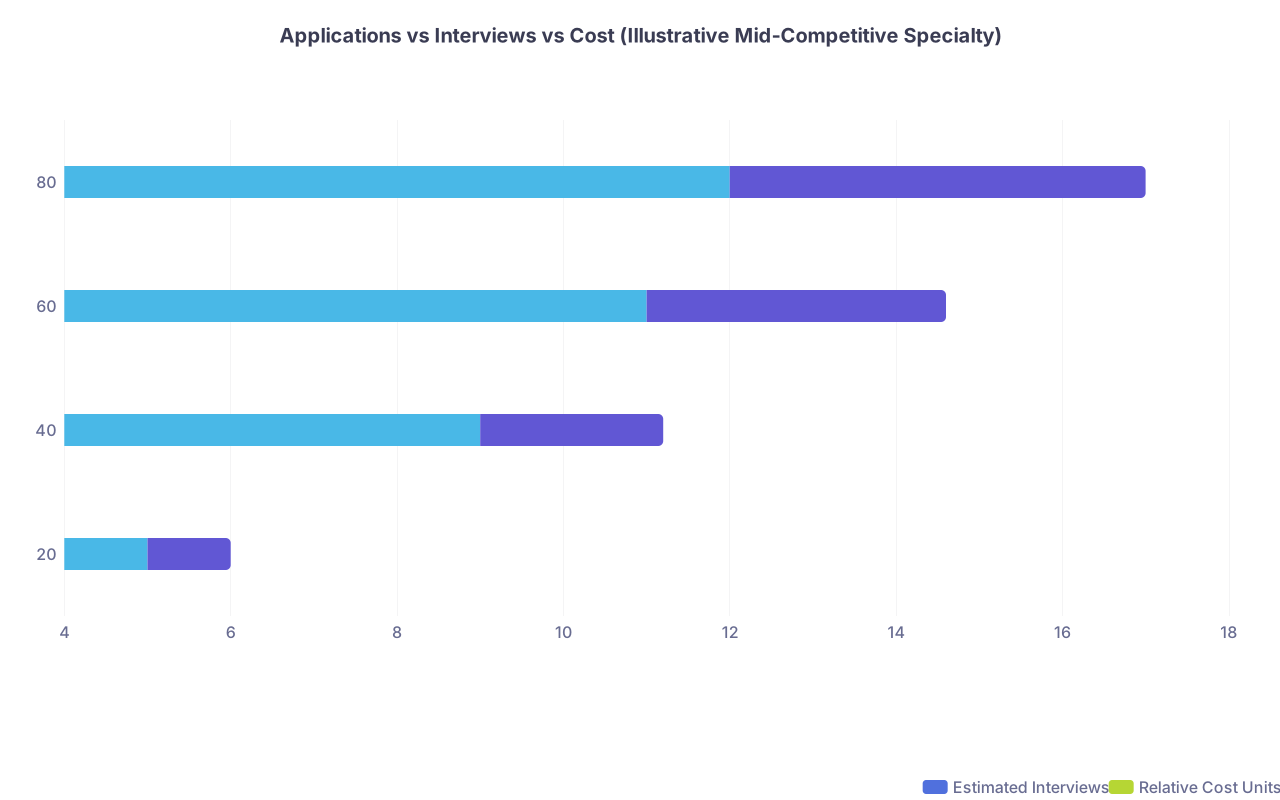
| Category | Estimated Interviews | Relative Cost Units |
|---|---|---|
| 20 | 5 | 1 |
| 40 | 9 | 2.2 |
| 60 | 11 | 3.6 |
| 80 | 12 | 5 |
Read it qualitatively:
- Interviews rise from 5 → 9 → 11 → 12.
- Cost index rises from 1 → 2.2 → 3.6 → 5.
By the time you go to 80 applications, you are spending about 5x the cost of a 20-program strategy for only ~2–3 extra interviews beyond what 40–60 well-selected programs could yield.
There are cases where that is rational (red flags, IMG status, uncertain specialty competitiveness), but pretending it is free or universally beneficial is dishonest.
So How Many Programs Should You Apply To—By Specialty?
There is no single correct number. There is, however, a logical way to choose a range where your yield is likely to be efficient.
Use this framework:
- Determine your target interview count based on specialty and applicant type.
- Use a realistic yield estimate (from your dean’s office, not Reddit) to back-calculate needed applications.
- Add a 20–30% buffer to account for noise.
- Stop before you enter obvious saturation unless you have clear risk factors.
Concretely:
- Internal Medicine (U.S. MD, average competitive)
- Target: 8–10 interviews.
- Realistic yield for good targeting: ~25–35%.
- Applications needed: 25–40, plus modest buffer → 30–45.
- General Surgery (U.S. MD, average competitive)
- Target: 11–13 interviews.
- Expected yield: ~15–25%.
- Applications needed: ~45–65, buffer → 50–70.
- Dermatology (U.S. MD, average competitive)
- Target: 14–16 interviews (if possible).
- Expected yield: ~15–20% early, worse as you add programs.
- Applications needed: 40–60, maybe up to ~70 if your home program is weak or absent.
- Psychiatry / Family Medicine / Pediatrics (U.S. MD, average):
- Target: 8–10 interviews.
- Yield can be 30–50% with proper targeting.
- Applications needed: 20–35.
If you are DO or IMG, shift these application ranges upward meaningfully. For IMG in IM, 80–120 is not crazy; your yield might sit at 5–10% and saturation is further away.
Practical Takeaways for Using Yield Data Intelligently
Strip away the noise and here is how to behave like an analyst rather than a panicked applicant:
Use your school’s historical data.
They know how many applications it historically took for “students like you” in your specialty to get 10–12 interviews.Recognize that not all 60-program lists are equal.
A list built with:- 15 strong fits
- 20 solid fits
- 15 realistic safeties
- 10 modest reaches
will produce far better yield than: - 10 home-region fits
- 20 random places you have never heard of
- 30 prestige reaches you will not realistically get.
Do not confuse outliers with norms.
“My friend applied to 120 programs in EM and got 20 interviews” says little unless you know:- Step scores
- School pedigree
- SLOEs / letters
- Geography
- Year in question (market varies)
Monitor early signals.
If within the first weeks of interview season you get zero traction from your top 20–30 “best fit” programs, your realized yield is lower than predicted. In those rare settings, late incremental applications to additional, lower-tier programs can make sense.Once you cross your target interview zone, shift focus.
Past a certain interview count (10+ for core, 12–15+ for competitive), extra applications rarely change outcome. Time is better spent preparing for interviews, improving communication, and researching programs so your rank list reflects genuine fit.
FAQs
1. If I have a red flag (failed Step, professionalism issue), should I always apply to the maximum possible programs?
No, but your efficient range shifts higher. Your yield will be lower at every application count, so a 1.5–2x bump relative to a similar applicant without red flags can be rational. Still, once you have saturated realistic geographic and tier options, dumping more applications into obvious misfits (where your red flag is a hard stop) will not help. The key is expanding breadth thoughtfully—more community programs, more regions that historically accept similar profiles—not blindly inflating volume.
2. Does dual applying (e.g., IM and Anesthesia) improve overall interview yield?
It can, but it behaves like adding a second, separate yield curve. You will usually see:
- Decent yield in your primary specialty’s efficient range.
- Lower but nonzero yield in the “backup” specialty.
The risk is self-inflicted saturation: you dilute focus, genericize your personal statements, and sometimes underperform in both pools. Dual applying improves the chance you match somewhere, but it does not magically turn low competitiveness into high yield. The data show it primarily benefits people who commit to a realistic backup and tailor their application to both fields, not those who treat the second specialty as an afterthought.
3. How does a strong home program affect my optimal application volume?
Strong home programs function like high-yield “bonus” applications. You often get:
- A near-guaranteed interview (assuming no major red flags).
- Insider advocacy at a program that may rank you favorably.
That effectively reduces the number of outside applications you need to hit your target interview count by 3–5 in some specialties. For Derm, Ortho, ENT, or PRS, a strong home program is a huge stabilizer and can justify staying on the lower end of recommended volume ranges, because your early yield is significantly boosted.
4. Are VSLO / away rotations changing interview yield curves?
Yes, particularly in surgical and competitive specialties. An away rotation is essentially a multi-week audition that creates:
- Extremely high-yield applications at that specific site and often at closely affiliated programs.
For applicants who nail an away, you are effectively increasing your yield at a select few programs into the 60–80% range for interviews, independent of broad ERAS volume. This can allow slight reductions in total applications, since your “must-get” interviews are partially secured through performance, not just paper credentials.
5. If I am late submitting ERAS, should I compensate by applying to more programs?
The data on timing show that earlier submission correlates with slightly higher interview yield, but the effect size is moderate, not catastrophic, for most specialties if you are only a few weeks behind. Compensating by dramatically inflating volume usually produces poor incremental yield, because late applications at long-shot programs are still long shots. A mild increase (for example, from 40 to 50) to buffer against timing is reasonable. A jump from 40 to 100 purely because of a two-week delay usually just multiplies your costs without a proportional increase in interviews.
Key points: interview yield drops as volume rises, and the drop is specialty-specific. Your job is not to maximize applications; it is to hit a sufficient interview count in the efficient zone of the curve, before saturation kills your return on investment.