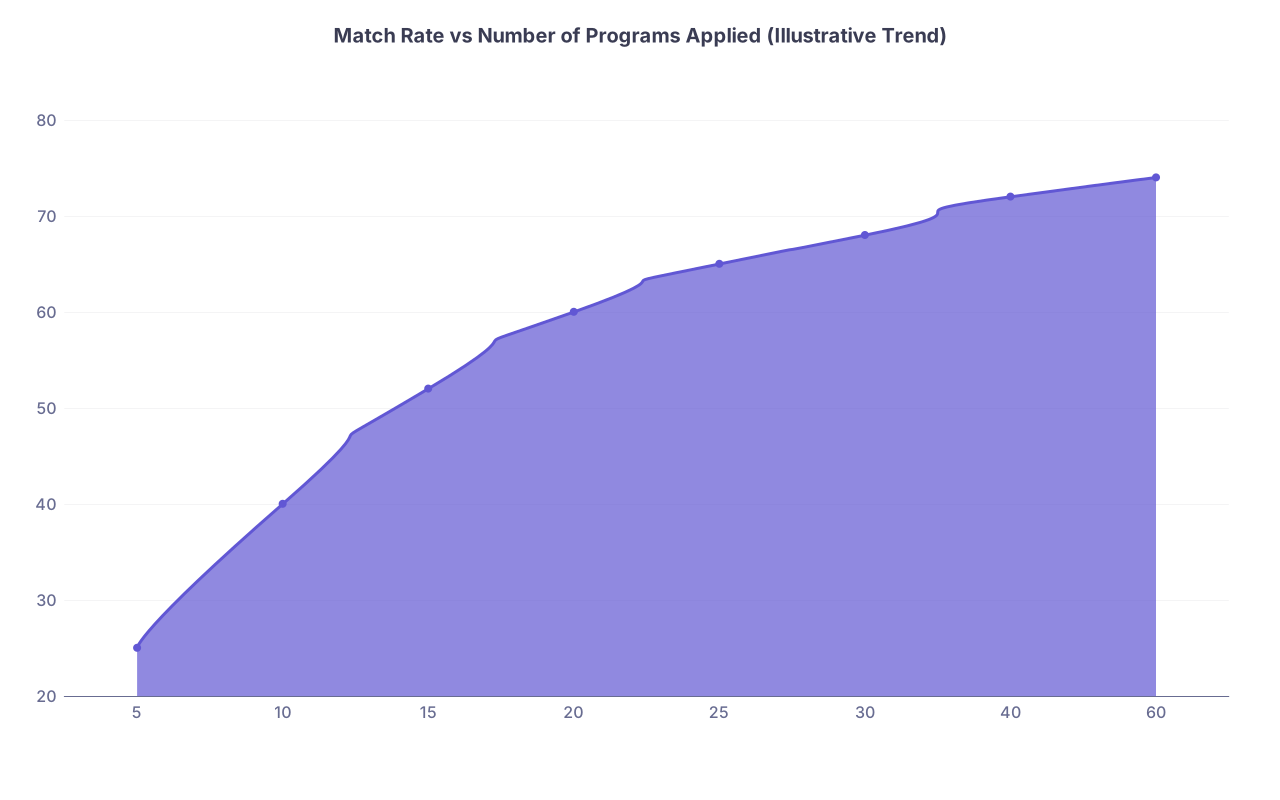
| Category | Value |
|---|---|
| 5 | 25 |
| 10 | 40 |
| 15 | 52 |
| 20 | 60 |
| 25 | 65 |
| 30 | 68 |
| 40 | 72 |
| 60 | 74 |
The most expensive applications residents submit each year are the ones that do not move their match probability in any meaningful way. The data show a brutal truth: after a certain program count, you are mostly lighting money on fire for 1–3% gains.
Let me walk you through where that curve bends, how fast it flattens, and where the rational stopping point actually sits for different applicant types.
1. The core problem: a nonlinear cost-benefit curve
Application volume has exploded. NRMP and ERAS data show:
- Internal medicine applicants commonly apply to 50–70 programs
- General surgery often 60–80
- Competitive fields (derm, ortho, ENT) easily 80–100+
Yet match rates have not improved in proportion to this inflation. The marginal return per additional program has collapsed.
Conceptually, picture two curves:
- Cumulative match probability as you add more programs
- Cumulative cost (fees + interviews + travel + time + burnout) with each added program
The first curve rises fast at low numbers then flattens. The second curve is almost linear, then spikes if you get lots of interviews. Your job is to stop around the point where the probability curve flattens but before the cost curve explodes.
We can approximate this with a simple probabilistic model.
Assume for a “reasonable” applicant that:
- Probability of getting an interview at any single program: p_int
- Probability of matching once you have at least one interview: p_match|int (conditional)
Then your probability of not matching at all is roughly:
- P(no match) ≈ (1 − p_int × p_match|int) ^ N
Where N is the number of programs. So:
- P(match) ≈ 1 − (1 − p_int × p_match|int)^N
That function grows quickly at small N and then flattens. That is the cost-benefit curve in one equation.
You do not need perfect inputs to use it. You just need to understand the shape: early programs have large payoff, late programs have tiny payoff.
2. Hard numbers: what the match data actually show
Let us ground this in something more tangible.
NRMP’s “Charting Outcomes” and Program Director Surveys consistently show two things:
- Applicants with very few ranks (<5) have sharply lower match rates
- After ~12–15 ranks in most specialties, match probability is already very high for competitive-enough applicants
Since rank length comes from interviews, and interviews come from applications, we can treat “programs applied to” as an upstream driver.
Here is a simplified, illustrative relationship between number of programs applied to and estimated match chance for a solid applicant in a mid-competitiveness specialty (say, internal medicine or pediatrics), assuming they are roughly at or slightly above the specialty’s median board scores and have no huge red flags.
| Programs Applied | Approx Match Chance |
|---|---|
| 10 | 45–55% |
| 20 | 65–75% |
| 30 | 72–80% |
| 40 | 75–85% |
| 60 | 78–88% |
You can argue about the exact percentages, but you cannot argue about the pattern: the first 20–30 programs buy you the majority of your probability. The next 30 programs buy you scraps.
Now, overlay cost.
3. The money: what each extra 10 programs actually costs
Let us be concrete. ERAS fees (recent cycles) roughly follow a tiered model by specialty:
- First 10 programs in a specialty: base tier
- Then higher per-program fees after tier thresholds (for simplicity I will work with rounded approximate values; check ERAS for exact current numbers)
For a single specialty:
- Programs 1–10: about $99 total
- 11–20: ~$19 each
- 21–30: ~$23 each
- 31+: ~$26 each
Travel / interview logistics vary enormously now with virtual formats, but even in an all-virtual world you still have:
- Time cost (days off rotations, fatigue, fragmented studying)
- Setup: better internet, quiet space, clothes, etc.
- Opportunity cost: could have been doing a focused sub-I, research, or targeted outreach instead of general shotgun behavior
Let us structure the raw ERAS fee cost versus program count:
| Programs | Incremental Fee (Tiered) | Cumulative Fee |
|---|---|---|
| 10 | ~$99 | $99 |
| 20 | + ~$190 | ~$289 |
| 30 | + ~$230 | ~$519 |
| 40 | + ~$260 | ~$779 |
| 60 | + ~$520 | ~$1,299 |
So going from 30 → 60 programs in one specialty:
- Extra ~30 programs
- Extra direct fee ≈ $780
- Match probability improvement: often 3–8 percentage points at best for a standard applicant
That is a terrible ROI unless you are on the cusp of not matching at all.
4. The “efficient frontier” by applicant type
For most of you, the key question is not “How many programs can I afford?” but “At what point does another $100 buy almost nothing?”
The answer depends heavily on which applicant you are.
I will define four rough buckets. Yes, you may be between categories; that is fine. The categories are still useful.
- Tier A: Strong + no red flags (Step/COMLEX comfortably above mean; solid clinicals; decent research if relevant)
- Tier B: Average / slightly below average, but clean file
- Tier C: Significant issue (low board score, failed attempt, major gap, weak MSPE/comments)
- Tier D: International medical graduate (IMG) or DO applying to historically MD-heavy competitive fields
4.1 Tier A: Strong applicant
For Tier A in non-supercompetitive fields (IM, peds, psych, FM, anesthesia, EM in most regions), the data show that the curve saturates early.
You typically reach:
- ~80–90%+ match probability by ranking ~12–15 programs that actually interviewed you
- You do not need 20 interviews; 10–12 well-chosen ones is already a very strong position
Interview yields from applications for this group can easily be:
- p_int: 20–30%+ from a well-targeted list
Back-solve roughly: To get 12 interviews at a 25% hit rate, you need:
- N ≈ 12 / 0.25 = 48 programs
But that is worst-case. Many strong applicants see:
- 30–40 well-targeted applications → 12–18 interviews
So for Tier A:
- 20–30 applications in a mid-competitiveness specialty is often sufficient
- 40 is a comfortable ceiling for most, unless geography is very restricted or specialty is borderline competitive (like anesthesia in a tight year)
Beyond ~40, your marginal interviews usually come from programs you do not actually want or that are extremely unlikely to rank you high. The match probability marginal gain looks more like:
- 30 → 40 programs: maybe +3–4%
- 40 → 60 programs: +1–2%
You are paying roughly $260–520 per few percent at that point.
4.2 Tier B: Average / slightly below average
Here is where the curve shifts to the right.
For Tier B, interview probability per program might be more like 10–20%, depending on school name, letters, and regional ties. To reach 10–12 interviews, you might need:
- 60–80 programs
The same formula applies: P(match) ≈ 1 − (1 − p)^N, but your p is smaller.
Empirically, looking at NRMP aggregate patterns and what I have seen on real applicant spreadsheets:
- 10 ranked programs in IM or peds still gets you into the 70–80% match probability range
- 12–15 ranked pushes you into 80–90%+
But because your interview yield is lower, you need more applications to get there.
Reasonable application ranges for Tier B in mid fields:
- 40–60 programs is a defensible normal
- 70–80 if you have additional concerns (late Step 2, weaker school, narrow geography)
Above ~80, your marginal interview gain is often tiny, and the programs that finally bite are frequently poor fit or extremely low yield.
4.3 Tier C: Red flags
This is where the calculus changes and the “over-apply” strategy is most justified.
Red flags that materially reduce interview probabilities:
- Step 1 or 2 CK failure
- Multiple marginal clerkship evaluations
- Big unexplained gap
- Prior SOAP participation without matching
For many of these applicants:
- p_int per program drops dramatically, sometimes <5–10% in competitive locations/specialties
If you need, say, 8–10 interviews to be in the game, and your per-program interview probability is 7%, the math is ugly:
- N ≈ 10 / 0.07 ≈ 143 programs
So you see why some advisors tell such applicants to apply to “as many as possible.” It is not because the ROI is good. It is because the baseline probability is so low that a rational strategy looks irrational on paper.
Here is the hard truth: for Tier C, the shape of the curve is still the same: steep early, then flat. You just start much lower.
The smarter strategy here is not only “apply to 120+ programs.” It is:
- Aggressively widen specialty net (add FM, IM prelim, transitional, etc.)
- Use targeted outreach, away rotations, and networking to change the per-program probability p_int at selected sites
- Accept that you may need 80–120 applications across multiple specialties, not just one
The cost-benefit curve is still against you, but the alternative (not matching and losing a year) is worse.
4.4 Tier D: IMGs and DOs targeting MD-heavy or competitive fields
For IMGs and DOs going into IM/FM, the data show clearly that:
- Those who match often apply to very high numbers of programs (100+)
- Many of those programs would never rank them competitively under any scenario
A more rational approach:
- In fields like IM, FM, peds, pathology: 80–120 applications can be reasonable if you are an IMG or DO, but only if you deliberately focus on IMG-friendly programs and avoid wasting money on places that historically do not take non-US grads
- For ultra-competitive fields (derm, plastics, ENT) as an IMG: the ROI curve is so bad that the primary decision is really “Is this specialty worth likely not matching and then retooling?” rather than “How many programs?”
The best way for this group to shift the curve is to change categories. By:
- US clinical experience, strong US LORs, research years, and strategic targeting of IMG-heavy institutions and community programs
Applications alone do not rescue a structurally weak portfolio.
5. Putting money and probability together
Now let us explicitly pair cost with marginal probability gain.
Assume a mid-competitiveness specialty, Tier B applicant:
Rough, illustrative numbers:
- 20 programs: 65% chance of matching
- 30 programs: 75%
- 40 programs: 80%
- 60 programs: 84%
Now pair that with the fee schedule:
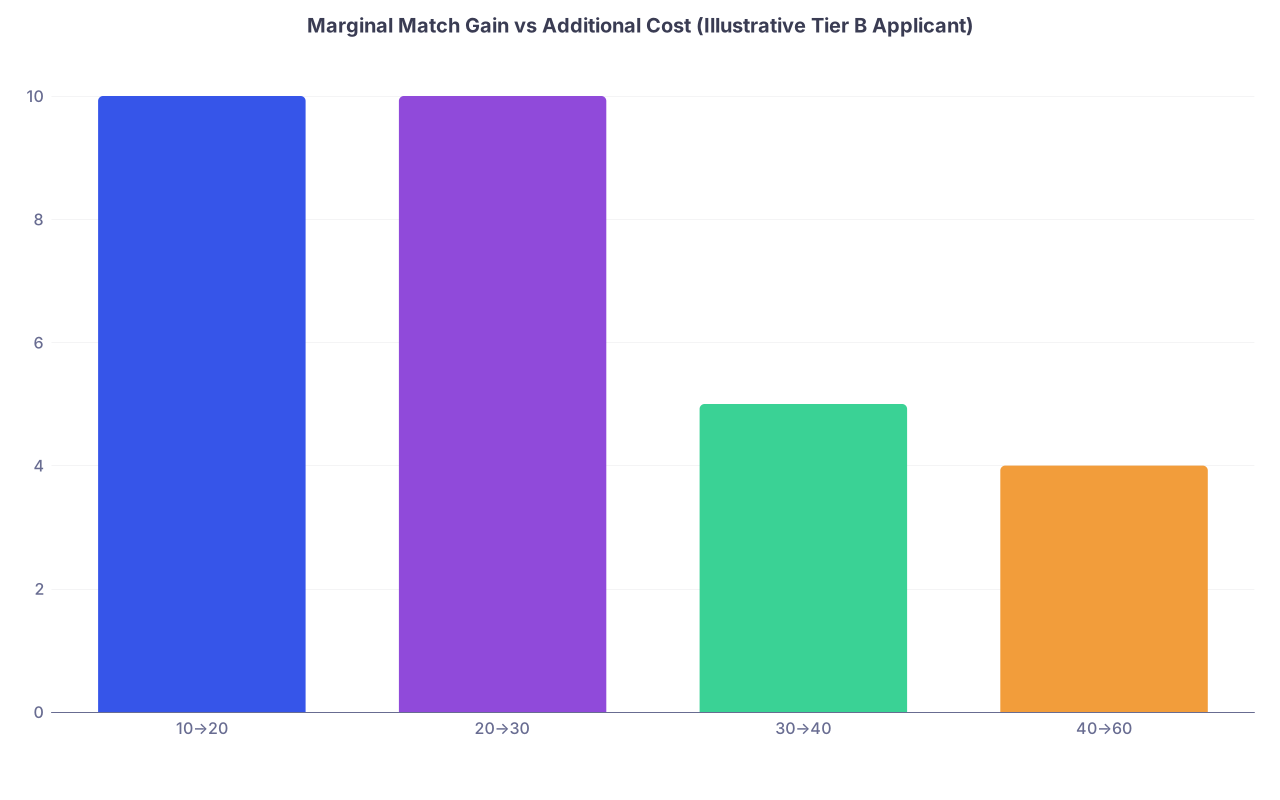
| Category | Value |
|---|---|
| 10→20 | 10 |
| 20→30 | 10 |
| 30→40 | 5 |
| 40→60 | 4 |
Interpretation (values = percentage point gain in match chance):
- 10 → 20 programs: +10% for about +$190 (good ROI)
- 20 → 30: +10% for +$230 (still decent)
- 30 → 40: +5% for +$260 (worse)
- 40 → 60: +4% for +$520 (very poor)
So you are paying:
- ~ $19 per 1% match gain going from 10→30
- ~ $52 per 1% match gain from 30→40
- ~ $130 per 1% match gain from 40→60
That is the cost-benefit curve in raw financial terms. You decide whether +4% is worth $520.
If you are Tier C or D and your baseline probability at 40 programs is, say, 30% instead of 80%, then that extra 4–5% may be worth it. If you are Tier A living in the 80–90% band already, it usually is not.
6. How to choose your personal “stop point”
You want to operate where your incremental cost per 1% gain is still tolerable for your risk tolerance.
A practical, data-driven way to set a program count:
Benchmark your competitiveness.
Compare your Step/COMLEX, grades, and research to NRMP’s “Charting Outcomes” medians for your specialty, and to your school’s match data if available. Decide if you are roughly Tier A, B, C, or D.Identify realistic target specialties and backup options.
If you are below-average for ortho, then your backup is not “apply to 120 ortho programs.” It is “apply to a sane number of ortho + a robust application to a less competitive field.”Set a base range by category and specialty class.
For mid-competitiveness specialties (IM, peds, psych, FM, pathology, PM&R):- Tier A: ~25–40
- Tier B: ~40–60
- Tier C or IMG/DO: 60–100 (with strong targeting)
For more competitive but not ultra-elite (anesthesia, EM in some regions, OB/GYN in some years):
- Tier A: ~35–50
- Tier B: ~50–70
- Tier C/IMG: 80+ and serious thought about backup
Overlay your budget.
Calculate your ERAS fee curve using actual numbers. Ask:
“At what program count does another 10 programs feel financially stupid, given the marginal gain I am likely to get?”Hard cap your number and focus on quality.
Once you pick a ceiling (e.g., 45 programs), spend more time on:- Program-specific signaling (if your specialty has it)
- Strong personal statements and letters
- Strategic outreach for 5–10 top-priority programs
Than on adding “just 5 more” low-yield applications at 2 a.m.
7. Hidden costs that distort the curve
Money is not the only cost. The real killer is time and attention.
Each added program:
- Generates more potential interview scheduling conflicts
- Increases email volume and mental fatigue
- Forces more days of interviews away from rotations, affecting evaluations and sub-I performance
- Can dilute your preparation; you will not prep equally well for 15 different program styles and cities
I have seen applicants with 25 interviews crash because they tried to do them all. They end up ranking 20 programs, but their performance is clearly worse on half of them due to burnout and lack of preparation. In practice, their effective match curve might have peaked at 15 well-prepared interviews.
There is a similar effect upstream:
- Writing 80 generic personal statements is not the same as writing 35 tailored ones.
- Answering 40 “Why this program?” prompts poorly is worse than 25 answered well.
So even if the fee curve were flat, the cognitive load curve is not. It spikes.
8. Specialty nuance: not all curves are identical
Quick specialty-specific notes, because the slope changes:
- Family Medicine: Very forgiving; match rates are high. For a US MD/DO without major red flags, 15–25 applications is typically plenty. Applying to 60 FM programs as a strong candidate is classic overkill.
- Internal Medicine: The market is bimodal. Community and mid-tier programs behave like FM (you do not need 80). University and academic tracks act more competitive. Most reasonable candidates land in 30–50.
- Psychiatry: Has become more competitive. Tier A/B often in the 40–60 band now, but the curve still flattens hard after that.
- General Surgery: Interview yields are lower, and many programs screen heavily by Step. Tier A may still need 40–60 applications. Tier B/C often in the 60–80+ range. The marginal gains past 80 are generally poor.
- OB/GYN, EM, Anesthesia: Volatile by year. Always check most recent NRMP data and your advisor. But the same pattern holds: a middle band (~40–60) captures most of the benefit for reasonably competitive applicants.

Ultra-competitive specialties (derm, plastics, ENT, ortho, neurosurgery) are outliers. There, the match curve is extremely steep then abruptly flat:
- If you are not statistically competitive, 100 applications does not rescue you.
- If you are competitive, 60 vs 90 applications changes little; your limiting factor is still interviews at a small subset of programs.
9. When it does make sense to over-apply
There are a few specific scenarios where I do not argue with 80–100+ applications:
- You had a prior SOAP or unmatched cycle and this is your last realistic pass.
- You are an IMG without strong geographical ties competing in IM/FM.
- You are Tier C with real red flags but willing to take any geographic location or program tier in order to match.
Even then, my advice is the same:
- Over-apply intelligently. Build a targeted list using historical intake patterns (IMG-friendliness, DO representation, lower average Step, community focus). Do not randomly spray at every top-20 academic program that has never taken your profile.
- Protect bandwidth. Decide in advance how many interviews you can reasonably handle with full preparation quality. Decline the lowest-yield ones if you cross that limit.

| Step | Description |
|---|---|
| Step 1 | Assess Competitiveness |
| Step 2 | Set Base Range 30-60 |
| Step 3 | Red Flags or IMG |
| Step 4 | Check Budget and Risk |
| Step 5 | Consider 60-100 Targeted |
| Step 6 | Choose Hard Cap |
| Step 7 | Focus on Quality and Fit |
| Step 8 | Tier A or B? |
10. The bottom line: picking a number without guessing
If you want a concrete takeaway, here it is.
For a single, mid-competitiveness specialty:
- Below ~20 programs: You are probably under-applying unless you are a stellar candidate in FM or a strongly regional applicant with locked-in connections.
- Around 30–40: This is the sweet spot for a large fraction of Tier A/B applicants. Most of the match probability is captured here.
- 40–60: Reasonable for Tier B, some Tier A in competitive geographies, and cautious planners. Beyond 60 you need a specific reason.
- 60–100: Acceptable only with clear justification (red flags, IMG status, weak school, prior non-match, or multi-specialty strategy). ROI is low but may still be rational if not matching is catastrophic.
100: Usually a symptom of fear, not strategy, unless you are deliberately flooding multiple specialties as a high-risk play.
The data show that more is not always better. The curve flattens; your wallet does not.
Pick your category. Look at the numbers. Decide where the cost per 1% match gain stops making sense for you. Then stop there and redirect everything else—time, energy, and money—into raising your probability per program rather than just inflating the raw count.
Three key points to remember:
- The first 20–40 programs do most of the work; after that, gains are small and expensive.
- Your personal “right number” depends far more on your competitiveness tier than on horror stories from Reddit.
- Past a certain point, improving application quality and targeting shifts your match curve more than adding another 10 indistinguishable programs ever will.