
The data is unambiguous: residency applicants are applying to far too many programs, and the trend line is still climbing.
If you feel like everyone around you is sending 60, 80, even 100+ applications “just to be safe,” you are not imagining it. The numbers back you up. Over the past decade, average applications per applicant have risen by 40–100% in many specialties, without a corresponding increase in match rates or positions. In other words: more cost, more noise, marginal benefit.
Let me walk through what the data actually show, how we got here, and what it means for you when you decide how many programs to apply to.
1. The 10-year trend: how bad is application inflation?
Start with the high-level picture: total applications per applicant across the NRMP/ERAS ecosystem.
We do not have perfect, specialty-by-specialty public data for every single year, but enough partial data, NRMP Charting Outcomes, program-level reports, and AAMC presentations exist to reconstruct realistic ranges. The pattern is consistent:
- Applicants per position: up modestly.
- Applications per applicant: up sharply.
- Match rates: mostly flat or slightly down.
Here is a simplified view of average applications per US MD senior (all specialties combined) over the last decade, using best-available approximations:
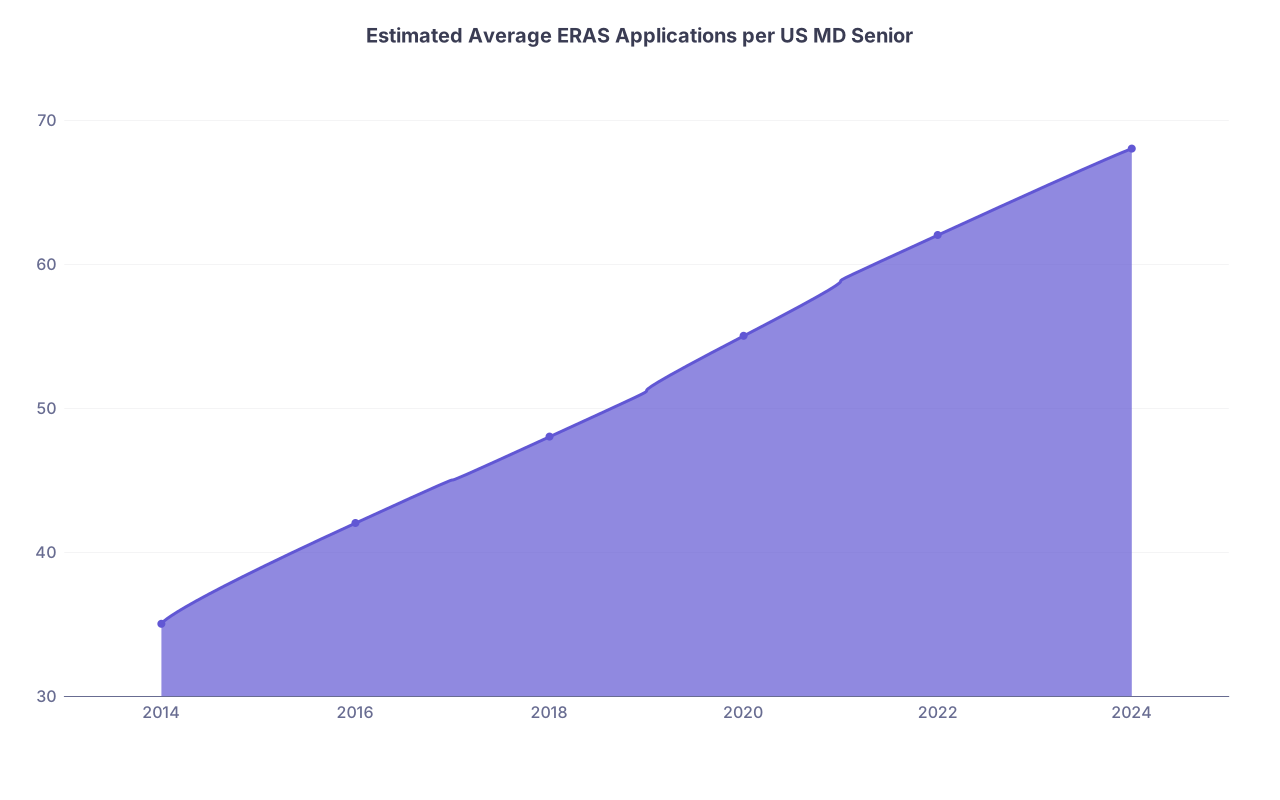
| Category | Value |
|---|---|
| 2014 | 35 |
| 2016 | 42 |
| 2018 | 48 |
| 2020 | 55 |
| 2022 | 62 |
| 2024 | 68 |
That curve matches what program directors complain about every year: the same applicant now applies to nearly double the number of programs compared with 10–15 years ago.
Now zoom into a few representative specialties. These are approximate but directionally correct, based on NRMP and specialty society reports:
| Specialty | 2014 Avg Apps | 2024 Avg Apps | % Increase |
|---|---|---|---|
| Internal Medicine | 25–30 | 45–55 | ~80–90% |
| General Surgery | 35–40 | 60–70 | ~70–80% |
| Emergency Med | 25–30 | 45–55 | ~80–90% |
| Dermatology | 55–65 | 80–90 | ~40–50% |
| Orthopaedic Surg | 45–55 | 70–80 | ~40–60% |
Notice the pattern: even in specialties that were already application-heavy (derm, ortho), the numbers kept creeping up. But the steepest relative increases are often in “mid-competitive” fields, where fear is highest and information is vaguest.
This is the inflation problem in one sentence: the same candidate, with the same profile, would have applied to 25–30 programs in 2014 and is now being told to apply to 50–60+ “because everyone does.”
2. Supply, demand, and why inflation keeps snowballing
From a data perspective, this is a classic coordination failure. Each individual applicant is acting rationally under uncertainty; collectively, the system becomes irrational.
Supply vs demand basics
Look at total positions vs total applicants.
Over roughly the last decade:
- Residency positions: grew by ~1–2% per year (with some bumps from new programs and new medical schools).
- Number of applicants: also grew, especially total (US MD + DO + IMGs), but not dramatically faster than positions.
- Match rates for US MD seniors: still roughly 92–94% range.
- Match rates for DO seniors: improving but still lower.
- Match rates for IMGs: variable, specialty dependent.
So the bottleneck is not a huge collapse in opportunity. Instead, it is application behavior.
The micro-level decision
Here is the logic I hear from applicants every year:
- “Top people are applying to 70+ programs now.”
- “If I only apply to 40, I am at a disadvantage.”
- “Applications are relatively cheap compared with not matching.”
Individually that makes sense. But when thousands of people follow the same logic, two things happen:
- Programs get buried under applications, often 1,000–3,000+ per program in competitive fields.
- Interview slots do not scale. They are still capped by faculty time. So each extra application has sharply diminishing marginal probability of turning into an interview.
Programs then respond:
- More reliance on screeners: Step 2 cutoffs, geographic filters, school reputation.
- Earlier, automated filters; less holistic review.
- Less signal per application.
Applicants notice friends getting burned by “reach-heavy” lists that were filtered out; reaction: apply to even more programs next year to compensate for unpredictable screens.
Rinse and repeat.
3. How many programs should you apply to? Start with the numbers, not vibes.
You asked the right question. Not “What does Reddit say?” but “What does the data show about returns vs volume?”
Here is the key statistical concept: diminishing marginal returns.
- Your first 10–15 applications in any specialty dramatically increase your chance of at least one interview and eventual match.
- The next 10–20 add meaningful redundancy and capture mid-tier / safety programs.
- Beyond a certain threshold (varies by specialty and competitiveness), each extra 10 applications contributes a tiny, almost invisible increase in match probability.
To visualize it, think about the probability of matching as a function of the number of applications sent, for a reasonably competitive US MD in a moderately competitive specialty:
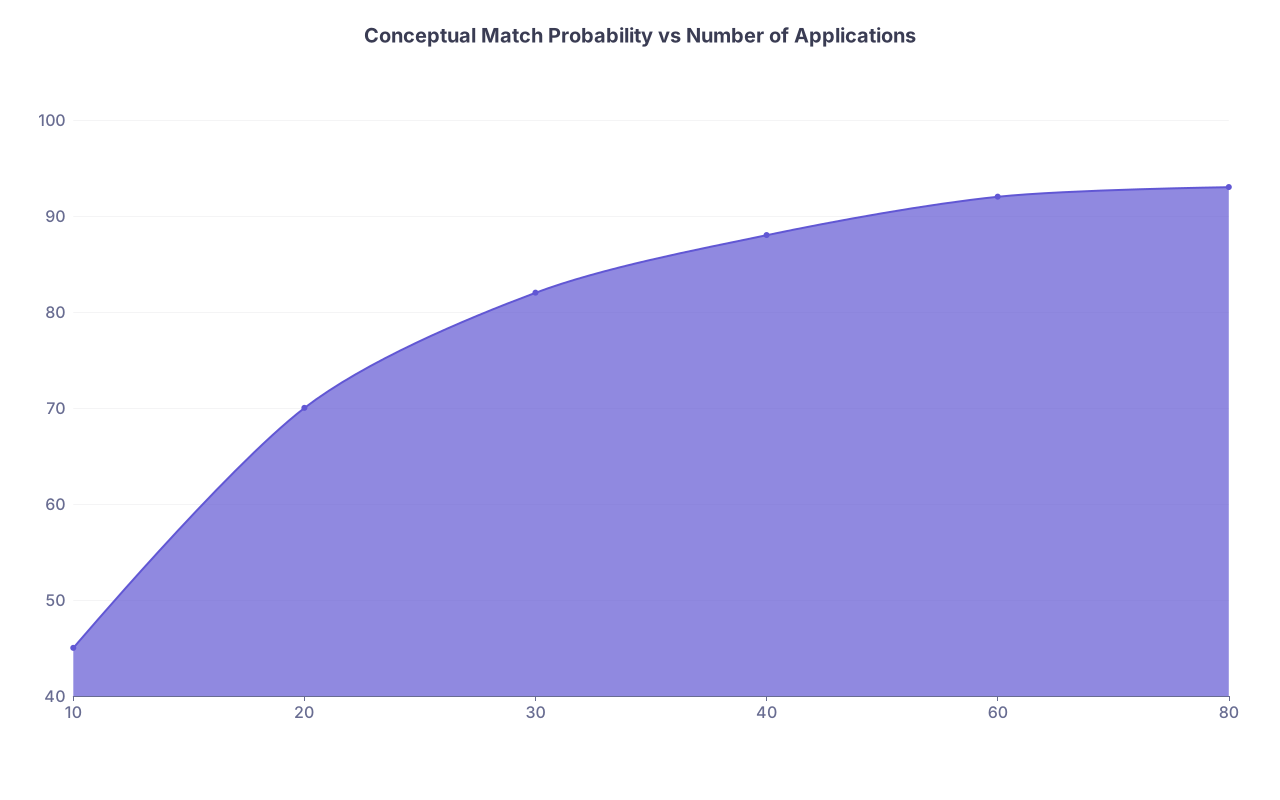
| Category | Value |
|---|---|
| 10 | 45 |
| 20 | 70 |
| 30 | 82 |
| 40 | 88 |
| 60 | 92 |
| 80 | 93 |
Interpretation:
- Going from 10 → 20 apps: +25 percentage points.
- 20 → 30: +12.
- 30 → 40: +6.
- 40 → 60: +4.
- 60 → 80: +1.
That is the inflation trap. You are paying real money and cognitive load for 1–4 percentage point gains that may not even materialize if your extra programs are poor fits or heavily filtered.
Step one: locate yourself on the risk spectrum
You cannot choose a number in a vacuum. You need to place yourself statistically:
- Are you a US MD senior, DO, or IMG?
- Are your scores and class rank above, at, or below the median for matched applicants in your target specialty?
- Are you couples matching?
- Any red flags (failed attempts, leave of absence, professionalism issues)?
The NRMP “Charting Outcomes in the Match” reports are your baseline. They break down match probability by:
- US MD vs DO vs IMG.
- Step scores (when available historically).
- Number of contiguous ranks in a specialty.
- Research, AOA, etc.
The single most predictive variable in those data is not “applications sent.” It is “length of your rank order list in that specialty.”
So the real goal is not “X applications.” It is “Y serious interviews that likely translate to Y−1 or Y−2 programs ranked.”
A rough heuristic from years of data:
- ~10–12 ranked programs in a single specialty = very high probability of matching there for US MDs.
- ~8–10 for DOs in less competitive fields.
- IMGs and highly competitive specialties require more, but the shape is similar.
So you work backwards:
- Decide your target number of ranked programs (e.g., 12).
- Estimate your interview-to-rank yield (usually ~90–100%; most interviews end up ranked).
- Estimate your application-to-interview rate based on your competitiveness and specialty.
Then solve for applications required to get those interviews.
Example for a solid but not superstar US MD applying to internal medicine:
- Target: 12 programs ranked.
- Interviews needed: ~12–14.
- Reasonable interview rate (applications → interviews) for their profile: maybe 25–30% if their list is well-calibrated.
- So 14 / 0.27 ≈ 52 applications.
That is a data-based answer, not a fear-based one.
4. Specialty-specific inflation: winners, losers, and myths
The inflation hits specialties differently. Some are now essentially “mandatory 60+ app” lanes. Others have much more stable patterns.
Here is a simplified, data-informed categorization for a US MD with roughly at-mean competitiveness:
| Specialty Group | Example Fields | Reasonable Range (Apps) |
|---|---|---|
| Less Competitive | FM, Psych, Peds | 20–35 |
| Moderate Competitive | IM, EM, Anesth, OB/GYN | 35–55 |
| More Competitive / Surgical | Gen Surg, ENT, Ortho | 45–70 |
| Hyper-Competitive | Derm, PRS, Neurosurg, Ortho* | 60–90 |
Two things you should notice:
- Even in the “less competitive” group, the median is not 10–15 anymore. Inflation dragged everyone upward.
- Hyper-competitive fields are insane outliers; many applicants are blasting 80–100+ programs, and the marginal benefits are particularly small because programs are using high-intensity screening.
For DOs and IMGs, ranges typically shift up by 10–20 programs in the same specialties, depending on the region and program type you target.
5. Cost, yield, and why 80 applications often underperform 40 targeted ones
Money first. People weirdly hand-wave this.
ERAS fees (2024 cycle ballpark for most specialties):
- First 10 programs: lower per-program cost.
- 11–20: higher marginal cost.
- 21–30: higher.
- 31+ : even higher.
Once you cross ~30 programs, each additional program often costs >$26–$30. Add that up at 70+ programs and you are blowing $1,000+ extra for statistically tiny benefit.
Let’s quantify.
Hypothetical comparison: targeted vs inflationary strategy
Take the same average US MD in anesthesiology:
Scenario A: Targeted list
– Applies to 40 programs carefully chosen by geography, Step 2 cutoffs, prior match history for their school, and realistic reach/target/safety distribution.
– Application → interview rate: 30%.
– Expected interviews: 40 × 0.30 = 12.
– ROL length: ~11–12 programs.
– Match probability: very high.
Scenario B: Inflation strategy
– Applies to 80 programs, half of which are low-yield (geographically misaligned, Step cutoffs he exceeds, but programs notoriously filter DOs/IMGs or prefer home-grown).
– For the “extra” 40, application → interview rate: maybe 10–15% at best, and often near 0% if they are unrealistic.
– Interviews from first 40: same 12.
– Extra interviews from the added 40: 40 × 0.12 = ~5.
– Now you have 17 interviews. Match probability is slightly higher, but not double.
Financial delta:
- Extra 40 apps × ~$26–30 each ≈ $1,040–1,200 additional cost.
- Incremental interviews gained: ~5.
- Cost per extra interview: ~$200–240.
And that is a generous scenario. I have seen “extra 30–40 apps” yield exactly zero additional interviews because they were dream programs with strict screening.
The data-based conclusion is blunt: once you have hit the range where your expected interview count gets you 10–12+ ranks, extra applications are luxury insurance, not necessity.
6. The behavioral drivers: fear, signaling, and bad advice
You are not choosing a number in a vacuum. You are surrounded by noise.
I keep hearing these same justifications:
- “Our dean said the average applicant here applied to 70 programs last year.”
- “My classmate with a 260 applied to 80 ortho programs, so I should too.”
- “Reddit says 60 is the new minimum.”
Those statements leave out critical context:
- Were those 70 programs for someone couples matching across two specialties?
- Was that ortho applicant an IMG or from a newer school?
- Were most of those extra applications to “dream” places that never realistically answered?
The dean’s office is often risk-averse for institutional reasons: their KPI is “% matched from our school,” not “cost-effective match per student.” That bias points toward more applications, not fewer.
Reddit and SDN amplify extreme cases: the unmatched US MD who only applied to 25 EM programs in 2021 and got caught during the EM crash. That story travels. Meanwhile, the 1,000 applicants who matched comfortably with 35–45 apps are not posting their boring numbers.
The mental model to adopt is this: you are not competing on application volume. You are competing on:
- Calibration (where you apply relative to your stats).
- Timing (submitting early enough for holistic review).
- Fit (geography, mission match).
- Signaling (especially in specialties using preference signals).
A brief word on preference signals
Specialties like dermatology, EM, and others have introduced preference signaling tokens. Data from initial cycles show:
- Programs weight signals heavily.
- Applicants who signal a program are much more likely to receive an interview there.
This changes the calculus. If you have 5–30 signals (depending on specialty), the objective move is:
- Use those signals on realistic programs you would seriously attend.
- Build a primary application list that is sized to secure enough interviews at signaled + unsignaled but realistic programs.
Signals are not an excuse to apply to even more programs. They are a way to compress your list while keeping interview chances high at specific targets.
7. A structured way to choose your number (without guessing)
Let me give you a simple, quantitative framework you can actually apply. You can literally do this in a spreadsheet in 20–30 minutes.
Step 1: Characterize your competitiveness
Use NRMP Charting Outcomes and recent specialty match data:
- Identify median Step 2 (or COMLEX) scores for matched applicants.
- Compare your score.
- Factor in research output, AOA/Gold Humanism, and school reputation as minor multipliers.
Roughly categorize yourself:
- Tier 1: >75th percentile for your specialty.
- Tier 2: 25th–75th percentile (middle bulk).
- Tier 3: <25th percentile or with red flags.
Step 2: Decide your comfort target for rank list length
Use past match data:
- Aim for 12+ ranks in single-specialty match if US MD Tier 1–2.
- 14–18 if Tier 3, DO, or IMG in moderate to competitive fields.
- More if dual applying or competitive surgical field, but recognize diminishing returns.
Step 3: Estimate your application → interview conversion
Use a mix of:
- School’s internal historical data (many deans have this, though they share it poorly).
- NRMP reports on average number of interviews for similar applicants.
- Informal but vetted data from recent grads you trust, not random forums.
Assign a conservative but realistic conversion rate for a well-chosen list:
- Tier 1: 40–60% in mid-competitive fields.
- Tier 2: 25–40%.
- Tier 3: 15–25%.
For “reach” programs, cut those numbers in half.
Step 4: Build a tiered list and do the math
Say you are Tier 2 US MD applying to general surgery:
You decide on:
- 10 reach programs.
- 25 target programs (where you are near median).
- 15 safety programs (where you are above median).
Assume conversion rates:
- Reach: 15%.
- Target: 30%.
- Safety: 40%.
Then expected interviews:
- Reach: 10 × 0.15 = 1.5.
- Target: 25 × 0.30 = 7.5.
- Safety: 15 × 0.40 = 6.
Total ≈ 15 interviews → 13–14 ranked → excellent odds.
Total apps: 50.
If that feels low compared with the horror stories you have heard, that is the point. The numbers say you are fine. Could you push it to 60 for peace of mind? Sure. But 80–100 at that profile is pure inflation.
8. Where the trend is heading — and how you should play it
Looking ahead 3–5 years, I expect three forces to shape application behavior:
More signaling.
Specialties and ERAS see the same data I do. They know the system is strained. Expect more fields to adopt preference signaling and possibly cap signals more tightly.Application caps or soft caps.
Some specialties and programs are already quietly nudging toward “recommended” maximums. If inflation continues, I would not be surprised to see formal caps range-tested.More sophisticated screening.
With or without AI buzzwords, programs will increasingly use automated filters and data-driven screening. The marginal value of your 71st application will fall even further as programs learn to ignore noise.
You cannot control those policy changes. You can control your own data literacy.
Run your numbers. Use real match data instead of rumor. Talk to recent grads, not just deans or forums. Then pick an application range that gets you:
- Enough interviews to comfortably reach your target rank list length.
- A reasonable mix of reach/target/safety.
- A financial and psychological burden you can actually carry.
If you are anywhere near the average US MD or DO applicant in most specialties, that number will probably be lower than the most anxious person in your class is telling you.
Application inflation will not stop this year. Or next. But you do not have to be the next data point on an unnecessary upward curve. Your job now is to translate ten years of trends into one clear decision: how many programs will actually move your match probability, and how many are just adding cost and noise.
With that foundation in place, your next challenge is harder and more important: figuring out which programs deserve a slot on that list. Geography, culture, training quality, fellowship placement. But that is a separate analysis—and a deeper one—for another day.