
The belief that “more residency applications are always better” is mathematically wrong.
Programs have data. NRMP has data. And once you actually look at the curves instead of the folklore on Reddit, the pattern is blunt: after a certain point, every extra application buys you almost nothing but debt and burnout.
Let’s walk through where that point is, how it shifts by specialty and competitiveness, and how to use the data to pick a rational number of programs rather than panic-clicking “apply all.”
The core problem: applicants are buying false security
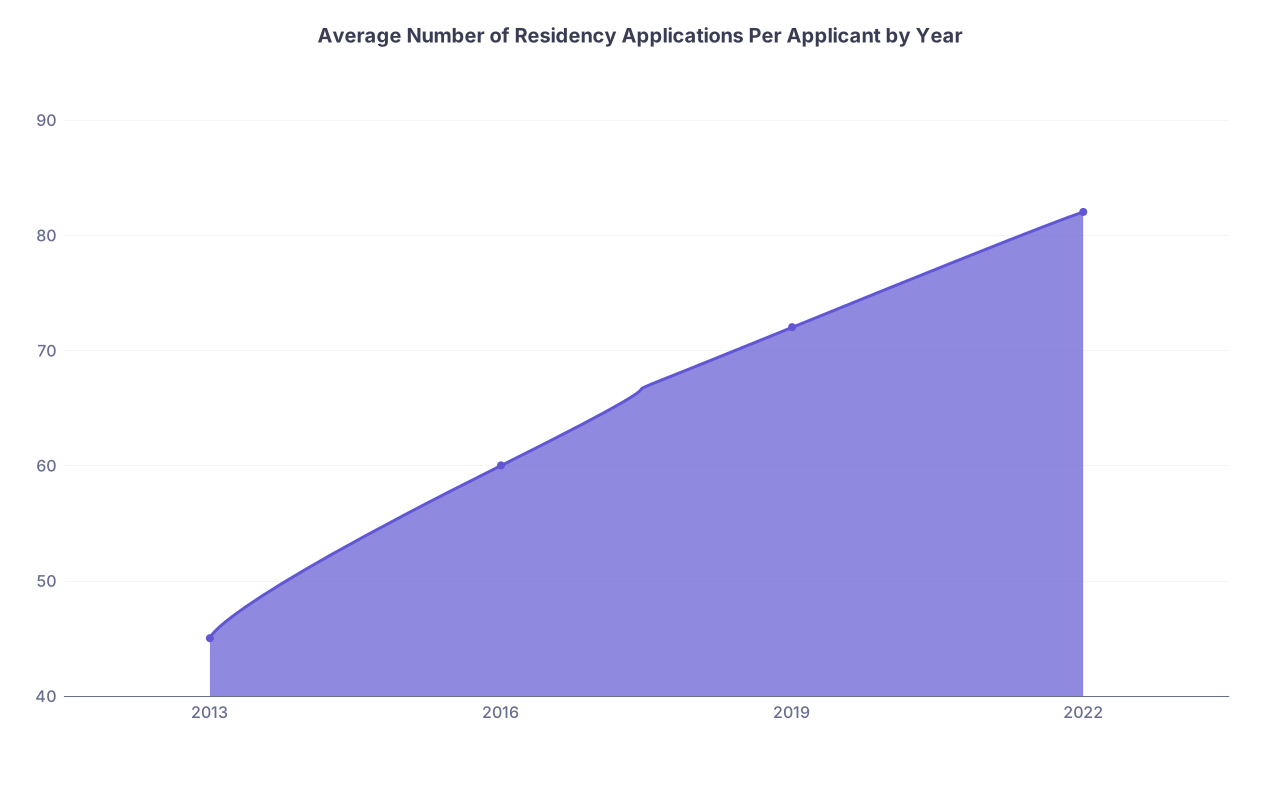
| Category | Value |
|---|---|
| 2013 | 45 |
| 2016 | 60 |
| 2019 | 72 |
| 2022 | 82 |
Over the past decade, the average number of applications per US MD applicant has exploded from roughly 40–50 to 70–80+ in many specialties. For some competitive fields (derm, ortho, plastics), 80–100+ is now “normal.”
The outcome data, though, have not improved at the same rate. Match rates have been remarkably stable once you account for Step score changes, specialty shifts, and applicant pool size.
That gap—between rapidly increasing applications and flat outcomes—is where diminishing returns live.
Here is the underlying logic:
- Each additional application costs money and time.
- Interview slots are fixed. Programs do not expand interview capacity linearly just because you all applied 40% more.
- Programs filter more aggressively when the application pile grows.
- Applicants are competing not only for positions but for interview invitations. Once you have “enough” interviews for your profile and specialty, extra interviews (and therefore extra applications) add almost no marginal match benefit.
The data show a curve that climbs quickly from 0–10 applications, keeps rising more slowly through the 20s–30s, then flattens and eventually becomes almost horizontal.
Where the curve flattens: interviews vs match probability
The NRMP Program Director Survey and the NRMP “Charting Outcomes” reports converge on one critical finding:
For most specialties, once you reach around 10–12 contiguous ranks on your list, the marginal benefit of more ranks drops off sharply.
That means the real question is not: “How many programs should I apply to?” The question is: “How many applications do I need to convert into how many interviews, to reach ~10–12 programs on my rank list?”
Because match probability is driven primarily by number of interviews, not number of applications.
The key metric: interviews, not applications
Think of it as a funnel:

| Step | Description |
|---|---|
| Step 1 | Total Applications |
| Step 2 | Programs Reviewing You |
| Step 3 | Interview Invites |
| Step 4 | Interviews Attended |
| Step 5 | Programs Ranked |
| Step 6 | Match Outcome |
You control A (how many programs you apply to). The game is to optimize D (interviews attended) and E (programs ranked).
The NRMP’s historical data show approximate relationships like this (these are rounded, but directionally right across many core specialties):
- 0–3 ranked programs → low match probability
- 4–6 ranked programs → moderate, but still risky
- 7–9 ranked programs → solid but not guaranteed
- 10–12 ranked programs → high match probability
14 ranked programs → only marginal gains
Once you have about 11–12 interviews in a typical specialty and you rank every program, your match probability is usually above 90%. Going from 12 to 18 interviews might increase your match probability by just a few percentage points, not from 50% to 95%.
So where do diminishing returns start for applications? At the point where an extra block of applications is unlikely to yield additional interviews for your profile.
Quantifying diminishing returns by specialty
Different specialties have different “slope” and “flattening” points. Internal medicine is not neurosurgery. A strong US MD is not the same as an average IMG.
Still, the patterns are surprisingly consistent.
Approximate application vs match curves
Below is an illustrative table of where diminishing returns typically kick in for an average applicant who is reasonably competitive for that specialty (board scores around recent matched median, no catastrophic red flags).
| Specialty Group | Rough Apps for Steep Gains | Range Where Returns Diminish | Beyond This = Minimal Gain |
|---|---|---|---|
| Primary Care (FM, IM, Peds) | 10–20 | 20–35 | >40 |
| Mid-competitive (EM, Anes, Neuro, Psych) | 20–30 | 30–45 | >50 |
| Competitive Surgical (Gen Surg, OB/GYN, Ortho) | 30–45 | 45–70 | >75 |
| Ultra-competitive (Derm, ENT, Plastics, NSG) | 40–60 | 60–80 | >90 |
Do not fetishize the exact numbers. The point is the shape:
- Rapid improvement in match chance going from low to moderate application numbers.
- Clear slowing somewhere in the middle range.
- Very small gains in the high range for a lot of cost.
A simple mental model: “effective interviews per 10 applications”
Imagine you could calculate, for yourself:
- For the first 10 applications: I get 3 interviews.
- For apps 11–20: I get 2 more interviews.
- For apps 21–30: I get 1.5 more.
- For apps 31–40: I get 1 more.
- For apps 41–50: I get 0.5 more.
- For apps 51–60: I get 0.2 more.
By the time you hit that 0.5 or 0.2 interview-per-10-apps territory, you are in the diminishing-returns zone. Extra apps become an expensive lottery ticket.
For many average–strong applicants in moderately competitive fields, that inflection often happens between 30 and 50 applications.
The money and time side: what you are really buying
Most people underestimate how quickly cost scales. The data do not.
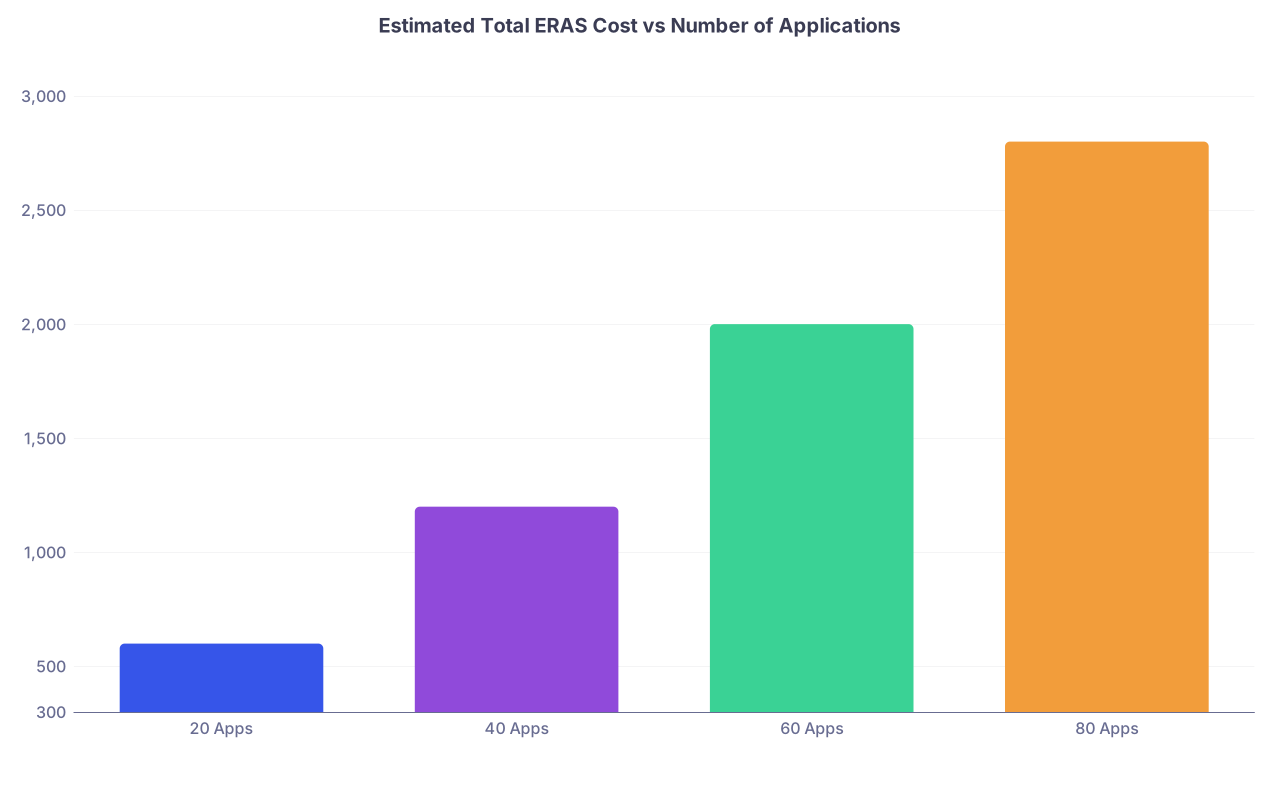
| Category | Value |
|---|---|
| 20 Apps | 600 |
| 40 Apps | 1200 |
| 60 Apps | 2000 |
| 80 Apps | 2800 |
(Rough, but directionally correct including ERAS fees and a modest interview budget; travel-heavy years can be even worse.)
Each 20 additional applications might cost you hundreds of dollars and several hours of prep, tracking, and emotional bandwidth. What are you buying?
If those 20 applications move you from:
- 3 to 6 interviews: excellent purchase.
- 6 to 9 interviews: probably still a good purchase in many specialties.
- 12 to 14 interviews: marginal at best.
- 14 to 16 interviews: almost pure anxiety spending.
You are also buying complexity. Keeping track of 90 applications, 25 interviews, and 18 waitlists is a part-time job. In real life, residents tell me what happens:
- They overapply.
- They get more interview offers than they can realistically attend.
- They cancel late, burning spots others could have used.
- They still match at a program roughly in line with their underlying competitiveness.
The system as a whole becomes less efficient. Individually, a lot of applicants waste money on applications that were never truly in play.
How to estimate your rational application number
Now we move from theory to a quantifiable strategy. You want to set a target number of applications based on:
- Specialty competitiveness.
- Your competitiveness.
- Your risk tolerance.
- Your target number of interviews.
Step 1: Estimate your “interview conversion rate”
You need an approximate ratio: applications → interviews.
You can estimate it from:
- Your school’s historical data (best source). Look at graduates with similar Step 2 CK, class rank, research, and red flags (or lack thereof).
- National benchmarks from NRMP “Charting Outcomes.”
- Talking with recent grads in your field.
Example scenario:
- Specialty: Categorical Internal Medicine.
- Profile: US MD, Step 2 CK 245, no gap years, decent clinical grades.
- Historical data from your school: Similar applicants got about 12–15 interviews from 30 applications.
That implies a rough 40–50% interview rate per application for an appropriate list of programs (right mix of academic vs community, geographic spread, etc.).
Step 2: Set a target number of interviews
Use NRMP-derived logic:
- Safer target for most non-ultra-competitive specialties: 10–12 interviews.
- For highly competitive surgical or lifestyle specialties: 12–14 is a more comfortable target if feasible.
- For backup specialty: you need enough interviews in that field independently (applying to a backup does not magically guarantee match).
Let’s say your target is 12 interviews.
Step 3: Back-calculate number of applications
Use the basic formula:
Number of applications ≈ Target interviews ÷ Expected interview rate
Internal Medicine example above:
- Target interviews: 12
- Expected interview rate: 0.4 (40%)
Applications ≈ 12 ÷ 0.4 = 30
Then add a small buffer based on your risk tolerance:
- Risk-tolerant: +10–15%
- Moderate: +20–25%
- Very risk-averse or slight red flags: +30–40%
Say you are moderate risk-averse: 30 × 1.25 = 37 or ~40 applications.
Now you are in a data-justified range, not just shooting in the dark with “I heard 70 is safe.”
Step 4: Identify your personal “diminishing returns” zone
Continuing the example:
- If each 10 additional applications beyond 40 is likely to add less than 1 interview, you are in diminishing returns territory.
- So applying to 80 programs in that scenario means buying ~4 extra interviews beyond the 12–14 range. Those interviews will not change your match probability very much.
You can repeat this exercise for any specialty if you are honest about your competitiveness.
Examples by specialty: what the data usually support
These are ballpark, data-informed ranges, not universal prescriptions. I am assuming US MD/DO with average-to-good application strength for that specialty and no major red flags.
Family Medicine / Internal Medicine / Pediatrics
The data show:
- Strong applicants often match with 8–12 interviews, frequently obtained from 15–25 applications.
- Applying to 60+ programs in these fields as a solid US MD is usually pure overkill.
Illustrative ranges:
- Strong US MD/DO: 15–30 programs.
- Average US MD/DO: 25–40 programs.
- US IMG / non-US IMG or red flags: 40–70 programs, sometimes more.
Diminishing returns for most US MD/DOs in these fields often start beyond ~35–40 applications.
Psychiatry / Neurology / Anesthesiology / EM
These “mid-competitive” fields vary widely by region.
- Reasonably strong US MDs often see good interview yields with 25–40 applications.
- Average applicants may sit more comfortably in the 35–50 range.
For many:
- Below ~20 applications is risky unless you are top-tier.
- Beyond ~50, interviews-per-10-apps starts to drop sharply.
Categorical General Surgery / OB-GYN / Ortho / ENT
Now you are in the higher-stakes zone, particularly for ortho and ENT.
Pattern:
- Many US MDs in these fields apply to 50–80 programs.
- NRMP data show the match probability curve climbing rapidly up to ~10–12 interviews, then flattening.
- For a reasonably competitive US MD, 40–60 applications often generates enough interviews; more can still help but with shrinking returns.
Diminishing returns often begin:
- Around 60+ for competitive surgical specialties in solid applicants.
- Earlier if your home program strongly supports you and you have strong research.
Ultra-competitive (Derm, Plastics, Neurosurgery)
This is where people panic and apply to 80–120+ programs. Sometimes that is justifiable. But even here, the marginal benefit curves flatten.
- Strong US MD in derm might get a lot of interviews from 40–60 applications.
- Average (for derm) applicants sometimes need 70–90 to secure a safe number.
- Past ~90–100, the extra match probability you buy per application is tiny unless you are a significantly weaker applicant trying to “sling enough mud against the wall.”
The main takeaway: in these fields, overapplying can make some sense, but you should still calculate your interview yield instead of blindly maxing out ERAS.
The psychology problem: fear vs evidence
What pushes people into 80, 90, 100+ applications when the numbers do not support it?
- The horror stories: “My friend only applied to 35 and did not match.”
- The social comparison: classmates flexing “I applied to 85, just to be safe.”
- The sunk-cost fallacy: You already spent 3–4 years angling for this specialty; another $1,000 feels small in comparison.
I am not dismissing the fear. The Match is a brutal, opaque process. But if you track outcomes instead of anecdotes, the pattern is clear:
- Most well-advised applicants who fail to match in non-ultra-competitive fields were underprepared, had red flags, or applied too narrowly (geographically or program type), not simply “too few total applications.”
- Many over-appliers who matched would also have matched with 20–30 fewer applications. They just will never know it.
Data-driven strategy is not about eliminating risk. It is about avoiding disproportionately expensive ways of shaving off tiny slivers of risk.
Practical guardrails: when to stop adding programs
Here is a simple decision framework that aligns with the data.
- Define a reasonable target number of interviews for your specialty and profile (10–12 for most; 12–14 for high-competitive).
- Estimate applications needed based on realistic interview conversion from past cohorts or similar profiles.
- Add buffer (20–40%) based on your risk tolerance and any red flags.
- Once you are above that buffered number, ask one question for each potential additional program:
- “Is this program plausibly one that might interview me, and one I would actually rank ahead of my current lowest realistic option?”
- If the answer is no or “probably not,” skip. You are entering the noise zone.
Do not add programs solely to inflate a false sense of security. The data show that security in the Match comes from:
- Number and quality of interviews.
- An honest, appropriately broad rank list.
Not from a bloated ERAS invoice.