
The usual advice about “apply broadly” is lazy. The data shows there are clear, specialty‑specific numbers where your match probability changes sharply. If you ignore those inflection points, you either burn money on pointless applications or quietly sabotage your odds.
This is about those numbers.
1. The macro view: how program count correlates with match rate
Let’s start with what the NRMP data actually shows when you strip out the noise.
Each year, the NRMP publishes outcomes by “number of contiguous ranks” in a specialty. In plain language: “How many programs did you realistically rank in that specialty?” That is the closest proxy we have for “how many programs did you apply to and interview at.”
Across specialties, the pattern is brutal and consistent:
- Going from 1–2 ranks to ~10 ranks raises match probability more than any other move.
- Past ~15–20 ranks in core specialties (IM, FM, Peds, Psych), returns drop sharply.
- In competitive fields, the “safe” zone shifts right. Sometimes far right.
You are buying probability with each additional realistic program. The early purchases are cheap and powerful. Later ones are expensive and weak.
To make this concrete, assume a simplified, independent-chance model. Suppose your true probability of matching at any one program in a specialty is p. If you rank N programs, the chance of not matching at any of them is:
(1 − p)ᴺ
So your match probability is:
1 − (1 − p)ᴺ
For modest p (say 0.07–0.12 per program), increasing N from 5 to 10 can add 20–30 percentage points to your overall match chance. Increasing N from 20 to 25 might move the needle by only 2–4 points.
The NRMP data essentially confirms this shape across specialties, but the actual N that matters depends heavily on:
- Specialty competitiveness
- Applicant type (US MD vs DO vs IMG)
- Strength category (above average vs borderline)
You are not buying “more chances.” You are buying movement along a known probability curve. The trick is knowing where that curve bends for your specialty.
2. Core specialties: IM, FM, Peds, Psych – where diminishing returns kick in early
For the four big, relatively less competitive specialties, the data is very forgiving as long as you hit a reasonable program count and do not have catastrophic red flags.
Internal Medicine (Categorical)
For US MD seniors aiming at categorical IM:
- Ranking ~8–10 programs typically pushes match probability into the 90%+ range for average applicants.
- Past ~15, match rate improvements are small for US MDs.
For DO seniors, the number shifts slightly higher:
- Think 12–15+ programs to achieve similar comfort.
For IMGs, the curve is much flatter at low N:
- 5 programs ranked? Your match odds are often under 40–50% unless you are unusually strong.
- Around 15–20+ ranks, you start to see meaningful gains, pushing 60–70%+ in some cohorts.
- 25–30+ is where many matched IMGs end up.
So if you are a typical US MD with decent IM application metrics and you are applying to 30+ categorical IM programs “just in case,” the data suggests you are overspending.
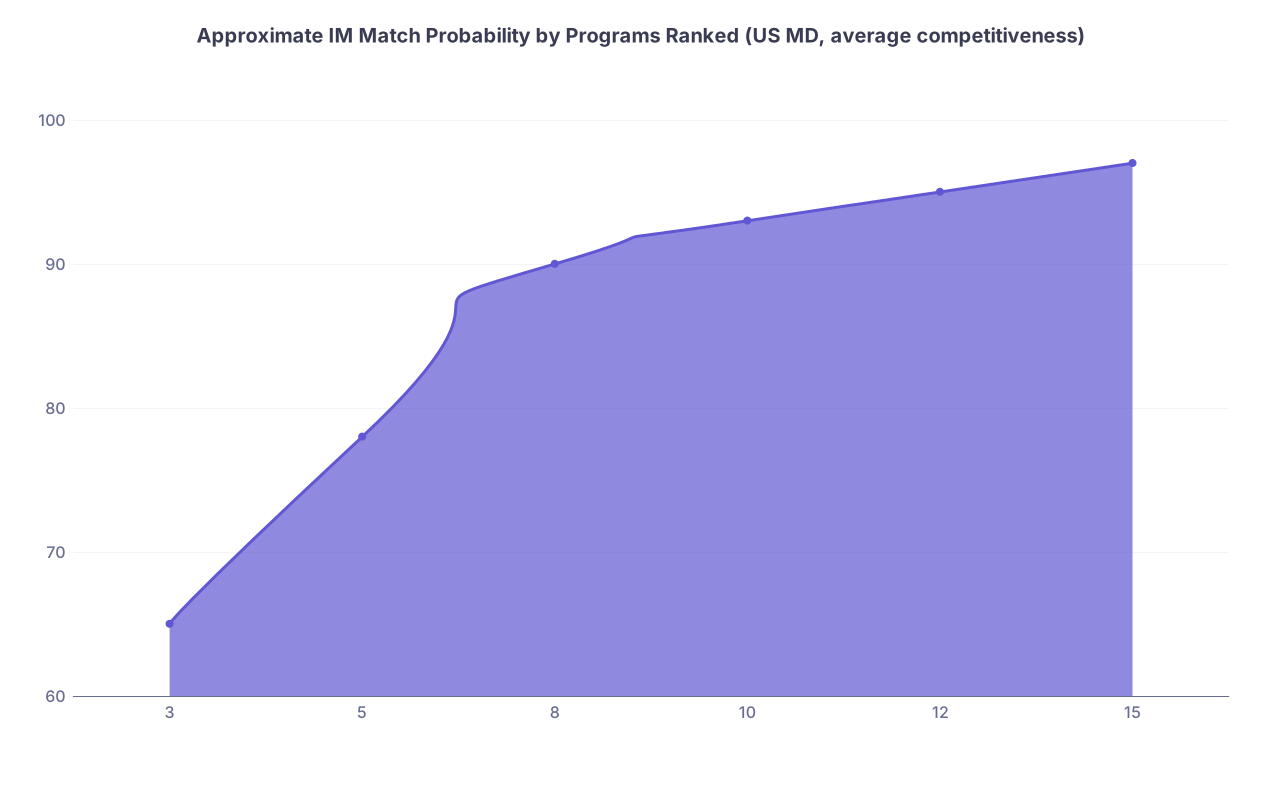
| Category | Value |
|---|---|
| 3 | 65 |
| 5 | 78 |
| 8 | 90 |
| 10 | 93 |
| 12 | 95 |
| 15 | 97 |
These are stylized but in line with NRMP patterns: the big jump is 3 → 8; after 10–12, the curve is almost flat.
Family Medicine
Family Medicine is even more forgiving for US grads:
- US MD: 8–10 well-chosen ranks often gets you to >95% match probability.
- DO: 10–12 ranks are usually comfortable.
- IMGs: 15–20+ ranks are often needed to get into the 60–70%+ zone, more if weak.
If you are a US grad applying to 40+ FM programs with a normal profile, you are buying almost no additional probability after the first 15–20.
Pediatrics
Peds behaves like IM, slightly less competitive at many places:
- US MD: 8–12 ranks is usually “safe.”
- DO: 12–15.
- IMGs: 15–25, depending on strength.
Psychiatry
Psychiatry has become more competitive in recent cycles, but the core pattern holds:
- US MD: pushing into the 90%+ match region around 10–12 contiguous ranks.
- DO: closer to 14–16.
- IMGs: realistically 20–25+.
Here is a comparative snapshot for an “average” US MD applicant across the four:
| Specialty | Ranks for ~90–95% Match | Ranks Where Returns Drop Off |
|---|---|---|
| Internal Med | 8–10 | ~15 |
| Family Med | 8–10 | ~15 |
| Pediatrics | 8–12 | ~15–18 |
| Psychiatry | 10–12 | ~18–20 |
The message: in these specialties, if you are a typical US MD or DO and you are under 10 ranks, you are gambling more than you think. Past ~15–20, you are mostly wasting money.
3. Competitive specialties: where “broad” actually means broad
This is where people get burned. They import IM/Fam Med logic into Derm, Ortho, ENT, etc. Completely different game.
Dermatology
Derm is statistically unforgiving, especially for non–US MDs:
- US MD seniors who match often rank 12–15+ programs, sometimes 20+.
- US MDs with <10 contiguous derm ranks have markedly lower match rates.
- For DOs and IMGs, match rates are much lower across the board, and effective N must be higher just to be in the conversation.
Here, “apply to 60 programs” is not crazy. Because:
- Your interview conversion rate might be 10–20%.
- If you want 12 interviews, you may need 60–80 applications.
Orthopaedic Surgery
Orthopaedic match dynamics (for US MDs):
- Many successful applicants rank 12–18+ programs.
- Drop below ~10 ranks and your match probability falls rapidly.
- Even at 15+ ranks, you are not seeing the 90–95% comfort you see in IM.
For DOs and IMGs, program count demands climb further, and many never reach a double-digit interview count despite broad application.
Otolaryngology (ENT), Plastic Surgery, Neurosurgery
Same overall structure:
- The “you are being reckless” line is not 10 programs. It is more like 15–20+.
- Even at 20 ranks, match probabilities are often well below 90% for average applicants.
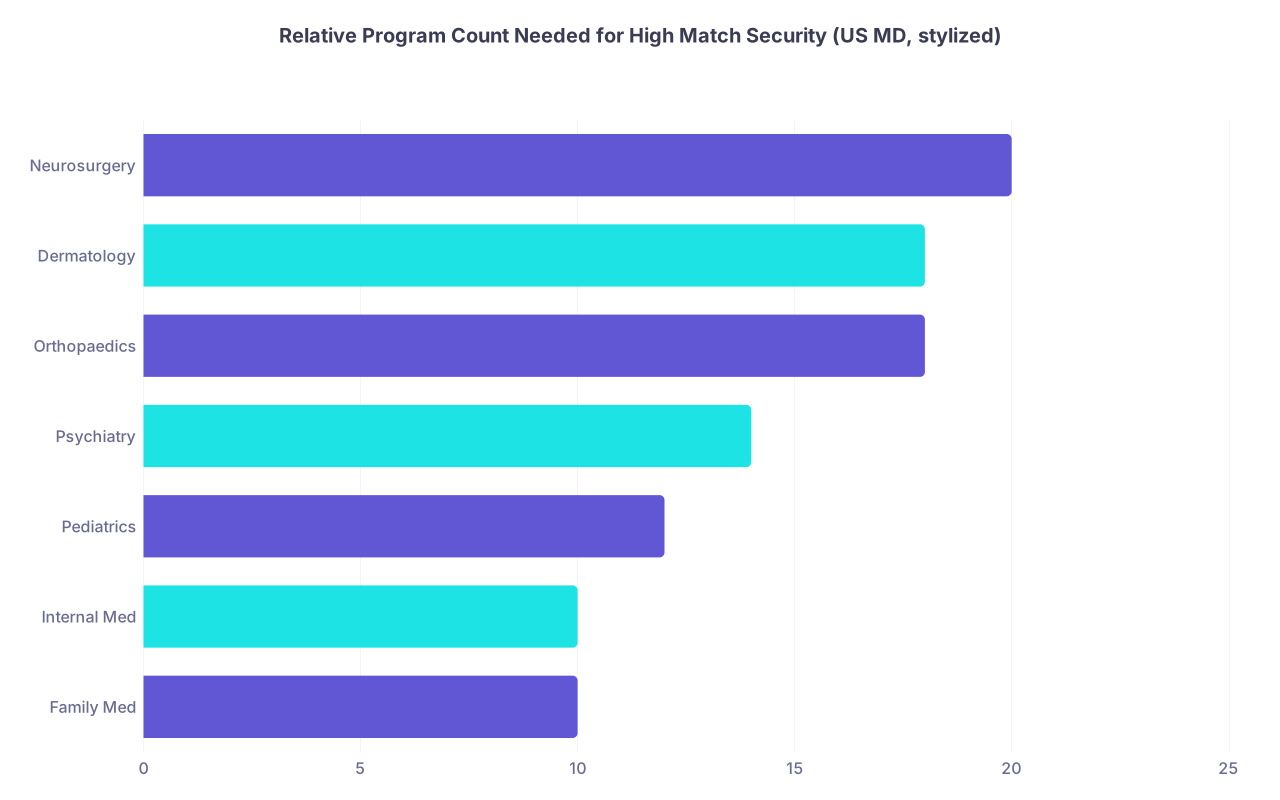
| Category | Value |
|---|---|
| Family Med | 10 |
| Internal Med | 10 |
| Pediatrics | 12 |
| Psychiatry | 14 |
| Orthopaedics | 18 |
| Dermatology | 18 |
| Neurosurgery | 20 |
Interpretation: the bar length here is the rough number of ranked programs where a reasonably competitive US MD begins to feel “less anxious.” You will not get to those ranks unless you apply to substantially more programs.
So if you are an “average” derm or ortho applicant applying to only 20 programs because “that was enough for my IM friends,” the numbers say you are under-applying for your specialty’s competitiveness tier.
4. The IMGs and DOs reality: the curve shifts right
US MDs often live on the left side of the curves. DOs and IMGs are pushed to the right. That is not opinion; it is evident in match rates at each rank bin.
The data pattern:
- At the same number of ranked programs within a specialty, US MD match rates > DO > US-IMG > non-US IMG.
- To get similar match probabilities, DOs and IMGs usually need more programs, more geographically diverse lists, and more “lower tier” choices.
For example, in a mid-competitive field like Psychiatry:
- A US MD might achieve ~90–95% match by ranking 10–12 programs.
- A DO might need 14–16 to get close to this.
- An IMG might need 20–25.
This is before considering exam failures, visa complications, or major academic issues. Those push you even further right.
So if you are an IMG planning to apply to only 15 IM programs because a US MD friend matched with 10, you are playing a different game with a different baseline probability per program.
5. Application counts vs rank counts: converting one to the other
Now the practical question: “How many programs should I apply to?” You never control your final rank count directly. You control:
- Programs applied to
- Program list quality (how realistic they are for you)
- Personal fit that drives interview yield
The downstream result is:
Applications → Interviews → Programs ranked
You care about the right end of that pipeline. But you have to set the left side.
A simple back-of-envelope framework
Use a three-step approximation.
Decide your target number of ranked programs based on specialty + applicant type:
- Core specialties (US MD, average): aim to rank 10–12+ programs.
- Core specialties (DO/IMG): aim to rank 15–20+.
- Competitive specialties (US MD): aim to rank 15–20+.
- Competitive specialties (DO/IMG): often 20+ ranks, plus consider categorical/back-up.
Estimate your interview conversion rate from applications. Conservative defaults:
- Strong, above-average applicant: 25–35% of applications yield interviews.
- Average applicant: 15–25%.
- Below-average / red flags / IMGs in US programs: 5–15%.
Factor that almost all interviews turn into rank list items. Suppose you attend all the interviews offered.
Example, Psych, US MD, average profile:
- Goal: 12 ranked programs.
- Expect you need ~12 interviews (you rarely exclude interview sites entirely).
- Assume 20% interview yield.
- Required applications ≈ 12 / 0.20 = 60.
Same specialty, IMG, average profile:
- Goal: 20 ranked programs.
- Interviews needed ≈ 20.
- Conservative yield: 10%.
- Applications ≈ 20 / 0.10 = 200.
This is why you often see IMGs with 150–250+ applications in moderately competitive fields. It is ugly but mathematically consistent.
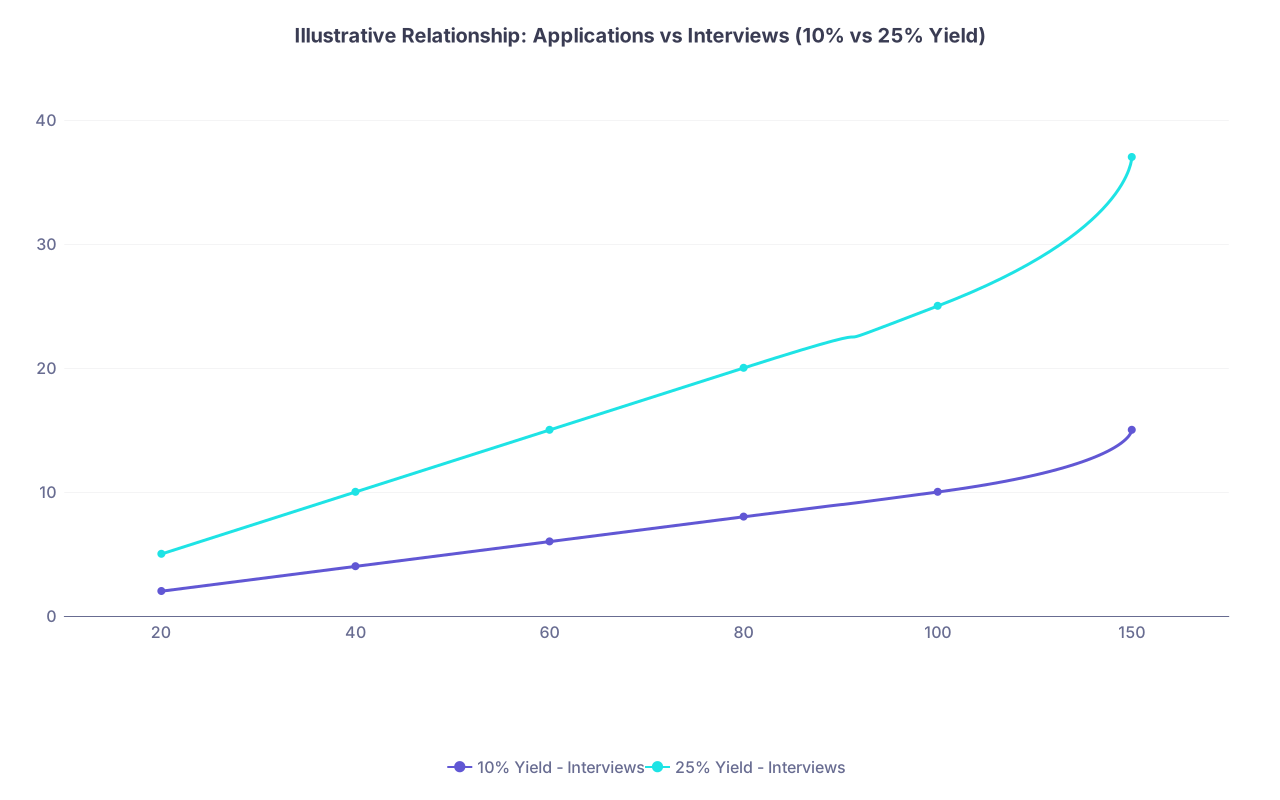
| Category | 10% Yield - Interviews | 25% Yield - Interviews |
|---|---|---|
| 20 | 2 | 5 |
| 40 | 4 | 10 |
| 60 | 6 | 15 |
| 80 | 8 | 20 |
| 100 | 10 | 25 |
| 150 | 15 | 37 |
Most applicants overestimate their yield and end up with too few interviews. The numbers above are not pessimistic; they are typical for average applications in crowded specialties.
6. Specialty-specific benchmarks: “numbers that move the needle”
Let me give you approximate thresholds where the probability curve bends for different buckets. These are directional, based on NRMP trends and real-world experience, not precise guarantees.
Think in three categories: danger zone, reasonable, overshoot for an average-strength applicant.
Internal Medicine – Categorical (Non-research heavy focus)
US MD:
- Danger zone: <8 ranked IM programs
- Reasonable: 10–15 ranked
- Overshoot for most: >20 ranked
DO:
- Danger zone: <10 ranks
- Reasonable: 12–18
- Overshoot: >25, unless other issues
IMG:
- Danger zone: <12 ranks
- Reasonable: 18–25
- Overshoot: >35 in typical cases
Family Medicine
US MD:
- Danger zone: <7 ranks
- Reasonable: 8–12
- Overshoot: >20
DO:
- Danger zone: <8
- Reasonable: 10–15
- Overshoot: >25
IMG:
- Danger zone: <12
- Reasonable: 18–25
- Overshoot: >35
Psychiatry
US MD:
- Danger zone: <8 ranks
- Reasonable: 10–14
- Overshoot: >22–25
DO:
- Danger zone: <10
- Reasonable: 14–18
- Overshoot: >30
IMG:
- Danger zone: <15
- Reasonable: 20–28
- Overshoot: >40
Orthopaedic Surgery (US MD focus)
US MD:
- Danger zone: <10 ranks
- Reasonable: 15–20
- Overshoot: >30, unless significant red flags
DO/IMG planning no back-up:
- Danger zone: <12
- Reasonable: 18–25
- Overshoot: rarely; the limiting factor is often interviews, not willingness to apply.
Dermatology (US MD focus)
US MD:
- Danger zone: <10 ranks
- Reasonable: 15–22
- Overshoot: >30 for a typical candidate, but again, interview offers limit you.
The core truth: “numbers that move the needle” in competitive specialties are much higher than in IM/FM/Peds/Psych. You do not get IM-level safety with 10 derm or ortho ranks.
7. Back-up and parallel planning: modeling two lists
One of the worst statistical errors I see is applicants treating a competitive specialty and its back-up as if they are independent. They are not.
If you apply to, say, 60 ortho programs and 30 categorical IM programs, your goal is not “60 ortho + 30 IM.” Your goal is:
- Enough ortho ranks to have a real shot at matching there
- Enough IM ranks that if ortho fails, your no-match probability stays acceptably low
Viewed probabilistically:
- Let P(Ortho match | 15 ortho ranks) = 0.40 (example).
- Let P(IM match | 12 IM ranks) = 0.90 (example).
If your IM list is ranked below all ortho programs, your overall no-match probability is roughly:
P(no ortho match) × P(no IM match)
= (1 − 0.40) × (1 − 0.90)
= 0.60 × 0.10
= 0.06 → 6%
The IM back-up list is an insurance policy. But only if the IM list itself is large enough. Applying to just 5 IM programs and calling it a “back-up” is self-deception. The data does not care what you call it.
Here’s the conceptual flow you are actually managing:

| Step | Description |
|---|---|
| Step 1 | Choose Target Specialty |
| Step 2 | Estimate Competitiveness Tier |
| Step 3 | Set Target Ranked Programs Main |
| Step 4 | Need Back up Specialty? |
| Step 5 | Set Target Ranked Programs Backup |
| Step 6 | Skip Backup |
| Step 7 | Estimate Interview Yield |
| Step 8 | Estimate Interview Yield Backup |
| Step 9 | Decide Applications Main |
| Step 10 | Decide Applications Backup |
If you skip steps C and E – explicit targets – you are just guessing.
8. Strategic trimming: when not to add more programs
There is an opposite failure mode: the “spray and pray” crowd adding more programs indiscriminately while ignoring true probability.
Here is where more programs do not move the needle:
Programs where you are categorically non-viable
- E.g., IMG applying to programs that explicitly never sponsor visas or have 0 IMGs in the last 5 years.
- US MD with repeated exam failures applying to ultra-competitive academic flagships that historically take none with similar profiles.
Extreme geographic or fit mismatch that will never be ranked
- If you are 100% certain you would not rank certain locations/program cultures, then these applications do not increase your ranked program count. They just cost money.
Redundant community programs with identical profile when your rank count is already beyond the bend
- US MD with 20 categorical IM ranks adding 10 more almost identical community IM programs. The incremental probability is minuscule.
The goal is not to maximize raw application count. It is to maximize the expected number of ranked programs that have non-trivial match probability given your profile.
You want to be aggressive in adding:
- Realistic safety and mid-tier programs
- Programs with a history of taking applicants like you (same degree type, visa status, Step attempts)
- Geographic regions where you genuinely would live
You can be brutal in cutting:
- “Prestige vanity” applications that will almost certainly not interview you
- Programs whose culture or location is a non-starter and would never cross your rank list
9. Pulling it together: a working template by specialty tier
Let’s distill this into a usable framework.
Assume you are an average applicant for your group (US MD vs DO vs IMG), and you want to keep your no-match probability comfortably low.
| Specialty Tier | US MD Target Ranks | DO Target Ranks | IMG Target Ranks |
|---|---|---|---|
| Core (IM, FM, Peds) | 10–12 | 12–18 | 18–25 |
| Psych (current cycles) | 10–14 | 14–18 | 20–28 |
| Mid-competitive (EM\*) | 12–16 | 16–20 | 22–30 |
| Highly competitive | 15–20 | 18–25+ | 20–30+ |
*EM is in flux with structural changes and saturation, but the approximate rank logic still holds conceptually.
Then, reverse-engineer applications using realistic interview yield estimates. That will give you a program count that is aggressive but not wasteful.
FAQ (exactly 4 questions)
1. Is there any situation where applying to 100+ programs in a core specialty makes sense?
For a typical US MD or DO in IM, FM, Peds, or Psych, no. Once you are in the zone of 15–25 plausible programs on your rank list, your incremental gains are tiny. The only time 100+ applications might be defensible is for IMGs with low yield and substantial red flags, where you are essentially casting a global net to salvage any interview you can get. Even then, the key is targeting, not raw volume.
2. How many programs should I apply to if I am dual applying (competitive + core)?
Start by setting independent target ranks for each: for example, 18 ortho programs and 12 IM programs. Then estimate interview yields separately and translate to applications. It is entirely normal to see numbers like 60–80 applications to the competitive field plus 25–40 to the back-up. Just do not let the competitive specialty steal slots from the back-up to the point that your back-up rank count becomes useless.
3. Can fewer, carefully chosen applications ever outperform a huge list?
Yes, especially for US MDs and DOs in core specialties. A focused list of 25–35 programs that are a very tight match for your academic profile, geography, and program type often produces more interviews and ranks than a sloppy list of 80 that includes many long shots and places you would never rank. The metric that matters is ranked programs with real probability, not application line items in ERAS.
4. My friends matched with far fewer programs than you are suggesting. Are these numbers overkill?
Some people win coin flips three times in a row and believe they are great strategists. The NRMP data aggregates thousands of applicants and shows where match probabilities on average change steeply. Your friends might be outliers: strong applicants, favorable geography, lucky interview seasons. Planning around anecdotal success is a high-variance strategy. Planning around the probability curves is not glamorous, but it is safer.
Key points:
- Every specialty has a “bend” in the match probability curve where extra programs stop adding much value; find that bend for your profile.
- US MDs can often be safe with 10–15 ranked core programs; DOs and IMGs usually need more, and competitive specialties shift everything upward.
- The winning strategy is not “apply everywhere,” but “apply enough, to the right programs, to hit your target rank count where the data shows your odds rise sharply.”