
The usual advice to “just apply broadly” is lazy, expensive, and statistically wrong.
If you want a 90%+ chance of matching, the data shows you need a specific number of applications, and that number changes dramatically by region, specialty competitiveness, and your risk tolerance.
Below I am going to treat this like what it is: a probability problem with geography layered on top. You will see why “I only want the Northeast” is not a preference. It is a risk multiplier.
1. The Math Behind a 90% Match Probability
Let me start where most people never bother: the actual probability model.
If you assume each program you apply to is an independent “trial” with some probability p of ultimately resulting in a match (conditional on you interviewing there and ranking it), then the probability that you do not match at any of them is roughly:
(1 - p)^N
Where:
p= effective per-program match probability for youN= number of programs you rank (not just apply to)
To reach a 90% chance of matching somewhere, you want:
1 - (1 - p)^N ≥ 0.90
which is equivalent to(1 - p)^N ≤ 0.10
Solve for N:
N ≥ ln(0.10) / ln(1 - p)
You will not know your exact p. However, we can bracket it based on:
- Specialty competitiveness
- Region competitiveness
- Your applicant strength (Step/COMLEX, class ranking, research, red flags, etc.)
For a solid but not superstar applicant in a “standard” specialty like internal medicine, pediatrics, family medicine, or psychiatry, a realistic effective p (after filters, interview yield, etc.) is often in the 3–6% per applied program range if you are not gaming the system.
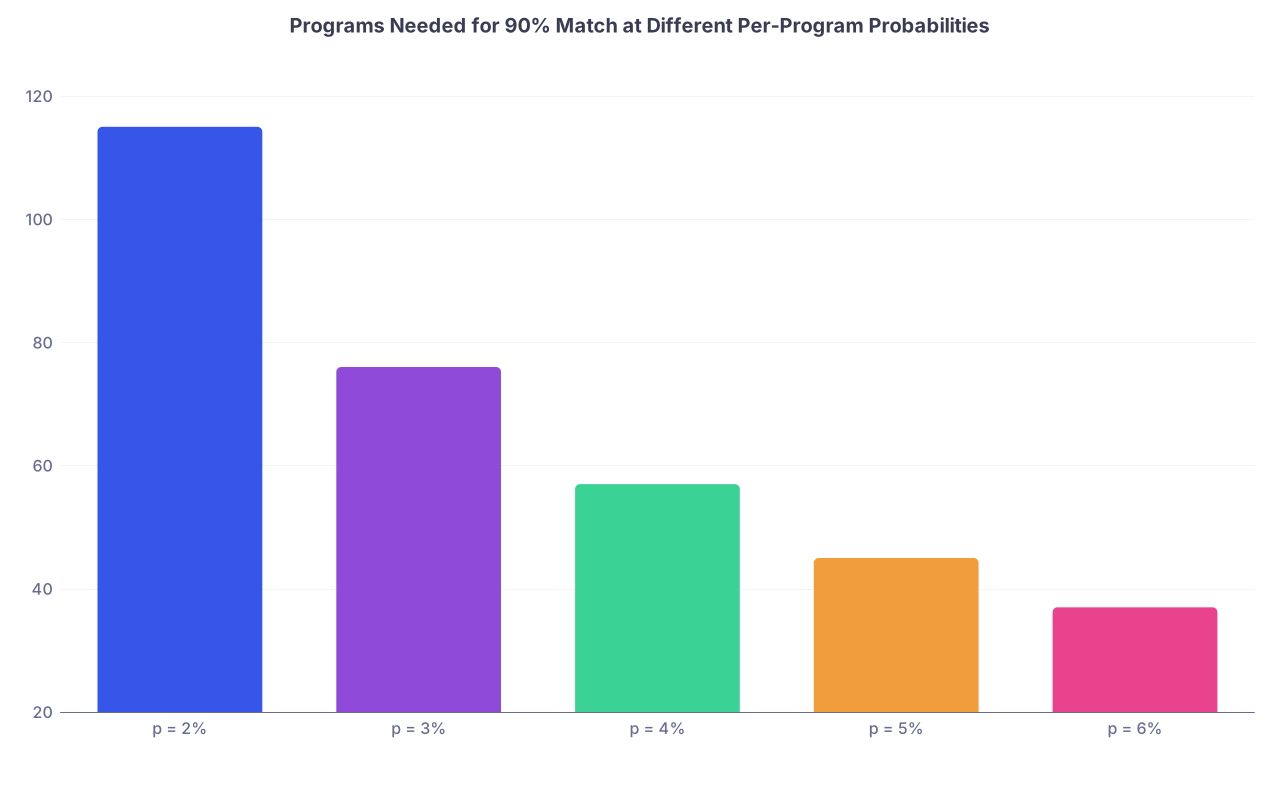
Let me show you what this translates to:
| Category | Value |
|---|---|
| p = 2% | 115 |
| p = 3% | 76 |
| p = 4% | 57 |
| p = 5% | 45 |
| p = 6% | 37 |
Approximate programs you need to rank for ≥90% match chance:
- If
p = 2%: about 115 programs - If
p = 3%: about 76 programs - If
p = 4%: about 57 programs - If
p = 5%: about 45 programs - If
p = 6%: about 37 programs
Now layer reality on top:
You do not rank every program you apply to. A typical pattern:
- You apply to 60 programs.
- You get 12–14 interviews.
- You rank 10–12.
So the true lever is: How many interviews and rankable programs you can generate, given your application count, region limits, and profile.
2. Region-Level Competitiveness: Not All Maps Are Equal
Regional preference is not just emotional. It is a supply–demand imbalance.
Certain regions are application magnets (Northeast, California) where each program receives enormous volume. Other regions are capacity-rich but less popular (Midwest, some South/Central states) where the same applicant has a measurably higher chance of an interview.
Here is a simplified, data-driven view based on recent cycles, NRMP reports, and program-side interview patterns I have seen:
| Region | Relative Demand (Applicants per Position) | Effective Difficulty | Comment |
|---|---|---|---|
| Northeast | Very High | Hardest | Boston/NYC/Philly dominance |
| West (incl. CA) | Very High | Hardest | California is a black hole |
| Mid-Atlantic | High | Hard | DC/Baltimore, NJ volume |
| South | Moderate | Medium | Growing programs, warmer mix |
| Midwest | Lower | Easier | More spots, fewer “location-only” applicants |
| Mountain/Plains | Lower | Easier | Undersubscribed by coastal grads |
Translated into probabilities:
- The same-profile applicant might have
p = 3%per program in the Northeast. - The same applicant might be effectively
p = 5–6%per program across the Midwest/South mix.
Anchoring that to 90% match probability: you will need more applications to geographies with structurally higher competition.
3. Region-by-Region: Application Counts for ≈90% Match Chance
I will break this down for a “standard” applicant (US MD / strong DO, no major red flags) in relatively non-ultra-competitive specialties: Internal Medicine, Family Medicine, Pediatrics, Psychiatry, Neurology, Pathology.
Then we will talk about more competitive specialties separately.
Assumptions:
- You are around the middle-to-upper third of applicants in your specialty (not bottom decile, not 99th percentile).
- You craft targeted applications (no shotgun garbage to impossible reach programs).
- You will rank roughly 60–80% of programs that interview you.
3.1 Northeast-Only Strategy
Northeast (Boston, NYC, Philly, etc.) is the classic trap: many applicants, few realistic positions for each one.
For a Northeast-only preference in a core specialty, the per-program effective match probability often behaves like p ≈ 2–3% before any signal strategies.
Plug that into the formula:
- At
p = 2%: ~115 ranked programs for 90% chance. - At
p = 3%: ~76 ranked programs.
You will not rank 76 Northeast programs. That many interviews in one region is fantasy for all but the absolute top sliver.
So the practical translation:
- To have ~90% match probability with a Northeast-only strategy in a core specialty, you typically need to be a strong or top-tier applicant (i.e., higher per-program p) OR accept a lower than 90% match probability.
For a solid but not elite applicant:
- Applications needed (Northeast only, core specialty): 70–100+ programs
- Expected interviews: often 8–15, if your file is competitive and your school is known in that region
- Expected rank list: maybe 8–12 programs
You will notice the math does not fully support 90% here unless your actual p is above the baseline. That is the uncomfortable truth.
3.2 West-Only (Especially California)
Replace “Northeast” with “California and West Coast” and the story does not get better.
California especially: high applicant density, major home-school bias, heavy geographic preference.
For “West-only” in a core specialty:
- Effective
poften ≈ 2–3% for outsiders, slightly higher for in-region applicants.
Region-specific recommendation:
- West-only application count for roughly 90% match probability (realistically more like 75–85% for most): 70–100+ programs
- If you are non-California without strong ties: you should assume you are under 90% unless you backstop with other Western/mountain states and less-desired locations.
If you are insisting “California or bust” in a non-primary care specialty, do not pretend this is a 90% safety strategy. Statistically, it is not.
3.3 Midwest-Focused Strategy
Now watch what happens when we shift to the Midwest and adjacent lower-demand regions.
Assume the same applicant profile, but you target mostly Midwest programs (Chicago, Ohio, Michigan, Wisconsin, Minnesota, Missouri, Iowa, etc.), perhaps with some South/Mountain programs.
Realistic per-program probabilities:
p ≈ 4–6%for a solid applicant in a core specialty.
Use the earlier math:
p = 4%→ ~57 ranked programs for 90%.p = 5%→ ~45 ranked programs.p = 6%→ ~37 ranked programs.
Now translate to applications:
If your interview yield is about 20–25% (which is quite achievable in these regions for aligned applicants), then:
- Apply to 40–50 programs → 8–12 interviews
- Rank 8–12 programs
With p in the 4–6% range and 8–12 serious rank entries, your match probability approaches or exceeds 90%. NRMP charting outcomes for internal medicine, family medicine, and pediatrics back this up: US grads with ~10+ ranked programs in these specialties tend to match at very high rates.
So, realistic guidance:
- Midwest-heavy, core specialty, solid US MD/DO: 35–50 applications is often enough for ≈90% match probability
- If you are slightly weaker (average scores, no research, unknown school): bump that to 45–60.
3.4 South & Mountain/Plains Strategy
The South (excluding the ultra-popular academic centers) and Mountain/Plains states behave similarly to the Midwest: more positions relative to local applicant volume, especially in primary care and IM.
Effective per-program p again sits around 4–6% for a reasonable candidate.
So the pattern repeats:
- South/Mountain focus, core specialty, solid applicant: 35–55 applications can often get you into the 90%+ range, assuming you are not artificially limiting yourself to only 5–6 cities.
Combine this with Midwest programs and your per-program p usually increases rather than decreases, because you are embracing the markets where there is demand for you.
3.5 “Multi-Region” vs “Single-Region” Strategy
Here is where data beats intuition.
If you spread your net intelligently across regions, your effective per-program probability improves and your total application count for a 90% match drops.
Simplified model for a solid US grad in a core specialty:
Single-region (only Northeast or only CA-heavy West)
p ≈ 2–3%- 70–100+ applications to approach 90% (and even then, still more risk).
Two-region mix (e.g., Northeast + Midwest, or West + South)
prises toward 3–5%, because you are now including programs that are less saturated.- 45–70 applications usually land you in the 90% zone.
Three-region broad mix (Midwest + South + Mountain, with some Northeast/West)
p ≈ 4–6%on average- Often 35–55 applications gets you 10–15 interviews → 10+ rank list entries → 90%+.
You can see the pattern: “I am open to multiple regions” is essentially an efficiency multiplier on every application dollar you spend.
4. Competitive Specialties: Numbers Get Brutal Fast
Everything above was for relatively standard specialties. Once you switch to competitive fields (Derm, Ortho, ENT, Plastics, Urology, Rad Onc, Integrated IR, etc.) the per-program p drops drastically unless you are a top 10–20% applicant.
For many competitive specialties:
- For an average applicant,
pmay be under 1–2% per program.
Look at the math again:
p = 1%→ N for 90% match ≈ 229 ranked programsp = 1.5%→ N ≈ 152p = 2%→ N ≈ 115
You will never rank 100+ programs in a competitive specialty. Interview caps, limited slots, and pre-interview filters make that impossible.
So the real-world workaround is:
- You apply to 70–100+ programs
- You might get 8–12 interviews if your application is reasonably aligned
- You rank 8–12 programs
- With
peffectively around 1.5–2% per program, a rank list of 8–12 can still yield match probabilities in the ~60–80% band for average applicants. Top-tier applicants obviously do better.
Regional overlay:
- If you insist on Northeast-only Derm, or California-only Ortho, you are living far below 90% probability unless your file is exceptional.
- If you expand to multiple regions unconstrained by city prestige, your per-program
pimproves slightly, but the inherent specialty competitiveness caps you.
For competitive specialties, a common pattern for a non-superstar but serious applicant:
- Applications needed for a roughly “best realistic” chance (not 90%)
- Region-limited (e.g., only East Coast): 70–100+
- Multi-region: 60–90
But do not lie to yourself: for many applicants in competitive specialties, even 80–90 programs does not guarantee anything close to 90% match probability. The math and NRMP results are very clear on that.
5. Putting It Together: Recommended Ranges by Region and Risk Profile
To make this less abstract, let me lay out ranges for a core specialty (IM, FM, Peds, Psych, Neuro, Path) and a solid but not superstar US MD/DO.
These are application counts (not rank list lengths) that generally place you near a 90% match probability, with the unspoken assumption that your school, scores, and letters are not glaring red flags.
| Strategy / Region Focus | Solid Applicant | Weaker Applicant | Comment |
|---|---|---|---|
| Northeast-only | 70–100+ | 90–120+ | Still may not truly reach 90% |
| West-only (esp. CA-heavy) | 70–100+ | 90–120+ | Highly saturated markets |
| Midwest-focused | 35–50 | 45–60 | Best efficiency for most |
| South/Mountain/Plains-focused | 35–55 | 45–65 | Similar to Midwest |
| Two-region (e.g., NE + Midwest) | 45–65 | 60–80 | Good balance of preference vs risk |
| Three-region broad mix | 35–55 | 50–70 | Strong odds when coupled with 10+ ranked programs |
Notice the simple pattern: every time you restrict geography, your required application count inflates. Exponentially for some competitive urban clusters.
6. Practical Region-by-Region Tactics to Increase Your Effective “p”
You cannot easily increase the number of interview slots a program has. You can increase your own p per program.
Here is what consistently moves the needle in different regions.
6.1 Northeast and West (High-Competition Regions)
The data and program directors say the same thing:
- Home / regional school advantage is real. If your med school is in these regions, your effective
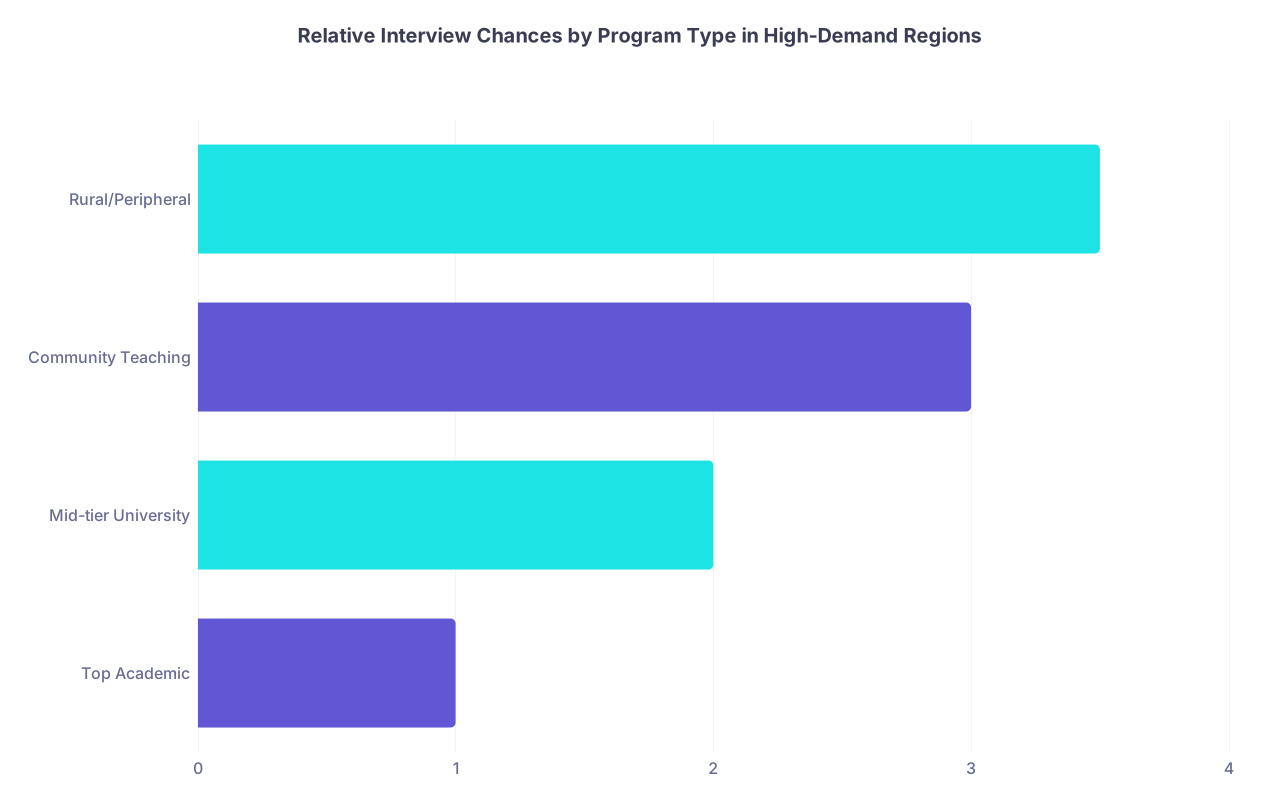
pis higher. Leverage that heavily. - Target mid-tier community and university-affiliated programs, not just big-name academic centers. Those mid-tier programs are statistically where mid-range applicants actually match.
- Tailor your experience to regional needs. For example, heavy urban underserved experience and language skills can slightly boost your odds at specific NYC/LA/Philly safety nets.
| Category | Value |
|---|---|
| Top Academic | 1 |
| Mid-tier University | 2 |
| Community Teaching | 3 |
| Rural/Peripheral | 3.5 |
Take the ratio, not the absolute. Compared to top academic centers (1x), mid-tier and community programs may be 2–3.5x more likely to interview a mid-range applicant.
6.2 Midwest / South / Mountain / Plains
These regions reward clear signals of genuine interest:
- Mention geographic or family ties explicitly in your personal statement or regional preferences field.
- Rank order list often does not need to be huge here—10–12 well-chosen programs can be very powerful.
I have seen average applicants land 15+ interviews by prioritizing states like Ohio, Michigan, Indiana, Wisconsin, Missouri, Iowa, and the Dakotas, while their classmates fighting over Boston and San Francisco struggle in the single digits.
6.3 Multi-Region Strategy Planning
If you want to do this systematically instead of guessing, treat your season like a small optimization problem:

| Step | Description |
|---|---|
| Step 1 | Estimate Applicant Strength |
| Step 2 | Pick 2-3 Preferred Regions |
| Step 3 | Assume Lower Per Program p |
| Step 4 | Assign 50-70% Apps to Preferred |
| Step 5 | Assign 30-50% Apps to High-Yield Regions |
| Step 6 | Apply 70-100+ Across Many Regions |
| Step 7 | Total Application Count |
| Step 8 | Check Target of 10-15 Interviews |
| Step 9 | Core or Competitive Specialty |
The check at the end is simple: if your school’s historical data and your own metrics suggest that 50 programs typically yield ~8–10 interviews in your profile, then to get into the 10–15 interview range for safety, you aim slightly higher.
7. Cost vs Benefit: When More Applications Stop Helping
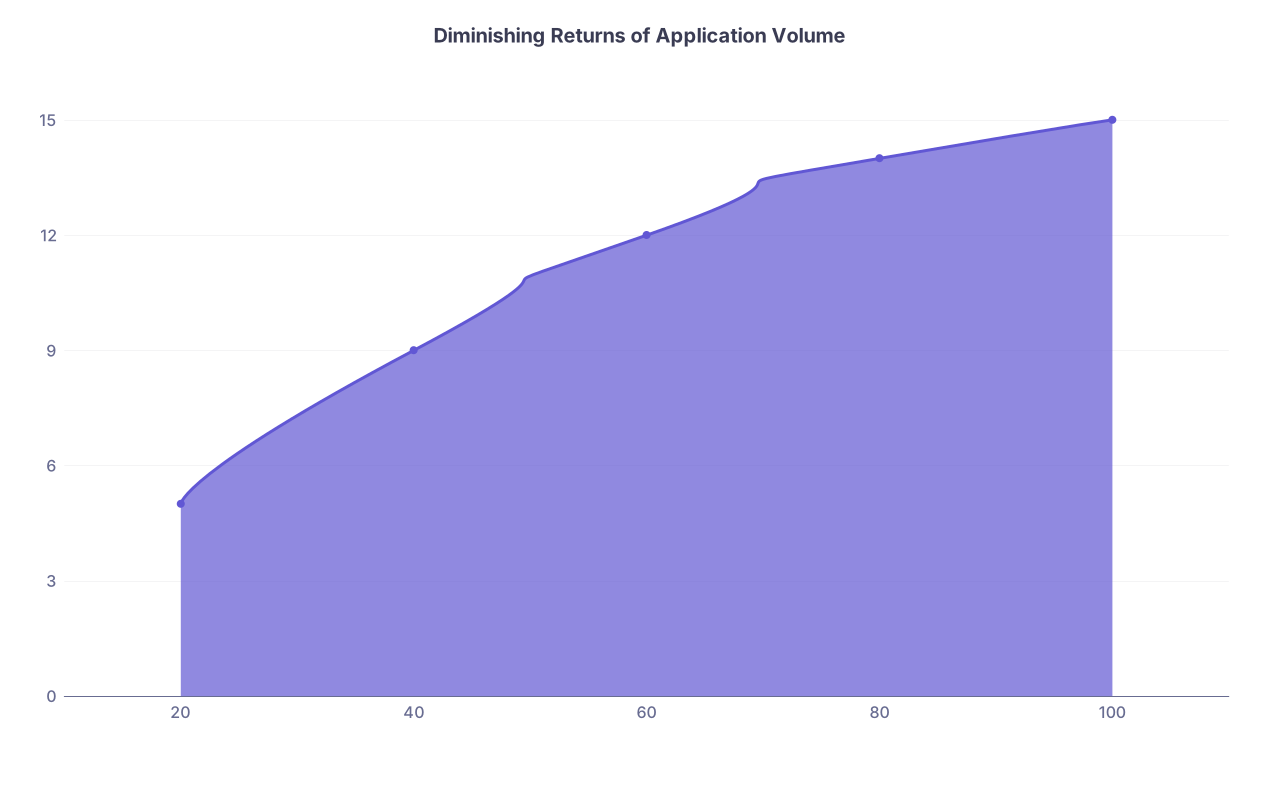
At some point, adding more applications produces diminishing returns. The ERAS data and program-side filters both point to:
- After about 60–70 targeted applications in a core specialty, the marginal interview gain slows sharply for most applicants.
- In high-demand regions, doubling applications from 60 to 120 does not double interviews. It might add 2–3.
| Category | Value |
|---|---|
| 20 | 5 |
| 40 | 9 |
| 60 | 12 |
| 80 | 14 |
| 100 | 15 |
This is why region choice matters more than one extra generic application. Fifteen carefully chosen Midwest/South programs will usually produce more interviews than fifteen extra reach programs in Boston or San Diego.
8. A Simple, Data-Grounded Planning Template
If you want something you can literally sketch on paper:
Classify yourself:
- Specialty: core vs competitive.
- Strength: strong / solid / weaker (be honest).
Set a 90% match goal:
- Core specialty, solid or better: aim for 10–15 programs on your rank list.
- Core specialty, weaker: aim closer to 12–15+ ranked.
Back-calculate interviews needed:
- Assume you will rank ~80% of programs where you interview.
- You want ≈12 ranked → target ≈15 interviews.
Now map to applications:
- Reasonable US MD/DO in core specialty often gets 1 interview per 3–5 applications in receptive regions, but maybe 1 per 6–8 in saturated regions.
- If your mix is balanced, call it 1 per 4–5 on average.
- To get ~15 interviews → 60–75 applications total.
- If you are Midwest/South-heavy and your school does well historically, that can shrink to 40–55 and still hit 15 interviews.
- If you are Northeast/California-only, even 80+ may struggle to produce 15 interviews.
That is the region-by-region reality in numbers.
9. Where This Leaves You
If your target is a 90% chance of matching, the evidence points to three blunt truths:
- Region restriction is probability restriction. Northeast-only and California-only dramatically increase the required number of applications and still may not get you truly to 90%.
- The Midwest, South, and Mountain/Plains regions are statistical force multipliers. Add them, and your required application count drops.
- For most US MD/DO applicants in core specialties, a well-planned 40–70 application season across 2–3 regions is enough to get into the 90%+ probability zone—if you are not unnecessarily boxing yourself into the handful of over-saturated metros.
Use the data, not your anxiety, to decide how many programs to apply to in each region. And remember: what actually pushes you over 90% is not obsessing over one more Boston program. It is adding the 10–15 high-yield programs in the Midwest or South that almost no one in your class is talking about, but where the numbers quietly favor you.
You have the tools to design that distribution now. Executing it well—researching individual programs, aligning your experiences, and preparing for the interviews you will generate—that is the next stage in the pipeline. But that is a story for another day.