
You’re sitting at your parents’ dining room table with a laptop, a half-finished spreadsheet, and a map pulled up. You’ve circled a 3‑hour radius around your hometown. Inside that circle? Maybe 6–10 residency programs in your specialty. Outside that circle? Dozens more.
Your dean says, “Cast a wide net.”
Your gut says, “I need to be near my family.”
ERAS says, “That’ll be $29 more for the next 10 programs.”
You’re trying to do two things at once that feel almost incompatible:
- Stay geographically close to family (for real reasons: illness, child care, mental health, partner’s job, etc.)
- Still have decent odds of matching by applying to “enough” programs.
Here’s how to boost your numbers—program count, interview count, realistic options—without blowing up your geographic fit or pretending you can move anywhere.
Step 1: Get Brutally Clear on Your “Must Stay Near Family” Reality
Before talking numbers, you need to define what “near family” actually means. Vague thinking here will wreck your strategy.
Ask yourself, and answer in writing:
- Who are you staying near and why? (Parent with cancer, partner whose job can’t move, shared custody situation, your own health, etc.)
- What is the max travel time you can realistically tolerate? 30 minutes? 1 hour? 3–4 hours?
- Are you okay with:
- A nearby airport but living in a different city?
- Driving in on weekends only?
- Live-in blocks vs. visiting on golden weekends?
Now translate that into a concrete “zone” instead of a feeling.
Example:
“My non‑negotiable: I must be within 2 hours by car of my parents because my mom is on dialysis and I’m the backup caregiver.”
That gives you: a 2‑hour driving radius. Not “the city where my family lives.” That distinction matters because:
- A strict “only this city” rule might give you 1–3 programs total. Dangerous.
- A radius gives you leverage. You might go from 3 programs to 12–15 within 2 hours.
Draw this out:
- Pull up Google Maps.
- Drop a pin at your anchor location (family home, major hospital where family is treated, etc.).
- Sketch 1–2 radii: 1 hour, 2 hours, maybe 3–4 hours if you’re somewhat flexible.
- List every ACGME-accredited program in that circle, not just the prestige names you’ve heard.
This becomes your Core Zone.
Step 2: Know Your Specialty’s Numbers So You Don’t Panic-Overapply
You cannot decide “how many programs” in a vacuum. Different specialties = very different risk.
Here’s a simplified example using fictional but directionally realistic targets (not exact NRMP numbers, but close enough to plan around):
| Specialty Type | Applicant Profile Example | Safer Target Range |
|---|---|---|
| Less competitive (FM, IM, Peds) | US MD, solid passes, no red flags | 15–25 programs |
| Moderate (Psych, Neuro, OB/GYN) | US MD, average app, maybe a B/C in class | 25–35 programs |
| Competitive (EM, Anes, Ortho) | US MD, average stats, no big issues | 35–50 programs |
| Very competitive (Derm, Plastics, Ortho w/ issues) | Below-average scores or red flags | 50–70+ programs |
If your specialty is low–moderate competitiveness and you’re an average US MD without red flags, applying to 60+ programs “just because” is usually overkill—and financially stupid.
But here’s the twist: geographic restriction is its own form of competitiveness problem. You can be an average IM applicant, but if you’re only willing to go to 6 programs in one metro area, you’ve effectively made IM into derm for yourself.
So you need two numbers:
- The “normal” application target for your specialty given your profile.
- An inflation factor to account for geographic limits—usually 1.5–2x if your core zone has fewer programs.
Example:
- You’re applying psych (moderate), average US MD: baseline 25–30 programs.
- Your core zone has only 8 psych programs.
- You bump total target to ~40–45, but structure them smartly (we’ll get there).
Step 3: Build a Three-Tier Program Strategy (While Staying Near Family)
You’re going to sort programs into three buckets, all with geography in mind.
Tier 1: Core Zone – True “Stay Near Family” Programs
These are programs that keep you within your defined acceptable radius.
Criteria:
- Within your non‑negotiable travel window.
- Any reputation level (university, community, county, underrated safety), as long as they’re accredited and not toxic disasters.
Your mistake here would be limiting this tier to only “good” or “prestige” programs near home. That’s backwards. If you must be near family, you stack every reasonable program in that zone, even if the website looks like it was last updated in 2012.
This tier is where you’re allowed to “over-apply”—because you’re not adding geography risk. If there are 12 legit programs in your zone, you apply to all 12. No debate.
Tier 2: Extended Zone – Reasonable Travel to Family
Now extend the radius.
- Maybe your core need is “can see them at least 1–2 times per month.”
- That might mean 3–4 hour drive or short direct flight.
- Think: another city with cheap megabus/train, or a major hub airport 1 flight away.
These are your fit + access programs. You’d prefer Tier 1, but Tier 2 still allows a real relationship with your family, not just holidays.
You pick them based on:
- Solid training.
- Your competitiveness fit (you’re not a clear reach at every single one).
- Practical accessibility: nonstop flights, reasonable train connections, no $800 tickets.
Tier 3: Safety Net – Training > Geography
These are your “if everything goes sideways, I still become a board-certified doctor” programs.
- Geography is looser: maybe cross-country.
- But you’re still at least trying for cities where:
- There’s an airport with relatively affordable flights home.
- You can visit for key events or emergencies without destroying your life.
This tier is not optional if:
- You’re in a competitive specialty, or
- Your core zone has fewer than 10–12 programs, or
- You have any red flags (Step failures, leaves, very low scores).
Step 4: Turn That Into Real Numbers (Without Blindly Applying to 80+)
Let’s walk a realistic scenario:
You:
- Specialty: Internal Medicine (categorical)
- US MD, Step 2: 232, no red flags
- Want to be near: parents in Cleveland due to dad’s CHF, you help with appointments
- Non‑negotiable: within 3 hours drive for Tier 1
- Extended: up to 1 cheap flight away for Tier 2
You map it out and find:
- Tier 1 (Core Zone, 3-hour drive): 9 IM programs (Cleveland, Akron, Pittsburgh, Columbus area)
- Tier 2 (Extended, easy flight or 6-hour drive): 12 more programs (Chicago, Detroit, Indianapolis, maybe Philadelphia depending on your threshold)
- Tier 3 (Safety Net): 10–15 additional programs spread nationally where you’d rather not go, but could.
Your target count for average IM should be about 20–25.
You have strong geographic constraints. So you inflate to ~30–35.
Distribution might look like:
- Tier 1: all 9 programs (non-negotiable to apply to every reasonable one)
- Tier 2: 15 programs you vet for fit and your competitiveness
- Tier 3: ~8–10 additional lower- to mid-tier programs where your stats are safe
Total: ~32–34 programs. Enough to be safe without going wallet-nuking.
Compare that to what many people do when anxious: 60+ programs (half in places they’d hate), no plan, just vibes and a credit card.
Step 5: Use Data, Not Vibes, to Pad Your List
If you’re going to boost numbers, at least do it intelligently.
Two quick tools:
- Look up program fill rates, board pass rates, and size. Mid‑tier community programs with solid board pass rates are good safety adds.
- Use NRMP data and any specialty-specific advising resources for “interview yield” estimates.
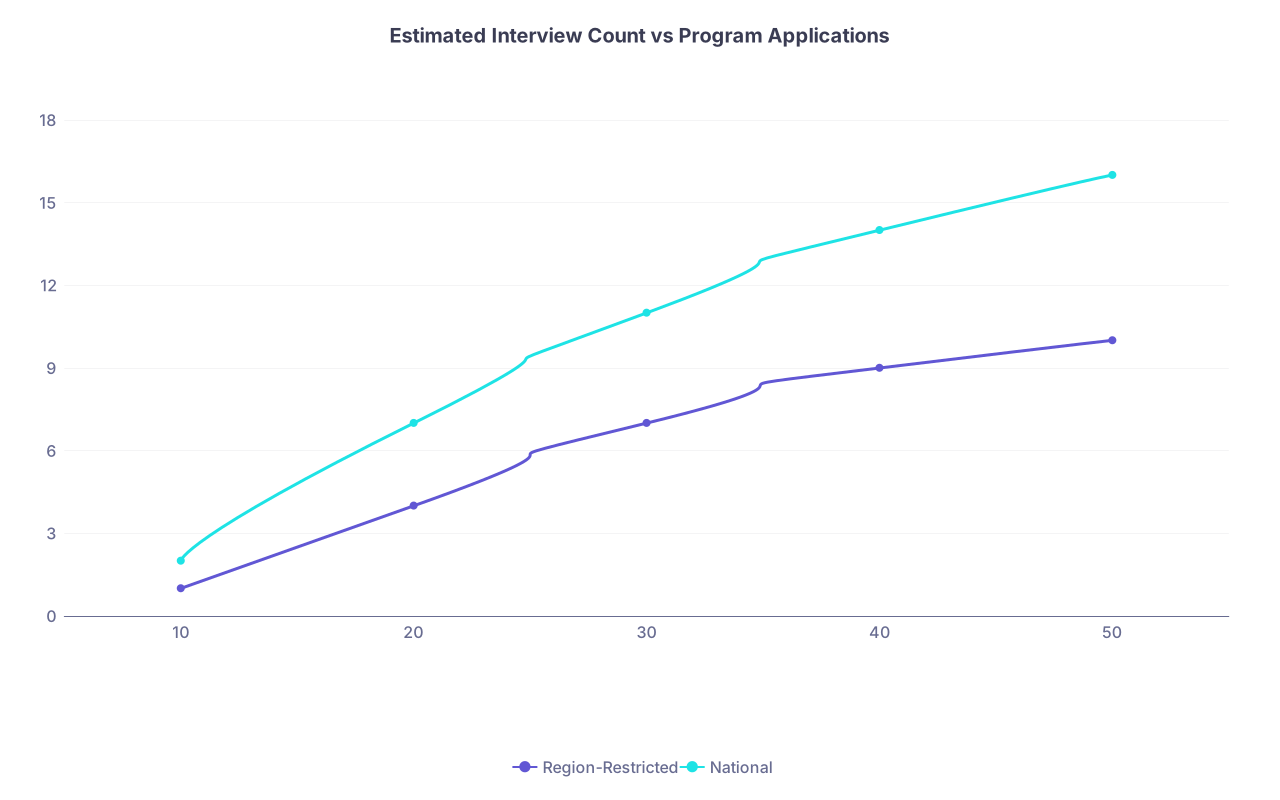
Here’s a rough example of how interview yield behaves with geographic restriction vs wider net:
| Category | Region-Restricted | National |
|---|---|---|
| 10 | 1 | 2 |
| 20 | 4 | 7 |
| 30 | 7 | 11 |
| 40 | 9 | 14 |
| 50 | 10 | 16 |
The point: you do lose some interview yield by restricting geography, so padding your total application number modestly is rational. But there’s a ceiling: past a certain point you’re just lighting money on fire.
Target something like:
- Less competitive field + geo restriction: 1.5x the usual program count
- Competitive field + geo restriction: 1.5–2x, but with brutal honesty about Tier 3
Step 6: Decide What You’ll Tolerate Before You Rank
This is where people get themselves into ethical and emotional knots.
You’ll see applicants do this:
- Apply to 70 programs “just in case.”
- Get 3 interviews: 1 near home, 2 across the country.
- Then say, “I’d rather go unmatched than go to [Far Away Hospital].”
That’s irrational. And unfair to everyone—programs, other applicants, yourself.
Here’s the rule: Do not apply anywhere you would 100% not attend if it were your only option.
Not “probably not.” Not “only if absolutely forced.” I mean 100% absolutely would not go. If that’s you, take that program off the list now and use that money on something else.
Before you submit ERAS:
- Make a list of your Tier 3 programs.
- For each one, ask: “If this were my only match, would I go there and be a decent resident?”
- If the answer is no → delete.
Harsh example I’ve seen:
Applicant applied to 65 EM programs, got 4 interviews, matched to a cross‑country site. Spent the first six months bitter, angry, and half-checked-out because “I only came here because I had no choice.” Patients do not care about your zip code preferences. If you are going to spend 3–7 years there, at least choose places you can accept being at.
Step 7: Communicate Your Family Situation Strategically (Not Desperately)
You’re not the only one trying to stay near family. Programs hear “I want to be close to my family” so often it becomes wallpaper. You have to be specific and measured.
Where to mention it:
- Personal statement: one or two sentences max, near the end, linking geographic preference to support system, not just comfort.
- Supplemental/application questions about geographic preference: be direct and consistent.
- Interviews: answer honestly when they ask, “Do you have geographic ties to this area?”
Good version:
“My parents live in the area and my dad has chronic health issues. I’m not his primary caregiver, but I’m part of the support system. Training nearby would allow me to help without compromising my residency responsibilities.”
Bad version:
“I absolutely have to be here because my family really needs me all the time and I can’t be far away.”
The first signals maturity and realism. The second sounds like you might be gone every other weekend.
Step 8: Timeline Check – Don’t Wait Until October to Realize You Only Have 6 Programs
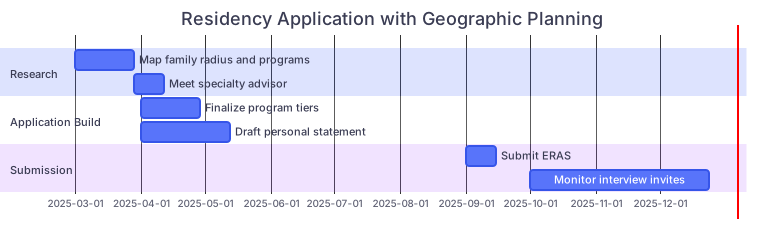
If you’re still early in the cycle, use a simple project view to keep yourself on track.
| Task | Details |
|---|---|
| Research: Map family radius and programs | a1, 2025-03, 4w |
| Research: Meet specialty advisor | a2, after a1, 2w |
| Application Build: Finalize program tiers | b1, 2025-04, 4w |
| Application Build: Draft personal statement | b2, 2025-04, 6w |
| Submission: Submit ERAS | c1, 2025-09, 2w |
| Submission: Monitor interview invites | c2, 2025-10, 12w |
The key is that “map family radius and programs” is early, not last-minute.
Step 9: Special Situations That Change the Math
A few scenarios where you need to be extra careful.
If You’re Couples Matching and Need to Stay Near Family
Nightmare combination, but not impossible.
Multiplying constraints means:
- You and your partner both need enough programs within the shared geographic zone.
- You almost certainly need to inflate total applications more than a solo applicant (think 1.5–2x).
You still follow the same three tiers—but both of you do this, and then find the overlap.
If You Have Serious Red Flags
Step failures, extended leaves, professionalism concerns—combined with geography restriction—can be lethal.
You must:
- Widen geography more than feels comfortable, or
- Apply to a much larger number within a broader radius, and
- Have a parallel plan (prelim year, SOAP, or research year).
If Your Family Situation Is Extremely Time-Intensive
If you’re effectively a primary caregiver, you need to be honest with yourself. Residency is not “flexible.” It will not magically adapt to your life.
Better options than silently hoping:
- Consider a one-year delay if the acute phase of illness is truly short-term.
- Talk now with a trusted advisor about prelim vs categorical, part-time leave policies, etc.
- Recognize that if you can’t tolerate being away more than a few hours often, some specialties and some programs will be a poor fit no matter what.
Sample Application Strategy Templates
Just to give concrete patterns.
Family Medicine, US MD, average app, must stay within 2 hours of Atlanta
- Zone mapping yields:
- Tier 1: 11 FM programs within 2 hours
- Tier 2: 10 FM programs within cheap nonstop flight (e.g., Charlotte, Raleigh, Nashville)
- Tier 3: 8 FM programs farther away but still okay
Target: 25–28 programs
Distribution:
- Tier 1: all 11
- Tier 2: 10 (pick those where your stats fit)
- Tier 3: 4–7 “only if needed” programs
OB/GYN, US MD, below-average Step 2, needs to stay near sick parent in Phoenix
- Tier 1: 4 programs (small market)
- Tier 2: 8 programs (Las Vegas, SoCal, Albuquerque)
- Tier 3: 15–20 across the country
Because OB/GYN is more competitive and the home zone is tiny:
- Target closer to 35–40 programs
- Tier 1: all 4 (obviously)
- Tier 2: all 8 (you need them)
- Tier 3: 20–25 wisely chosen programs where you at least meet their typical score band
FAQs
1. What if my home area literally only has 1–2 programs in my specialty?
Then “I must do this specialty and I must stay exactly here” might not be realistic. You either:
- Broaden geography (bigger radius, consider flights), or
- Reconsider specialty choice if family proximity is truly non‑negotiable.
I’ve seen people change from something like ENT to FM or IM specifically so they could reliably match within a tight region. That’s not failure. That’s making an adult tradeoff.
2. Should I explain my entire family situation in my personal statement to justify my geographic restriction?
No. You’re applying for a residency job, not a hardship scholarship.
Do this instead:
- One or two concise sentences about family ties or caregiving role.
- Emphasize that you understand residency comes first, but support system matters.
- Save details for when programs ask about it, not as your main narrative.
If your whole personal statement is “Here’s my family’s tragedy,” programs may wonder if you’ll be able to prioritize training.
3. Is it better to over-apply now and just cancel interviews that are too far from home?
If you’re genuinely willing to train there if it’s your only option, fine. If you already know you’d never rank them, don’t apply.
Programs spend serious time and money interviewing you. Hoarding interviews at places you’d never consider attending is selfish and it hurts other applicants. Apply only where you’d at least consider ranking.
4. What if I do not match in my region but match far away—should I decline and try again next year?
Almost always, no. If you match, you go.
Declining a categorical spot to reapply next year, just for geography, is usually a terrible bet unless something truly extreme changed (e.g., sudden catastrophic illness in your family during the cycle, and your program is willing to release you and support a reapply plan). Being board-certified with a job gives you far more ability to control geography later than being unmatched and scrambling.
Bottom Line (So You Don’t Forget)
- Define your “near family” constraint concretely as a radius and build a three-tier program list around it.
- Use data and specialty norms to set a sane application count, then inflate modestly (1.5–2x) for geographic restriction—not blindly to 60–80.
- Do not apply anywhere you’d never attend; protect your future self and other applicants by making those calls now, not in February.
That’s how you boost your program numbers without losing the family fit that actually matters to you.