
You’re staring at a US map on your laptop at 11:47 PM.
ERAS is open. You’ve got 120 programs on a spreadsheet… but your partner’s job, your kid’s school, or your visa situation means you can realistically live in maybe 2–3 regions.
Your brain is stuck on the same loop:
- “If I apply broadly, I might match… but I’ll blow up my relationship / finances / sanity moving somewhere random.”
- “If I restrict too much, I might not match at all.”
You’re not asking, “How many programs total?” in the abstract. You’re asking:
“How far can I tighten my geographic restriction and still be reasonably safe?”
This is where you need to be cold‑blooded and strategic, not idealistic.
Let’s walk through how to plan a geographic restriction and adjust your program volume so you are not playing Russian roulette with the Match.
Step 1: Be Brutally Clear On Why You’re Restricting
Before you start counting programs, you need to know what’s non‑negotiable and what’s just preference. Those are not the same thing.
Common non‑negotiable reasons:
- Partner locked into a specific city/region for work or training
- Shared custody / kids who can’t move states
- Elderly/ill family who truly need you nearby
- Immigration/visa constraints (e.g., must be in states with lots of H‑1B friendly programs, must avoid certain visa-unfriendly regions)
- Significant financial or health constraints limiting relocation
Common preferences that people pretend are non‑negotiable:
- “I love the West Coast vibe”
- “I do not want winter”
- “I want to be near friends”
- “I really like big cities”
Those might still matter. But if you’re a borderline applicant and you’re drawing a box on the map because you “hate humidity,” you’re setting yourself up to scramble/SOAP.
So, literally write this down in two columns:
Non‑negotiable region constraints vs. “would be nice” preferences.
If it is not on the left side, it does not get to shrink your map. You can weight it later when ranking, but you do not restrict applications over it.
Step 2: Know Your Risk Category First, Not Last
You should not be deciding geographic restriction in a vacuum. Your competitiveness determines how much you can safely restrict.
I’m going to simplify you into three buckets for this decision:
High‑risk:
- Step 2 score below your specialty’s average,
- red flags (failures, professionalism issues, big gap),
- no home program and weak letters,
- or you’re in a hyper‑competitive specialty (Derm, Ortho, ENT, etc.) without top‑tier metrics.
Medium‑risk:
- Decent board scores,
- some research / okay letters,
- maybe one soft flag (old attempt, unusual path),
- or competitive specialty but slightly below average.
Lower‑risk:
- Strong scores and letters,
- solid home or away rotations,
- no major issues,
- or you’re in a less competitive specialty (FM, psych, peds, IM) with above‑average stats.
You probably already know where you sit, even if your advisor won’t say it out loud.
Let me be blunt:
- High‑risk + tight geography = you are actively courting an unmatched outcome.
- Medium‑risk + moderate geography can be okay if you compensate with volume.
- Lower‑risk + thoughtful geography can often work out fine with reasonable program numbers.
You don’t get to play the same geographic game in Orthopedic Surgery as you do in Family Medicine. Or as an IMG as you do as a US MD with a 260.
Step 3: Map the Actual Program Supply, Not Your Vibes
People make a huge mistake here: they say, “I’ll stay in the Northeast” like that’s a detailed plan. It’s not.
You need to know: How many realistic programs exist inside the area you’re willing to live?
Realistic = they take people like you.
Do this systematically:
Pick your true geographic boundary
Example:- “Within a 3‑hour drive of Chicago”
- “East Coast, but no Deep South”
- “Only in Texas”
Make it concrete, not “vibes.”
Pull the program list
Use FREIDA, specialty societies, or residency explorer tools. Filter by state.Kill the fantasy programs
Any place that never interviews your profile (e.g., IMG‑unfriendly, no DOs, no visas) gets crossed out.
Look at:- Their current residents (backgrounds, schools)
- Visa statements
- DO/IMG history
- Step 2 cutoffs if they list them
Count what’s left
That number is your real supply inside your geographic box.
Now compare your number to this rough guide (adjust a bit specialty by specialty, but the ratios stand):
| Risk Level | Less Competitive (FM/Peds/Psych/IM) | Competitive (EM/OB/Anes) | Very Competitive (Derm/Ortho/ENT) |
|---|---|---|---|
| Lower-risk | 20–30 | 40–60 | 60–80+ |
| Medium | 40–60 | 60–80+ | 80–100+ |
| High-risk | 60–80+ | 80–120+ | 120+ |
If your geographic restriction leaves you with, say, 18 realistic IM programs and you’re medium‑risk, that’s not a “preference decision” anymore. That’s a high chance you don’t match.
Step 4: Decide Between Three Moves – Expand, Compensate, or Rethink
Once you know your supply, you’ve got 3 options:
Expand geography
Widen your circle (e.g., add adjacent states, include smaller cities, accept one weather/region you dislike).Compensate with volume
If you’re in a region with lots of programs (Northeast, Midwest, large states like Texas), sometimes sheer volume within that region can offset some restriction.Rethink timing or specialty
Harsh but real: if your non‑negotiables plus your profile equal <20 viable programs, you might need:- A prelim year + reapplication,
- A less competitive specialty,
- Or postponing a cycle to strengthen yourself.
You can’t wish your way out of a numbers problem.
Step 5: Build a Tiered List Inside Your Restriction
Once you commit to a restricted region, you must not get cute and only apply to your “dream” programs within that area. That’s how people end up in SOAP saying, “But I really wanted to be near family.”
Inside your chosen region, you need a spread:
- Top‑reach programs: Great to have, but not too many.
- Mid‑range realistic programs: Where your profile actually matches their typical residents.
- Safety‑leaning programs: Community or less‑prestigious programs that still meet your life constraints.
If your list is 70% reach programs and 30% realistic/safety in a restricted geographic area, you’re playing a losing game.
This is where you scrutinize each program:
- Check their current resident schools and scores (when posted).
- Look at your school’s match list—who has matched where with similar profiles.
- See if your advisors know which programs are historically “friendlier” to your institution or background.
You want a healthy chunk of programs where you’d feel bored calling them a “safety.” That’s usually exactly why they’re safer.
Step 6: How Many Programs to Apply to When You’re Geographically Limited
Now we answer your original question directly: how many programs should you apply to when you’re restricting geography?
Let me give you realistic patterns I’ve seen work:
Scenario A: Less Competitive Specialty, Moderate Restriction
Example: US MD, solid but not superstar, applying IM or FM, wants to stay within a 1–2 state radius (say, Midwest only).
Safe ranges:
- Lower‑risk: 25–35 programs in that region
- Medium‑risk: 40–60 programs in that region
- High‑risk: Push 60–80+ if they exist, and seriously consider widening the map
If your region has 90+ viable programs and you’re applying to only 20 “top ones,” that’s not being geographically restricted. That’s being selectively delusional.
Scenario B: Competitive Specialty, But Region With Dense Programs
Example: Anesthesiology or EM, wants East Coast only, especially large metros (NYC/Boston/Philly/Baltimore/DC).
Here, geographic restriction hurts less because program density is high.
Rough numbers:
- Lower‑risk: 45–60
- Medium‑risk: 60–80
- High‑risk: 80–100+ within that megaregion, plus at least some programs slightly outside your preferred zone if at all possible
If you insist on “NYC only” as a non‑negotiable and you’re not a top applicant, you are accepting a major unmatched risk. I’ve watched that movie. It doesn’t end well.
Scenario C: Strong Non‑Negotiable (Partner, Kids, Family Illness)
Example: You truly must be within commutable distance of one metro area. Maybe this leaves you only 10–25 relevant programs across IM/FM/Peds/Psych.
This is where people get in trouble because they pretend this is just a normal cycle.
Let me be direct:
If your absolute non‑negotiable radius yields:
- 25+ realistic programs in a less competitive field → Application to all of them + stellar application prep may be just acceptable, especially if you’re a strong candidate. Still risky if you’re medium risk.
- 10–20 programs total → That’s “I may not match and I know it” territory. You should talk seriously with mentors about:
- Dual applying (e.g., IM + FM, Psych + FM) within that radius
- Doing a prelim/TY year broader, then trying again
- Deferring graduation or adding a research year to strengthen your app before you restrict
You cannot lower the mathematical risk with strategy alone when you only have 12 total chairs at the table.
Step 7: Decide How “Real” Your Restriction Is
There are two types of geographic restrictions:
- Hard line: You will not move outside it, even if you otherwise go unmatched.
- Preference line: You strongly prefer it, but if Match Day is on the line, you’d live elsewhere.
Be honest with yourself. If it’s a preference line, then:
- Apply to your preferred region heavily (maybe 60–80% of apps).
- Add 20–40% outside that region as true safety net.
If it’s a hard line for a real reason (custody, health), then accept:
- Your unmatched risk may be materially higher,
- Your job is to maximize everything else in your control: application quality, strategic program choice, volume within that region.
Step 8: Use Data, Not Hope, to Adjust Volume
Here’s what happens every year: someone says, “But my friend restricted and still matched.” Fine. People win at casinos too. That doesn’t mean the odds were good.
Use whatever data you can get your hands on:
- NRMP charting outcomes (look at interview counts vs match probability).
- Your school’s specific match data by specialty and region.
- Honest feedback from advisors who know your specialty.
Then think like this:
- “With my profile, national data suggests I need ~12–14 interviews to have a comfortable chance in this specialty.”
- “Historically, my school’s grads get interview invites from about 20–25% of programs they apply to in this field.”
- “So to get 14 interviews, I might need 56–70 applications.”
If you’re restricting geography and your viable program pool is less than that target application count, you’re already below the safe line.
That’s your warning light.
Here’s a simple visual for how geography and volume trade off:
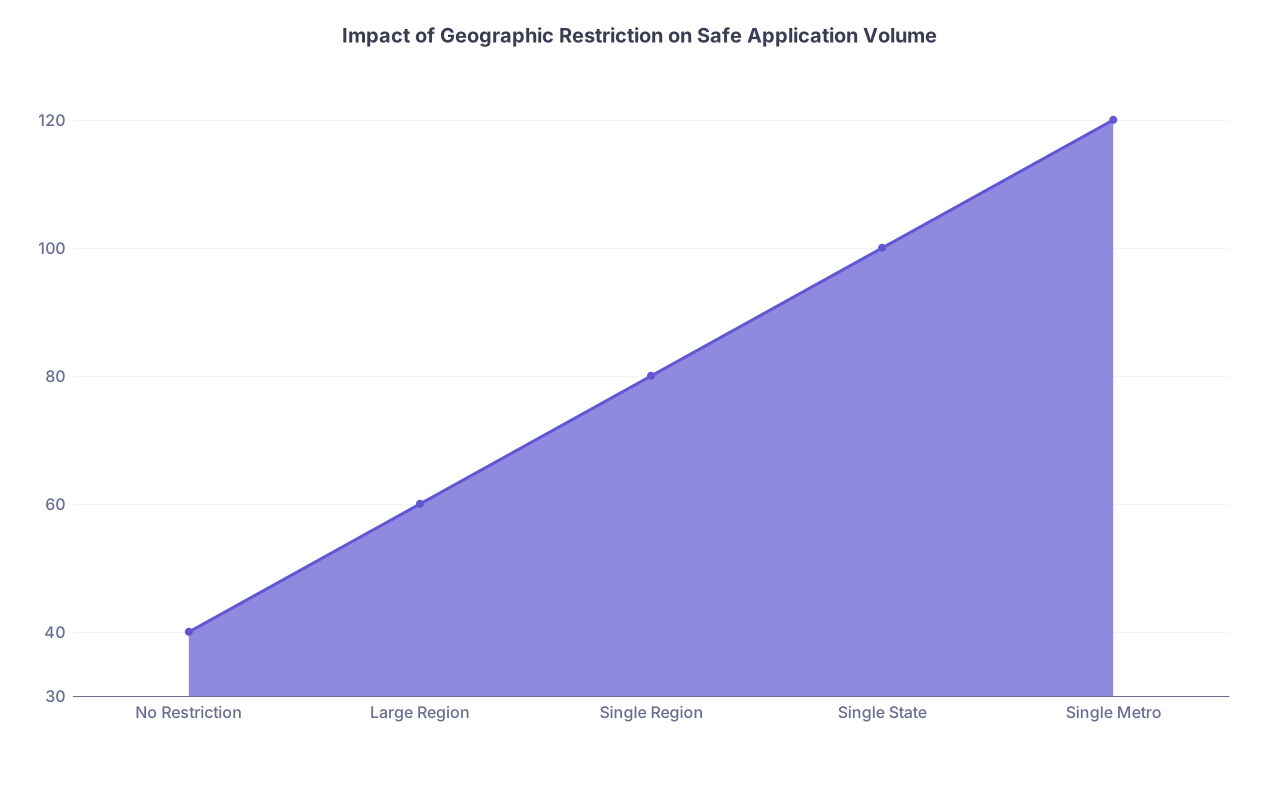
| Category | Value |
|---|---|
| No Restriction | 40 |
| Large Region | 60 |
| Single Region | 80 |
| Single State | 100 |
| Single Metro | 120 |
As geographic freedom goes down, the safe number of applications goes up—until you run out of programs. Once you hit that wall, you’re not “safer” by wanting more. You’re just stuck.
Step 9: Communicate Thoughtfully With Programs About Geography
If your geographic restriction is for a legitimate reason (family illness, partner job, kids), programs often see that as a positive—evidence you’re likely to stay.
A few practical moves:
Use your personal statement or secondary questions (if any) to briefly explain your tie to the region:
“My partner’s job and our extended family are all in the Pacific Northwest, and we’re eager to build our long‑term life here.”If you have a hard constraint (e.g., shared custody requires being in X area), you do not need to pour your life story into ERAS, but you can say in interviews:
“I’m committed to this region long‑term due to family obligations, so I would be very stable here for all three years.”Have your letters quietly reinforce your regional tie if appropriate:
“She has strong ties to the Midwest and is specifically hoping to train here long term.”
This does not fix a weak application, but it does help you stand out as a likely-to-rank-high-local candidate.
Step 10: Don’t Sabotage Yourself With Sloppy Execution
If you’re going to restrict geography, everything else has to be tight:
- No late ERAS submission “because I was busy.”
- No generic “I want strong clinical training” paragraphs for every program.
- No missing transcripts or delayed letters because you didn’t nag your writer.
When your safety net is smaller (fewer regions), each program matters more.
This is not the cycle to:
- Half‑ass your personal statement,
- Skip researching programs,
- Or send the same lazy paragraph to a rural community program and a research‑heavy academic center.
You chose constraint. That means you have to out‑execute the average applicant within that constraint.
Quick Reality Checks Before You Hit Submit
Ask yourself these and answer honestly:
- If I go unmatched because I refused to widen my map one more state/region, will I be at peace with that?
- Does my restricted region still give me at least:
- 30–40 realistic programs in a less competitive specialty if I’m medium‑risk?
- 60+ if I’m applying to something more competitive or I have soft red flags?
- Is my restriction truly non‑negotiable… or just fear/discomfort dressed up as necessity?
- Inside my region, is my list mostly realistic programs, or mostly reaches with nice websites?
- Have I actually verified that programs in my region take people like me (US MD/DO, IMG, visa, whatever your situation is)?
If you cannot get those answers into a reasonable range, you’re not planning. You’re gambling.
One Concrete Example to Anchor This
Let’s say you’re a US DO, average Step 2, applying Family Medicine. Partner has a locked-in job in Dallas. You truly must be within 3 hours of Dallas.
You map it out and find:
- 28 FM programs in that radius
- 6 never take DOs → down to 22
- 2 are brand new with chaotic leadership → you’re wary but keep them as backup
- So call it 20 solid-ish programs
You’re medium‑risk. Less competitive field. But 20 total is still tight.
A rational plan:
- Apply to all 20 nearby FM programs.
- Also apply to 10–15 slightly outside 3 hours that you could make work if absolutely necessary (partner might commute, you fly on weekends, temporary long-distance).
- Consider dual applying to IM or Psych in that same radius if your CV supports it.
- Crush your app quality and letters.
- Tell local programs explicitly, “My partner’s job and our family are here; we’re committed long term to this area.”
An irrational plan:
- Apply to only 12 “top” FM programs within 2 hours of Dallas because you like their websites.
- Refuse to dual apply.
- Refuse to consider any city your partner finds “boring.”
- Then act surprised in March.
You see the difference.
Summary: The 3 Things You Actually Need to Do
Quantify your restriction, don’t vibe it.
Draw the real map, count realistic programs, and compare it to your risk level. If your pool is tiny, you’re in high‑risk territory whether you like it or not.Use volume and realism inside your chosen area.
Apply to most or all viable programs in that region, with a strong mix of realistic and safety-leaning options—not just reach programs with fancy names.Decide if your line is truly hard, and own the risk.
If your reason is legitimate and non‑negotiable, accept that your unmatched risk may be higher and over‑optimize everything else. If it’s just preference, expand your geography at least a bit so you’re not one bad January email away from SOAP.