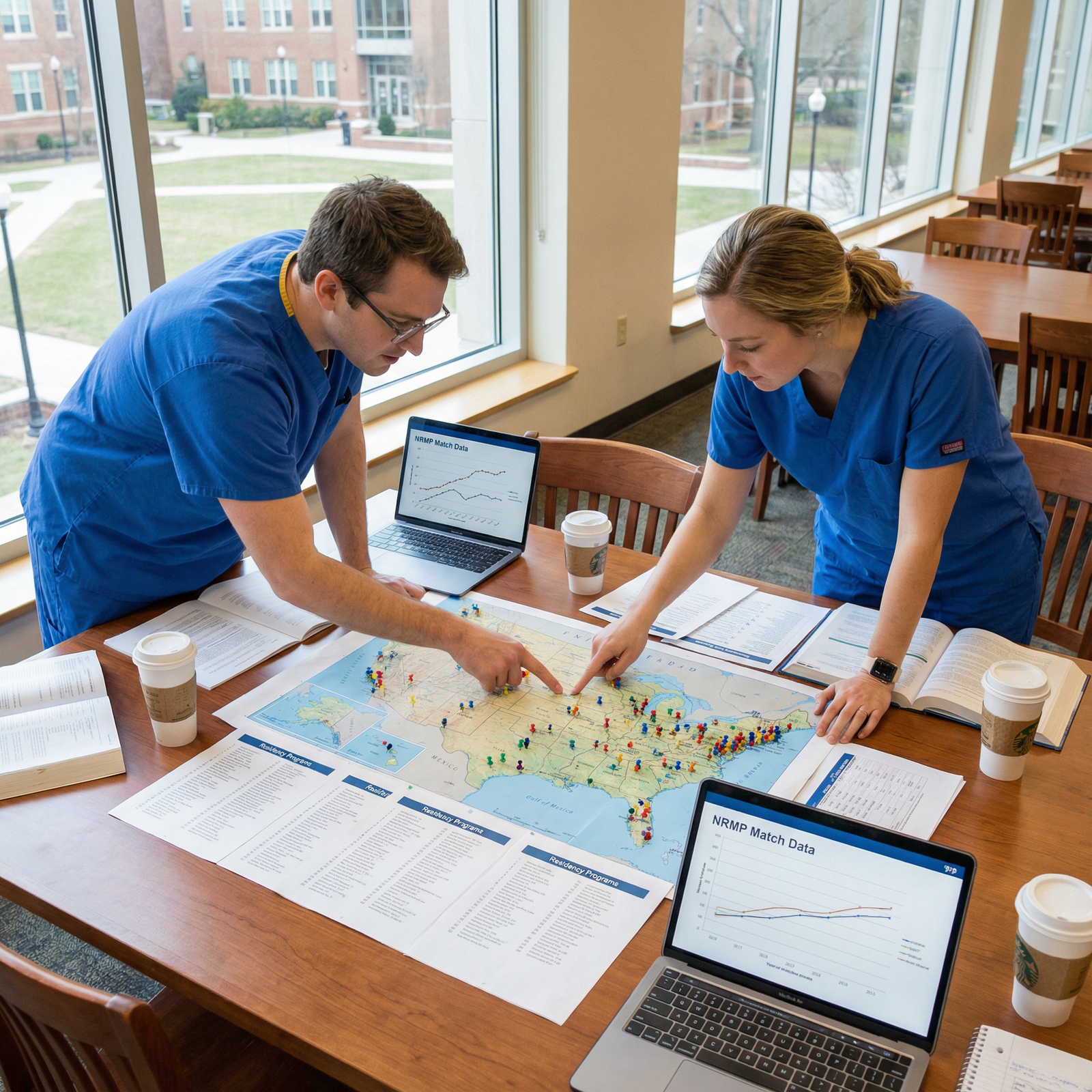
The usual “apply to 80–100 programs just to be safe” advice is garbage for visa-needing applicants.
You are not playing the same game as a US citizen or green card holder. The rules are different, the filters are different, and if you copy their strategy, you will waste thousands of dollars and still get iced out by silent auto-rejections.
This article is about what people actually do when they have to match and need a J‑1 or H‑1B. How to set a realistic program count based on policy, not vibes. Step by step.
Step 1: Accept the harsh but useful reality
If you need a visa, your “true” program pool is much smaller than what ERAS lets you click.
There are four (overlapping) buckets you must care about:
- Programs that do not sponsor any visa
- Programs that sponsor only J‑1
- Programs that sponsor J‑1 and H‑1B (or say “H‑1B considered”)
- Programs that are silent / unclear (and may auto-reject you anyway)
Most applicants I talk to make two big mistakes:
- They count all programs in a specialty and then say, “I’ll apply to 80, that’s safe.”
- They ignore policy details (H‑1B vs J‑1, Step 3 requirement, USMLE cutoffs), then act shocked when 60 of 80 apps vanish into a black hole.
You will not fix bias or immigration policy with an extra 20 applications. You fight it by:
- Targeting the right policy-compatible programs
- Matching your profile to your visa tier
- Applying aggressively but not blindly
Let’s build a structure for that.
Step 2: Know what kind of visa-needing applicant you are
You cannot set a realistic program count until you’re brutally honest about your profile.
Use this as a quick self-sort.
| Tier | Profile Snapshot | Typical Interview Range (if apps are well targeted) |
|---|---|---|
| A | Step 1 Pass, Step 2 ≥ 245, recent grad, 1+ US LORs, solid English | 8–18 interviews |
| B | Step 1 Pass, Step 2 230–244, ≤5 years since grad, some US exposure | 5–12 interviews |
| C | Step 1 Pass, Step 2 220–229 or older grad or limited US experience | 2–7 interviews |
| D | Step 1 Pass, Step 2 <220 or >10 years since grad, major gaps | 0–4 interviews |
Is this harsh? Yes. But this is roughly what I see across cycles when people actually match.
You should adjust:
- Upwards if: strong US research, home US clinical experience, unique niche (AI, MPH, etc.), or couples match with strong partner.
- Downwards if: multiple failures, no US LORs, weak communication skills, specialty change late in the game.
Pin yourself to a tier. Write it down. You’ll use it when deciding how many programs you need just to have a shot.
Step 3: Understand how visa policies shrink your pool
This is where your fantasy list dies and your realistic strategy begins.
For each specialty, you must break programs into policy categories. Use FREIDA, program websites, and sometimes emailing the coordinator when info is unclear (but do that after you’ve built a preliminary list).
Here’s the structure that actually matters:
| Category | Policy | How to Treat It |
|---|---|---|
| A | Explicitly “We do not sponsor visas” | Exclude completely |
| B | “We sponsor J‑1 only” | Include if J‑1 acceptable |
| C | “J‑1 and H‑1B considered / sponsored” | Prime targets if you want H‑1B |
| D | Silent, but historically has IMGs with visas | Possible, but lower yield |
| E | Silent, and current residents are all US citizens/GC | Low priority / often auto-filter |
Then overlay your reality:
- If you’re okay with J‑1: B + C are your core.
- If you strongly prefer H‑1B: C is your core; B is optional but should still be considered unless you truly cannot accept J‑1.
- If your Step 3 is not done: Some H‑1B-friendly programs will quietly ignore you; favor those that do not require Step 3 for ranking.
Step 4: Use a simple formula to set your core program count
Now we combine:
- Your tier (A–D from above)
- The visa category (B–E)
- Your risk tolerance (conservative / balanced / aggressive)
Here’s a realistic starting point for Internal Medicine as example (adjust for other specialties below).
Assume you are okay with J‑1 or H‑1B.
Internal Medicine example (IMG / visa-needing)
Rough numbers (these aren’t perfect, but directionally right):
- Total categorical IM programs: ~400
- Realistically visa-friendly programs (J‑1 or H‑1B, actually taking IMGs, not just saying they “may sponsor”): maybe 140–180 in a given year
You should not be counting from 400. You should be counting from that 140–180.
Now, by tier:
- Tier A (strong): Apply to 80–120 IM programs
- Tier B (mid): Apply to 120–160 IM programs
- Tier C (weaker / older grad): 160–220 IM programs
- Tier D (very weak / high risk): 220–260 IM programs
Those numbers assume:
- You’re building a tight visa-compatible list, not random.
- You’re mainly focusing on community and mid-tier university programs, not wasting 40 apps on ultra-competitive places that never take visas.
The higher your tier, the more you can trade quantity for quality. A Tier A applicant who carefully curates 90 programs usually does better than a Tier A who blasts 180 random ones.
Step 5: Adjust for specialty competitiveness
Some specialties tolerate visa-needing IMGs. Some basically don’t.
Here’s how I’d set total, across all programs in that specialty (not broken by visa type) for a visa-needing applicant who’s actually trying to match, not just “seeing what happens.”
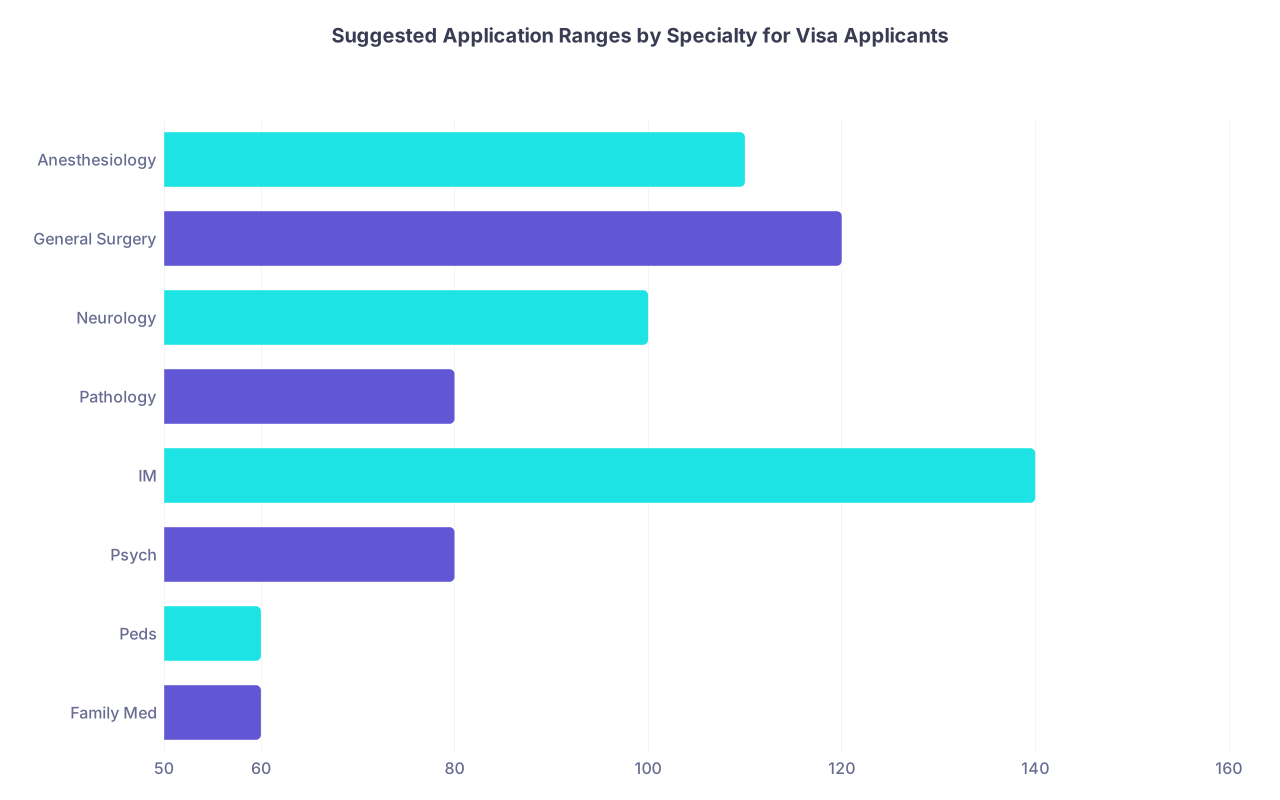
| Category | Value |
|---|---|
| Family Med | 60 |
| Peds | 60 |
| Psych | 80 |
| IM | 140 |
| Pathology | 80 |
| Neurology | 100 |
| General Surgery | 120 |
| Anesthesiology | 110 |
Interpretation (these are ranges, not single numbers):
Family Medicine (visas accepted in many places)
- Tier A–B: 40–60 programs
- Tier C–D: 60–90
Pediatrics
- Tier A–B: 40–60
- Tier C–D: 60–90
Psychiatry
- Tier A–B: 60–80
- Tier C–D: 80–110
Internal Medicine
- Tier A–B: 80–160 (as detailed above)
- Tier C–D: 160–260
Pathology / Neurology
- Tier A–B: 60–100
- Tier C–D: 100–150
General Surgery / Anesthesiology (much more competitive for visas, many silent “no”)
- Tier A–B: 100–160
- Tier C–D: 160–220
If you’re in a very competitive specialty (Derm, Plastics, Ortho, ENT, etc.) and need a visa, you either:
- Have a very unusual, very strong profile (USMD/DO, major research, Step 2 255+, strong connections), or
- You’re almost certainly going to need a backup specialty with real visa support.
For most visa-needing applicants, the smart move is:
- One main specialty (e.g., IM, Psych, FM)
- Maybe one backup only if you can write believable, separate personal statements
Step 6: Reduce the “fake” programs from your list
Here’s the ugly part: A lot of programs that say they sponsor visas are basically closed to you.
Obvious red flags to down-rank or cut:
- Website says: “We may consider exceptional non-US citizens at the discretion of the program director” and their current residents are 100% US grads.
- They sponsor only J‑1 but you’re dead‑set on H‑1B.
- Their “IMG FAQ” says: “We require USMLE Step 2 ≥ 245 and graduation within last 3 years,” and you’re at 228, 6 years out.
- They require US clinical experience and you have none, and they’ve never taken someone without it.
The process I use with applicants is very mechanical:
- Download or build a spreadsheet with all programs in your specialty.
- For each, add columns: Visa policy (none / J‑1 / J‑1+H‑1B / unclear), IMGs in program Y/N, USMLE cutoff Y/N, Grad year limit, USCE requirement, geographic preference.
- Color code:
- Green: aligned with your stats + visa situation
- Yellow: borderline but possible
- Red: clearly misaligned
You build your application counts from green + some yellow, not all three colors equally.
Step 7: Map program count to realistic interview expectations
Let’s be specific. Suppose you’re:
- IMG, need a J‑1 (H‑1B okay but not required)
- Step 2: 236
- 3 years since graduation
- 2 months USCE, 2 US LORs
- Targeting Internal Medicine
You’re a solid Tier B.
If you apply to 140 well-selected IM programs that:
- Explicitly sponsor J‑1
- Take IMGs consistently
- Don’t have a hard cutoff above 240
- Aren’t hyper-competitive university programs that match mostly USMDs
Then a realistic expectation is:
- 8–15 interview invites
- If your interviews go reasonably well, 70–90% chance of matching somewhere in that pool
If you instead apply to 140 random IM programs, including:
- 40 that don’t sponsor visas or never take IMGs
- 30 that require Step 2 ≥ 245
- 20 that prefer US grads and are vague about visa sponsorship
You might get:
- 2–5 interviews
- And you’ll blame “bad luck” instead of “bad list.”
The number is not the main variable. The visa-focused targeting is.
Step 8: Factor in money, time, and burnout
You’re not just paying ERAS fees. You’re paying with:
- Time to customize personal statements and program signaling (if applicable)
- Emotional bandwidth dealing with 100+ rejections
- Actual dollars you may not have
For visa-needing applicants, application fees add up fast because the recommended count is usually higher.
Very rough ERAS fee pattern (subject to change, check current numbers):
- 1–10 programs: small base fee
- 11–20: more per program
- 21–30: higher per program
- 31+: highest tier per program
If you’re applying to 180 programs, the cost will be painful. So you balance:
- Diminishing returns: Going from 140 to 220 programs doesn’t double your interview count. It might add 2–4 more interviews at most.
- Financial reality: Maybe you can afford 140 strategically chosen programs and 1–2 specialties, not 220 sloppy ones.
My rule of thumb:
- Spend more time building the list so you can spend less money clicking random programs.
If you’re an older grad / lower Step score and can’t afford 200+ apps, you must be laser-targeted:
- Community and smaller university programs
- Historically IMG heavy
- J‑1 friendly at minimum
- Regions more open to IMGs (Midwest, South, certain Northeast areas)
Step 9: Special case – H‑1B focused applicants
If you’re trying to get H‑1B, you need to be especially cold-blooded about your chances.
Program reality:
- Only a subset of programs sponsor H‑1B at all.
- Among those, many quietly prefer US grads or very strong IMGs.
- Several require Step 3 passed before rank list or even before interview.
If you:
- Need H‑1B
- AND don’t have Step 3 done
- AND are Tier B/C
Then your pool is smaller. Really smaller.
Here’s how I’d approach it:
- Identify all programs explicitly listing H‑1B support in your specialty.
- Separate them into:
- H‑1B + Step 3 required
- H‑1B where Step 3 is “preferred but not required”
- If Step 3 is not done:
- Apply broadly to the “preferred but not required” group.
- Treat “required” programs as long shots unless you’ll have Step 3 passed by interview season.
- Also apply to J‑1 programs unless you have a genuine reason you cannot do a J‑1 (e.g., home country 2‑year rule will destroy your long-term plans).
I’ve seen applicants tank their entire cycle because they insisted on H‑1B + no Step 3 + mediocre scores and refused to apply J‑1. That’s not strategy; that’s fantasy.
Step 10: A concrete “how many” plan by situation
Let me make this painfully practical. Here are real-world scenarios and what I’d recommend.
Scenario 1: Strong IMG, needs visa, wants Internal Medicine
- Step 2: 248
- 1 year since grad
- 3 US rotations, 3 US LORs
- Okay with J‑1 or H‑1B
Plan:
- IM only
- 100–140 IM programs, heavily community / lower-mid tier university, all visa-friendly
- Avoid ultra-top university programs unless you have direct connections
Scenario 2: Mid IMG, wants Psych, needs J‑1
- Step 2: 233
- 3 years since grad
- 1 US rotation, 1–2 US LORs
- Priority: Psychiatry, open to backup
Plan:
- 70–90 Psych programs (visa-friendly, known IMG takers)
- 20–40 FM or IM as backup (only if you can write convincing, specialty-specific statements)
- Total 90–130 programs
Scenario 3: Older grad, weaker scores, needs any visa
- Step 2: 222
- 8 years since grad
- Some home-country clinical, minimal USCE
Plan:
- 120–160 Family Medicine
- 80–120 Internal Medicine or Pediatrics (only the most IMG-heavy, visa-friendly programs)
- Total 200–260, if financially possible
- But with ruthless filtering: IMGs in current residents, graduation year flexibility, J‑1 openness
Expected interview count is still modest. But this is what “giving yourself a chance” looks like.
Step 11: When should you not just increase program count?
There are times when adding more programs does almost nothing:
- Your personal statement and experiences scream “I don’t know what I want.” Programs smell that.
- You are applying to competitive specialties with no visa history at those programs.
- Your filters are lazy: you’re not distinguishing visa policies, you’re just sorting alphabetically.
Before you add another 40 programs, ask:
- Have I maxed out the realistic visa-friendly pool?
- Have I already applied to all programs that match my profile and visa needs?
If the answer is yes, more applications just mean more money burned.
FAQ (exactly 4 questions)
1. Is there a minimum number of programs visa-needing applicants should apply to in any specialty?
For a visa-needing IMG in a relatively open specialty (IM, FM, Peds), applying to fewer than 60 programs is rarely reasonable unless you’re an exceptionally strong candidate (Tier A) with strong US connections. For most Tier B/C applicants, I’d treat 80–100 as a practical floor if the list is well targeted and visa-compatible. Below that, you’re often depending too much on luck.
2. Should I apply to programs that are silent about visas on their website?
Yes, but carefully and not as your primary pool. If a program is silent yet has current or recent residents with J‑1 or H‑1B, they’re fair game. If they’re silent and all residents are US grads, that’s lower yield. In your spreadsheet, mark these as “yellow.” Include them once you’ve already applied to pretty much all the clearly visa-friendly programs that fit your profile.
3. How many specialties should a visa-needing applicant realistically pursue?
For most people, one main specialty plus one backup is the upper limit if you want to look credible. Three or more specialties usually dilutes your story and leads to generic personal statements that hurt you everywhere. The exception: if your primary specialty is extremely competitive for IMGs with visas, you might lean more heavily into the backup and treat the main one as a long-shot side bet (with fewer applications).
4. Do SOAP chances change how many programs I should apply to?
Not much. SOAP is brutal for visa-needing applicants because many unfilled spots are in programs that don’t sponsor visas or are extremely restrictive. You should approach the main Match as if SOAP will not rescue you. If anything, SOAP’s unpredictability is one more reason to build a serious, visa-focused program list on the front end instead of “saving money now and trying SOAP later.”
Open a spreadsheet today and list your specialty and target visa type in row 1, then start categorizing programs by policy (no visa, J‑1 only, J‑1/H‑1B, unclear) for at least 30 minutes—only after you’ve done that are you allowed to decide how many programs to apply to.