
The biggest mistake military-bound applicants make is pretending they have “one” match, when in reality they’re in two different games with different rules and different odds.
If you’re trying to balance military GME with a civilian backup, you don’t need vibes. You need numbers. And a plan.
Here’s how to think about “how many programs” when you’re splitting attention between military and civilian systems—and what to do in some very specific, messy real-life scenarios.
Step 1: Be Honest About Your Actual Situation
Before numbers, labels.
You’re in one of a few common buckets:
- HPSP student applying the year military match and civilian ERAS timelines overlap
- USUHS student locked into military first, maybe civilian deferred later
- Active duty GMO/flight surgeon returning to residency
- Civilian student considering FAP or post-match military options and wants to keep doors open
If you’re not clear what you are, you’ll make bad decisions about how many programs to rank across systems.
Let’s define “systems” quickly:
- Military GME: JSGMESB process (Army/Navy/Air Force), early timeline, limited programs
- Civilian GME: ERAS + NRMP Match (and for some, SOAP if things go sideways)
You’re not choosing “military or civilian.” You’re dialing how much risk you’re willing to carry in each lane. That’s what “how many programs” is really about.
Step 2: Understand the Two Different Risk Profiles
Military and civilian risk look very different.
| Aspect | Military GME | Civilian GME |
|---|---|---|
| Number of programs | Often 1–5 feasible | 30–80+ possible |
| Transparency | Poor | Better (charting outcomes, data) |
| Backup if no spot | GMO/operational tour | SOAP, prelim/TY, reapply |
| Control | Limited (needs of service) | More control via # of apps |
| Timeline | Earlier decisions | Later but more flexible |
The military side is “binary-ish”: small number of slots, needs-of-service, systems that do not care what your desire ranking is. You can’t “shotgun” 40 Army programs. They don’t exist.
Civilian is probabilistic: the more realistic programs you rank, the more you can bend the odds in your favor.
So your total risk isn’t:
“How many total programs across both systems?”
It’s:
“How much risk is already baked into my military side, and how aggressively do I need to compensate on the civilian side?”
Step 3: Use a Simple Risk Category For Yourself
I’m going to give you a blunt scale I use when working with dual military–civilian applicants.
You are either:
- Low risk: Above-average stats, no red flags, realistic specialty for your profile
- Moderate risk: Some weaker elements (average scores, limited letters, late decision, weaker clinical grades)
- High risk: Low scores for the field, failed exam, gaps, applying very competitive specialty, or very location-restricted
This is not about how you feel. It’s about how your file looks to a stranger reading it in 90 seconds.
You already know roughly which bucket you are in. If you’re hesitating—assume the higher risk bucket. Safer that way.
Step 4: Military First — How Many Programs Are Actually in Play?
You cannot apply to 50 military programs. The system won’t let you. Your branch and specialty dramatically limit what’s even on the board.
Here’s how to sanity-check your military side.
A. Count your real military options
Ask yourself:
- How many training locations actually exist in my branch for my specialty?
- Am I willing to go to all of them? (Be honest. Don’t say yes if your spouse will divorce you over Fort Nowhere.)
- Are there any joint service or civilian-deferred spots?
This might give you something like:
- Army Internal Medicine: Maybe 4–5 installations
- Navy General Surgery: 2–3 real possibilities
- Air Force Psych: 1–2 locations plus some deferrals
Now cut out the places you absolutely will not go. That’s your real list.
If that list is:
- 4–5 programs and your file is strong for that specialty → lower military risk
- 1–2 programs and/or your specialty is tight (e.g., ortho, derm, EM) → high military risk
B. Look at historical fill and rumors (the real kind)
You want to know:
- Does this specialty in my branch overfill, underfill, or just fill most years?
- Are they pushing more people to GMO / fleet / battalion surgeon instead of residency?
- What are recent grads at your school saying?
If your seniors are telling you: “Navy EM has been brutal; lots of really good people got pushed to GMO,” that’s your warning sign. It means your default “backup” is not a prelim year. It’s three to four years doing operational medicine.
Now ask yourself the only question that matters:
“If I ended up as a GMO instead of a resident, am I okay with that outcome for the next 3–4 years?”
If the answer is “absolutely not,” you have zero business under-applying to civilian programs.
Step 5: Civilian Backup Numbers — Concrete Targets
Let me cut through the noise. Here’s where most dual applicants land if they’re being rational.
Assumptions: You’re applying at least “normally” through ERAS and will submit a real rank list.
| Risk Level | Specialty Competitiveness | Civilian Programs to Apply To |
|---|---|---|
| Low | Low/Moderate | 20–30 |
| Low | Competitive | 40–60 |
| Moderate | Low/Moderate | 30–45 |
| Moderate | Competitive | 60–80 |
| High | Low/Moderate | 45–60 |
| High | Competitive | 70–100+ |
Yes, those upper numbers look ridiculous. No, I’m not apologizing.
You’re not just protecting against “not matching.” You’re also protecting against “only matching at programs I cannot live with.”
You can adjust slightly based on:
- Strong geographic ties (family, med school, undergrad)
- A powerful letter or mentor who knows programs
- Real financial constraints (but don’t pretend you can’t afford applications while dropping thousands on other things)
Step 6: Calibrating Across Systems, Not Just Within One
Now let’s do what almost nobody does: actually coordinate the two sets of numbers.
Think in terms of total safety net, not isolated lists.
Framework I use with applicants:
- How much military risk am I taking on (scale 1–10)?
- How much civilian risk am I comfortable with (scale 1–10)?
- If my military risk is 7–9, my civilian risk had better be 1–3.
In other words: High risk on one side demands low risk on the other.
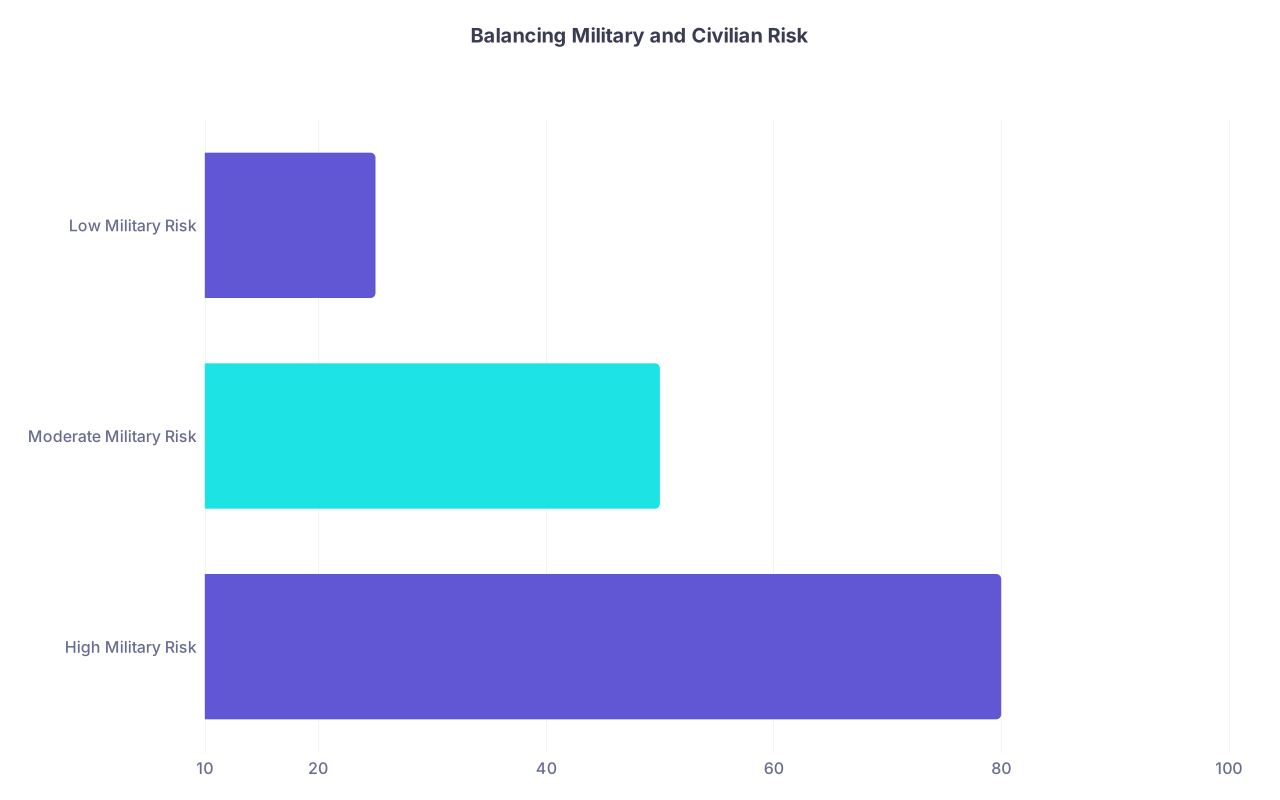
| Category | Value |
|---|---|
| High Military Risk | 80 |
| Moderate Military Risk | 50 |
| Low Military Risk | 25 |
Think of that chart like this:
- High military risk → You should be in the 80+ civilian apps mindset if possible
- Moderate military risk → Around 40–60 civilian apps
- Low military risk → You can live in the 20–40 range and sleep at night
Is this perfect math? No. But it keeps people from doing the truly dumb combo: high military risk + 15 civilian applications “to places I’d love.”
Step 7: Concrete Scenarios (This Is Where People Screw Up)
Let’s walk through real setups I’ve seen.
Scenario 1: HPSP, competitive specialty, branch notorious for GMOs
Profile:
- Navy HPSP, applying EM or Ortho
- Step 2 is fine (250-ish), no red flags
- Navy has limited spots, GMO is common
- You absolutely do not want to do GMO
Wrong move (I’ve watched this happen):
- Rank all Navy spots for your specialty
- Toss in 12–15 civilian EM programs “just in case”
- Tell yourself “I’ll probably match something”
Better move:
- Accept that Navy EM/Ortho is high risk by definition
- Apply to 60–80 civilian EM programs, geographically reasonable but broad
- Build a rank list that includes a spread of reach, match, and safer programs
- If military match hits → great. If not, you are sitting on a serious civilian list.
Emotionally, people hate this because it feels like “wasted effort” if the military match hits. But you are not paying for peace of mind. You’re paying to avoid waking up in February realizing you’re going to sea for three years because you got cute with your ERAS list.
Scenario 2: Army Internal Medicine, mid-tier applicant
Profile:
- Army HPSP, IM
- Solid but not stunning application: Step 2 ~235, a couple of good letters, no failures
- Multiple Army IM programs historically fill but not ultra-competitive
This is moderate risk military, moderate competitiveness specialty.
Reasonable civilian calibration:
- Civilian IM: 30–40 programs if you’re broadly open geographically
- If you’re very location restricted (spouse job, kids, etc.): push toward 45–50 and make sure some are lower-tier community programs
You could get away with fewer civilian IM applications here, but only if:
- You’re okay with the real possibility of being sent to an Army location you ranked low, or
- You’re okay not matching military and doing something non-IM in the Army (less common, but not impossible)
Scenario 3: USUHS student, family ties to specific city
Profile:
- USUHS, obligated military service
- Applying Psych
- Civilian desire is “eventual” — maybe a civilian deferment, but mostly you’re locked in military for now
- Strong family pull to one metro area
Here, your primary match is military. Civilian is long-game, not immediate backup.
Your “how many programs” focus:
- For military: Rank every psych program you’d realistically attend; there usually aren’t that many
- For civilian: You’re NOT doing a full-blown ERAS push yet. Maybe a few targeted programs if your branch allows deferrals, but you’re not trying to fire off 60 apps.
This is one of the few cases where “just a handful” of civilian programs makes sense, because you’re not really in the two-system match this year.
The mistake here would be pretending you’re HPSP and overspending time + money on a civilian backup you realistically can’t use this cycle.
Scenario 4: Prior-service GMO trying to get back into residency (civilian OK, but wants military first)
Profile:
- Army GMO, 3 years in, wants EM
- Step 1 pass, Step 2 low 230s, solid operational letters, some rust on clinical skills
- Would prefer military EM but will absolutely take civilian if that’s the path back
You are high risk for military EM return. And somewhat high risk for civilian EM too depending on year and market.
Strategy:
- Military: Apply to every EM program and seriously consider IM/FP as parallel options if you’re okay with that path
- Civilian: 70–90 EM applications, plus strongly consider a parallel path (e.g., applying to IM at 20–30 programs as well)
This is one situation where dual-applying specialties (EM + IM) on the civilian side makes sense. Yes, it’s a grind. The alternative is washing out of both systems and being stuck repeating this cycle with an even older graduation year.
Step 8: Managing Time, Money, and Sanity
By now you might be thinking: “Okay, I get the risk argument. But I’m not a machine. How do I physically do this?”
A few hard-earned tips:
1. Front-load your ERAS work before military boards heat up
Do not wait for the JSGMESB results to start your civilian work. That’s how you end up rushing 30 apps in two days and sending garbage personal statements.
Aim for:
- Personal statement variants drafted early (one per specialty)
- Letters requested early enough for both military and civilian systems
- Program list roughed out before interview season
2. Use tiers, not individual snowflake analysis for each program
Stop pretending you can deeply research 80 programs. You can’t.
Do this instead:
- Create tiers (A/B/C) based on competitiveness and desirability
- Tier A: Dream/strong programs
- Tier B: Reasonable matches
- Tier C: Community/lower-tier, safety anchors
Then:
- Customize more for Tier A/B
- Use a leaner but still decent approach for Tier C

| Step | Description |
|---|---|
| Step 1 | Build Master List |
| Step 2 | Assign Tiers A B C |
| Step 3 | Draft Core Materials |
| Step 4 | Customize Tier A and B |
| Step 5 | Light Customize Tier C |
| Step 6 | Submit All Apps |
You do not need 80 lovingly hand-crafted paragraphs about why you love every city.
3. Be ruthless about redundancy
If two programs are effectively identical (same region, similar vibe, similar tier), pick the one more likely to rank you—community over big-name academic if you’re risk-averse.
That said: in a high-risk situation, err on the side of more, not fewer.
4. Money talk
Application fees add up, yes. So does an extra year of your life reapplying or being forced into a career detour you didn’t want.
I’ve watched people save $500 on application fees and then blow $20,000 trying to piece together a research year or scramble into something they dislike.
If you truly cannot afford broad applications:
- Prioritize civilian safety programs over sexy names
- Expand geographically before expanding into competitive tiers
- Ask your school and the military support channels about emergency grants; these exist in more places than people realize
Step 9: When You’re Tempted to Shrink Your List
This is the part of the year where people get tired and start rationalizing:
- “My mentor said I’m very strong; I probably don’t need that many.”
- “I got a couple of nice emails from programs; I think I’m safe.”
- “I’ll just lean on the military match and trust the process.”
No.
Here’s the honest bottom line:
- The military match is less under your control than the civilian one.
- Your only lever of control on the civilian side is: where you apply and how many places see your file.
- When both systems are in play and you truly care about avoiding an unwanted outcome (GMO, no match, wrong specialty), your civilian list should feel a little excessive.
Not insane. But slightly uncomfortable. That’s usually the right zone.
Step 10: The Simple Checklist Before You Hit Submit
Right before you finalize everything, ask yourself:
- Did I overestimate how much the military system “likes” me?
- If the military match vanished tomorrow, would my civilian list still make me feel reasonably secure?
- Do I have at least:
- 10+ programs where I’m clearly above their usual bar
- A solid middle chunk where I’m in range
- A realistic sense of where my specialty falls on the competitiveness spectrum this year
And the killer question:
“If I don’t get my top choices, do I still have enough places on either system’s list that I can tolerate?”
If that answer is “no,” your problem is not just numbers. It’s strategy. But numbers are the part you can fix this week.
Key Takeaways
- Treat military and civilian as two different risk systems—and compensate. High risk on the military side demands more civilian applications.
- For most dual applicants, “enough programs” on the civilian side means 30–80 applications, not 10–20. Especially in competitive fields or GMO-heavy branches.
- Your goal is not to conserve effort; it’s to avoid outcomes you absolutely do not want. Calibrate your program numbers to that, not to wishful thinking.