
It’s August. You’re on ERAS, and the “Programs” tab looks like a battlefield. On one side: the dream specialty everyone calls “reach” for your numbers. On the other: the safe-but-acceptable backup that you can see yourself doing, even if it’s not the fantasy. You’re hearing different things from everyone:
“Just go all in on derm.”
“Be realistic, you need a backup.”
“Apply to 150 programs across two specialties.”
You’re stuck on one basic question:
If you dual apply across competitiveness levels, how many programs in each specialty do you actually apply to, and how do you split the list so you don’t torpedo both options?
Let’s walk through this like we’re sitting together with your score report, CV, and a spreadsheet. I’ll give you the concrete numbers, decision rules, and pitfalls that people only talk about in group chats and back hallways.
Step 1: Decide If You’re Truly in a Dual-Apply Situation
Not everyone should dual apply. Some people do it out of panic and just waste money.
You’re probably in a real dual-apply situation if at least one of these is true:
- You’re targeting a very competitive or small-field specialty:
- Dermatology, Ortho, Plastics, ENT, Neurosurgery, Urology, Ophtho, IR, Radiation Oncology, some EM markets now.
- You have some red flags:
- Step failure
- Low Step 2 for your target specialty (e.g., 220 aiming Ortho/ENT)
- Limited or late specialty exposure (e.g., decided on ENT in late M4)
- You’re a DO or IMG going after a specialty/programs that historically take few from your background.
- You have major geography or visa constraints.
If you’re going into Internal Medicine with solid scores and normal CV? Dual applying IM + FM “just because” is usually overkill and signals anxiety, not strategy.
Rule I use:
If your “main” specialty has a realistic but non-trivial chance you end up unmatched even if you execute well → dual apply.
If matching your main specialty is very likely with a sane application strategy → pick one specialty and stop splitting focus.
Step 2: Choose Your Primary vs Backup Specialty (Be Honest)
Do not pretend they’re equal in your head. They’re not. And programs can smell indecision.
Ask yourself two questions and be absurdly direct:
- If I only matched in one of them, which would I be happier doing for the next 30 years?
- If I swing hard at my dream specialty and miss, can I emotionally and financially tolerate a reapplication year?
If the dream specialty is truly “I will regret not trying,” then it’s primary.
If you already feel yourself rationalizing the backup as “actually I think I’d like that more,” then stop kidding yourself and make that the primary.
Once you pick:
- Primary specialty: where your brand, story, letters, and most of your applications go.
- Backup specialty: where you are strategically securing a safety net without sabotaging your primary.
Step 3: Rough Application Counts by Specialty Type
Here’s what people dance around: actual numbers. These are ballpark total program counts per specialty if you were applying to that specialty alone with an average or slightly below-average applicant profile (US MD/DO, not super-stellar, not disastrous).
| Specialty Type | Example Fields | Typical Range (If Single Specialty) |
|---|---|---|
| Ultra-competitive/small field | Derm, Plastics, ENT, NSGY | 60–100+ |
| Competitive procedural | Ortho, EM (in some regions) | 50–80 |
| Mid-competitive | Anesthesia, OB/GYN, Psych | 40–70 |
| Broad-access primary care | IM, FM, Peds | 25–50 |
Now, when you dual apply, you do not just add both full numbers together. That’s how people end up applying to 140+ programs and then complaining about interview burnout and 5-figure fees.
You’re constrained by:
- Money
- Time for interviews
- Your ability to look committed to both fields
Step 4: Core Principle – Protect Your Floor First
Think in tiers:
- Floor – Minimum number of backup programs that makes going unmatched unlikely.
- Ceiling – Maximum total programs you can apply to without complete insanity.
- Primary focus – Everything above the floor is invested in your dream specialty.
For most applicants:
- Realistic total ERAS cap: 60–100 programs across both specialties.
- 60–70 if you’re in a broad field combo (e.g., IM + FM).
- 80–100 if one is ultra-competitive.
You build from the floor up.
Step 5: Building the Split – Concrete Templates
Let me give you actual templates and then we can adjust.
Scenario A: Ultra-Competitive + Safer Backup
Example: Derm + IM, ENT + IM, Ortho + IM/FM
You’re chasing a long-shot but acceptable dream. You cannot risk being completely unmatched.
Rough starting splits for a typical US MD/DO with borderline stats for the dream specialty:
- Total programs: 80–100
- Backup (IM/FM/Peds) floor: 35–45
- Primary (derm/ortho/ENT/etc.): rest
So a very common balanced layout looks like:
- 40 IM programs
- 50 Derm programs
Total: 90
If you’re a stronger applicant for the dream specialty (great research, great letters, above-average Step), you can “lean” more:
- 30 IM
- 60 Derm
Total: 90
If you’re weaker (Step failure, DO/IMG in derm/ENT/ortho), you lean harder into the safety:
- 50 IM
- 40 Derm
Total: 90
The core rule:
You almost never go below ~30 in your backup unless the backup field is extremely broad and you’re overqualified for it.
Scenario B: Two Mid-Competitive Fields, One Clearly Preferred
Example: OB/GYN + IM, Anesthesia + IM, Psych + FM, EM + IM
Here both are realistic. One is just riskier.
Reasonable total: 60–80 programs.
Balanced but preference-weighted split (average applicant):
- Primary mid-competitive: 35–45
- Backup mid/broad: 25–35
Examples:
Strong toward primary (you’d be sad but fine in backup):
- 45 Anesthesia
- 25 IM
Total: 70
More nervous about matching:
- 35 Anesthesia
- 35 IM
Total: 70
If your CV is noticeably stronger in one (lots of OB/GYN stuff, almost nothing in IM), goose that one up 5–10 programs and trim the other.
Scenario C: Two Broad-Access Fields
Example: IM + FM, FM + Peds, Peds + Psych
This is often unnecessary. If your numbers are average, you can usually pick one and be fine.
If you insist on dual applying (geography issues, failed Step, IMG, etc.):
Total: 45–60 programs.
For someone who really prefers IM over FM:
- 35 IM
- 15–20 FM
Total: 50–55
Or evenly anxious:
- 25 IM
- 25 FM
Total: 50
Again, if you’re a US MD with no major red flags, 30–40 well-chosen programs in a single primary care specialty is usually plenty. Dual applying in this setting screams “I don’t know what I want,” which is not the vibe you want.
Step 6: Adjusting for Your Specific Risk Factors
Use this as a multiplier system in your head.
Start with the template above, then ask:
DO vs MD?
- DO aiming at historically MD-heavy specialty (e.g., ENT, Derm, Plastics):
Add 10–20 programs to primary and keep backup robust (40–50). - DO in primary care (IM/FM/Peds): less dramatic. Maybe add 5–10 programs, not 25.
- DO aiming at historically MD-heavy specialty (e.g., ENT, Derm, Plastics):
IMG (US-IMG or Non-US)?
- Competitive field (Radiation Oncology, Anesthesia in certain regions, EM right now):
You are not over-applying at 80–100 programs across both. Just do it.
Backup floor 40–50 in a field that actually takes IMGs. - Broad-access field: 50–70 total, with 30–40 in your true backup.
- Competitive field (Radiation Oncology, Anesthesia in certain regions, EM right now):
Exam Issues
- One failed Step/COMLEX or Step 2 in the low 220s:
- Add ~10 programs to backup.
- Be selective in ultra-competitive; more total apps does not fully compensate for harsh filters.
- Multiple failures:
- Backup should basically become primary in your mind.
- 50–60 in the safer specialty, 20–30 max in the dream as a swing, not a plan.
- One failed Step/COMLEX or Step 2 in the low 220s:
-
- “Partner is locked to one city” or “must be within one state”:
- Increase total programs because geographic filter shrinks your pool.
- Example: You only care about the Northeast → maybe 70–90 total applications where a normal person might do 50–70.
- “Partner is locked to one city” or “must be within one state”:
Step 7: How Many Programs = How Many Interviews?
You’re not actually chasing raw program count. You’re chasing enough interviews to rank.
Rough rule many people use (and I agree with):
- For broad fields (IM, FM, Psych, Peds):
10–12 interviews in one specialty → very high likelihood of matching. - For competitive but not insane fields (Anesthesia, OB/GYN, EM):
12–14+ interviews is a strong place. - For ultra-competitive:
Honestly, 8–10 interviews is already a solid shot, but getting that many is the problem.
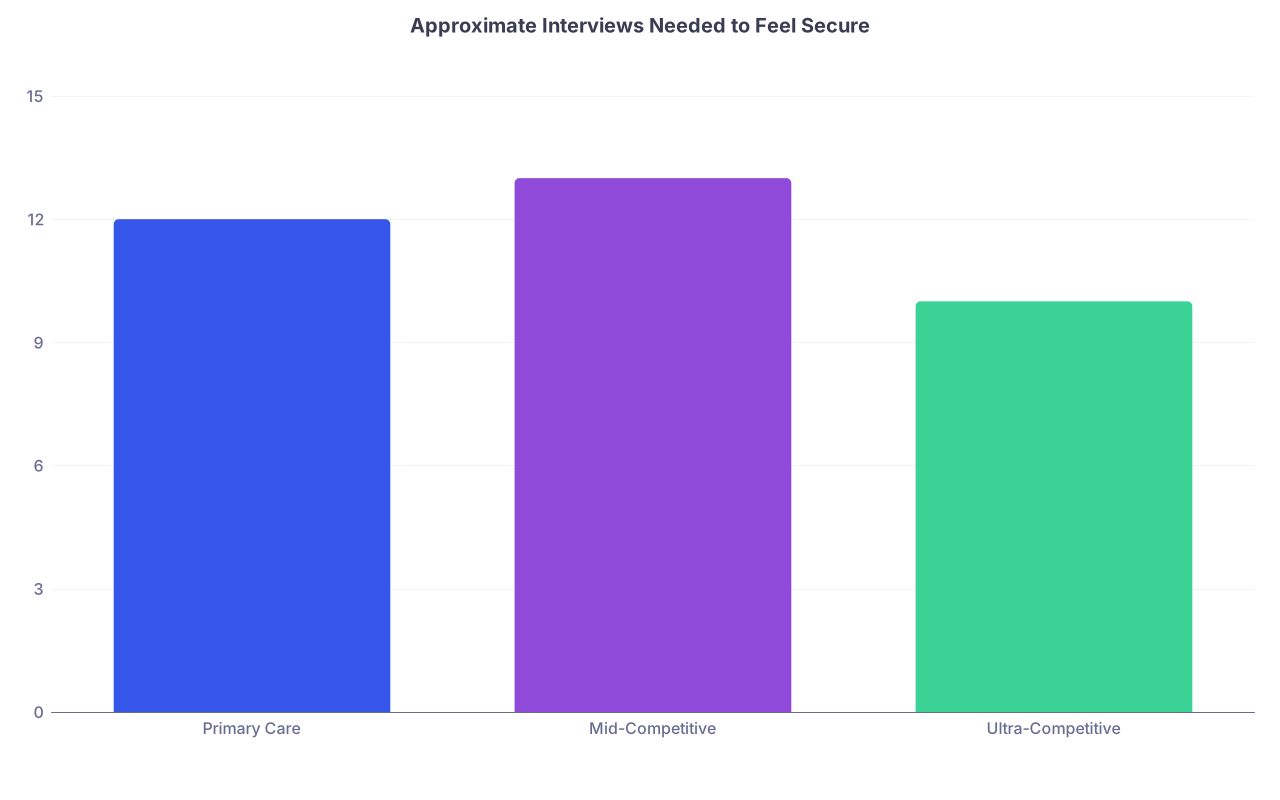
| Category | Value |
|---|---|
| Primary Care | 12 |
| Mid-Competitive | 13 |
| Ultra-Competitive | 10 |
So your dual-apply goal is:
- Secure ~10–12 backup interviews
- Hope to land as many primary interviews as possible
If you hit, say, 4 derm interviews and 11 IM interviews? Your decision is basically made for you on rank list day.
Step 8: How to Build the Actual Lists Without Looking Uncommitted
This is where people tank themselves. They shotgun both specialties without showing commitment to either.
You need a branding split:
Letters:
- Majority from your primary specialty (2–3 letters).
- 1 letter from backup if you have one, plus a general medicine/surgery letter if appropriate.
Personal statements:
- Completely separate statements for each specialty.
- Do not say “I also love [other specialty]” inside them. Ever.
Program selection:
- For the primary specialty, you can include a mix: reaches, matches, safeties.
- For backup, lean toward programs that are:
- Historically friendly to dual applicants or career switchers
- Less name-brand, more likely to appreciate a “grateful to be here” applicant
Geographic overlap:
- Try to target overlapping regions so your interviews are logistically manageable, but don’t make that your only filter.
- Example: ENT mostly East Coast, IM also mostly East Coast, with some Midwest to pad numbers.
Step 9: Prioritizing Interviews When They Clash
This is where the “how many programs” question collides with real life.
You can probably handle:
- 12–18 interviews total without losing your mind
- 20+ if you’re willing to be exhausted and live out of a suitcase (or Zoom box) for weeks
If you’re lucky/unlucky enough to have conflicts:
Basic triage rules:
- If you have very few in the primary specialty, protect every single one you can.
- Once you’ve hit ~10–12 backup interviews, you can start sacrificing lower-tier backup interviews for strong primary interviews.
- Consider program type and reputation:
- Giving up a community IM interview for a good academic anesthesia interview? Reasonable.
- Giving up a strong, well-fitting backup program you’d be happy at for a reach primary that barely knows you exist? Questionable.

| Step | Description |
|---|---|
| Step 1 | Interview Conflict |
| Step 2 | Protect backup interview |
| Step 3 | Prioritize primary |
| Step 4 | Keep backup or decide by location fit |
| Step 5 | Backup interviews >= 10? |
| Step 6 | Primary interview at strong program? |
Step 10: Common Dual-Apply Screwups (Avoid These)
I’ve watched people do these and regret it:
Applying too thin in the backup.
“I did 20 IM programs and 80 ortho.”
They matched nowhere. They were not ortho-competitive and treated IM like a casual safety. IM does not exist to catch people who barely applied.Sending mixed signals.
Using the same generic personal statement for both specialties with minor edits. Programs can tell. They read hundreds; you are not tricking anyone.Over-applying the dream, under-prepping it.
Sending 70 derm apps but doing no away rotations, no meaningful research, and no derm-specific letters. That’s applying for the fantasy, not the job.Letting others pick your risk tolerance.
Classmates screaming “Apply to 120!” or “You’ll be fine with 30!” do not live your life or pay your bills. Run your own numbers.Not using Program Director data.
Every year, NRMP’s Program Director Survey gives a sense of what matters. If your profile is below typical for your dream specialty, you compensate with more total applications plus a stronger backup, not blind optimism.
Quick Reference: Sample Splits by Situation
Think of this as the cheat sheet you’d scribble on the back of an envelope.
| Applicant Type | Primary/Backup | Recommended Split |
|---|---|---|
| US MD, average, Derm + IM | 50 Derm / 40 IM | Total 90 |
| US MD, weaker, Ortho + IM | 40 Ortho / 50 IM | Total 90 |
| DO, strong, Anesthesia + IM | 45 Anes / 35 IM | Total 80 |
| US-IMG, Psych + IM | 35 Psych / 40 IM | Total 75 |
| US MD, strong, EM + FM | 35 EM / 20 FM | Total 55 |
Tweak up or down by ~10 programs based on geography constraints, exam issues, and school reputation.
FAQs
1. Can I triple apply to three specialties?
You can. I almost always think it’s a mistake.
By the time you split 70–90 programs three ways, you’re putting 20–30 per specialty. That’s thin almost everywhere except maybe FM for a very strong applicant. You also look unfocused, your letters become scattered, and you will struggle to explain your story at interviews. If you seriously think you need three specialties, you probably haven’t done the hard work of picking a primary and a realistic backup.
2. If I get enough backup interviews, should I cancel remaining backup applications or interviews?
Cancel late backup interviews if:
- You’ve already hit ~10–12 solid backup interviews,
- The new backup interview requires missing a rare primary interview, or
- You’d never actually rank that backup program above existing options.
Do not rage-cancel all your backup interviews the moment you get 2–3 primary interviews. People overestimate how “safe” a small number of competitive specialty interviews is.
3. How do I explain dual applying to programs without sounding flaky?
Simple, honest, and brief. For example:
To primary specialty:
“I explored both IM and Derm this year. While I applied broadly, my sustained research, sub-internships, and mentorship have been anchored in dermatology, and this is where I see my long-term career.”To backup specialty:
“I applied to dermatology and internal medicine this cycle. As I’ve progressed, I’ve realized how much I value longitudinal patient relationships and the diagnostic breadth of IM, and I’m fully committed to a career in internal medicine if given the opportunity.”
State the exploration, then underline your commitment to that specialty in that room.
4. Is there ever a time to go 100% all-in on the competitive specialty with no backup?
Yes. If:
- You’re a very strong applicant by that specialty’s standards (great scores/clinical evals, strong letters, research, maybe an away rotation),
- You can emotionally and financially tolerate reapplying or doing a research year if you miss, and
- You’d genuinely regret not swinging hard.
I’ve seen people match ortho, ENT, derm after going all-in with 60–80 apps and no backup. But they were realistic: if they missed, they’d take a research year or adjust next cycle. That’s a conscious gamble, not denial.
You’re standing at a fork: hedge too little and you risk a blank Match email; hedge too much and you never really commit to the thing you want. With a clear primary, a sturdy backup floor, and a reasonable total cap, you can walk that line without losing your mind or your savings.
Once your program list is set and money’s left your account, the game shifts: now it’s about interview prep, signaling genuine interest, and building a rank list that actually reflects your priorities. That’s the next phase. For now, get your split right so you have something to rank when that time comes.