
It’s late. You’ve got ERAS open in one tab, Residency Explorer and NRMP data in another, and your bank account in a third. You’re not 24, you did not go straight through, and your timeline looks like a patchwork quilt: post-bacc, maybe a prior career, maybe a leave of absence, maybe a failed Step attempt or a year off for life blowing up.
You’re staring at that number box: “Programs to apply to.”
Do you put 30? 60? 120? You’ve heard horror stories: “I applied to 150 programs and only got 5 interviews.” You’ve also heard the opposite: “Do not overapply, it’s a waste of money.” None of those people had your exact story though. You’re older. You’ve got gaps. Maybe red flags. Maybe IMG. Maybe a combination.
This is where you need a cold, unsentimental strategy.
I’m going to walk you through when you should overshoot program numbers as a non-traditional applicant with gaps, and when more applications won’t actually move the needle.
Step 1: Define What Kind of “Non-Traditional With Gaps” You Are
“Non-traditional” is a lazy umbrella term. Programs care about specifics.
Here’s the brutal truth: the details of your path matter more than the label. So first, you have to categorize yourself accurately.
A. Age and Path
Ask yourself:
- Are you ≥30 at graduation?
- Did you have a prior career (nurse, PA, engineer, teacher, military) and then pivot?
- Did you do a post-bacc or SMP?
- Did you have significant non-medical work gaps (unemployment, caregiving, immigration issues)?
Age alone is not the problem. Age + weaker metrics + gaps + below-average school support? That combination absolutely is.
B. Types of “Gaps” and Flags
You need to be honest about which of these apply:
Formal gaps in training
- Leave of absence during med school
- Time off between preclinical and clinical years
- Extra year(s) to graduate
- Remediation of courses or clerkships
Exam/academic issues
- Step 1 fail
- Step 2 CK fail or very late Step 2
- Multiple shelf failures
- Class decile/quartile at the bottom
Time out of clinical work
- More than 1 year since graduation without structured clinical work
- Career switchers who’ve been out of clinical environments for a while
- IMGs who graduated 5–10+ years ago
Non-linear or “messy” narrative
- Switched specialties late (e.g., applied surg then pivoted to FM/IM in a scramble)
- Prior residency attempt that was incomplete or ended poorly
- Disciplinary issues, professionalism concerns
If you check more than one of those, you’re in the zone where overshooting program numbers is worth considering, not automatically required but very likely wise.
Step 2: Understand What “Overshooting” Actually Means For You
“Apply to more programs” is useless advice without context.
You’re asking: “At what point does more applications actually buy me more interview chances?” That depends on your risk category.
Let me give you a baseline first: a completely standard, U.S. MD, no-gap, mid-tier applicant in a less competitive specialty might sit here:
| Specialty | Typical Safe Range | Very Competitive Range |
|---|---|---|
| Internal Medicine | 25–40 | 50–60 |
| Family Medicine | 20–35 | 40–50 |
| Pediatrics | 20–35 | 40–55 |
| Psychiatry | 25–40 | 50–60 |
| General Surgery | 40–60 | 70–90 |
That’s not you.
You’re not building a “comfortable” list; you’re constructing a salvage or hedge list, depending on how rough your story is.
For non-traditional applicants with gaps, “overshooting” usually means:
- In primary care fields: 60–120+ programs
- In moderately competitive fields (e.g., categorical IM mid-tier): 80–150+ if you’ve got multiple risk factors
- In super competitive fields (Derm, Ortho, ENT, etc.): overshooting is usually not the fix – switching fields or adding a backup is
You do not need 200+ programs for FM if your only “issue” is being 32 with a prior career. You might need 200+ if you are an older IMG with multiple fails and 8 years since graduation trying for IM.
Step 3: Estimate Your Risk Level Honestly
You can’t choose the right number without putting yourself in a bucket.
Use this rough framework. It’s not perfect, but it’s better than vibes.
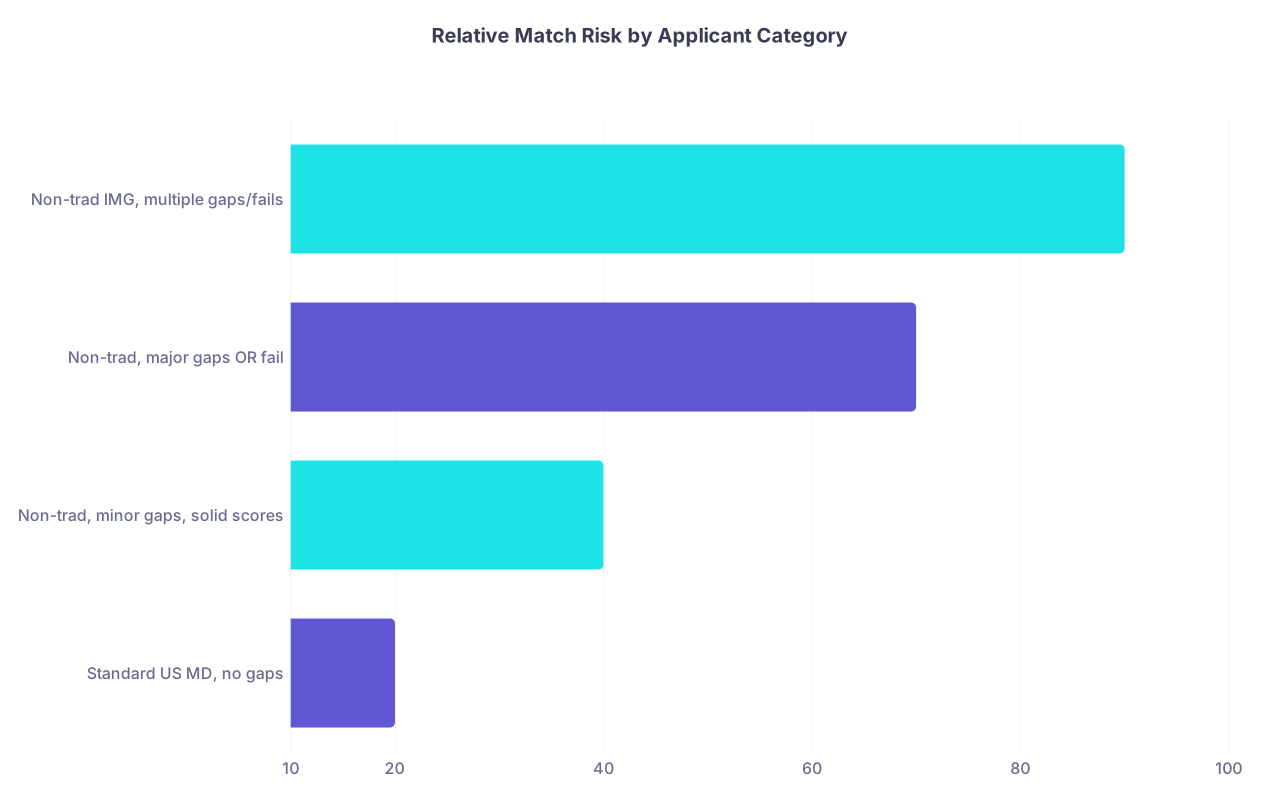
| Category | Value |
|---|---|
| Standard US MD, no gaps | 20 |
| Non-trad, minor gaps, solid scores | 40 |
| Non-trad, major gaps OR fail | 70 |
| Non-trad IMG, multiple gaps/fails | 90 |
Think of these as “risk points.” More points = more reason to overshoot:
- +10: Age ≥30 at graduation
- +10: Prior non-medical career >3 years
- +15: Leave of absence or extra year to graduate
- +20: Any Step fail
- +10: Step scores below the 25th percentile for your target specialty
- +10: IMG or DO applying to very MD-heavy specialty/region
- +10: Gap of >2 years since graduation without structured clinical role
- +10: Switching specialties late without matching letters
Rough interpretation:
- 0–20 points: Mild risk. You’re “non-traditional” on paper, but your app is clean.
- 25–45 points: Moderate risk. You benefit from the higher end of normal ranges.
- 50+ points: High risk. This is where overshooting can move you from “no match” to “some chance.”
If you’re in the 50+ category and you’re applying like a standard applicant, you’re gambling, not planning.
Step 4: When Overshooting Makes Sense (and When It Doesn’t)
Let’s get specific. I’ll walk through scenarios I’ve seen and what I’d do if I were in your shoes.
Scenario 1: Older Applicant, Clean Record, Just Non-Linear
Example: 33-year-old US MD, prior career in finance, did a post-bacc, graduated on time, no LOA, Step 2 in the 230s, wants IM.
Risk points: Age +10, prior career +10 = 20. No fails. No LOA. No major academic concerns.
If you’re this person, you don’t need to blow out to 150 programs.
Strategy:
- Internal Medicine: 40–60 programs is usually fine if your letters are solid and you’re not restricting to Manhattan and San Francisco only.
- Family Medicine: 25–40 programs.
- Peds/Psych: 30–50 programs.
Overshooting above that? Diminishing returns. Put the money into travel for interviews or doing a strong away rotation instead.
Scenario 2: Leave of Absence + Step Fail + Older
Example: 34-year-old US DO, LOA second year for personal/medical reasons, Step 1 fail (now Pass on retake) or COMLEX Level 1 fail, Step 2 220s, applying FM and IM.
Risk points: Age +10, LOA +15, fail +20 = 45. If there’s also a delay in graduation, you’re easily over 50.
This is the profile where overshooting is not optional if you want a real shot.
I’d be blunt here:
- Pick a safer primary specialty. FM, IM, Peds, Psych. Do not aim for EM, Anesthesia, or competitive surgery with this portfolio.
- Program numbers:
- If FM-only: I’d be around 80–120 programs, heavy on community programs, unopposed sites, and less desirable regions.
- If dual FM + IM: split something like 60–80 FM + 40–60 IM, but only if your letters support both.
What doesn’t work: saying “I’ll just apply to 40 FM programs in big coastal cities and hope someone likes my story.” They won’t see your story if you never get through the filter.
Scenario 3: Non-Trad IMG with Time Since Graduation
Example: 38-year-old IMG, graduated 8 years ago, practiced in home country, then immigrated, did some observerships, Step 1 pass, Step 2 230, applying IM.
This is the classic “I need numbers” situation. Programs are nervous about time since graduation. That’s not fair. It’s real.
For this profile:
- If you’re going for Internal Medicine: I’d seriously look at 120–200+ programs.
- You should be:
- Hitting every community IM program that accepts IMGs in the country
- Not being picky about geography
- Aggressively using email to highlight your US clinical experiences
If you try 40–60 IM programs like a typical US MD, you are playing fantasy, not strategy.
Scenario 4: Prior Residency Attempt or Match Failure
Example: 35-year-old US IMG, did 1 year of categorical surgery then left or was not renewed. Now switching to IM or FM. Or, someone who went unmatched last year with a weak interview count.
These are “program director eyebrow-raise” situations. They don’t have time to dig deep into your explanation if you never enter their interview pool.
For a re-applicant or prior incomplete residency:
- You should be targeting the absolute upper end of program numbers for your chosen specialty:
- IM: 100–150+
- FM: 80–120
- Peds/Psych: 80–120
- You also need:
- Fresh letters from current clinical work
- A clear, short explanation in your personal statement of what happened and what changed
If you went unmatched last year after applying to 40 IM programs and got 2 interviews, and this year you’re planning 50 IM with no meaningful improvement in your application, do not expect a different outcome.
You either:
- Radically widen the net (100–150+), and/or
- Switch to a safer specialty, and/or
- Do a meaningful gap year with strong US clinical/research and reapply after improvement
Step 5: How to Set Your Actual Number – A Working Formula
You want a number. So let’s be mechanical for a minute.
Baseline for a standard, no-gap US applicant in a non-competitive field: 30 programs.
Now add:
- +10–15 programs if:
- You’re DO applying to mostly MD-heavy regions
- You attend a lower-tier or new school without strong match history
- +20–40 programs if:
- You have a Step fail
- You have a formal LOA or extra year to graduate
- You’re an older IMG (>5 years since grad)
- +20–30 programs if:
- +20–40 programs if:
- You went unmatched before in the same specialty
- You’re switching from a prior residency attempt with unclear outcome
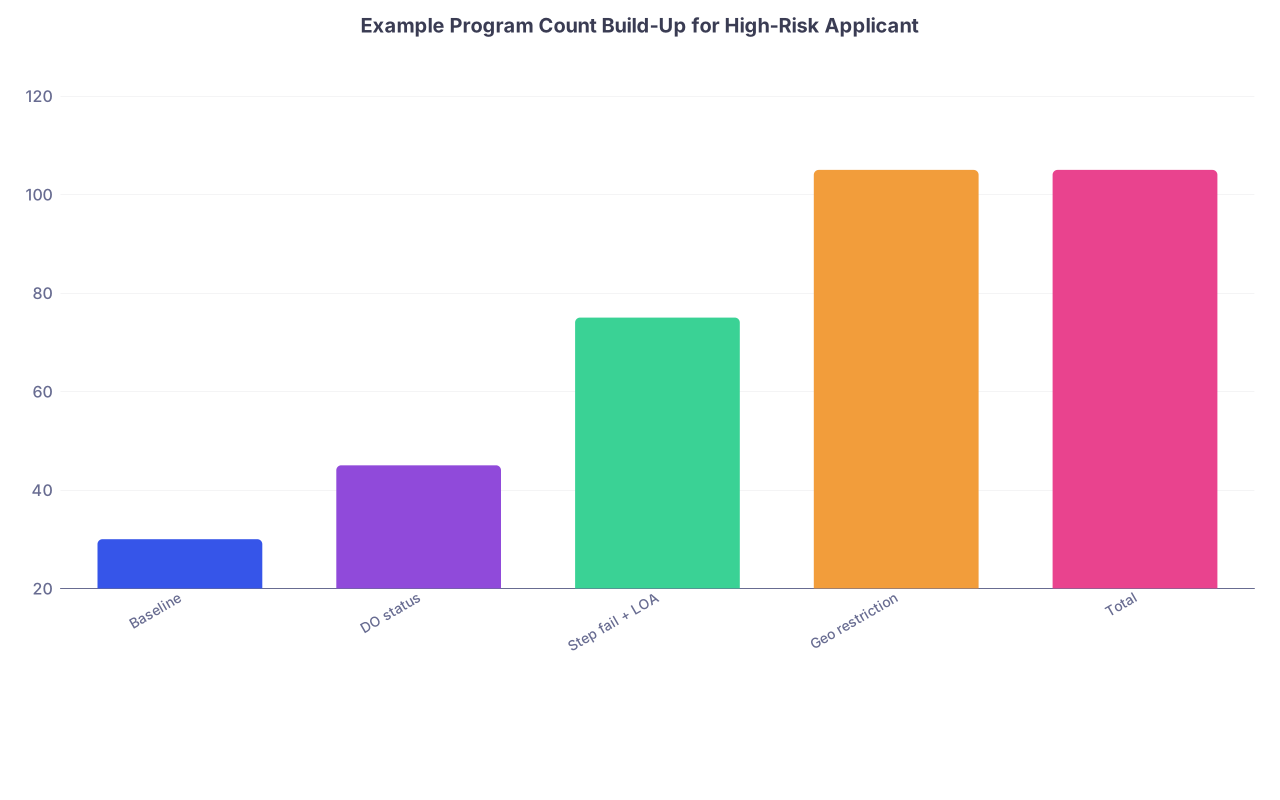
You can easily see how a baseline “30” for FM becomes:
- DO + Step fail + LOA + wants only Northeast
= 30 + 15 + 30 + 30 = 105 FM programs
That’s not overkill. That’s proportional to your risk.
| Category | Value |
|---|---|
| Baseline | 30 |
| DO status | 45 |
| Step fail + LOA | 75 |
| Geo restriction | 105 |
| Total | 105 |
Step 6: Where Overshooting Won’t Save You
Some hard truths.
More applications will not fix:
Completely unrealistic specialty choices.
A 210 Step 2, LOA, 8 years since graduation IMG applying to Dermatology at 200 programs is still not going to match Derm. That’s not pessimism, that’s data.Not taking a genuine safer specialty.
People love to play mental games: “I’ll apply to 150 Anesthesia programs instead of switching to IM.” That’s just lighting money on fire.Not having any recent clinical work.
If you’ve been totally out for 4 years with no clinics, observerships, or related roles, increasing from 60 to 180 applications helps, but you still may need a structured bridge year.Trash application materials.
If your personal statement is generic, your experiences are poorly written, and your letters are weak, scaling from 50 to 150 only multiplies how many people see a weak app. You need to fix content before you hit “Apply to All.”
Overshooting only makes sense after you’ve done everything reasonably possible to present the strongest version of your non-traditional path.
Step 7: Target Smarter While You Overshoot
Overshooting is not just about raw volume. It’s also about where those extra applications go.
Think in layers:
Core layer (realistic targets)
Programs where:- Your scores are near or slightly below their averages
- They historically take DOs or IMGs like you
- They are community or lower-tier university programs
Reach layer
A small number of more competitive programs. Not 50 of them. Maybe 10–20 max.Safety layer
Programs in less popular locations, smaller cities, or less glamorous regions that:- Consistently take IMGs/DOs/non-traditional applicants
- Aren’t on everyone’s “top 10 dream” list
When you overshoot, what increases most is the core and safety layers, not endless dream programs.
Step 8: Money, Sanity, and When to Stop
Each additional program costs real money. For a high-risk non-traditional applicant, unfortunately, the cost floor is higher.
Still, there is a stopping point.
If all of these are true:
- You’ve applied to:
- At least 80–100+ programs in a primary care specialty and
- They’re appropriately distributed across regions and program tiers
- You have:
- No new planned improvements (no new exam scores coming, no new strong letters, no new clinical work)
- You’ve already:
- Addressed your gaps honestly and succinctly in your application
Then doubling again from 100 to 200 often yields smaller return per dollar than:
- Doing more targeted outreach emails to PDs
- Getting help rewriting your personal statement
- Preparing harder for the interviews you do get
Overshooting should feel strategic, not panicked.
Step 9: Quick Reality Checks by Profile
If you want a sanity check, here’s how I’d react to a few common lines I hear:
“I’m 31, clean record, US MD, Step 2 240, aiming for IM, thinking 80 programs.”
I’d say: you’re overshooting. Cut to 40–60 and be intentional.“I’m 35, US DO, LOA, Step 1 fail but passed on second, Step 2 225, applying FM only, planning 45 programs.”
Too low. I’d push that to 80–100.“I’m 37, Caribbean IMG, 6 years since graduation, Step 1 pass, Step 2 230, applying IM, planning 60 programs, mostly big coastal cities.”
Way too low and way too selective. I’d want 150+ with heavy Midwest/South community presence.“I went unmatched last year in IM with 8 interviews from 70 apps, reapplying this year with better Step 2 and new letters, planning 80 apps.”
Reasonable to modestly increase to 100–120 if finances allow, especially if you’re adding more lower-tier/safety programs.
Final Takeaways
Being non-traditional with gaps is not an automatic death sentence, but it does change the math. Your program number should be built from your actual risk profile, not from what your classmate did.
Overshooting only makes sense once your specialty choice is realistic and your application materials are honestly as strong and clear as you can make them. More weak applications don’t solve weak fundamentals.
High-risk applicants (older, gaps, fails, time since graduation, IMG/DO) should expect to sit at the upper end of program ranges—often 80–150+ in IM/FM/Peds/Psych—if they’re serious about giving themselves a real shot rather than a symbolic one.