
Most applicants are calibrating their program list wrong when they mix USMLE and COMLEX.
They either apply like they are a pure USMLE applicant. Or like they are a pure COMLEX applicant. Both are mistakes. If you have one, the other, or both, you need a score-based formula for how many programs to apply to and where.
I am going to walk you through that formula.
1. The brutal truth about USMLE vs COMLEX in residency selection
Let me be blunt.
Program directors do not treat USMLE and COMLEX as equal currencies. They never have. They say they do on their websites. Then in ranking meetings you hear: “What is their Step 2?” or “Do we have a USMLE for this DO?”
I have seen this pattern repeatedly:
- DO applicant with strong COMLEX, no USMLE, applies to competitive IM or EM → half the programs quietly filter them out.
- Same COMLEX, plus decent Step 2 CK → dramatically more interview invites.
- MD applicant with just enough Step 2 CK to clear filters → gets looks even with no COMLEX at all.
So you need to adjust your target program number based on:
- Which exams you have (USMLE only, COMLEX only, or both).
- How strong those scores are relative to your chosen specialty.
- How “USMLE-centric” your target programs are.
Let us systematize that.
2. Step 1: Classify yourself into one of 4 applicant types
Before you decide how many programs to apply to, you need to know what bucket you are in. This dictates how programs read your application and what filters hit you.

Applicant Type A: MD with USMLE only
- You took Step 2 CK (Step 1 is now pass/fail, assume pass).
- No COMLEX, obviously.
- Programs know exactly how to compare you to the national pool.
This is the “default” applicant. Program numbers are usually quoted for this group.
Applicant Type B: DO with COMLEX only
- You took COMLEX Level 1 and Level 2.
- No USMLE score.
Reality check: many ACGME programs still bulk import ERAS and look at USMLE first. Some have adjusted their filters for COMLEX. Many have not. You are at baseline disadvantaged at more “USMLE-centric” institutions, especially in competitive specialties.
Applicant Type C: DO with COMLEX + USMLE
- You took COMLEX and Step 2 CK (Step 1 maybe, maybe not, but now less important).
- You have both currencies.
- Programs can compare you directly to MDs with Step 2 CK, and to DOs with COMLEX only.
This is the strongest position for DOs targeting ACGME residencies, especially in competitive fields.
Applicant Type D: MD with USMLE + (optional) COMLEX
Rare. Usually from special circumstances. For most specialties and programs, COMLEX will not add much for an MD. You are basically treated like Type A with some extra noise in your file.
For the rest of this article, I will focus on A, B, and C. If you are D, follow the A pathway and ignore COMLEX for strategy purposes.
3. Step 2: Benchmark your scores against your specialty
You cannot calibrate program numbers if you do not know whether your scores are:
- Above average
- Average
- Below average
For USMLE Step 2 CK, broad bands (not exact, not perfect, but useful):
- 270+ → Elite outlier
- 260–269 → Very strong
- 250–259 → Strong
- 240–249 → Solid / slightly above average
- 230–239 → Slightly below average
- 220–229 → Below average / risky in competitive fields
- <220 → Concerning for many non-primary care specialties
For COMLEX Level 2, rough bands:
- 750+ → Elite
- 700–749 → Very strong
- 650–699 → Strong
- 600–649 → Above average
- 550–599 → Slightly above / average depending on specialty
- 500–549 → Slightly below average for many ACGME programs
- <500 → Risk for many non-primary care programs
To make this less abstract, look at this simplified comparison:
| Band Label | Step 2 CK Range | COMLEX Level 2 Range |
|---|---|---|
| Elite | 270+ | 750+ |
| Very Strong | 260–269 | 700–749 |
| Strong | 250–259 | 650–699 |
| Above Avg | 240–249 | 600–649 |
| Average | 230–239 | 550–599 |
| Below Avg | 220–229 | 500–549 |
| Concerning | <220 | <500 |
Now classify your primary score:
- Type A (MD): Primary = Step 2 CK.
- Type B (DO COMLEX-only): Primary = COMLEX L2.
- Type C (DO both): Primary for ACGME = Step 2 CK, but we will use both.
Write it down: “I am [Band] in my specialty.”
If you are targeting a hyper-competitive field (derm, ortho, plastics, ENT, urology, neurosurgery, integrated IR), slide the bar up by one: “Strong” may behave like “Average” in those fields.
4. Step 3: Reality of specialty competitiveness
Your score does not live in a vacuum. A 240 Step 2 is plenty for Family Medicine. It is marginal for Dermatology. So you adjust your base program number by specialty.
Here is a simplified base recommendation for Type A MD applicants with average-ish applications (no red flags, decent clinical performance, some research if the field expects it):
| Specialty Tier | Examples | Base Program Count |
|---|---|---|
| Primary Care / Less Competitive | FM, IM (categorical), Peds, Psych, Neuro | 25–35 |
| Mid-Competitive | EM, Anesthesia, OB/GYN, Gen Surg, PM&R | 35–45 |
| Highly Competitive | Ortho, ENT, Urology, Ophtho, Radiology | 50–70 |
| Ultra-Competitive | Derm, Plastics, Neurosurg, IR (integrated) | 70–90+ |
This table is for MD, USMLE only, average band scores. We will adjust this for your exact situation in the next section.
The mistake I see: DO applicants with COMLEX only applying at MD “base numbers” and then wondering why the interview count is depressed. Or high Step 2 CK MDs applying like they are average and wasting thousands of dollars on excess applications.
We are going to fix that with a multiplier system.
5. Step 4: Build your personal “Program Count Multiplier”
Here is the core framework:
- Start with the base program number from the table above (pick a single number in the range).
- Apply Score Strength Multiplier.
- Apply Exam Type Multiplier (USMLE vs COMLEX).
- Apply Portfolio Multiplier (research, red flags, visa, etc.).
- Sanity check against your budget and time.
Let us walk each one.
5.1 Score Strength Multiplier
Use your primary score band (Step 2 CK for A/C, COMLEX L2 for B if no Step 2).
- Elite / Very strong → 0.7–0.8× base
- Strong → 0.9× base
- Above average → 1.0× base
- Average → 1.1× base
- Below average → 1.3× base
- Concerning → 1.5–2.0× base (and serious Plan B discussions)
Example:
Base for Anesthesia (mid-competitive) = 40 programs.
- Step 2 CK 260 (Very Strong) → 40 × 0.8 ≈ 32 programs.
- Step 2 CK 232 (Average) → 40 × 1.1 ≈ 44 programs.
- COMLEX L2 515, no USMLE (Below avg) → base 40 × 1.3 ≈ 52 programs (and that is before exam-type adjustment).
5.2 Exam Type Multiplier (USMLE vs COMLEX)
This is where most DOs get blindsided.
Use this:
- Type A (MD, USMLE only) → multiplier 1.0
- Type C (DO with USMLE + COMLEX)
- Apply 1.0 for DO-friendly fields and programs.
- Apply 1.1 for highly USMLE-centric or competitive specialties (because DO status still matters).
- Type B (DO with COMLEX only)
- 1.2 for DO-heavy or clearly DO-friendly specialties (FM, IM, Peds, Psych, EM at DO-friendly sites).
- 1.4–1.6 for more competitive ACGME programs and USMLE-heavy specialties.
This is not “fair.” It is what I have watched in actual applicant data.
Example: DO, COMLEX-only, mid-range score, applying to IM at ACGME programs:
- Base for IM = 30
- Score Average → 1.1 → 33
- Exam-type (COMLEX only) → 1.2 → 33 × 1.2 ≈ 40 programs
Same candidate but aiming for EM at mixed ACGME programs:
- Base for EM (mid-competitive) = 40
- Score Average → 1.1 → 44
- Exam-type (COMLEX only in EM) → 1.4 → 44 × 1.4 ≈ 62 programs
You see how quickly this grows.
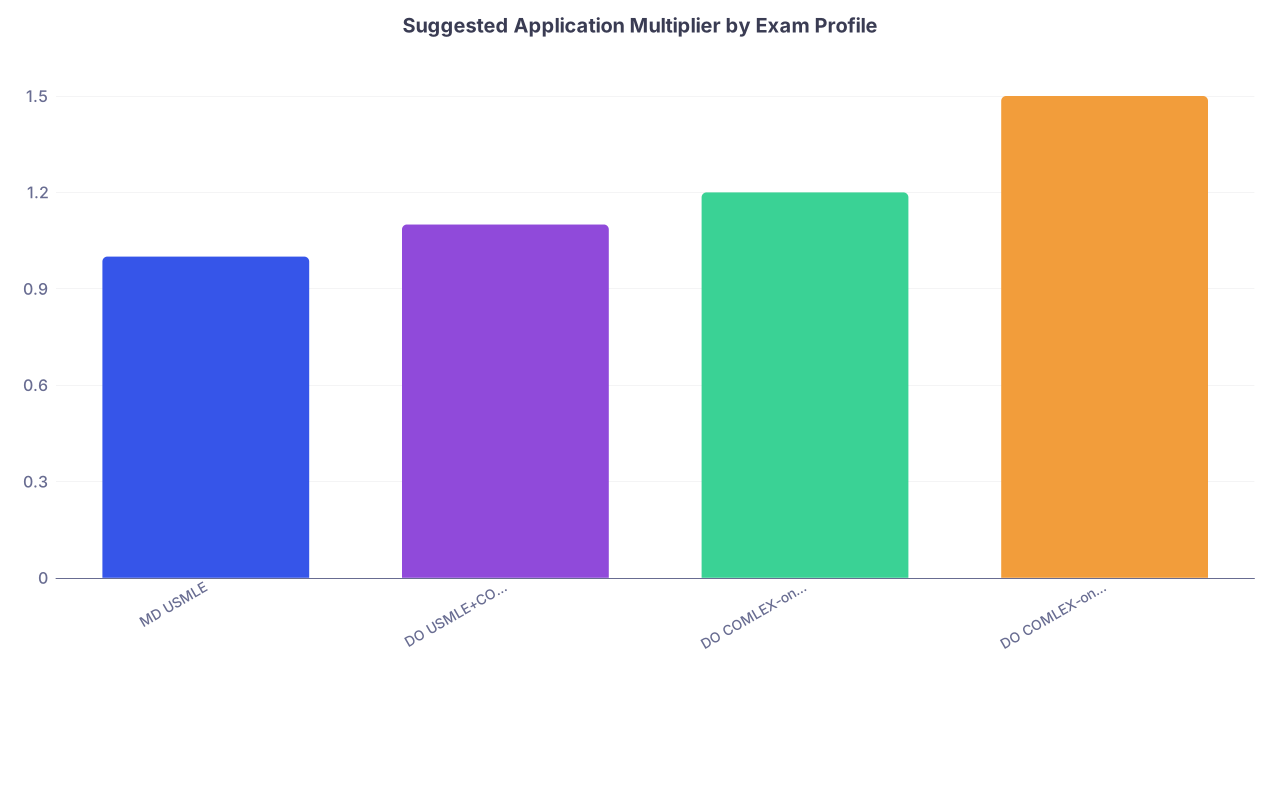
| Category | Value |
|---|---|
| MD USMLE | 1 |
| DO USMLE+COMLEX | 1.1 |
| DO COMLEX-only DO-friendly | 1.2 |
| DO COMLEX-only competitive | 1.5 |
5.3 Portfolio Multiplier (the non-score reality check)
Scores are not everything. You adjust further if:
Add 10–20% more programs if:
- You are an IMG / non-US grad.
- You need visa sponsorship.
- You have a fail or major red flag.
- You are switching specialties late.
- You lack expected research in a research-heavy field (e.g., radiation oncology, derm, academic IM).
Subtract 10–20% if:
- You are from a powerhouse school in the specialty, applying with strong letters.
- You have heavy, high-quality research in that field.
- You have home or regional connections with strong pipelines.
Treat these as ±0.8–1.2 multipliers.
6. Concrete scenarios: How many programs should YOU apply to?
Let’s run through specific realistic examples so you can mirror the logic.
Scenario 1: MD, USMLE only, applying to Internal Medicine
- Step 2 CK: 243 → Above average
- No major red flags, average research.
- Specialty: IM (categorical, mostly academic programs).
- Base for IM → 30 programs.
- Score multiplier (Above average) → 1.0 → 30.
- Exam-type (MD with USMLE) → 1.0 → 30.
- Portfolio: let us say no bonus or penalty → 1.0 → 30 programs.
If you wanted to aim slightly higher or you are location picky, you could push to 35–40, but you do not need 60+ for this profile.
Scenario 2: DO with COMLEX only, applying to Internal Medicine
- COMLEX L2: 560 → Average.
- No USMLE.
- Wants mostly ACGME IM in urban areas.
- Base for IM → 30.
- Score (Average) → 1.1 → 33.
- Exam-type (DO COMLEX-only, IM) → 1.2 → 33 × 1.2 ≈ 40.
- Portfolio: maybe slight bump if aiming for mostly academic programs → 1.1 → 40 × 1.1 ≈ 44 programs.
Here is the punchline: this DO should very likely apply to 40–50 IM programs, not 25–30. And seriously consider taking Step 2 CK if still early enough, because it reduces that penalty.
Scenario 3: DO with COMLEX + USMLE, applying to EM
- COMLEX L2: 640 (Strong).
- Step 2 CK: 252 (Strong).
- EM, mostly academic/mid-tier programs, DO-friendly and mixed.
- Base for EM → 40.
- Score (Strong) → 0.9 → 36.
- Exam-type: DO with USMLE in a relatively DO-accepting specialty → 1.0–1.1. Use 1.05 → 36 × 1.05 ≈ 38.
- Portfolio: no big plus or minus → 1.0 → ~40 programs.
EM is volatile these days; I would tell this person to stay in the 40–45 range and diversify regionally.
Scenario 4: DO with COMLEX only, applying to General Surgery
- COMLEX L2: 580 (Average).
- No Step 2 CK.
- Targeting ACGME categorical GS.
This is a tough lane.
- Base for Gen Surg (mid-competitive) → 40.
- Score (Average) → 1.1 → 44.
- Exam-type (COMLEX only in GS) → 1.5 (yes, that high) → 44 × 1.5 ≈ 66.
- Portfolio: if there is minimal surgery research or weaker letters, maybe another 1.1 → 66 × 1.1 ≈ ~72 programs.
For this type of applicant, I also recommend:
- Parallel planning with prelim surgery and maybe transitional year.
- Strongly considering Step 2 CK if not too late, to drop that exam penalty.
Scenario 5: MD, high Step 2, applying to Anesthesia
- Step 2 CK: 262 (Very strong).
- Solid school, one anesthesia rotation with strong letter.
- Base for Anesthesia → 40.
- Score (Very strong) → 0.8 → 32.
- Exam-type (MD with USMLE) → 1.0 → 32.
- Portfolio: maybe small downward adjust, strong candidate → 0.9 → 32 × 0.9 ≈ ~29 programs.
Do not apply to 70 anesthesia programs with a 262 Step 2 and clean application unless you have bizarre geographic needs. It is a waste.
7. USMLE vs COMLEX: When should a DO still take Step 2 CK?
This question comes up constantly and it directly affects program numbers.
If you are DO Type B (COMLEX only) and not yet in the application cycle, ask:
- Are you targeting mostly ACGME residencies in:
- General Surgery
- Anesthesia
- EM
- Radiology
- Or any of the highly competitive subspecialties?
If yes, the answer is almost always: take Step 2 CK unless there is a compelling reason not to (e.g., major test anxiety, failed attempts, or timing that would delay your application).
Why?
Because that exam-type multiplier is brutal. Step 2 CK can easily reduce your required program count by 20–30% and open doors at programs that quietly screen COMLEX-only applicants.
I have seen this pattern year after year:
- DO, 600–630 COMLEX L2, no Step → 50–70 applications, modest interview yield.
- Same score band + Step 2 CK 240+ → 35–50 applications, better interview yield and better program mix.
If you are close to the cycle and you cannot take Step 2 CK without hurting timing, then accept the multiplier reality and adjust your program number up instead of pretending you are in the same lane.
8. How to build your final program list (step-by-step)
Now you know your rough target count. Next problem: which programs fill those slots?
Here is the workflow I recommend.

| Step | Description |
|---|---|
| Step 1 | Define Specialty and Score Band |
| Step 2 | Determine Base Program Count |
| Step 3 | Apply Score and Exam Multipliers |
| Step 4 | Set Target Program Number |
| Step 5 | Create DO Friendly and Geography Filters |
| Step 6 | Segment Programs into Tiers |
| Step 7 | Balance List by Tier and Location |
| Step 8 | Finalize and Double Check Against Budget |
Step 1: Set your exact target number
Use the multipliers:
- Pick base from table.
- Multiply score factor.
- Multiply exam-type factor.
- Multiply portfolio factor.
Round to a whole number and say out loud:
“I am applying to X programs.”
Step 2: Build a wide pool, then filter
Use tools like:
- FREIDA
- EMRA Match (for EM)
- Specialty-specific DO-friendly lists from student orgs or forums (but double-check; they go stale).
Tag each program by:
- DO vs MD friendliness (historical DO residents, explicit statements, previous matches from your school).
- Geography (must-have, nice-to-have, avoid).
- Program type: academic vs community vs hybrid.
Step 3: Tier your programs
Split your pool into:
- Reach: average applicant at that program has higher scores / stronger profiles than you.
- Target: you are roughly in their central band.
- Safety: your scores and profile are higher than their typical range.
Aim for something like:
- 20–30% reach
- 50–60% target
- 20–30% safety
For DO COMLEX-only in competitive fields, lean heavier on target and safety.
Step 4: Apply your exam reality
For DOs:
- Give extra weight to programs that:
- List COMLEX conversion explicitly.
- Have DOs in current residents.
- Historically interview COMLEX-only applicants (ask upperclassmen / recent grads).
- Deprioritize or drop:
- Programs that “prefer” or “require” USMLE on their site (unless you have it and it is good).
9. Budget and time constraints: hard limits
You can mathematically justify 80 programs. Your wallet and sanity might disagree.
Application costs and interview time are not infinite. At some point, extra applications add little marginal benefit. Here is a rough sanity chart for total single-specialty applications:
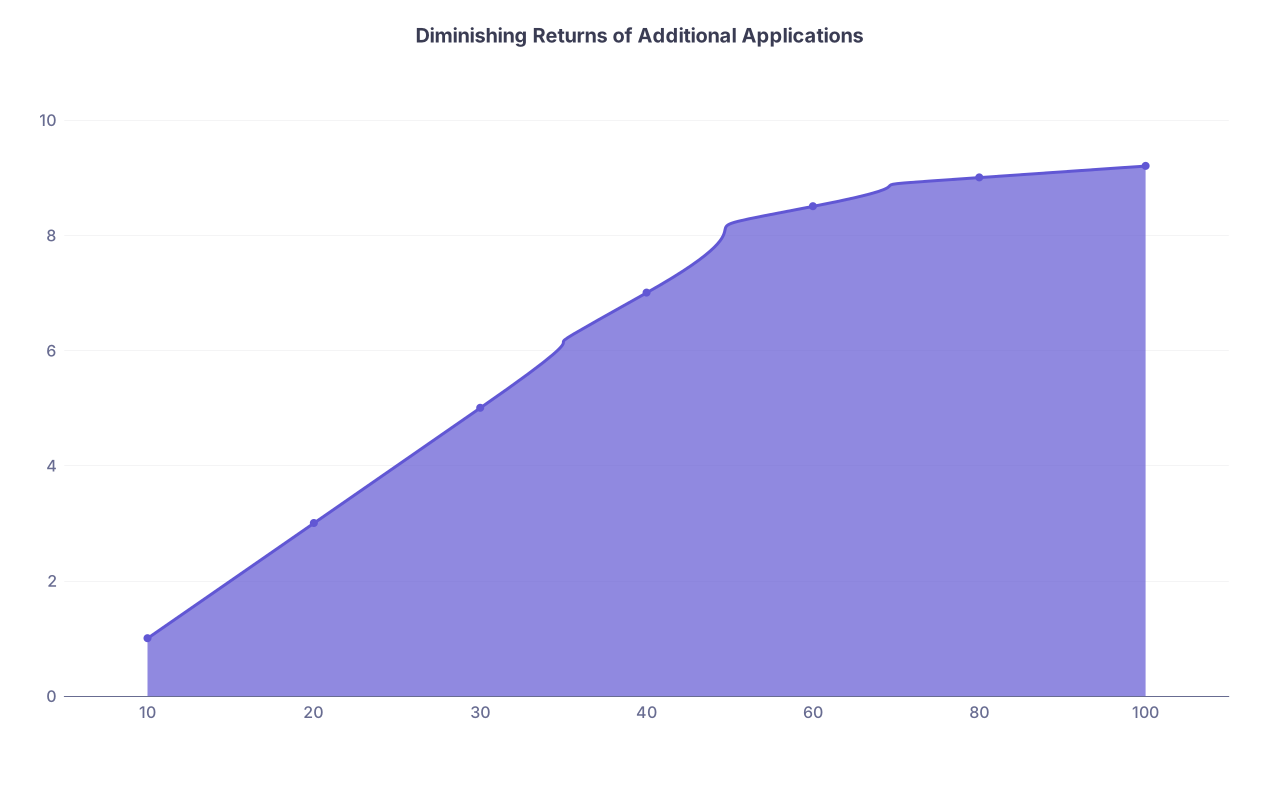
| Category | Value |
|---|---|
| 10 | 1 |
| 20 | 3 |
| 30 | 5 |
| 40 | 7 |
| 60 | 8.5 |
| 80 | 9 |
| 100 | 9.2 |
Interpretation: going from 30 to 60 programs helps a lot in many situations. Going from 80 to 100 often adds almost nothing except cost.
My rules of thumb:
If your calculation gives >80 programs in one specialty, ask:
- Is my specialty choice realistic with my scores and exam mix?
- Should I add a back-up specialty instead of bloating my primary list?
- Is there a step I missed (like taking Step 2 CK)?
If your calculation gives <20 programs in a competitive specialty:
- You are probably under-applying unless you have truly elite scores and a powerhouse CV.
- Consider bumping to at least 30–35 unless your advisor who sees your whole file tells you otherwise.
10. Quick calibration checklist
Before you click “Submit” on ERAS, run this list:
- I know my applicant type (MD USMLE, DO COMLEX-only, DO both).
- I classified my score into a clear band for my specialty.
- I picked a base program number from a realistic specialty tier.
- I applied:
- Score multiplier
- Exam-type multiplier
- Portfolio multiplier
- My final number:
- Makes sense given my budget and time.
- Is not dramatically lower than peers with weaker profiles.
- Is not bloated because I am anxious and ignoring the math.
If any of those answers feel shaky, fix them now. Not later.
FAQ (exactly 3 questions)
1. I am a DO with strong COMLEX scores but no USMLE; is it too late to take Step 2 CK, or should I just apply to more programs?
If your application season has not started or you are early enough that a Step 2 CK score would be back before programs download files, I recommend taking Step 2 CK if you are realistically likely to score at or above the equivalent of your COMLEX band. That usually means you are consistently scoring solidly on NBMEs or other reputable practice materials. If you are within 4–6 weeks of ERAS opening and you are not already prepared, adding Step 2 can delay your app or lead to a rushed, poor performance. In that case, accept the COMLEX-only penalty, raise your program number with the exam-type multiplier, and focus on strengthening every other part of your application.
2. How do I adjust if I am applying to two specialties with different competitiveness and exam expectations (for example, IM and Neurology)?
Treat them as two separate calculations. For each specialty, determine: base program number, then apply score, exam-type, and portfolio multipliers. You will likely end up with a higher recommended count for the more competitive specialty. Do not try to “average” them. Instead, decide which specialty is primary. Apply roughly two-thirds of your total application budget to the primary, one-third to the secondary, and be explicit with your mentors and letter writers about this strategy. Be realistic: you cannot run two full, independent 60-program campaigns without diluting effort and interview bandwidth.
3. My Step 2 CK and COMLEX L2 are mismatched (for example, high COMLEX, average Step 2); which should I emphasize and how does that affect my program count?
Programs will almost always anchor on Step 2 CK first in ACGME settings. If your Step 2 is noticeably lower than your COMLEX band, you still benefit from having a USMLE score, but not as much as if they were concordant. In that case, calibrate your score multiplier to your Step 2 band, not to COMLEX, for most ACGME programs. You can highlight the stronger COMLEX performance in conversations or advisor discussions, but institutionally the filters fire on Step 2. That means your recommended program number probably sits between what a COMLEX-only candidate and a high-Step-2 candidate would need. Use slightly higher program counts than you would if both scores were equally strong, and focus your list on programs with a track record of training DOs, where both scores will be read in context.
Open your score report right now and write three things at the top: your applicant type, your score band, and your target specialty tier. Then run the multiplier steps and decide on a concrete program number today, before fear or ego pushes you into either under-applying or wasting money on 40 unnecessary applications.