
Balancing prestige against volume is not “an art.” It is a math problem with emotions layered on top. Treat it like art and you overapply blindly. Treat it like math and you actually match.
You want a practical framework for how many programs to apply to, and how many “reach vs realistic vs safety” to include. So let’s build one. Step-by-step. With numbers.
Step 1: Accept the Core Reality – Prestige Is a Multiplier, Volume Is Insurance
You are fighting two forces:
Prestige pull
- Everyone wants the big-name academic center.
- Your classmates are flexing their “dream programs.”
- You feel like if you do not at least try, you are selling yourself short.
Volume protection
- NRMP data is brutally clear: more interviews = higher match chance.
- You do not control interviews. You control applications.
- Volume is how you insure against randomness, hidden cutoffs, and bad luck.
Most people screw this up in exactly two ways:
- They apply to too many reach programs and not enough realistic ones.
- Or they say, “I am not competitive anyway,” and apply to too few places overall.
The solution is not “apply to more.” The solution is:
Match your list size and list distribution to your actual competitiveness and your specialty’s competitiveness.
Let’s quantify that.
Step 2: Know Your Risk Level – You Are Not “Average”
You cannot build a smart application list if you keep telling yourself, “I am roughly average.” That is how you end up with 40 applications to places that will never open your file.
You need a risk category. One, and only one, of these: Low, Moderate, or High risk.
A. Define Your Specialty Risk
First, how dangerous is the specialty itself?
| Tier | Examples | Baseline Risk |
|---|---|---|
| Very High | Derm, Plastics, Ortho, ENT, Neurosurg, Integrated Vascular, IR (integrated) | Extreme |
| High | EM (varies by cycle), Anesth (recently tighter), Urology, Ophtho, Rad Onc (volatile) | High |
| Moderate | IM categorical, Gen Surg categorical, OB/GYN, Psych, PM&R | Moderate |
| Lower | Peds, Family, Neuro, Path, IM prelim/TY | Lower |
You already know where your specialty sits. If you are pretending Derm is “probably fine this year,” stop.
B. Define Your Personal Risk
Now your own profile. Brutally.
You are Low Risk if:
- US MD, no fails, no major red flags.
- For Step 2: around or above the median for your specialty (or Step 1 when it still mattered).
- Solid clinical evals, at least average letters, some research or at least something relevant.
You are Moderate Risk if ANY of these:
- Step 2 a bit below specialty median.
- DO student applying to more competitive specialties (IM, Psych, EM, etc. in strong regions).
- One minor academic issue (one fail, one LOA with explanation, a late Step 2, limited home support).
- International grad with strong US letters and recent US clinical experience.
You are High Risk if ANY of these:
- IMG / FMG without strong US letters and recent US experience.
- Step 2 significantly below typical matched values in your specialty.
- Multiple red flags: repeated exams, professionalism issues, big gaps, late application.
- Switching specialties late or with weak alignment in experiences.
Now combine Specialty Risk + Personal Risk to get your overall risk.
Step 3: Decide Your Total Application Volume – Use a Numeric Range, Not a Guess
Here is the part everyone wants: the actual numbers.
These are starting ranges, not commandments, but they are based on what I have actually seen work.
| Overall Risk | Lower-Risk Specialty | Moderate Specialty | Very Competitive Specialty |
|---|---|---|---|
| Low | 15–25 | 25–35 | 40–50 |
| Moderate | 25–35 | 35–50 | 60–80 |
| High | 35–50 | 60–80 | 80–120 |
Some reality checks:
US MD, solid IM applicant with no red flags?
25–30 is plenty if the list is well constructed and you apply early.US MD applying Derm with a realistic profile?
You are likely in the 40–60 range if you want a real shot.IMG applying IM with Step 2 below 230 and no US research?
You are not applying to 20 programs and “seeing what happens.” You are in 80–120+ territory.
If these numbers feel “too high,” you are reacting emotionally, not strategically. But there is another side:
If you are a strong US MD applying Pediatrics and you are planning 80 applications because “everyone else is,” you are wasting money and time.
Now we have volume ranges. Next, we sift them into prestige tiers.
Step 4: Break Programs into Three Tiers That Actually Matter
Forget “top 10,” “top 20,” or Instagram rankings. For your purposes you only need three practical buckets:
Reach (Prestige / High Bar) Programs
- Big-name academic centers.
- Programs whose typical matched residents have stronger board scores / research / pedigree than you.
- Or locations where demand far exceeds supply (NYC, SF, LA, Boston) for your specialty.
Realistic (Target) Programs
- Your stats and experiences sit at or slightly above their typical matched residents.
- They interview many applicants with your profile.
- They may be academic or community, but you are not a stretch.
Safety (Solid / Backstop) Programs
- Programs that regularly match people with weaker profiles than yours.
- Often community or smaller city programs, maybe less desirable geography.
- You would rather not end up unmatched than be picky about these.
You will underestimate how many True Safety programs you need. Everyone does. Fix that now.
Step 5: Use a 3-Bucket Distribution – And Stick to It
Now we layer prestige on top of volume.
A. Baseline Distribution Formula
For most applicants, a sane distribution looks like this:
- 20–30% Reach
- 50–60% Realistic
- 20–30% Safety
That is for moderate risk in a moderate specialty.
We adjust from there:
If you are Low Risk in a moderate or lower-risk specialty:
- Reach: 30–40%
- Realistic: 40–50%
- Safety: 10–20%
You can afford more prestige. You still need safeties.
If you are Moderate Risk:
- Reach: 20–30%
- Realistic: 50–60%
- Safety: 20–30%
This is the default many people should use and almost nobody does.
If you are High Risk:
- Reach: 10–20% (and those “reach” programs should still not be fantasy)
- Realistic: 40–50%
- Safety: 30–50%
You are not playing for “dream.” You are playing for “match.”
B. Concrete Examples
Let’s make it painfully specific.
Example 1: US MD, Psych, Moderate Risk
- Specialty: Psych (moderate competitiveness, rising interest)
- You: Step 2 slightly below national matched mean, average research, good evals, no red flags.
- Volume target: 35–45 programs
Let’s pick 40 programs.
Distribution:
- Reach (25%): 10
- Realistic (50%): 20
- Safety (25%): 10
What that looks like:
- 10 big-name university or urban desirable locations where you are a bit below their usual profile.
- 20 solid university-affiliated or community programs where your stats are squarely in range.
- 10 less popular geography, true mid-tier or lower-tier programs where applicants with weaker files match.
This list gets you enough shots at “prestige” while protecting you from ending up with 3 total interviews.
Example 2: IMG, Internal Medicine, High Risk
- Specialty: IM (broad but segmented; IMG-heavy in many places)
- You: Step 2 around 220, some gaps, one attempt on Step 1, moderate USCE.
- Volume target: 80–100 programs
Let’s pick 90 programs.
Distribution:
- Reach (15%): 13
- Realistic (40%): 36
- Safety (45%): 41
Yes, 41 safety-type programs. That is not overkill for an IMG with risk. That is reality.
Step 6: Prestige vs Volume – Use a Cold Calculation, Not Vibes
Now, how do you trade off prestige slots vs extra volume?
Here is the core rule:
Any time you add a reach program, ask: “Would I be better off adding one more realistic or safety instead?”
If your answer is:
- “I already have strong volume in realistic/safety and I want a little more upside” → Add the reach.
- “Honestly my list is already reach-heavy” → You cut a reach. Add a realistic. Full stop.
To make this less abstract, use this simple Return on Application (RoA) way of thinking:
Reach program:
- Very low probability of interview, high appeal.
- Emotional payoff if you get it, but mathematically weak.
Realistic program:
- Moderate to high probability of interview.
- Highest impact on total number of interviews.
Safety program:
- Aim for high interview probability, lower desirability.
- Insurance that you do not go unmatched.
Most applicants overestimate the RoA of reach programs and underestimate the RoA of realistic ones.
Pretend each application costs you 1 “unit” of attention and money:
- Would you rather spend that 1 unit on a place that has a 2% chance of interviewing you or a place that has a 30–40% chance?
- If you already have 10 reaches, the 11th one adds almost nothing. If you have 6 realistic programs and add a 7th, that might be the difference between 8 vs 10 interviews.
If you have not yet internalized this, reread that last paragraph.
Step 7: Build the List in the Right Order
You should not start by listing your dream institutions. That is backward.
Build in this order:
Anchor with Safeties
- Identify at least 8–10 true safeties no matter what specialty, more if high risk.
- Criteria: They regularly take applicants with your stats or worse; geography is less desirable; program is stable but not hype.
- Do this first so you cannot “forget” to add them later when you get prestige-drunk.
Fill in Realistic Programs
- This is your core list. Where you truly belong on paper.
- Look at recent residents’ med schools and scores (program websites, FREIDA, mentors).
- Fill out to your target number for this bucket based on your distribution.
Only Then Add Reach Programs
- Now you know how many reach slots you have left.
- Use them intentionally: either big-name academic, specific city you love, or unique training tracks.
- Every single reach needs a justification beyond “sounds cool.”
This order prevents the “35 reach, 5 realistic, 3 safety” disaster I see way too often.
Step 8: Use Hard Cut Criteria – Do Not Fall in Love with Logos
Set rules for yourself up front.
Examples of automatic cut criteria (modify for your situation):
- Will not go anywhere that is newly accredited and unstable unless I am high risk and need the volume.
- Will not apply to programs with consistent resident complaints about toxicity without clear leadership change.
- Will cap at X programs in one city to avoid geographic oversaturation.
- Will not list a program as “reach” if literally nobody with my basic profile (US/DO/IMG, scores, etc.) has matched there in years.
And here is a harsh but useful rule:
If you would honestly rather scramble into a prelim spot or SOAP into another specialty than train at a given residency, that program is not a safety. It should not be on your list.
You are not required to like every safety. But if you would hate your life there and consider quitting medicine, that is not a safety. That is a trap. Remove it and accept that your true number of safety programs is now lower than it looks.
Step 9: Adjust Once – Then Stop Tinkering
You will be tempted to edit your list 30 times. Each time you talk to a classmate. Each time you see someone match somewhere fancy on social media.
Set a fixed adjustment protocol:
- Build your initial list with the framework above.
- Run it by:
- One trusted faculty advisor in your specialty.
- One senior resident or recent grad who matched in that field.
- Make one round of rational adjustments:
- Add or remove 5–10 programs max.
- Shift 1–2 programs between “reach vs realistic” if both advisors agree.
Then you lock it. No more than minor changes afterwards (for example, if ERAS tokens / signals or specialty-specific rules change something structural).
Constant tinkering is a sign you are letting anxiety, not strategy, drive the bus.
Step 10: Watch the Interview Yield Early and React Intelligently
Applications go out. Then nothing happens. Then everything happens at once.
You need a simple monitoring plan, not obsessive refreshing.
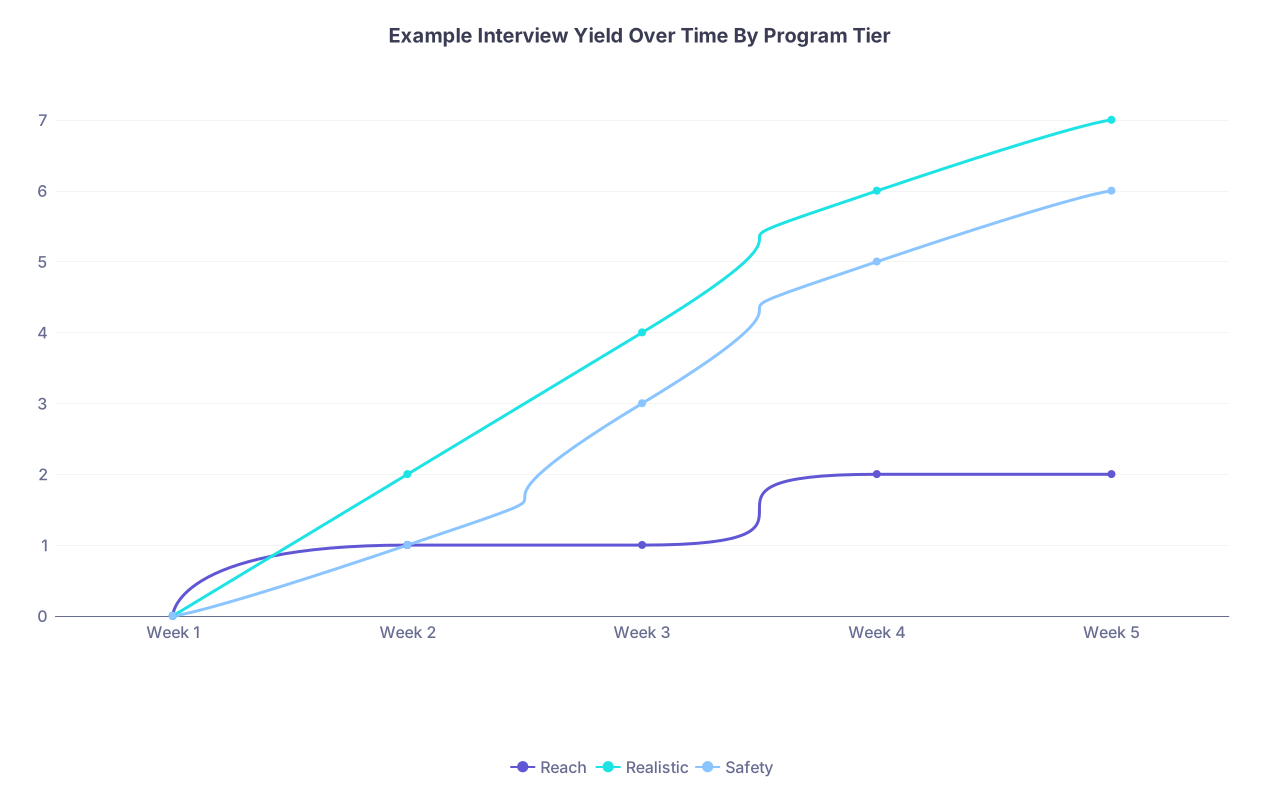
| Category | Reach | Realistic | Safety |
|---|---|---|---|
| Week 1 | 0 | 0 | 0 |
| Week 2 | 1 | 2 | 1 |
| Week 3 | 1 | 4 | 3 |
| Week 4 | 2 | 6 | 5 |
| Week 5 | 2 | 7 | 6 |
Practical approach:
- Make a simple spreadsheet:
- Columns: Program, Tier (reach/realistic/safety), Date applied, Interview Y/N, Date invite.
- After 3–4 weeks in a typical cycle:
- If you have zero interviews at any tier, you are in trouble and should start looking at SOAP planning scenarios with your advisor.
- If you have only reach interviews and none at realistic/safety, your distribution was off, but at least you have something.
- If you have some realistic and some safety interviews, you are on track; do not panic that you have not heard from X famous program.
Do not try to submit a massive wave of late applications to “fix” a poorly performing cycle unless:
- You applied very late initially, or
- You had an obvious missing piece (late Step 2 release) and now your file is stronger.
Late mass-application is usually just expensive noise.
Step 11: Use Signaling / Preference Tools Ruthlessly (When Available)
Some specialties now use program signals, geographic preferences, or similar systems. These change the prestige vs volume calculus slightly.
Rules of thumb:
- Use the majority of your signals on realistic programs you would strongly consider ranking near the top.
- Use a minority on truly high-reach programs where a signal actually might get you looked at.
- Do not waste signals on:
- True safeties (they already like your profile; they do not need convincing).
- Programs that are so competitive that a signal is statistically meaningless unless you are already a top candidate.
Think of signals as concentrated volume. You only have a few. Spend them where the RoA is best, not just where your ego wants the logo.
Step 12: Sanity-Check with a Visual Map
If you are a visual person, sketch it.

| Step | Description |
|---|---|
| Step 1 | Define Specialty Risk |
| Step 2 | Define Personal Risk |
| Step 3 | Set Total Application Range |
| Step 4 | Assign Reach Realistic Safety Percentages |
| Step 5 | Pick True Safety Programs First |
| Step 6 | Fill Core Realistic Programs |
| Step 7 | Add Limited Reach Programs |
| Step 8 | Advisor Review and Single Adjustment |
| Step 9 | Submit and Track Interview Yield |
If at any point you realize:
- Your “Reach” circle is swallowing everything else, or
- You have 3 true safety programs total,
you go back up this chain and fix it before submission.
Step 13: Concrete Mini-Templates You Can Steal
You might want plug-and-play patterns. Fine. Here are a few.
| Applicant | Total Apps | Reach | Realistic | Safety |
|---|---|---|---|---|
| Strong US MD, IM | 28 | 8 | 14 | 6 |
| Average US MD, Psych | 40 | 10 | 20 | 10 |
| US DO, EM (moderate risk) | 45 | 10 | 22 | 13 |
| IMG, IM (high risk) | 90 | 13 | 36 | 41 |
| Strong US MD, Derm | 50 | 20 | 25 | 5 |
Do not copy these blindly. But if your own plan is wildly different from the row that most looks like you, you should have a very specific reason.
Step 14: Do Not Let Ego Destroy Your Safety Net
Last point, and it is not polite.
I have watched strong students go unmatched because they could not accept that they truly needed:
- More “boring” community programs
- Less geographic snobbery
- Fewer name-brand reaches
Their classmates with almost identical stats matched. The only difference was that those classmates treated this like risk management, not identity protection.
You are not your program logo. You are not your hospital city. You are someone trying to secure a training spot so you can actually practice medicine.
If you keep that in mind, your prestige vs volume decisions get a lot sharper.

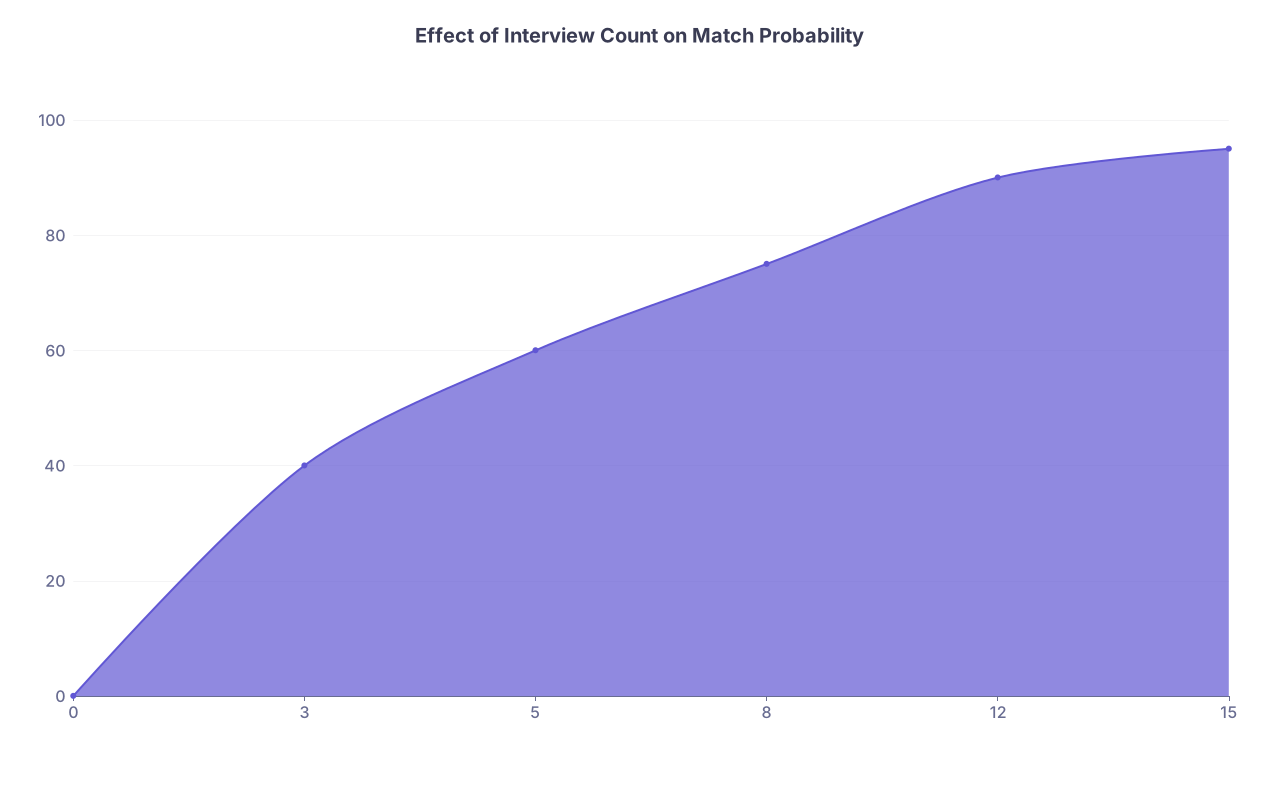
| Category | Value |
|---|---|
| 0 | 0 |
| 3 | 40 |
| 5 | 60 |
| 8 | 75 |
| 12 | 90 |
| 15 | 95 |
The 3 Things To Remember
Volume protects you. Distribution decides whether that volume actually converts into interviews. Do not let reach programs crowd out realistic and safety slots.
Build from the bottom up. Lock in true safeties first, then realistic programs, then sprinkle prestige on top. Not the other way around.
Match your list size to your risk, not your ego. Honest self-classification (specialty + personal risk) will tell you if you need 25 programs or 100. Listen to that answer, then commit.