
It is late September. ERAS is open, your personal statement is “done,” and your classmates are asking, “So how many places did you apply?”
You have a spreadsheet with 50+ programs. Or 80. Or 12.
None of it feels strategic. You are just checking boxes and hoping.
Let us fix that.
This is about building a tiered list—reach, target, and safety programs—and more importantly, deciding how many of each you actually need for a sane, high-yield application strategy.
Step 1: Get Your Risk Profile Right First
Before you start throwing programs into tiers, you need to know what you look like on paper. Not what you wish you looked like. What PDs will actually see.
Here is the blunt framework I use when I work with applicants: Green, Yellow, Red profiles.
| Profile | USMD | USDO | IMG | Exams | Red Flags |
|---|---|---|---|---|---|
| Green | Mid–high | Mid–high | Rare | No fails, solid scores | None |
| Yellow | Borderline | Borderline | Common | Average / 1 weaker | Mild issues |
| Red | At risk | At risk | Very common | Fail / low scores | Significant |
Green-profile applicant (lower risk)
You’re here if most of this fits:
- USMD or strong USDO
- No exam failures, no leaves of absence
- Step 2 CK solid for your specialty:
- Competitive (Derm, Ortho, ENT, Plastics, Urology, Neurosurg): usually ≥ 245–250
- Mid-competitive (EM, Anesthesia, Gen Surg, OB, Neuro, Rad): usually ≥ 235–240
- Less competitive (FM, Psych, Peds, IM, Path): often ≥ 225–230 is fine
- Decent clinical evals, some research or at least a coherent story
- No professionalism issues, no unexplained gaps
You are not guaranteed anything, but the math is not stacked against you.
Yellow-profile applicant (moderate risk)
You’re here if:
- Step 2 CK is average or slightly below for your specialty
- Or you are switching fields late
- Or your school is less known / newer DO school / offshore Caribbean
- Or you have:
- A weak core clerkship grade in the specialty you want
- Minimal or no specialty-specific research when that field typically wants it
- A minor red flag (repeat course, brief LOA, one bad eval) with a reasonable explanation
You will need more programs and a smarter tier strategy. No room for fantasy lists.
Red-profile applicant (higher risk)
If any of this is true, treat yourself as red:
- Any USMLE/COMLEX failure
- Very low Step 2 CK relative to your target specialty
- Multiple remediation events, professionalism concerns, or big unexplained gaps
- IMG applying to competitive or mid-competitive specialties
- Re-applicant who went unmatched last year in the same specialty
You must be brutally realistic with your specialty choice and program list. Your safety tier is not optional; it is your lifeline.
Step 2: Define Reach, Target, and Safety For You (Not in General)
“Reach,” “target,” and “safety” mean nothing unless they’re anchored to your numbers and your specialty.
Here is how I define them when I am building lists with students.
Reach programs
Programs where, if you match, you will be pleasantly surprised.
Typical reach characteristics:
- They state or clearly show Step 2 averages above yours
- They are in big-name academic centers or extremely desirable cities
- They heavily favor:
- Home students
- Top 20 med schools
- High research output
- Their interview lists are stacked with people who have:
- Publications in the field
- Multiple away rotations at that institution or region
- For IM, think Mass General, UCSF, Hopkins.
For Ortho, think HSS, Mayo, Rush.
For EM, think Hennepin, Denver, Highland.
Reach does not mean impossible. It means low probability but not zero.
Target programs
Where your stats and profile are squarely in their usual range:
- Their Step 2 CK averages (if known) are right around yours
- Recent match lists from your school show people like you matching there
- They are a mix of academic and strong community programs
- Your school type, degree, and background are common in their residents
If I am scanning a roster and thinking, “You’d fit right into this group,” that’s target.
Safety programs
Programs where you statistically should be getting interviews if you apply broadly and on time.
Signs a program is safety for you:
- Their residents, on average, have lower or similar scores compared to yours
- Many residents from:
- Osteopathic schools (if you are DO)
- Large IMGs cohorts (if you are IMG)
- Mid-tier / lower-tier US schools (if you are at a similar school)
- Program is:
- Community-based
- Less prestigious region
- Less competitive geography (Midwest, rural South, smaller cities)
- They historically fill mostly in SOAP or barely fill in the main Match when you look them up on NRMP or FRIEDA trends
Key point: A “safety” for a USMD in FM may be a “reach” for an IMG in EM. These labels are relative, not universal.
Step 3: Decide Your Total Program Count (By Specialty & Risk)
You cannot create sensible tiers until you know roughly how many programs you should apply to at all.
Here is a practical baseline for first-time applicants applying to one specialty only:
| Specialty Competitiveness | Green Profile | Yellow Profile | Red Profile |
|---|---|---|---|
| Less competitive | 15–25 | 25–40 | 40–60 |
| Mid-competitive | 25–35 | 35–60 | 60–80 |
| Highly competitive | 40–60 | 60–90 | 90–120+ |
Examples:
- USMD, solid scores, applying Internal Medicine → 20–30 is reasonable.
- DO with average scores, applying Anesthesia → I like 40–60.
- Caribbean IMG, Step 2 pass on second attempt, applying FM → 60+ is not crazy.
- USMD with 260 Step 2, Derm + strong research → 40–60 Derm programs; often also a backup specialty.
Do programs cost money? Yes.
Do under-applicants regret it more than over-applicants? Also yes.
Step 4: Convert Total Count Into Tier Counts
Now we split that total number into reach, target, and safety.
Here is a good starting template for a single-specialty applicant:
- Green-profile
- 20–30% Reach
- 50–60% Target
- 20–30% Safety
- Yellow-profile
- 10–20% Reach
- 40–50% Target
- 30–50% Safety
- Red-profile
- 0–10% Reach
- 30–40% Target
- 50–70% Safety
Let’s put actual numbers to this.
Example 1: Green-profile IM applicant, total 25 programs
- 20% Reach → 5 programs
- 60% Target → 15 programs
- 20% Safety → 5 programs
So your list might look like:
- 5 big-name academics / top cities (MGH-level)
- 15 solid university & community-affiliated IM programs
- 5 clearly less competitive community IM programs in smaller cities
Example 2: Yellow-profile Anesthesia applicant, total 50 programs
- 15% Reach → ~8 programs
- 45% Target → ~22 programs
- 40% Safety → ~20 programs
You are deliberately heavy on safety because Anesthesia is mid-competitive and you are not a slam dunk.
Example 3: Red-profile FM applicant, total 70 programs
- 5% Reach → 3–4 programs
- 35% Target → ~25 programs
- 60% Safety → ~40+ programs
This is the applicant with:
- An exam failure
- Or IMG status
- Or serious red flags
Notice: The “tiers” are not about prestige. They are about matching probability given your actual risk.
Step 5: Actually Building the Tiers Step-by-Step
You have your numbers. Now you need to turn that into a real list without losing your mind.
Step 5A: Start with Target programs
Most people start with reach because ego. That is backwards.
Do this instead:
- Pull up FRIEDA, program websites, and your school’s match lists.
- Identify:
- Programs where your seniors with similar stats matched.
- Programs whose current residents look like you (degree, school type, geography).
- Mark 15–30 of those (depending on specialty) as potential Target.
- Double-check:
- They generally take people from your degree type (DO/IMG/USMD).
- They are not all in the same hyper-competitive city.
Build the spine of your application first: targets.
Step 5B: Add Safety programs, not backup specialties (yet)
Safeties are not programs you “hate but might tolerate.” They are programs where your probability of an interview is clearly higher.
How to find them:
- Look for:
- Programs that did not fully fill in past NRMP charts (or barely filled)
- Heavy DO or IMG representation (if relevant to you)
- Less popular locations: smaller cities, interior states, rural programs
- Ask residents, advisors, or recent grads:
- “Which programs on your interview list felt easier to get into?”
- “Where did classmates with lower scores match?”
You should end with the number of safety programs your risk level demands (from Step 4). If you are yellow or red and your safety count is under 30–40, you are playing with fire.
Step 5C: Now, and only now, add Reach programs
Reaches are dessert. You do not build a diet out of dessert.
Criteria to pick reaches:
- Places you would truly be excited to rank high, not just “brand name flex.”
- At least some evidence that they occasionally take:
- Your school type
- Your degree (DO/IMG)
- Non-superhuman Step 2 scores
Limit yourself according to your tier strategy. If you are yellow-profile Anesthesia and find yourself with 25 reaches on a 60-program list, you are not “ambitious.” You are sabotaging yourself.
Step 6: Adjusting Tiers Based on Interview Goals
You do not care about number of applications.
You care about number of interviews.
Look at NRMP’s “Charting Outcomes” for your specialty. There is usually a curve showing interviews vs probability of matching.
Roughly:
- Most specialties:
- 10–12 interviews → ~80–90% chance of matching
- 14–16+ interviews → high 90s
- Very competitive specialties (Derm, Ortho, etc.):
- Even 10–12 interviews might not guarantee much; you still need a decent number.
So when you build tiers, back-calculate:
- If you are:
- Green-profile in a less competitive field: you might only need 8–10 interviews to be comfortable.
- Yellow-profile in a mid-competitive field: you want 12–14+.
- Red-profile in any field: you want as many as you can feasibly get.
Tier strategy then becomes:
- If your profile is weaker:
- Safety count goes up to increase interview volume.
- Reach count goes down; they rarely convert to interviews.
- If you get to November with:
- 0–3 interviews → You did not have enough safety or your specialty choice is unrealistic.
- 4–6 interviews → borderline, may need SOAP or reconsider backup plans.
- 10+ interviews → stop panicking and prepare for interviews properly.
Step 7: Dual-Application and Backup Specialty Logic
Some of you are in the danger zone by definition: IMGs shooting for EM, US students with failures applying Ortho, etc.
For these people, tiering within a single specialty is not enough. You may need two specialties.
Here is a structured approach.
Situation A: Very competitive field + realistic backup
Example: USMD wants Ortho but is willing to do General Surgery or Prelim surgery year.
Plan:
- Primary specialty (Ortho) – aggressive but not reckless:
- 40–60 Ortho programs: mostly target + safety (yes, there are “safer” Ortho programs), a few reaches
- Backup specialty (Gen Surg or Prelim Surgery):
- 25–40 programs, heavy on safety
- In the backup list:
- 0–5 Reach
- 10–15 Target
- 15–25 Safety
Situation B: Moderate-competitive field + categorical backup
Example: DO student with average scores wants Anesthesia but is fully open to IM.
Plan:
- Anesthesia:
- 40–50 total: mostly target + safety
- IM:
- 20–30 total: mostly safety, a few target
Total programs will be higher, yes. But your total probability of matching into something goes up a lot.
Step 8: Common Dumb Mistakes (And What To Do Instead)
I see the same bad patterns every year. If you want to avoid SOAP, pay attention here.
Mistake 1: Overloading on reach programs
Example: 50-program Derm list, 35 are top-10 name brands, 10 are mid-tier academic, 5 are genuine safety-ish. Applicant has okay scores and some research but nothing extraordinary.
Fix:
- Cap your reaches by percentage, not vibe.
- If you are not a top-5% applicant, 50–60% of your list cannot be reach. That is fantasy.
Mistake 2: “I don’t want to live there” syndrome
Applicant refuses to apply to excellent safety programs in the Midwest or South because they “must” be in NYC or California.
They do not match. Suddenly, anywhere is fine in SOAP.
Fix:
- During initial tier building, include any place you could tolerate for 3–5 years, not just where you would love to be.
- Use geography as a tiebreaker, not the primary filter, especially if you are yellow/red.
Mistake 3: Assuming DO/IMG-friendly = safety
Many DO- or IMG-heavy programs are still quite competitive—within that applicant pool.
Fix:
- Look at:
- How many applications they receive
- Their recent fill rates
- Talk to people from your school: “Which programs were interview-heavy for our grads?”
Mistake 4: Not recalibrating after the MSPE or new scores
You get a surprisingly low Step 2 CK. Or your MSPE has weaker language than expected. But you keep your original tier plan built on your old assumption.
Fix:
- If a major data point (Step 2, big red flag reveal) arrives before applying:
- Rebuild your tiers. Immediately.
- Shift 10–20% of your list from reach/target to safety.
- If it arrives after applying:
- Be mentally prepared for lower interview counts.
- Aggressively prepare for SOAP and backup plans.
Step 9: A Simple Workflow to Build Your Tiered List in 1–2 Days
Stop tinkering for weeks. Here is a direct workflow that actually gets you to a finished product.
Day 1 (3–4 hours)
Clarify profile
- Decide: Green, Yellow, or Red based on your scores, school, and flags.
- Look up NRMP “Charting Outcomes” for your specialty.
Set total application number
- Use the table from Step 3.
- Adjust ±10 based on anxiety and budget.
Build Target list first (50–60% of total)
- Use:
- Your school’s match list from last 3–5 years.
- FRIEDA and program websites.
- Fill in a spreadsheet with:
- Program, city, type (university/community), your tier guess.
- Use:
Day 2 (3–4 hours)
Add Safety programs (30–50% of total)
- Focus on:
- Undersubscribed locations
- Programs with many residents like you
- Keep adding until you hit your safety number from Step 4.
- Focus on:
Add Reach programs (0–30% depending on risk)
- Choose places you would really love.
- Verify they occasionally interview or match people like you.
Check distribution
- Count #reach, #target, #safety.
- Compare to target distribution based on your risk level.
- Reclassify borderline programs or swap some out until proportions are sane.
Reality-check with a human
- Show an advisor, mentor, or recent grad:
- Your risk category
- Your total numbers
- Your tier breakdown
- Ask:
- “Where am I clearly overreaching?”
- “Where should I add more safety?”
- Show an advisor, mentor, or recent grad:
You walk away with a concrete, defensible list. Not vibes.
Visual: How Risk Profile Shifts Your Tier Balance
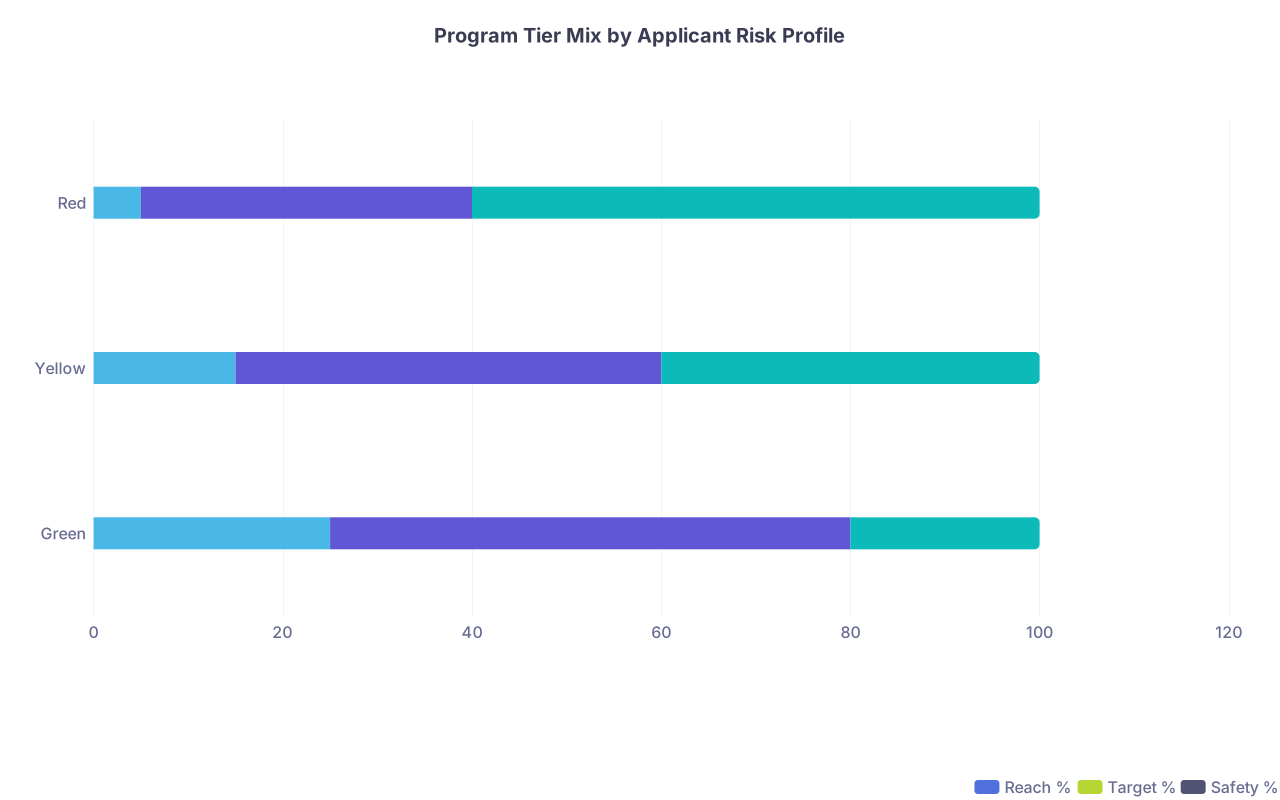
| Category | Reach % | Target % | Safety % |
|---|---|---|---|
| Green | 25 | 55 | 20 |
| Yellow | 15 | 45 | 40 |
| Red | 5 | 35 | 60 |
Quick Example: Two Realistic Scenarios
Let me walk you through two compressed examples so you see this in action.
Scenario 1: USMD, average applicant, Internal Medicine
- Step 2 CK: 234
- No fails, mid-tier USMD, average research
- Wants IM, open to most geographies
- Risk profile: Yellow
- Field: Less- to mid-competitive, depending on where you apply
Total programs: 30–35
Using yellow profile distribution:
- 15% Reach → 5
- 45% Target → 15
- 40% Safety → 12–14
Concrete structure:
- 5 Reach:
- Big-name coastal academics where your school rarely matches
- 15 Target:
- Mix of university-affiliated and strong community programs where grads like you have matched
- 12–14 Safety:
- Community IM in Midwest, South, smaller cities, DO/IMG-friendly but with strong training
This applicant, if applying on time with a decent personal statement and no disasters in the MSPE, should be able to generate 10–14 interviews. Very matchable.
Scenario 2: Caribbean IMG, one Step failure, Family Medicine
- Step 2 CK: 223 on second attempt
- Some outpatient FM experience, decent letters
- Risk profile: Red
- Field: Less competitive, but applicant risk is high
Total programs: 70–80
Using red profile distribution:
- 5% Reach → 3–4
- 35% Target → 25–28
- 60% Safety → 42–48
Concrete structure:
- 3–4 Reach:
- University-affiliated FM programs with mixed IMG representation
- 25–28 Target:
- Community FM with many IMGs, but decent fill rates
- 42–48 Safety:
- Smaller community FM programs, less desirable locations, historically high IMG intake, occasional SOAP participation
This is how you turn a high-risk profile into a matchable one: heavy safety emphasis, wide geographic net.
Process View: From Self-Assessment to Final List

| Step | Description |
|---|---|
| Step 1 | Assess Scores and Red Flags |
| Step 2 | Assign Risk Profile |
| Step 3 | Set Total Program Number |
| Step 4 | Build Target List |
| Step 5 | Add Safety Programs |
| Step 6 | Add Reach Programs |
| Step 7 | Check Tier Proportions |
| Step 8 | Review With Advisor |
| Step 9 | Finalize Application List |
The Bottom Line
Three points to keep in your head while you build your list:
Your tiers are about probability, not prestige. Reach, target, and safety are defined by your actual competitiveness in that specialty, not how famous the program is.
Your risk profile dictates your counts. Green-profile applicants can afford more reach. Yellow and red profiles need a heavy safety buffer and often more total applications.
Aim for interview volume, not application volume. Build your list so that, on paper, you are likely to generate 10–14+ interviews in your main specialty. Tiers are just the structure that gets you there.
You fix the “How many programs?” problem by making it a math problem, not an ego problem. Build your tiers like that, and you put yourself in a much better position on Match Day.