
Applying to two specialties is not “casting a wider net.” It is doubling your risk of doing it badly.
Done right, dual applying is a calculated numbers game. Done wrong, it is a scattered, underfunded, low-yield mess that can sink both applications.
You asked the correct question: “What exact program number splits actually work?” So I am going to give you numbers. Clear thresholds. Concrete examples. And a stepwise method to decide your split in under an hour.
Step 1: Admit Why You Are Dual Applying
Before you touch numbers, you need to be brutally honest about why you are adding a second specialty. That reason drives your split.
You are usually in one of four buckets:
High-risk competitive specialty + safety
Examples:- Derm + Internal Medicine
- Ortho + Preliminary Surgery / TY + IM backup
- Plastics + General Surgery
- ENT + TY/Prelim
Moderately competitive + moderately competitive
Examples:- EM + IM
- Anesthesia + IM
- Neuro + Psych
Geo-limited applicant applying to two related fields to stay in one region
Examples:- FM + IM in one state
- Peds + Child Neurology
- IM + Neurology for one city/region
Board / application red flags hedging with a more forgiving specialty
Examples:- Step 1/Level 1 fail, aiming for IM + FM
- Significant leave of absence, dual applying Psych + FM
If you lie to yourself here (“I just really like both equally”), you will under-apply to the backup and end up with 8–10 interviews in neither. That is how you miss the Match.
So decide your bucket. Then match it to the right strategy below.
Step 2: Understand the Real Math Behind Match Safety
Forget vibes. Look at interview numbers.
- Most U.S. MD seniors:
- 8–10 categorical interviews in a single specialty → moderate match probability
- 10–12+ → usually safe
- U.S. DO / IMGs often need more interviews in competitive or crowded specialties (think 12–14+).
That means, per specialty, your split has to be built around:
“How many interviews do I want in each field?”
Rough rule of thumb:
- If specialty is your primary goal → aim for 10–12 interviews there
- If specialty is true backup → aim for 8–10 interviews there
Now reverse-engineer how many programs that usually requires.
Step 3: Baseline Program Counts for Single-Specialty Applicants
Here is the starting point before you split.
These numbers assume:
- U.S. MD or strong U.S. DO
- No huge red flags
- Decent but not superstar application (mid-range scores, some research if needed)
| Specialty Tier | Example Fields | Typical Program Count |
|---|---|---|
| Ultra-competitive | Derm, Plastics, Ortho, ENT | 60–90 |
| Competitive | EM, Anesthesia, Neuro, Rad Onc | 40–60 |
| Mid-range | IM categorical, Psych, Peds | 30–45 |
| Less competitive | FM, Path, PM&R, Neurology (some) | 25–40 |
Use this as your “full-send” number if you were only applying to one specialty.
Dual applying means you rarely get to fully fund two maxed-out lists. You have to shave one, sometimes both.
Step 4: The Four Core Split Models (Pick One)
Now the part you actually care about: exact splits that work.
Model 1: “Moonshot + Lifeboat” Split
(Very competitive + safer backup)
Use this if:
- Your heart is set on a very competitive specialty
- Your objective chances are middling—scores/research below the typical matched range
- You are genuinely willing to do the backup if you match there
Example combinations:
- Dermatology + IM
- Ortho + Preliminary Surgery / TY + IM backup
- ENT + TY/Prelim
- Plastics + General Surgery
General rule:
- Competitive specialty: 50–65% of your total apps
- Backup: 35–50%
If you can afford the fees, target 90–110 programs total.
Example: Ortho (primary) + IM (backup)
- Total budget: ~100 applications
- Ortho: 60–70 programs
- IM: 30–40 categorical programs
What this usually yields (if your application is coherent and aligned):
- Ortho: 5–10 interviews
- IM: 8–12 interviews
That is the pattern I see over and over: 4–6 in the moonshot, 10+ in the lifeboat. Which means you actually match somewhere.
Red flag pattern that fails:
- Ortho: 40–45
- IM: 15–20
- And a scattered personal statement / LOR alignment
That combo tends to produce 1–3 ortho interviews and 3–5 IM interviews. That is exactly how people end up SOAPing.
Concrete splits for Model 1 (target ranges):
If you are a strong applicant for competitive field
- Competitive: 60–75 programs
- Backup: 25–35 programs
If you are an average / below-average applicant there
- Competitive: 50–60 programs
- Backup: 35–50 programs
Model 2: “Parallel Tracks” Split
(Two moderately competitive specialties)
Use this if:
- You truly would be happy in either field
- Your profile fits both (letters, experiences, story can credibly match both)
- Neither field is true “backup,” both are realistic primary options
Examples:
- EM + IM
- Anesthesia + IM
- Neurology + Psych
- Peds + IM
Total applications usually land 60–90 programs combined.
Here, go closer to 50/50 or 60/40 instead of 70/30.
Example: EM + IM
- Baseline if EM only: 50 programs
- Baseline if IM only: 40 programs
Dual apply:
- EM: 35–45 programs
- IM: 30–40 programs
Realistic outcomes (for a decent U.S. MD/DO):
- EM: 8–12 interviews
- IM: 8–12 interviews
Which gives you enough data to rank both fields and still have a serious list.
When this model fails:
- You try to keep one “secret primary” and starve the other:
- EM: 50
- IM: 10
- Your application reads like: “I love resuscitation, ED flow, shift work,” and then you send that same vibe to IM PDs.
You cannot just change the specialty name in the personal statement and expect PDs not to notice.
Concrete splits for Model 2:
- Total 70 programs: 35/35
- Total 80 programs: 40/40
- Total 90 programs: 45/45 or 50/40 depending on small preference
If you slightly prefer one:
- 70 total: 40 (preferred) / 30 (other)
- 80 total: 45 / 35
Model 3: “Geo-Locked” Split
(Same region, different specialties)
You are not just trying to match. You are trying to match in one state/city because of family, partner, immigration, custody, etc.
Here the number of geographic regions matters more than raw program count.
You typically:
- Apply to two specialties in the same tight region,
- To increase the total number of local interview offers.
Example:
- You must stay in the Northeast corridor (say Boston to NYC).
- You like both FM and IM.
- Your absolute priority is staying near your children.
Your plan is not “40 FM + 40 IM anywhere.” Your plan is:
- All FM programs in your target region
- All IM programs in your target region
- Only a handful outside the region as true last-ditch options
Numbers that work:
- Region with many programs (NYC, Boston, Chicago, Philly, LA, etc.):
- IM: 25–35 local
- FM: 25–35 local
- Optional: 10–15 outside region in each if you really cannot move
Total may be 60–90 programs, but the key phrase is “maximum regional saturation.”
Failure pattern here:
- IM: 20 randomly scattered nationwide
- FM: 20 randomly scattered nationwide
- Only 5–7 in your actual target region
Then you act surprised when your 10 interviews are spread across five states you cannot move to.
If geography is non-negotiable, sacrifice “breadth of cities,” not “breadth of specialties.”
Model 4: “Red Flag Hedge” Split
(Board fail / low scores + more forgiving specialty)
You know programs are going to hesitate:
- Step 1 or Level 1 fail
- Step 2 CK / Level 2 below specialty norms
- Big gap or professionalism issue
Your main specialty might accept you, but your odds are lower. So you choose a second specialty known to be more forgiving or with more spots.
Examples:
- IM + FM
- Psych + FM
- Neuro + IM
- Path + FM
Here you rarely have the luxury of a 50/50 split. You need the backup to be fully saturated, because some programs in your preferred field will auto-screen you out.
Concrete numbers (U.S. grad with significant red flag):
- Target total: 80–100 programs
If your preferred is IM and backup is FM:
- IM: 35–45 programs
- FM: 45–55 programs
Or if preferred is Psych and backup is FM:
- Psych: 30–40 programs
- FM: 50–60 programs
I have seen this save people who otherwise would have zero interviews.
What fails here:
- IM: 30
- FM: 15
…with a Step 1 fail. That is denial, not a strategy.
Step 5: Use Your Objective Stats to Tighten the Split
You are not a generic “mid-range applicant.” Your actual numbers and experiences should move the split up or down.
Here is a rough calibration:
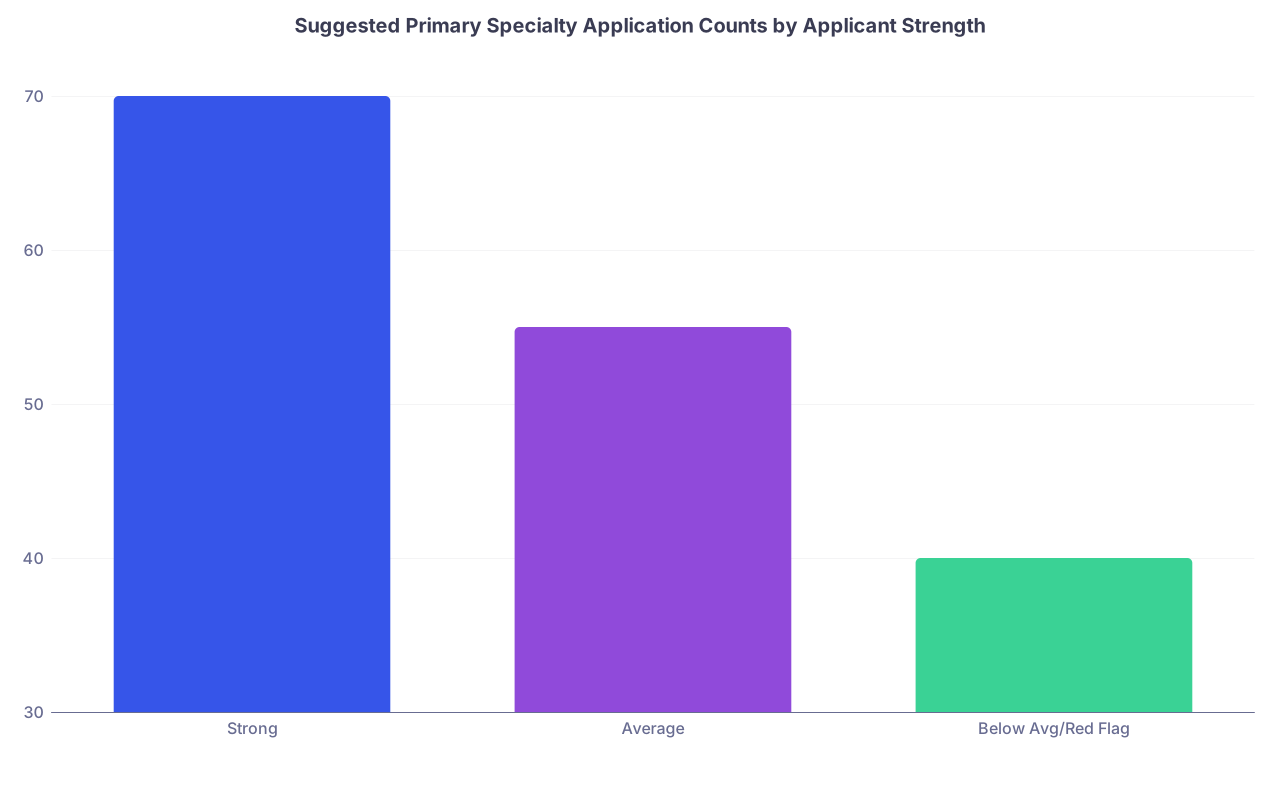
| Category | Value |
|---|---|
| Strong | 70 |
| Average | 55 |
| Below Avg/Red Flag | 40 |
(Assuming the primary is a competitive or mid-range specialty, and you are dual applying.)
If you are strong for the primary specialty:
- Higher scores than average matched
- Strong letters from that field
- Meaningful research or leadership there
Then:
- Go heavier on the primary:
- Primary: 60–75
- Secondary: 25–35
If you are weaker for that specialty / switching late:
- No sub-I
- Minimal exposure
- Letters mostly in other fields
Then:
- Be more conservative:
- Primary: 45–55
- Backup: 40–55
If you are honestly low in both fields, the answer is not “split 50/50 smaller.” It is “increase total volume to 90–110 if financially possible.”
Step 6: Align Everything Else With Your Split (Or You Waste the Numbers)
Numbers alone do not save you. If the rest of your application screams “I do not really care about this specialty,” you will not get the interviews your program count could have produced.
Minimum you must do for each specialty:
Separate personal statement
- Do not recycle. Ever.
- For backup, still show genuine enthusiasm. Avoid obviously “consolation prize” language.
At least 2 letters clearly tied to that specialty
- EM needs SLOEs. Ortho needs ortho letters. Derm needs derm/research letters.
- Backup field (IM/FM/Psych etc.) should have at least 1–2 strong letters in-field.
Program list filtered for plausibility
- Do not waste apps on:
- Ultra-elite programs way above your stats
- Programs known to be IMG/DO-unfriendly if you are IMG/DO
- Places that never take dual applicants from your profile type
- Do not waste apps on:
ERAS filters smartly used
- For each specialty, create tiers:
- “Reach”
- “Target”
- “Safer”
- Aim for:
- 20–30% reach
- 50–60% target
- 20–30% safer
- For each specialty, create tiers:
Step 7: Build Your Actual List in 45 Minutes
Here is the quick-and-dirty, no-excuse protocol.

| Step | Description |
|---|---|
| Step 1 | Choose two specialties |
| Step 2 | Pick primary |
| Step 3 | Determine applicant strength |
| Step 4 | Select split model |
| Step 5 | Set target total program count |
| Step 6 | Assign primary and backup counts |
| Step 7 | Filter programs into tiers |
| Step 8 | Draft separate PS and LOR plans |
| Step 9 | Finalize ERAS list |
Follow this sequence:
Decide your primary specialty
Not 50/50 in your heart. Which one will you regret not matching more?Pick your model
- Competitive + backup → Model 1
- Equal interest moderate fields → Model 2
- Geographic lock → Model 3
- Red flag hedge → Model 4
Set your budgeted total
- Tight budget: 60–70
- Moderate: 80–90
- Aggressive: 100–110
Apply the percentages from your model
- Example: 80 total, Model 1 (competitive + backup), average strength
- Competitive: 50
- Backup: 30
- Example: 80 total, Model 1 (competitive + backup), average strength
Go into FREIDA / program lists and fill the slots
- Start with:
- Your med school region
- States you can live in
- Programs that have taken your school / profile in past years
- Start with:
Check your tiers
- For each specialty:
- ~20–25% reach
- ~50–60% target
- ~20–25% safer
- For each specialty:
Run it by someone who knows actual match data
- PD, APD, advising dean, recent grad in your specialty
- Ask them: “Does this number of programs and tiers look reasonable for me?”
Step 8: Examples of Splits That Actually Worked (And One That Did Not)
These are anonymized composites based on real patterns.
Example 1: Derm + IM (Worked)
- U.S. MD, AOA, Step 2 255
- Some derm research but no home derm program
Applications:
- Derm: 70 programs
- IM: 35 programs (heavy in Northeast)
Outcome:
- Derm: 9 interviews
- IM: 12 interviews
- Ranked both, matched Derm.
Why it worked:
- Derm number high enough for a non-home applicant.
- IM list not treated as an afterthought; solid volume and regional focus.
Example 2: EM + IM (Worked)
- U.S. DO, Step 2 240s equivalent, strong EM rotations, decent IM letters
Applications:
- EM: 40 programs
- IM: 35 programs
Outcome:
- EM: 8 interviews
- IM: 9 interviews
- Matched EM.
Why it worked:
- Truly parallel strategy.
- No attempt to hide dual interest; each PS and letter set aligned.
Example 3: Ortho + IM (Failed – then fixed the next year)
Year 1 (failed):
- U.S. MD, low 230s Step 2, limited ortho exposure
- Ortho: 45
- IM: 15
Outcome:
- Ortho: 2 interviews
- IM: 3 interviews
- Did not match, had to SOAP.
Year 2 (fixed):
- Spent a research year in Ortho & some IM clinical work
- Ortho: 55
- IM: 40
Outcome:
- Ortho: 6 interviews
- IM: 11 interviews
- Matched IM.
Why the second year worked:
- Backup was no longer starved.
- Program numbers aligned with actual competitiveness.
- He dropped the fantasy that 15 IM apps was “enough just in case.”
Step 9: Do Not Ignore Time, Money, and Burnout
Dual applying is not free. It costs:
- Extra program fees
- Extra PS/LOR coordination
- Double the interview scheduling chaos
You must be realistic:
If funds are very limited:
- Choose one specialty and apply broadly
- Or pick a dual strategy with a total under 70 but heavily weighted backup, like:
- Primary: 30–35
- Backup: 30–35
If your time is limited:
- Do not apply to 110 programs with no bandwidth to interview at 20+
- Aim for a modest list that you can properly interview for:
- Total: 70–80
- Pri: 40–45
- Backup: 25–35
The point: A smaller, well-planned split beats a bloated, half-baked one.
Step 10: Quick Reference: Recommended Splits by Scenario
Use this when you are actually building your list.
| Scenario | Total Apps | Primary Count | Backup Count |
|---|---|---|---|
| Very comp + safer, avg strength | 90 | 55–60 | 30–35 |
| Very comp + safer, weaker profile | 100 | 50–55 | 45–50 |
| Two moderate fields, equal interest | 80 | 40 | 40 |
| Geo-locked, same region | 70–90 | 35–45 | 35–45 |
| Red flag hedge (IM + FM, etc.) | 90–100 | 35–45 | 50–60 |
And visually, how an “average” dual applicant might allocate applications:
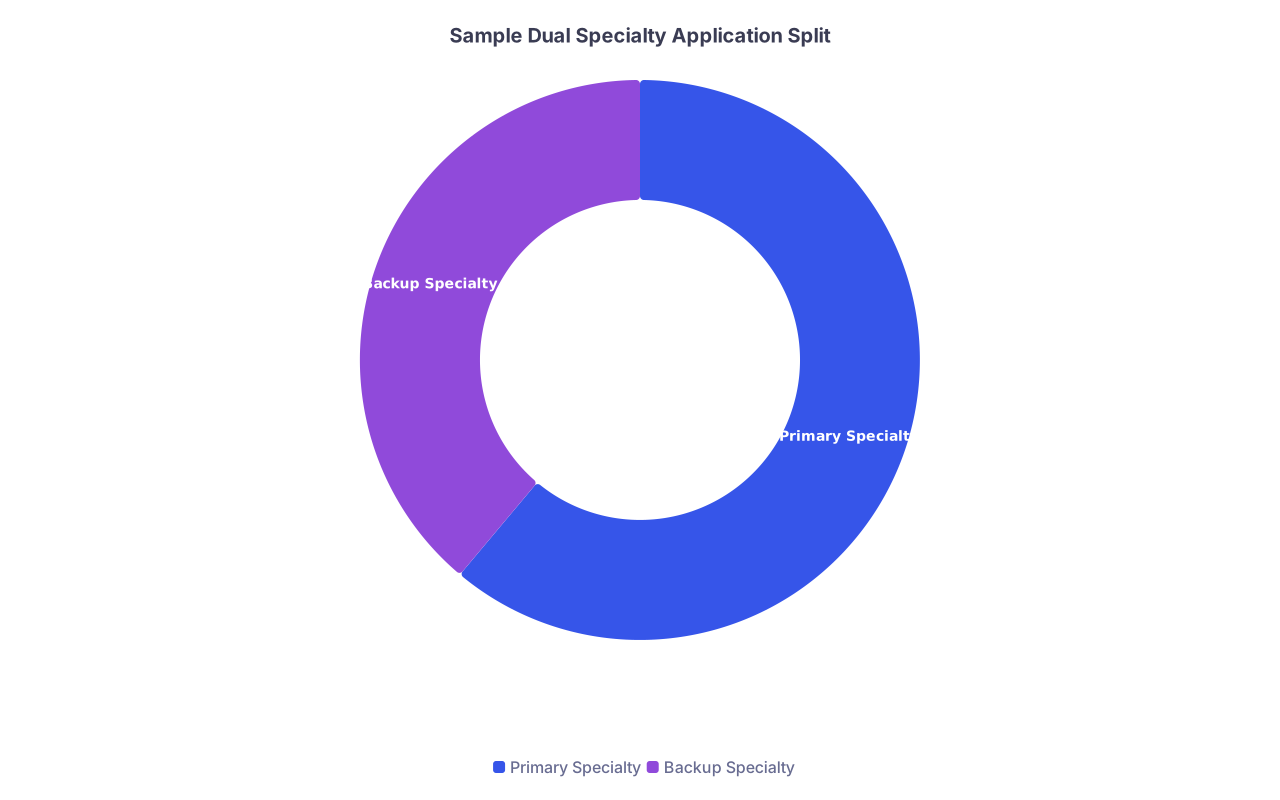
| Category | Value |
|---|---|
| Primary Specialty | 55 |
| Backup Specialty | 35 |
Final Calibration: Specialty-Specific Adjustments
A few targeted notes, because not all fields behave the same way.

EM:
- The market has been volatile. In some cycles, EM is softer; in others, it tightens.
- Dual applying EM + IM or EM + Anesthesia is common.
- Do not go below 35–40 EM programs if EM is primary.
Derm/Plastics/ENT/Ortho:
- These are not “50-program” fields for average applicants. They are more like 70–90 if you truly want a shot and do not have a home program.
- If you cannot afford that, your backup needs to be very robust (40–60 programs).
IM/FM/Psych/Peds:
- These scale well as backups.
- 35–50 programs of a less competitive field commonly produce 10+ interviews if your application is coherent and your grades are not catastrophic.
Neurology, Path, PM&R:
- Often forgiving as backups, but they still require alignment.
- Do not slap 20 random programs and call it a hedge. Think 40–50 if they are your true safety net.
What You Should Do Today
Do not just nod and move on. Open a blank document and do these three steps right now:
Write down your primary and backup specialties and label the model you are using (Moonshot + Lifeboat, Parallel Tracks, Geo-Locked, or Red Flag Hedge).
Set your exact total program target (e.g., 80) and then assign hard numbers:
- “Primary: 50 programs”
- “Backup: 30 programs”
Open FREIDA or your program list and start filling in slots until you hit those numbers, separating them clearly into two columns: Primary vs Backup.
If your numbers are vague, your outcome will be vague. Define the split precisely today—on paper, with actual counts—before ERAS locks and the scramble begins.