
You opened your NRMP results email last March and saw the word you had been dreading: “Did not match.”
This cycle, you promised yourself you would not be in that position again. So now you are sitting in front of a spreadsheet with 150+ programs, wondering if you should just push it to 200 and be “safe.” Friends are saying, “Just apply everywhere.” Your bank account is not amused. And under all of this is the real fear: “If I underestimate and do not match again, I am done.”
You are not. But if you repeat last year’s strategy with just more programs, you are gambling, not fixing the problem.
Let me walk you through this with a clear goal: by the end, you will know roughly how many more programs you actually need, and how to build a smarter, not just bigger, list.
Step 1: Diagnose Why You Did Not Match (Before Touching Program Numbers)
Before we talk numbers, you need to be brutally honest about why last cycle failed. The “I guess I did not apply to enough programs” explanation is usually lazy. Sometimes true. Often incomplete.
There are four main failure modes:
- Application volume problem – you simply did not apply broadly enough for your profile.
- Application quality problem – weak personal statement, generic letters, messy ERAS, poor signal strategy, no clear narrative.
- Competitiveness mismatch – your stats/attempts/gaps vs the tier of programs you chose.
- Interview performance problem – plenty of interviews, but bad conversions to ranks or ranking decisions that did not match your risk level.
You need to know which bucket(s) you fell into.
Ask yourself (and be honest):
- How many programs did you apply to?
- How many interview invitations did you receive?
- How many interviews did you actually attend?
- What was your USMLE/COMLEX history (scores, fails, multiple attempts)?
- Any red flags? (LOA, professionalism issue, unmatched SOAP twice, visa need, big gap, change of specialty)
- Did any faculty explicitly tell you your application had issues?
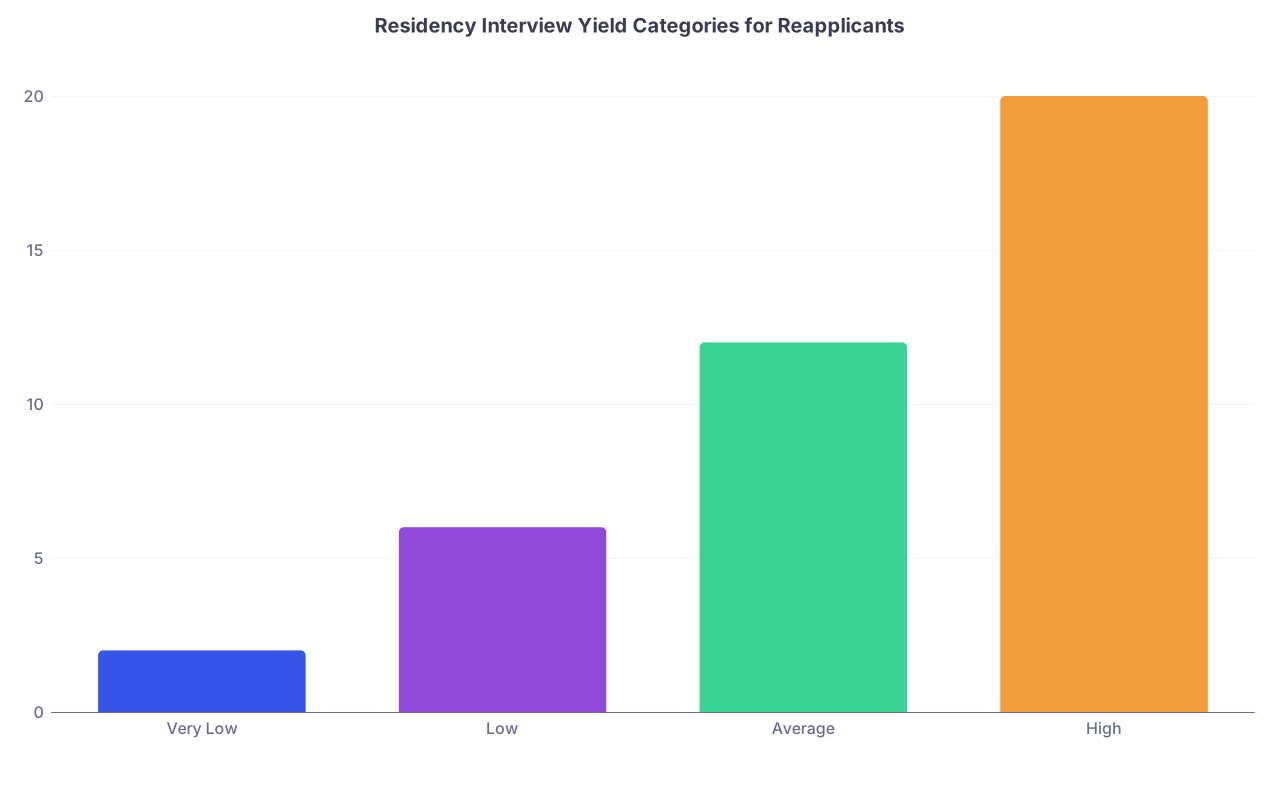
Now categorize yourself by interview yield (invites / programs applied):
| Category | Value |
|---|---|
| Very Low | 2 |
| Low | 6 |
| Average | 12 |
| High | 20 |
Rough interpretation:
- Very low yield:
- Example: Applied to 120 IM programs, got 0–3 interviews.
- Problem: Significant competitiveness or red-flag issue, or list was way too top-heavy.
- Low yield:
- Example: Applied to 120, got 4–8 interviews.
- Problem: Some mix of competitiveness, list composition, and quality.
- Average yield:
- Example: Applied to 80, got 10–14 interviews.
- Problem: You were close. Interview skills, ranking, or random variance.
- High yield but still unmatched:
- Example: 15–20+ interviews and still did not match.
- Problem: Interview performance, ranking strategy, or a specific specialty pattern (like couples match mistakes).
If you had 10+ interviews and did not match, your problem is not “too few programs.” It is:
- Interviewing
- How you ranked programs
- Or a serious professionalism / fit concern noticed by multiple places
That is a different article. Here, I am focusing on those who truly need to adjust how many programs and which programs they apply to.
Step 2: Categorize Your Risk Level as a Reapplicant
As a reapplicant, your “risk tier” changes how many programs you actually need. You are not starting from zero; you already have data from last year.
Use this rough classification:
| Tier | Description | Typical Features |
|---|---|---|
| A – Mild risk | Solid app, just below average | Modest scores, few interviews, no major red flags |
| B – Moderate risk | Noticeable concerns, still competitive | Older grad, one fail, limited USCE, weaker school |
| C – High risk | Multiple significant issues | Multiple failures, long gap, second/third reapplicant |
Tier A – Mild Risk Reapplicant
- US grad or strong IMG.
- Scores close to or slightly below recent matched averages for your specialty.
- No exam failures.
- Came close last year (some interviews, maybe SOAPed).
- Problem was likely list composition, late application, or mediocre documents.
Tier B – Moderate Risk Reapplicant
- One board failure or multiple attempts.
- Older graduate (5–10 years out).
- Limited US clinical experience for IMGs.
- Specialty slightly above your competitiveness.
- Last year: Low interview yield even with a decently sized list.
Tier C – High Risk Reapplicant
- More than one board failure or very low scores.
- Long time since graduation (10+ years).
- Specialty switch after failing to match in a highly competitive field.
- Prior SOAP failure, professionalism flags, or second/third reapplication.
The higher your tier, the more programs you need just to give probability a fair shot. But there is an upper limit where more becomes meaningless spam.
Step 3: Use Last Year’s Numbers To Set This Year’s Target
Now we turn last year’s painful data into a tool.
You need three things from last cycle:
- Programs applied: P_last
- Interview invites: I_last
- Interviews attended: A_last (if different from invites)
Your invite rate:Invite Rate = I_last / P_last
Benchmark: What are you aiming for?
In most non-ultra-competitive specialties, reapplicants should target:
- 10–12 interviews: Reasonable chance to match if you are not carrying severe red flags.
- 12–15 interviews: Safer zone for reapplicants, especially IMGs or with 1 board fail.
- 15+: Excellent, but often not realistic for high-risk reapplicants.
Let us set a target interviews number: call it I_target
For most reapplicants: I_target = 12 is a reasonable goal.
Now:
Needed Programs ≈ I_target / Invite Rate
If your invite rate was abysmal last year (like 1–2%), you must also fix the application itself, not just multiply programs by 4. But this math keeps you grounded.
Step 4: Concrete “How Many Programs” Ranges by Specialty and Risk
I will give you practical ranges that I have seen actually work. Yes, you will find people on Reddit saying “I matched with 40 apps.” Good for them. That is not you right now.
These ranges assume:
- You fix obvious application quality issues.
- You submit early.
- You apply to an appropriate mix of program tiers.
Internal Medicine (categorical)
- Tier A (mild risk US MD/DO or strong IMG)
- Last year: 60–80 programs, got 4–8 interviews
- This year: 90–120 programs
- Focus: Ramp up low and mid-tier community programs, more geographic spread.
- Tier B (US grad with one fail, average IMG, older grad)
- This year: 120–160 programs
- Accept that you are playing volume plus targeted strategy.
- Tier C (multiple fails, old IMG, repeated attempts)
- This year: 160–200+ programs, but only if:
- You aggressively fix red flags where possible.
- You add prelim / transitional and maybe FM as backup.
- Past ~220 for IM, extra apps usually give diminishing returns unless your prior list was absurdly top-heavy.
- This year: 160–200+ programs, but only if:
Family Medicine
More forgiving, but still rational.
- Tier A: 60–90 programs
- Tier B: 90–120 programs
- Tier C: 120–150 programs
Above 150, check whether you actually have enough new realistic programs versus just re-sending to places that ignored you.
Pediatrics
- Tier A: 60–80
- Tier B: 80–110
- Tier C: 110–140
Psychiatry
More competitive recently.
- Tier A: 80–110
- Tier B: 110–140
- Tier C: 140–180, plus consider adding FM or IM as a dual strategy.
General Surgery (categorical)
Harder field, especially as a reapplicant.
- Tier A: 80–120
- Tier B: 120–160, plus prelim surgery apps.
- Tier C:
- Prelim-heavy strategy: 60–100 prelim surgery + selected categorical (40–80)
- Or serious reconsideration of specialty.
Transitional Year / Prelim Medicine
If you just need a year for visa / experience / stepping stone:
- TY: 40–80 (TY is surprisingly competitive; do not under-apply).
- Prelim medicine: 60–100.
To summarize some realistic ranges:
| Specialty | Tier A | Tier B | Tier C |
|---|---|---|---|
| Internal Medicine | 90–120 | 120–160 | 160–200+ |
| Family Medicine | 60–90 | 90–120 | 120–150 |
| Pediatrics | 60–80 | 80–110 | 110–140 |
| Psychiatry | 80–110 | 110–140 | 140–180 |
| Gen Surgery (cat) | 80–120 | 120–160 | Prelim-heavy |
These are not sacred numbers. They are reality-tested ranges that keep you from the two classic errors:
- Reapplying to 50–60 programs when your profile clearly needs 120+.
- Panic-applying to 230+ programs without changing anything substantive.
Step 5: Adjust for Where You Messed Up Last Year
Raw program count is only half the story. Where you put those programs matters more.
Here is how to use last year’s data intelligently.
1. Analyze last year’s list
Sort your old spreadsheet (if you do not have one, rebuild it from ERAS history) into:
- Programs that invited you
- Programs that rejected you early
- Programs that never responded
Patterns to look for:
- Did you get nearly all your interviews from one region? One type (community vs academic)?
- Were your only invites from low-IMG, low-name recognition community programs?
- Were there states where you applied heavily and got nothing?
Once you see that pattern, you can start shifting.
2. Re-apply vs replace
Do not blindly reapply to every program that ghosted you.
General rules:
- Definitely reapply to:
- Programs that interviewed you.
- Programs that sent you “waitlist” or “very competitive pool” type messages.
- Programs that match lots of IMGs or reapplicants and where your profile still fits.
- Probably skip:
- Places that screen out your major red flag on paper (e.g., clearly state “no attempts” and you have a fail).
- Extremely competitive brand-name places that did not even auto-reject you with a token email last year.
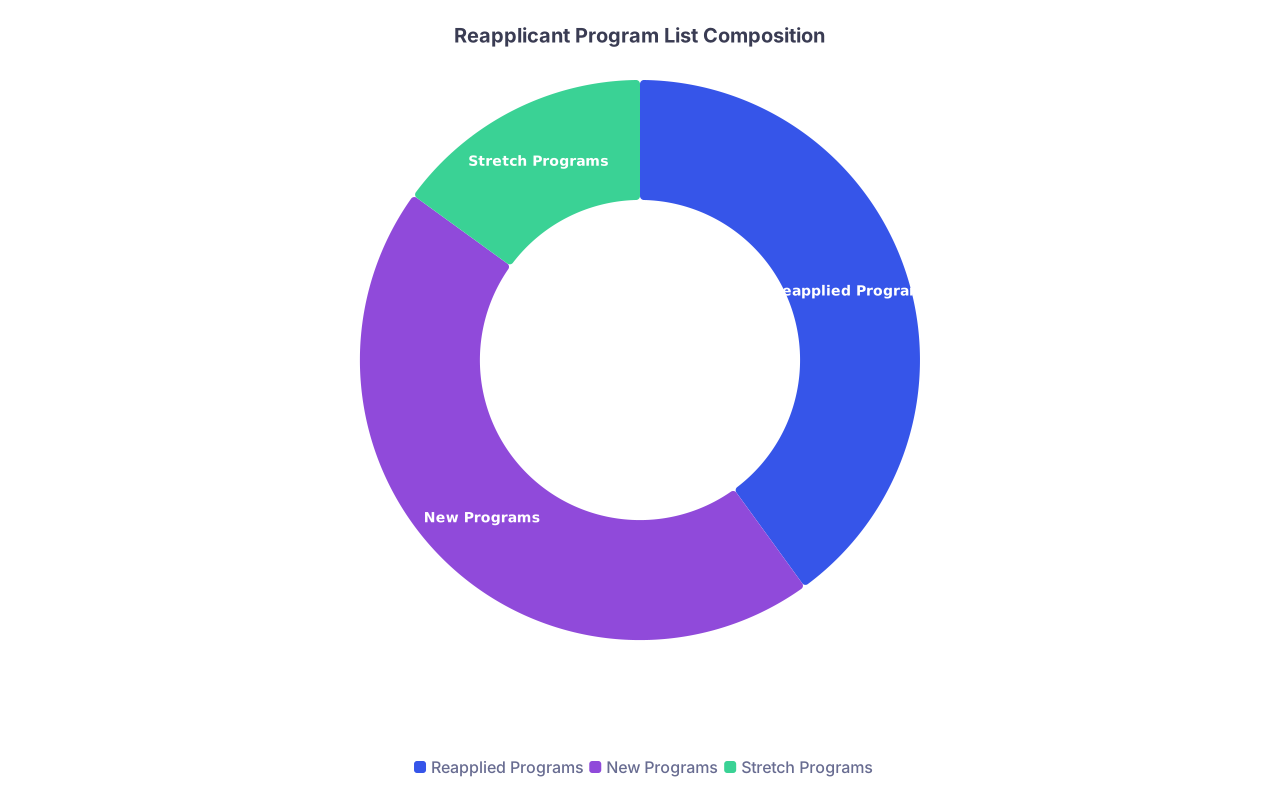
Aim for this breakdown in your new list:
| Category | Value |
|---|---|
| Reapplied Programs | 40 |
| New Programs | 45 |
| Stretch Programs | 15 |
- ~40%: Reapplied programs (smartly selected).
- ~45%: New realistic programs (more geographic and tier diversity).
- ~15%: Stretch programs (higher-tier, but not absurd for your profile).
Step 6: Specialty-Specific Reality Checks
You are not applying into a vacuum. The “how many” question changes if you are switching specialties or clinging to a hyper-competitive field.
If you are switching from a competitive to a less competitive specialty
Example: Categorical surgery → Internal Medicine.
You do not automatically get to use your prior program counts. Surgery failure does not equal IM failure.
Your new specialty sees:
- A prior unsuccessful match attempt.
- Often lighter IM-specific experiences.
- Possibly exams that were “good enough for surgery apps” but only average for IM.
You should:
- Treat yourself as at least Tier B in the new specialty on first reapplication.
- Build 120–160 IM program lists (for IM), heavily community-weighted.
- Secure at least one strong, recent letter in the new specialty.
If you insist on reapplying to a very competitive specialty
Derm, ortho, plastics, ENT. As a reapplicant, your realistic path is:
- Dramatically improved CV (research, year-out, strong insider support), and
- A massive number of realistically reachable programs.
The problem: For ultra-competitive fields, the total number of programs that will seriously consider a reapplicant is small. You cannot fix that by going from 60 to 200, because there are not 200 realistic targets.
What you should do:
- Talk to a mentor in that field who will be ruthlessly honest.
- If you still proceed, accept:
- High risk of another unmatched cycle.
- Need for a parallel backup specialty with its own substantial list.
Step 7: Money, Time, and Sanity: Do the Cost–Benefit Calculation
ERAS fees climb quickly. Doubling your program count from 100 to 200 is not free.
Rough rule (numbers vary by year, but the pattern holds):
- First 10: base cost.
- 11–20: small increase.
- 21–30: more.
- 31+ programs: you start paying a premium per program group.
Larger lists also cost time:
- Extra time to research, sort, and track them.
- Potential more interview invites that overlap, forcing you to choose.
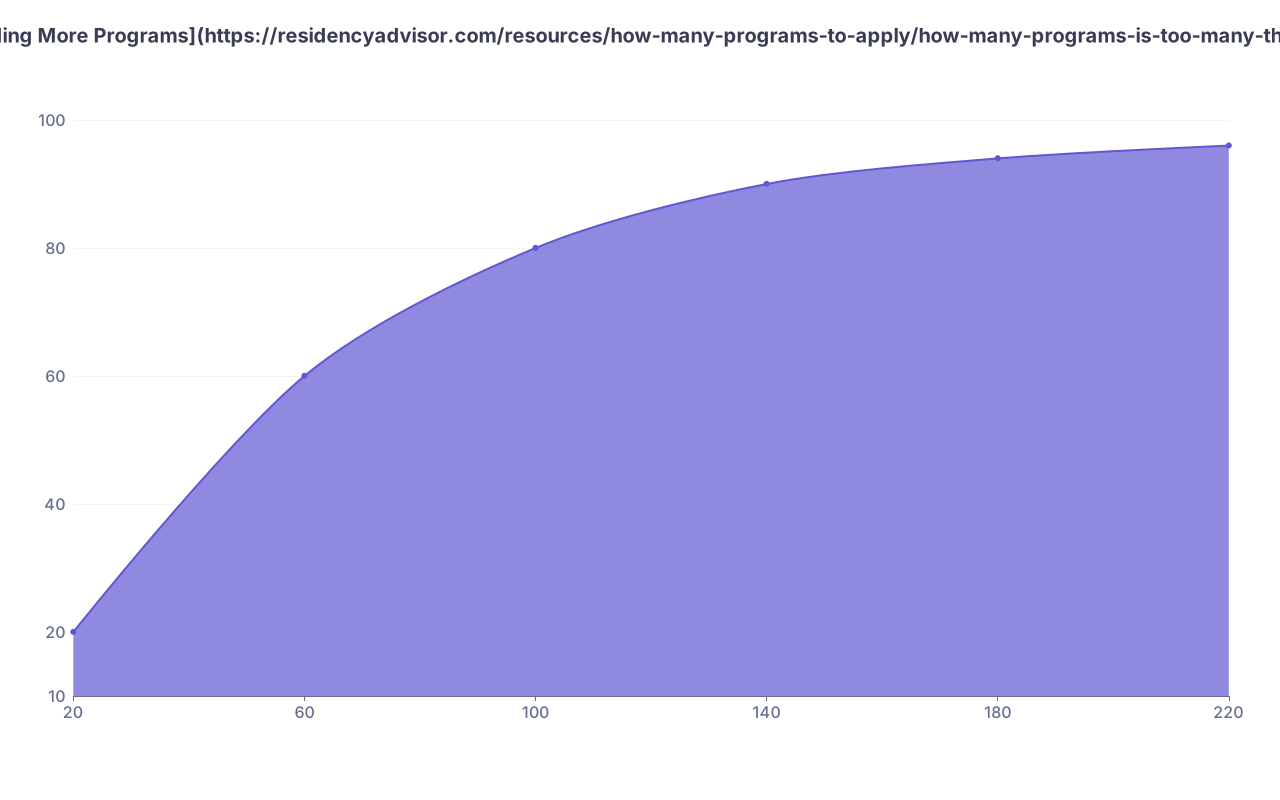
So you ask: “At what point does adding 10 more programs add almost no additional chance to match?”
Here is a simplification:
| Category | Value |
|---|---|
| 20 | 20 |
| 60 | 60 |
| 100 | 80 |
| 140 | 90 |
| 180 | 94 |
| 220 | 96 |
Interpretation for a typical reapplicant in a core specialty (IM/FM/Peds):
- Going from 20 → 60 programs: Huge jump in match chances.
- 60 → 100: Still meaningful, especially for Tier B/C.
- 100 → 140: Moderate benefit.
- 140 → 180: Small but sometimes justified for high-risk profiles.
- 180 → 220+: Tiny gains in most situations; often just financial self-harm.
If you are Tier B or C and can comfortably afford 20–40 more programs beyond 140, it may be worth it. If you are putting those last 40 on a credit card you are already struggling with, that is usually a bad trade.
Step 8: Build a Concrete Program List Strategy
Now, let us turn this into an actual plan.
Step 8A: Set your target count
Decide:
- Specialty (or specialties).
- Your risk tier.
- Target program count range (e.g., IM Tier B → 130–150).
Write that number down. That is your working ceiling.
Step 8B: Segment your list by competitiveness
You want 3 buckets:
- Safer programs (where you are at or above their usual matched profile)
- Reasonable programs (you are close to their historical range)
- Stretch programs (above your stats but not impossible)
Aim roughly for:
- 50–60% safer
- 30–40% reasonable
- 10–15% stretch
If you are Tier C, push safer programs higher (60–70%).
Step 8C: Geographic and institutional diversity
Do not apply only to “places I want to live.” That is how people end up unmatched twice.
Balance:
- Regions: East, Midwest, South, West (for U.S. programs).
- Institution types: community, university-affiliated community, academic.
- Urban vs suburban vs smaller city.
If last year all your interviews came from the Midwest and South, allocate more programs there. Stop pretending California will suddenly love your application this year.
Step 8D: Prioritize programs open to reapplicants
Focus on programs that:
- Take IMGs (if you are one).
- Have matched reapplicants historically.
- Do not state strict “no attempts” policies if you have a fail.
- Are not hyper-competitive name brands.
You can often infer this from:
- Past match lists of similar schools.
- Online resident profiles.
- FMG/IMG forums and match spreadsheets (yes, those messy Google Sheets are actually useful).
Step 9: Fix Application Quality so Extra Programs Actually Matter
One hard truth: If you do not change the quality of what you are sending, adding 50 more recipients may give you 1–2 more interviews. That is not a good trade.
Minimum upgrades you should make as a reapplicant:
- New, stronger letters of recommendation
- At least one from a recent attending in your chosen specialty.
- Replace any generic or old letters.
- Rewritten personal statement
- Explicit but brief acknowledgment of being a reapplicant.
- Clear narrative of what you fixed / improved over the last year.
- Updated CV with tangible progress
- New clinical experience, research, QI, teaching, or job relevant to medicine.
- Show you did not just sit and “wait for next ERAS.”
- Cleaner, more targeted ERAS experiences section
- Fewer, better-written entries.
- Stronger use of action verbs, concrete impact, and outcomes.
If you are not changing these things, then expanding from 100 → 160 programs is mostly wishful thinking.
Step 10: Use a Simple Flow to Sanity-Check Your Plan
Here is a quick mental flow for whether to add more programs or stop where you are:

| Step | Description |
|---|---|
| Step 1 | Start - Last Cycle Data |
| Step 2 | Increase program count and fix application |
| Step 3 | Focus on interview skills and ranking |
| Step 4 | Modest increase in programs plus quality improvements |
| Step 5 | Focus more on application quality than count |
| Step 6 | Expand to 140-180 range |
| Step 7 | Increase 30-50 programs and refine list |
| Step 8 | Do not massively increase count |
| Step 9 | Invite rate above 10 percent? |
| Step 10 | Had 10 or more interviews? |
| Step 11 | Already over 160 programs? |
Keep this mental picture: if your invite rate is low and your program count was not already huge, a bigger, smarter list makes sense. If your invite rate was decent and you just did poorly on interviews, adding 60 more programs is like ordering more textbooks when you never read the first ones.
FAQs
1. I applied to 120 programs last year (IM), got 4 interviews, did not match. How many should I apply to now?
You are roughly Tier B. That invite rate (about 3–4%) is low but not hopeless.
Here is what I would do:
- Target 140–170 IM programs, heavily community-based, in regions historically friendly to your profile (Midwest, South, certain East Coast and inland states).
- Reapply to every program that actually interviewed you and a subset of similar programs.
- Add prelim medicine and possibly a small number (20–30) of FM programs if you truly cannot afford another unmatched year.
- Overhaul your letters, personal statement, and experiences. Do not just recycle.
2. I had 12 interviews and still did not match. Should I go from 80 to 160 programs?
No. Your problem is almost certainly not the number of programs. Something went wrong with:
- Interview skills
- How you ranked programs
- Or a concerning pattern that came out during visits
Your priority:
- Get specific feedback from at least 2–3 interviewers or mentors who know you well.
- Do mock interviews with harsh feedback, not just compliments.
- Adjust your rank strategy for next time (less “prestige chasing,” more safety programs high on your list).
Going from 80 to 160 programs might get you 2–3 extra interviews. That will not fix a fundamentally interview-driven problem.
3. I cannot afford 150+ applications. How do I maximize a smaller list as a reapplicant?
Then you must pay with strategy and quality instead of brute force.
- Limit to 80–100 highly targeted programs in a less competitive specialty (FM, IM, Peds).
- Prioritize:
- Programs known to take IMGs/reapplicants.
- Regions where similar applicants have matched (Midwest/South etc.).
- Aggressively improve your:
- Clinical experience in that specialty.
- Letters (at least one “glowing” letter from a recent supervisor).
- Narrative as a reapplicant.
- Apply day 1 of ERAS opening with everything complete.
You cannot afford to be picky with geography or prestige. Maximize fit and probability, not Instagram appeal.
Open your spreadsheet right now and write three numbers at the top:
Last year’s programs, last year’s interviews, this year’s target interviews (e.g., 12).
Run the invite-rate math and compare it with the ranges above. Then set a hard target range for this year’s program count and start replacing vague anxiety with an actual list.