
The way most applicants pick the number of residency programs is upside down. They start with a random number they heard on Reddit, then try to make their lives and budget fit that number. That is backwards.
You need a formula, not folklore.
This is a stepwise way to decide how many and which programs to apply to, using your actual risk level, budget, and goals. Not “peace of mind.” Not fear. Data and structure.
Step 1: Stop Asking “How Many?” In Isolation
You cannot answer “How many programs should I apply to?” until you answer three other questions:
- What is my baseline competitiveness in my specialty?
- How much risk can I tolerate?
- How much money and time can I realistically spend?
Here is the blunt truth:
- Some people are overapplying by 2–3x and burning thousands of dollars for no added safety.
- Others are underapplying by 10–20 programs and missing the Match solely because they tried to “be reasonable.”
You are going to build a personalized range, not chase a one-size-fits-all number.
Let us start by placing you in a risk bucket.
Step 2: Assign Yourself a Risk Category (Accurately)
Forget feelings. Use a checklist.
You will label yourself:
- Low risk
- Moderate risk
- High risk
- Very high risk / At risk for not matching
Be honest. I have seen too many “I thought I was fine” stories from people with 1 failed attempt and a weak application list.
2.1. Core Factors That Actually Matter
For your chosen specialty, look at:
- USMLE/COMLEX performance
- Any failures?
- Scores significantly below the specialty’s usual range?
- Medical school type
- US MD vs US DO vs International Medical Graduate (IMG)
- Red flags
- Leaves of absence, professionalism concerns, probation, unexplained gaps
- Clinical performance
- Failed clerkships or repeated rotations
- Weak or generic letters, no home support
- Fit with specialty
- Solid evidence in your CV you know what you are signing up for:
- Relevant electives, sub-I’s
- Specialty-specific research
- Strong letters from that specialty
- Solid evidence in your CV you know what you are signing up for:
- Specialty competitiveness
- Applying to Derm vs FM is a different planet
Now use this practical grid.
| Category | Typical Profile |
|---|---|
| Low Risk | US MD, no failures, scores at/above specialty mean, good letters, no red flags |
| Moderate Risk | US MD/DO with slightly low scores or minor gaps, or IMG with strong profile |
| High Risk | Any exam failure, low scores for specialty, weak specialty exposure, or mid-tier IMG |
| Very High Risk | Multiple failures, serious red flags, late specialty switch, or lower-tier IMG in competitive field |
If you are between categories, round up in risk. Underestimating risk is how people end up in SOAP.
Step 3: Use a Data-Driven Base Range
Now we tie risk category to a starting range of program numbers. This is for categorical applications in moderately to highly competitive specialties (IM, EM, Gen Surg, OB/GYN, Psych, Anesth, etc.). For ultra-competitive (Derm, Plastics, Ortho, ENT, IR) and very non-competitive (FM, Path in some years), I will adjust in a moment.
| Risk Level | US MD | US DO | IMG |
|---|---|---|---|
| Low | 25–35 | 30–40 | 45–60 |
| Moderate | 35–45 | 45–60 | 60–80 |
| High | 45–60 | 60–80 | 80–120 |
| Very High | 60–80 | 80–120 | 120–160 |
That is the starting point, not the final answer.
3.1. Specialty Adjustments (Reality Check)
Some specialties punish under-application more than others.
Use this quick modifier on top of the table above:
- Family Medicine, Pediatrics (less competitive scenarios):
- Subtract 5–10 programs across the board if you are US MD/DO and low risk
- Everyone else: stay in the table ranges
- Internal Medicine (categorical):
- Stick close to the table
- Psychiatry, Neurology, PM&R:
- Low risk US MD/DO: can be comfortable at lower end of table
- High/Very high risk or IMG: stay at or above table midpoints
- General Surgery, OB/GYN, EM, Anesthesia:
- Add 5–10 programs to whatever the table tells you, especially if non-US MD
- Ultra-competitive (Derm, Ortho, ENT, Plastics, IR integrated):
- Add 10–20 programs above the table
- Strongly consider a backup specialty with its own full application list
This is where people get burned: they use “average” numbers in a specialty that is nowhere near average for their profile.
Step 4: Do a Sanity Check With Actual Match Data
You want to anchor your number in something more concrete than vibes.
Pull up:
- NRMP “Charting Outcomes in the Match” for your:
- Specialty
- Applicant type (US MD / DO / IMG)
- NRMP “Results and Data” primary Match report
Look for:
- Median and interquartile range of number of ranks for matched applicants like you
- Match rates by:
- Score ranges
- Applicant type (US MD/DO/IMG)
- Presence of exam failures
What you are looking for:
- If matched applicants like you typically had 11–14 ranks, and you know only ~60–75% of interviews convert to ranks (cancellations, bad fit, etc.), then you want about 15–18 interviews.
- To get 15–18 interviews in most specialties, you typically need:
- Low risk: ~25–35 applications
- Moderate risk: ~35–50
- High risk: ~50–70+
That lines up with the table above for a reason. It is loosely informed by those patterns.
You are not trying to match a precise study. You are just making sure your number is not wildly disconnected from what has actually worked for applicants like you.
Step 5: Add Two Correction Factors: Geography and Red Flags
Now we personalize.
5.1. Geography Correction
You need more applications if:
- You are geographically rigid:
- Partner’s job
- Kids in school
- Visa/location constraints
- You are only willing to be in:
- Major coastal cities
- “Top 30” academic centers
In that case:
- Add 10–15 programs if you are limiting to 1–2 regions
- Add 5–10 programs if you are avoiding large parts of the country (e.g., “no Midwest,” “no Deep South”)
If you are truly open to anywhere in the country, including community programs and smaller cities, you can stay close to your baseline from Step 3.
5.2. Red Flag Correction
“Red flag” is not a vague concept. It is specific:
- USMLE/COMLEX failure (any)
- Clerkship failure
- Formal professionalism sanction
- Unexplained leave of absence
- Major discrepancy in story (e.g., unexplained multi-year gap)
If you have:
- 1 moderate flag (e.g., Step 1 fail, later passed Step 2 with decent score):
- Add 10–15 programs
- >1 flag or a big flag:
- Add 15–25 programs
- Strongly consider:
- Backup specialty
- Broad geographical spread
That is not pessimism. That is how programs behave. Many filter hard. Your job is to send enough applications to find the ones that look beyond the first screen.
Step 6: Set a Money and Energy Ceiling
You now have an ideal range. Before you slam “submit to all,” you have to overlay reality: ERAS fees and your capacity to handle interviews.
Let me be blunt: there is a point where more programs adds noise, not safety.
6.1. Understand the Cost Curve
ERAS is front-loaded cheap, then ramps.
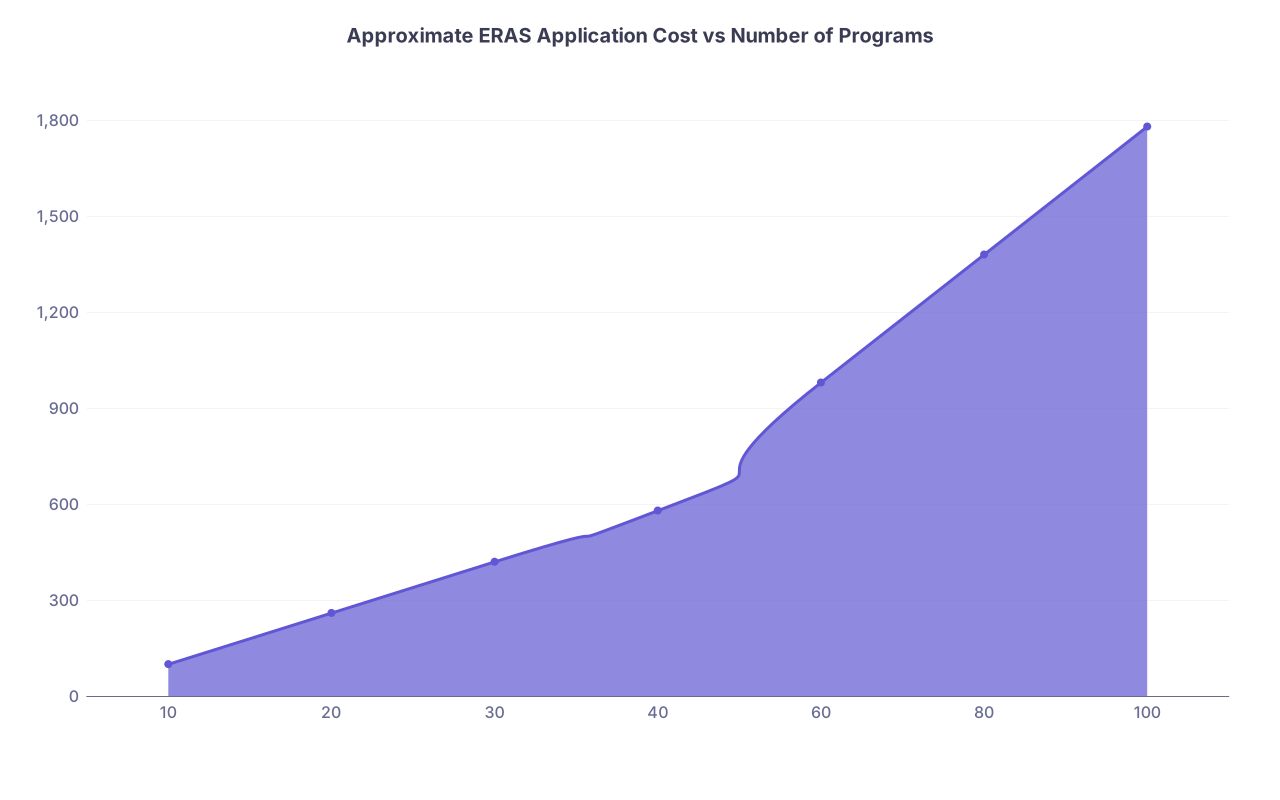
| Category | Value |
|---|---|
| 10 | 99 |
| 20 | 259 |
| 30 | 419 |
| 40 | 579 |
| 60 | 979 |
| 80 | 1379 |
| 100 | 1779 |
These are ballpark numbers based on recent cycles. Exact fees change, but the pattern is stable: once you cross ~40–60 programs, your marginal cost per added program climbs.
You also have:
- Interview travel (if in-person)
- Time cost: days off rotations, lost study time
So you cannot just crank number of programs to 120 because you are anxious.
6.2. Define Your Ceiling
Decide now, before stress hits:
- Total application budget (including potential away rotations and interviews)
- Max number of interview days you can realistically handle without destroying your rotations and sanity
Then ask:
- Does my risk-adjusted target (Steps 3–5) fit under that ceiling?
- If yes: good.
- If no: you must either:
- Cut cost in other areas (fewer away rotations, fewer couples’ travel trips), or
- Adjust your strategy (add a backup specialty, broaden geography, rely more on safety programs).
Step 7: Build a Tiered Program List (Not Just a Big One)
Now we answer: not just “how many,” but which.
Here is where applicants sabotage themselves. They apply to 80 programs, but 50 of them are unrealistic. That is not a safety net. That is wishful spending.
You want a tiered list:
- Reach
- Realistic
- Safety
Target distribution (for most moderate+ risk applicants):
- 20–30% Reach
- 40–60% Realistic
- 20–30% Safety
7.1. How to Define Tiers Without Lying to Yourself
Use filters:
- Historical fill rates by applicant type
- Program reputation and competitiveness
- Past match lists from your school
- Word-of-mouth from seniors who matched recently
Concrete example for a moderate-risk US DO applying IM, planning 45 applications:
- 10–12 reach:
- Big-name university programs in competitive regions
- 20–25 realistic:
- Solid university-affiliated and strong community programs across multiple regions
- 10–12 safety:
- Community-heavy, IMG-friendly or DO-friendly programs, smaller cities, less popular states
If your list is 60 programs and 45 are reach… call it what it is: a fantasy list.
Step 8: Use a Simple Scoring System to Prioritize Programs
When your ideal list is longer than your budget, you need a ruthless way to cut.
Use a basic score from 1–5 for each program on:
- Interview likelihood (your fit + their past patterns)
- Personal desirability (location, training, family)
- Safety value (how much this program protects you from not matching)
Assign:
- Interview likelihood: weight ×2
- Desirability: weight ×1
- Safety value: weight ×1
Then compute:
Total score = 2 × (likelihood) + 1 × (desirability) + 1 × (safety)
Max 20, min 4
Sort by total score. Start cutting from the bottom until you hit your budget-driven max number.
This is not math for math’s sake. It forces you to admit:
- “Yes, I would love to live in San Diego, but I have a 1/10 chance of them even reading my app and they are not safety programs.”
Step 9: Special Situations That Change Your Number
There are a few scenarios where the usual ranges break.
9.1. Couples Match
Couples Match is not two solos stuck together. It multiplies risk.
You need to:
- Increase total number of programs each partner applies to by:
- 10–20% if both are low/moderate risk in non-ultra-competitive specialties
- 20–40% if either is high risk or in a competitive specialty
Then:
- Prioritize:
- Institutions with multiple specialties
- Cities with several programs in your fields
- Accept that:
- You may sacrifice geography or prestige to increase chance of matching together
9.2. Backup Specialty
If you are high/very high risk in a competitive field (e.g., Ortho, Derm, ENT) you need to stop fantasizing that “going all in shows commitment.”
That is how people end up fully unmatched.
Instead:
- Build two complete lists:
- Primary specialty: full, risk-adjusted range (often 40–80+)
- Backup specialty: full, risk-adjusted range (often 25–40+)
- Apply broadly in both, not “5 pity apps” in a backup.
Yes, it is expensive. Being unmatched is worse.
9.3. Very Flexible vs Very Rigid Applicants
Two actual patterns I see:
- Maximally flexible: will go anywhere, any size, any type of program
- Can shave 5–10 programs off the ranges and still be safe
- Extremely rigid: wants:
- Only big cities, AND
- Only university programs, AND
- Only one geographic region
- Needs to add 10–20 programs and may still carry higher risk of not matching
Step 10: Turn This Into a Concrete Number (Worked Examples)
Let us walk through three quick scenarios and compute numbers using the formula.
Example 1: Low-Risk US MD, Internal Medicine
- US MD, IM applicant
- Step 2 a bit above national average, no failures
- Good letters, strong clinical grades
- Open to most regions, but prefers East Coast
- No red flags
Steps:
- Risk: Low
- Base from table (US MD, low risk): 25–35
- Specialty (IM): no adjustment
- Geography: wants East Coast but not rigid, maybe subtract Midwest/Deep South
→ Add 5 programs
→ Range: 30–40 - Red flags: none
- Budget: can afford 35–40
Final target: 35–38 programs, tiered roughly:
- 10 reach
- 18 realistic
- 8–10 safety
Example 2: Moderate-Risk DO, General Surgery
- US DO
- Step 2 slightly below Gen Surg mean, no failures
- 1 away rotation with average evals
- Wants coastal city if possible, but says they are “open”
- No formal red flags
Steps:
- Risk: Moderate
- Base from table (US DO, moderate): 45–60
- Specialty (Gen Surg): +5–10
→ 50–70 - Geography: really dislikes Midwest and South, basically East/West only
→ +10
→ 60–80 - Red flags: none
- Budget reality: can stretch to about 65 programs comfortably
Final target: ~65 programs, with:
- 15–18 reach
- 30–35 realistic
- 12–15 safety
Example 3: High-Risk IMG, Psychiatry, With Step 1 Fail
- IMG (non-US)
- Step 1 fail, Step 2 225’s equivalent
- Several psychiatry electives, one US rotation
- Open to any location
- Strong personal story, but obvious red flag
Steps:
- Risk: High (borderline very high)
- Base from table (IMG, high): 80–120
- Specialty (Psych): slightly more forgiving
→ You can stay near the lower half but not much - Geography: open to anywhere → no change
- Red flag: Step 1 fail → +15–20
→ 95–140 - Budget: can afford about 100 applications
Final target: ~100 programs, with a heavy emphasis on safety and IMG-friendly programs. Also strongly consider:
- Backup specialty (e.g., IM or FM) with an additional 40–60 applications if budget allows.
Step 11: Build a Shortlist Protocol, Not a One-Time Decision
Your number is not final the day ERAS opens. You will adjust as the season evolves.
Use this simple protocol:
- Before submitting ERAS:
- Choose Target N and Max N (e.g., Target = 55, Max = 65)
- Submit to Target N
- Watch for early interview patterns (first 3–4 weeks):
- If you have 0–2 interviews by mid-October as a high-risk applicant:
- Consider adding 10–15 additional programs from your extended list.
- If you are getting more than enough, do not add more. You are done.
- If you have 0–2 interviews by mid-October as a high-risk applicant:
- Do not blow your entire list on Day 1 if you are very high risk and financially stretched. Reserve a small pool (10–15) to deploy if early response is poor.
This is how you avoid both panic over-application and stubborn under-application.
Step 12: Red-Flag Mistakes to Avoid
To keep this practical, here are the blunt errors I see over and over:
- Copying someone else’s number (friend, Reddit, SDN) without adjusting for:
- Your exam history
- Your applicant type
- Your specialty
- All reach, no safety:
- 60 apps to elite academic programs, 5 to realistic options
- Assuming strong home support replaces a broad list:
- Home program may not rank you as high as you think
- Pretending a failure is “no big deal”:
- It is a big deal to many filters. You compensate with volume and smarter program selection.
- Ignoring geography rigidity:
- “I applied to 40 programs” sounds fine until you admit they are all within one 200-mile radius.
If you avoid those, you are ahead of half your peers.
Quick Recap: The Formula In Plain English
Three things to remember:
Your risk category drives your base range.
Use the tables. Low risk US MD in IM is not the same as high-risk IMG in Gen Surg. Stop pretending they are.You correct that base range with geographic rigidity and red flags.
Open and clean record? You can trim. Rigid, failed an exam? You add. It is that simple.You cap the final number by money, energy, and a tiered, realistic list.
Many apps + all reach = still dangerous. A structured mix of reach/realistic/safety within your budget = actual strategy.
If you follow this stepwise process, you will not just pick a number. You will build a residency list that matches who you are, what you bring, and how much risk you can live with.