
The residency culture of “apply to everything, figure it out later” is broken—and mid-season is exactly when it starts to hurt you.
If you are staring at 15–30 interview invites and feeling more dread than excitement, you are not special. You are overapplied. The good news: you can fix it without tanking your match odds—if you cut smart, not randomly.
This is the plan I walk people through when they message me in November saying, “I booked 22 interviews and I am already dead inside.” Let us be blunt: you are not going to 22 interviews. You should not. You do not need to. And you are risking burnout, poor performance, and wasted money if you try.
Here is how to trim interviews safely—step by step.
1. Get Clear on How Many Interviews You Actually Need
Before you cancel anything, you need a target number. Otherwise you will oscillate between panic and guilt and cancel the wrong ones.
As a rough rule of thumb for categorical positions (MD/DO, U.S. graduates, no major red flags):
| Specialty Tier | Examples | Solid Target Range |
|---|---|---|
| Less competitive | FM, Psych, Peds, IM (community-heavy list) | 8–12 interviews |
| Moderate | IM with some academic reach, Anesthesia, Neurology, EM | 10–14 interviews |
| Competitive | OB/GYN, Gen Surg, Radiology | 12–16 interviews |
| Very competitive | Derm, Ortho, ENT, Plastics, integrated IR | 14–18+ interviews |
If you are an IMG, have multiple exam failures, or are switching specialties, you sometimes need to stay on the higher end. But most U.S. seniors in less or moderately competitive fields are wildly overshooting.
To make this more concrete:
A typical U.S. MD average applicant in Internal Medicine can match with:
- 8–10 strong interviews very safely
- 10–12 comfortably
14 is usually overkill unless you have specific geography needs
A typical U.S. MD in General Surgery:
- Aim: 12–15
18 is usually overkill and will crush your energy
If you have 18+ interviews in almost any specialty, you are probably overapplied unless:
- You are a reapplicant who previously did not match, or
- You are dual applying in a backup specialty.
To sanity-check yourself, look at how your actual number compares to your specialty norms.
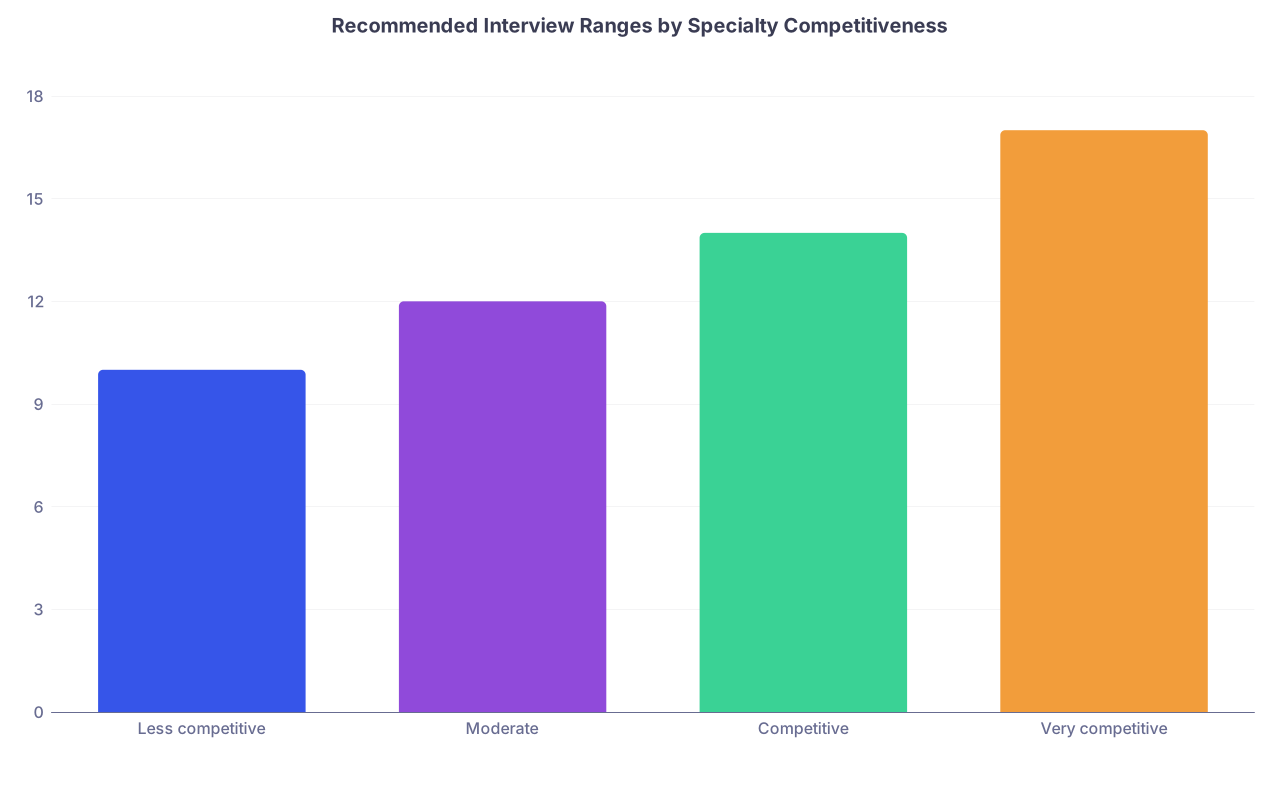
| Category | Value |
|---|---|
| Less competitive | 10 |
| Moderate | 12 |
| Competitive | 14 |
| Very competitive | 17 |
Now set a personal target, not a vague feeling:
- “I will keep 12 categorical IM interviews.”
- “I will keep 14 OB/GYN interviews.”
- “I will keep 8 FM interviews because I am risk-tolerant and geographically flexible.”
Write that number down. It anchors the rest of your decisions.
2. Build a Simple, Ruthless Interview Inventory
You cannot trim what you have not organized. Take one hour and build a sheet. Pen-and-paper, Excel, Notion—do not overthink it.
You need columns for:
- Program name
- City/state
- Type: University / University-affiliated / Large community / Small community
- Interview type: Categorical, Preliminary, TY, Advanced
- Date of interview
- Your genuine interest level (1–5)
- Program strength for your goals (1–5)
- Geography preference (1–3)
- Backup/“safety” level (1–3)
- Red flags for you (free text)
Then, score every program quickly. Do not obsess. Gut-level is fine.
Example of quick scoring:
Interest:
- 5 = “I would be excited to match here.”
- 3 = “Fine if I match, not my dream.”
- 1 = “I do not actually want to live or train here.”
Program strength:
- 5 = Strong reputation, strong fellowship match in my interest, solid research
- 3 = Decent training, average outcomes
- 1 = Very weak reputation, poor outcomes, or you have specific concerns
Geography:
- 3 = Near family/partner/desired city
- 2 = Neutral
- 1 = Actively undesired region
Once scored, create a simple composite priority score:
Priority Score = Interest + Program Strength + Geography
So a program might be:
- Interest 5
- Strength 4
- Geography 3
Total = 12 (top tier)
Another:
- Interest 2
- Strength 2
- Geography 1
Total = 5 (prime cancellation candidate)
Sort your list from highest to lowest priority score. You now have a rational view of your interview portfolio, not just a chaotic inbox.
3. Decide What Must Stay, What Can Go, and What Is Insurance
You are going to separate interviews into three buckets:
- Core interviews – must keep
- Insurance interviews – keep some, not all
- Disposable interviews – safe to cancel
Core Interviews
These are:
- High interest (4–5), and
- Reasonable or strong program quality (3–5), and
- Not completely off your geographic or lifestyle map
These are your:
- Home program
- Dream regions (partner job, family support, major city you want)
- Academic centers that open doors for your goals
These form the backbone of your rank list.
Insurance Interviews
You should not cancel all your “meh but safe” places. That is how people end up scrambling.
Insurance interviews are:
- Interest 2–3
- Strength 2–3
- Geography 1–3
- Programs you believe would rank you fairly high if you show genuine interest
These tend to be:
- Smaller community programs
- Less desirable locations
- Newer programs with fewer applicants
You usually keep enough of these to feel that even in a worst case you will match.
Disposable Interviews
These go. These are the ones killing your schedule and adding nothing.
Common patterns:
- You would never rank them over your current core interviews.
- You already have multiple programs in that same tier and region.
- The date is horrible (back-to-back with a dream program, or in the middle of exams).
- You know in your gut: “I would be upset if I matched here over other options.”
Let me be direct: if you would honestly rank a program at the very bottom, and you already have enough higher-priority interviews, you are burning time and money going.
4. Use a Structured Cut Algorithm (So You Do Not Panic-Cancel the Wrong Ones)
Here is the exact framework I give to applicants to decide what to cut.
Step 1: Confirm Your Minimum Safe Number
Take your target range from earlier.
Example:
- You are a U.S. MD in Anesthesiology with 19 interviews.
- Target range: 10–14.
- Personal safety floor: 12.
So you can, in theory, cancel up to 7 interviews and still be in a comfortable zone.
Step 2: Protect Diversity in Your List
You want a mix:
- A few reach/“dream” programs
- A solid block of realistic mid-tier programs
- A handful of true safeties / insurance
If the only interviews you cancel are safeties, you could end up with a list full of dream programs that do not rank you high enough.
So measure your current spread:
- Count how many are “reach,” “realistic,” “safety.”
Rough safe pattern:
- 20–30% reach
- 40–60% realistic
- 20–30% safety / insurance
If you are heavy on safety already, those are ripe for trimming.
Step 3: Rank Programs by Priority Score
Using your composite score (Interest + Strength + Geography), sort them. Now:
- Mark the top X as “absolute keep” where X = your safety floor (say 12).
- Below those, look at clustered low scores.
Any program in the bottom 20–30% of scores is a candidate to cut—if canceling them does not drop you below your safety floor.
Step 4: Add Date and Logistics Layer
From the low-priority group, filter further by:
- Unreasonable travel or time zone issues
- Back-to-back with programs you care about more
- Falling on exam weeks, personal conflicts, or mental health breaking points
If you have to choose between keeping a mid-interest program on a brutal 7am Zoom after three days straight, or a similar-tier program on a relaxed Friday—keep the easy one.
5. Timing: When Is It Safe to Start Canceling?
You do not cut aggressively on day one. But you also should not wait until January when you are already burnt out.
Typical safe pattern:
Early cycle (first 1–2 weeks of invites):
Accept almost everything you would realistically consider. You are collecting data on your demand.Mid-season (late October–November for most specialties):
When you:- Are already at or above your safety floor, and
- Are still getting invites, and
- See obvious low-priority programs on bad dates
Start canceling strategically.
Late season (December–early January):
- If you have a comfortable number of interviews and a balanced mix, you can be more liberal trimming low-interest safety programs.
- If invites have clearly slowed or stopped and you are at the lower edge of your safe range, hold onto what you have.
Here is a simple timeline visual so you see the shift:
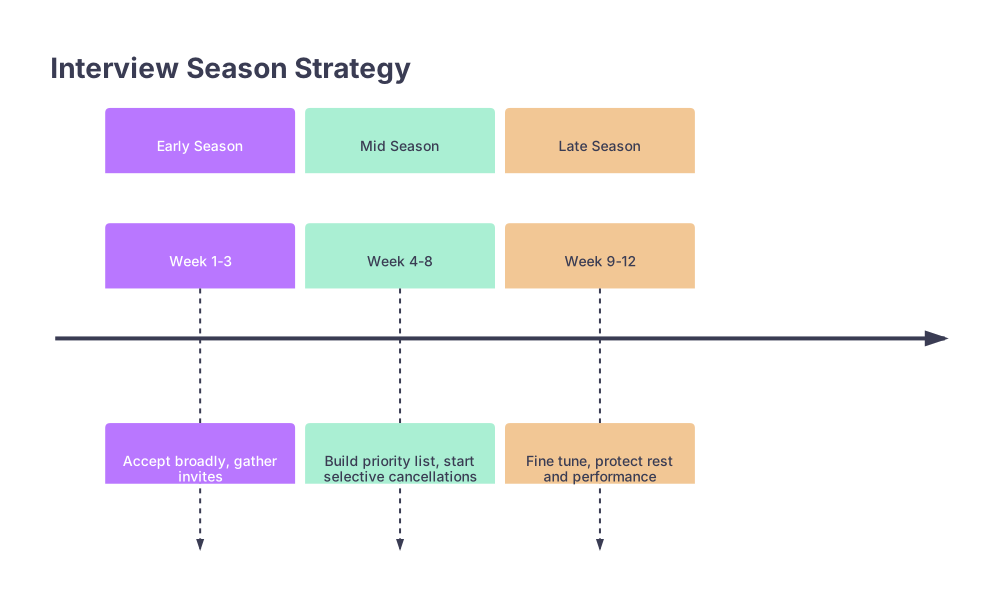
| Period | Event |
|---|---|
| Early Season - Week 1-3 | Accept broadly, gather invites |
| Mid Season - Week 4-8 | Build priority list, start selective cancellations |
| Late Season - Week 9-12 | Fine tune, protect rest and performance |
If you are an IMG or previously unmatched, you shift everything a bit more conservative. Start trimming later. Cancel less aggressively.
6. How to Cancel Without Burning Bridges
Programs are not angry that you canceled. They are angry when you ghost, no-show, or cancel the night before unless it is a true emergency.
Here is the protocol:
Minimum Notice
- Ideal: ≥ 2 weeks before the interview date
- Acceptable: 7–10 days
- Only emergency: < 72 hours (and you explain briefly and sincerely)
Exact Email Template You Can Use
Subject: Cancellation of Interview – [Your Name], [Specialty]
Body:
Dear Dr. [PD Last Name] and the [Program Name] team,
Thank you again for the opportunity to interview with your residency program on [date]. After careful consideration of my interview schedule and personal circumstances, I need to respectfully withdraw my interview from consideration this season.
I appreciate your time and the consideration you have extended to me, and I wish your residents and faculty a successful recruitment season.
Sincerely,
[Full Name], [Degree]
AAMC ID: [if applicable]
That is it. No long explanation. No drama. Professional and clean.
If they used an online scheduler, also:
- Cancel the date in the system right after emailing.
Do Not Do This
- Do not no-show.
- Do not send a “maybe I can still attend if I have energy” message.
- Do not lie with wild stories. “Personal circumstances” covers 99% of real reasons—schedule overload, financial strain, mental health, family.
Programs will fill that slot with another applicant who wants it. You are doing them a favor by giving them time.
7. Protecting Your Energy and Performance (The Real Reason to Trim)
This is the part people underestimate. Interview season is not just about quantity of interviews; it is about quality of performance and your mental and physical survival.
You need to ask:
- How many interviews can I do while still:
- Sounding alive
- Having thoughtful answers
- Showing real interest
- Not hating my life by December
Most people start to noticeably fade after:
- 10+ Zoom interviews in 2–3 weeks, or
- Multiple travel-heavy interviews strung together
That leads to:
- Flat affect
- Recycled, robotic answers
- Weak questions for programs
- Bad read from faculty (“seems uninterested”)
Ironically, having too many interviews can hurt your performance more than help your match odds.
You want space in your schedule for:
- Sleep
- Actual preparation (reviewing program website, alumni, case volumes)
- Debriefing and note taking after each interview
Here is a simple planning heuristic I give:
- Aim for no more than:
- 3 interviews / week consistently, or
- 4 in a week only if short and virtual
- Protect 1–2 completely free days per week during peak season
If your current schedule has weeks with 5–6 interviews stacked, that is a warning sign you need to drop some.
8. Special Situations: Dual Applicants, Prelim/TY, and Backup Strategies
Not all interview portfolios are created equal. A few tricky cases require separate handling.
A. Dual Applying (e.g., Derm + IM, Ortho + TY, etc.)
- Protect enough interviews in your backup specialty to ensure match safety.
- If your primary specialty is going well (e.g., 12+ strong Derm interviews), you can more aggressively cancel backup interviews in IM/Peds that you clearly would never rank above your weakest Derm programs.
- If your primary specialty is not going well (e.g., 3–4 interviews only), you treat your backup specialty exactly like your main one and keep a full safe number of interviews there.
Do not cancel backup interviews early just because a couple of reach programs invited you in your competitive specialty.
B. Prelim and TY Interviews
If you are applying to advanced specialties (Neuro, Derm, Radiology, Anesthesia in some structures, etc.) that require a prelim or TY year:
- Count prelim/TY interviews separately from your categorical/advanced.
- Aim for:
- 4–6 prelim/TY interviews if they are mostly safe, reasonable places, or
- 6–8 if you are very picky about location or type (IM vs Surgery vs TY)
Cancel prelim interviews when:
- You already have multiple solid options in the same city or region.
- You have enough total prelim interviews to meet your comfort range.
C. Reapplicants / Previous Unmatched
If you have a prior no-match, your risk tolerance needs to be lower.
- Keep closer to the upper end of recommended interview numbers.
- Trim only the absolute lowest interest / worst fit programs after you have a solid buffer (e.g., 15+ interviews in IM).
- It is reasonable to sacrifice some comfort and do more interviews one more year to avoid a second unmatched cycle.
9. Quick Reality Check: Did You Actually Overapply?
Some applicants feel overapplied when they are not. Others are in denial. Here is a quick check.
You probably did overapply if:
- You have > 18 interviews in any non-ultra-competitive specialty.
- You have > 25 interviews in FM, Psych, Peds, or community-heavy IM.
- You are turning down interviews at places you would genuinely be fine matching because you are too exhausted.
You probably did not overapply (or at least should not cut yet) if:
- You are IM/psych/FM with fewer than 8 interviews by late November.
- You are surgically oriented or in a very competitive specialty with < 12 interviews by December.
- You are an IMG with < 12–14 interviews total.
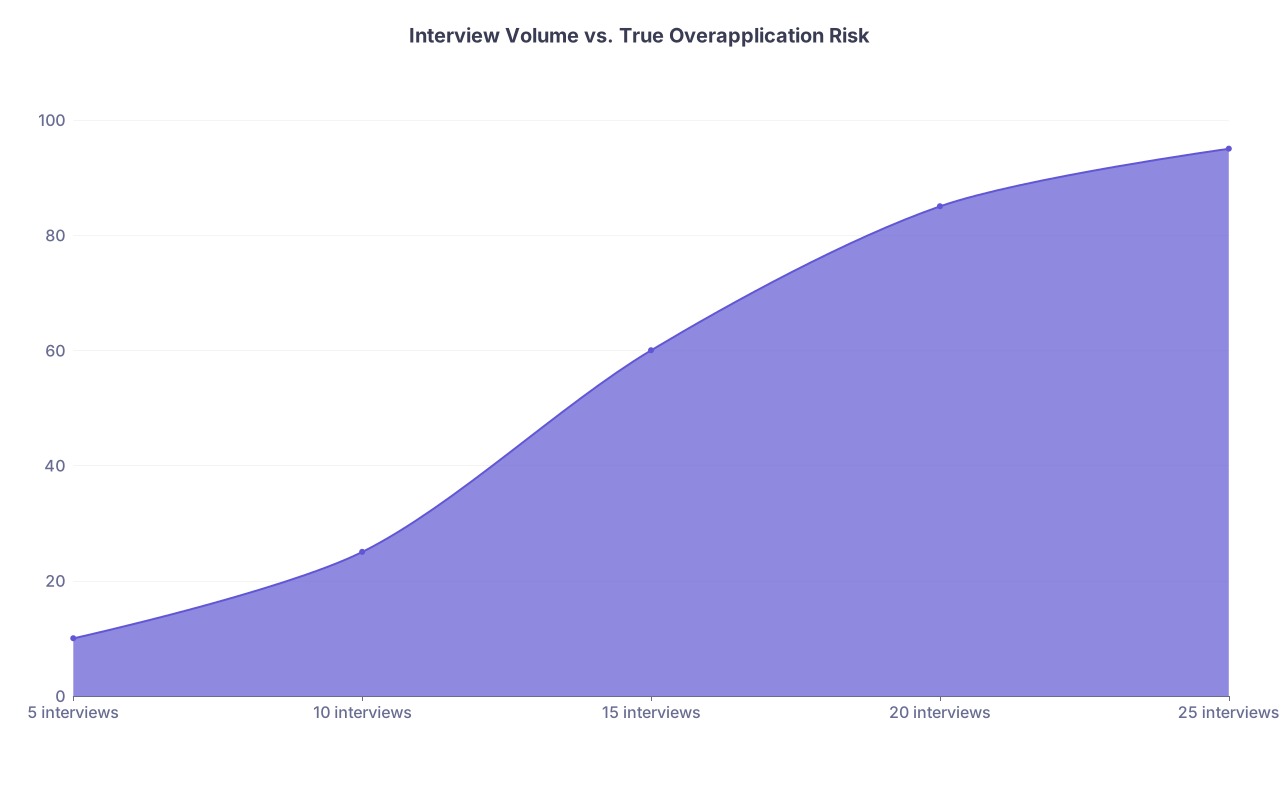
| Category | Value |
|---|---|
| 5 interviews | 10 |
| 10 interviews | 25 |
| 15 interviews | 60 |
| 20 interviews | 85 |
| 25 interviews | 95 |
(Values here represent approximate “risk of having actually overapplied” in percentage, for a typical U.S. senior in a moderately competitive specialty. Once you are past 15–20 interviews, the marginal benefit of more approaches zero.)
If you are on the border and anxious, lean slightly conservative: delay cutting until you see how invitations evolve over 1–2 more weeks.
10. Put It All Together: A 30-Minute Action Script
Here is your no-nonsense workflow.
In the next 30 minutes:
- List all interviews you have scheduled or pending.
- Score each on:
- Interest (1–5)
- Program strength (1–5)
- Geography (1–3)
- Compute a priority score (Interest + Strength + Geography).
- Sort by score from highest to lowest.
- Decide your safe floor (e.g., “I want 12 solid interviews minimum”).
- Mark top 12 as must-keep.
- Scan the bottom 20–30% of the list:
- Identify 3–5 obvious low-priority interviews on bad dates or in undesired locations.
- Cancel 1–3 of them today using the template—starting with the worst combination of:
- Low score
- Difficult timing
- Least alignment with your goals
Then pause. See how you feel with a slightly lighter schedule. As more invites or conflicts appear, repeat the process weekly.
FAQ (Exactly 4 Questions)
1. What if I cancel and then end up with fewer interviews than I need?
If you are canceling correctly, this is unlikely. Only start trimming when you are at or above your safe floor for your specialty and applicant type. If you are still receiving new invites, your interview pool is dynamic—cancelling a low-priority program to keep bandwidth for a better one is a rational trade. If invitations truly dry up and you are sitting on the low end of your safe range, stop canceling. At that point, showing up rested and prepared to the ones you kept matters more than shaving your list further.
2. Should I decline interview offers up front instead of accepting and then canceling?
Yes, if you know from the start you would never rank that program. For example, you get an offer in a city you refuse to live in, and you already have a full pipeline of interviews elsewhere. Declining immediately is kinder to the program; they can offer the slot to another applicant sooner. Accept and later cancel only when you are still uncertain about your invite volume or need flexibility while your schedule stabilizes.
3. Do programs talk to each other about who cancels interviews?
Rarely in any systematic way. They are busy running their own process. What they do notice (and sometimes remember) is unprofessional behavior: no-shows, serial last-minute cancellations without reason, or clearly dishonest explanations. A clean, timely cancellation email is not going to blacklist you across a specialty. In fact, most coordinators are relieved when people free up spots early enough to fill from their waitlist.
4. How many interviews do I need to feel “safe” if my scores or application are below average?
If you are a U.S. MD/DO with modest exam scores but no major red flags, bump your target range up by 2–3 interviews compared to the standard numbers—so for IM, that might mean 12–14 instead of 8–10. If you have a prior failure, leave of absence, or are an IMG without strong U.S. experience, you may need to aim even higher (15–18 in many fields). In those cases, trim only the bottom of your list and do not chase perfection; your priority is having a sufficient number of realistic programs that will rank you, not maximizing prestige.
Open your interview spreadsheet right now, add three columns—Interest, Strength, Geography—and score every program you have. Your bottom five will almost immediately reveal which interviews you should cancel this week.