
The usual “apply smart, not broad” advice does not apply to you if you only have international rotations. You do not get to be cute with your program list. You must win on volume and strategy.
You chose (or inherited) a path with international clinical experience only. Maybe your school has no U.S. affiliations. Maybe visas, money, or life got in the way of doing U.S. rotations. Whatever the reason, you are now competing in a system that heavily prefers U.S. clinical exposure. You cannot change that bias. You can only outwork it and out-plan everyone around you.
This is the playbook for using program volume and structure to compensate for the lack of U.S. rotations. Not vibes. Not hope. Math, targeting, and disciplined execution.
1. Understand Exactly What You Are Trying To Overcome
You are not just “a little less competitive.” You are missing one of the biggest screening tools programs use: recent U.S. clinical experience (USCE) with letters from U.S. faculty.
Here is how that typically hurts you:
- Many programs have a hard filter: “6–12 months USCE required” or “No IMGs without U.S. rotations.”
- Your letters are from non‑U.S. physicians, often weighted less.
- Programs worry about:
- Your familiarity with U.S. healthcare systems and EMR.
- Your communication and team dynamics in U.S. hospitals.
- Your ability to hit the ground running on July 1.
You cannot fix this with one thing. Not just by “writing a great personal statement.” Not just by “getting a 260+”. You fix it by stacking advantages:
- Scores
- Research or scholarly work
- Strong home or international letters
- Strategic program selection
- Aggressive application volume
- Clean, low‑risk profile (no unexplained gaps, no major red flags)
If you do not treat this like a multi-front problem, your match odds drop fast.
2. How Volume Actually Compensates — And Where It Does Not
More applications do not help if you are blasting them into programs that would never look at you. Volume works only when paired with realistic targeting.
Think in three tiers:
-
- Explicit “US clinical experience required.”
- “We do not sponsor visas.” (if you need one)
- “We do not consider IMGs.”
These are dead applications. Zero probability.
Conditional-no programs
- “USCE preferred” but not absolutely required.
- Historically low IMG percentage but not zero.
- Strong preference for U.S. grads, but your other metrics could compensate.
These are long shots. Good only if you have already saturated better options.
Realistic programs
- IMGs regularly in the program.
- Visa sponsorship exists.
- No hard USCE requirement or only “preferred.”
- Locations less desirable (community, non‑major city, non‑coastal).
These are where volume works. You multiply your chances by increasing N here.
Here is the principle: You cannot make a 0.0% chance into a 5% chance with more applications. You can turn a 2–5% chance per program into a 50–60% overall chance if you apply to enough realistic programs.
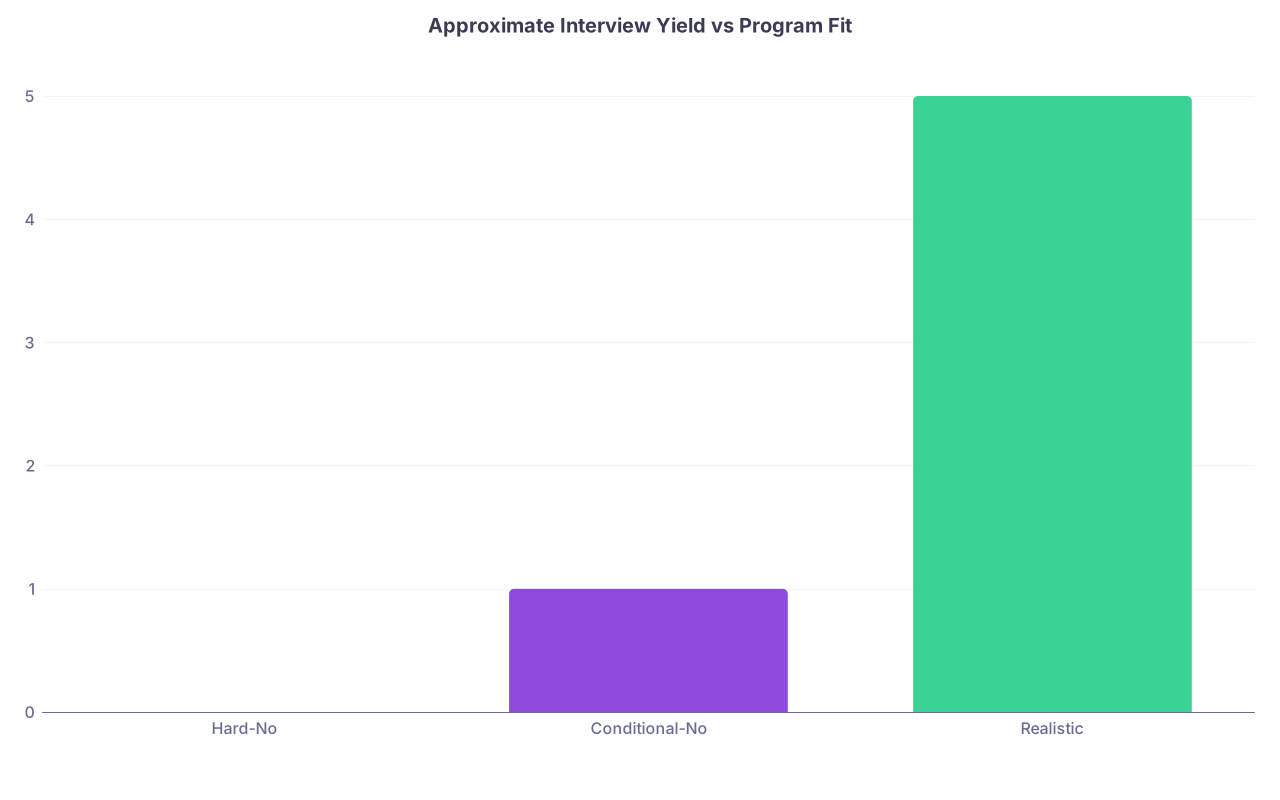
| Category | Value |
|---|---|
| Hard-No | 0 |
| Conditional-No | 1 |
| Realistic | 5 |
These numbers are illustrative, not exact, but the pattern holds. Volume only pays off where there is at least some baseline openness to your profile.
3. How Many Programs You Should Actually Apply To
If you are an international graduate with only international rotations, you start from a position of disadvantage, even with strong scores. The “normal” U.S. senior numbers (applying to 20–40 programs) do not apply to you.
Here is a realistic framework by profile, assuming no U.S. rotations and talking about categorical positions:
| Profile (Non‑USCE) | Less Competitive Specialties (IM, FM, Psych, Peds) | Moderately Competitive (Anes, Neuro, OB) | Highly Competitive (Derm, Ortho, ENT, Plastics) |
|---|---|---|---|
| Strong: Step 2 ≥ 250, recent grad, research, no gaps | 120–160 programs | 160–220 | Usually not realistic; consider research year |
| Solid: Step 2 235–249, ≤ 5 years since grad | 160–220 programs | 220–260+ | Essentially non‑viable without major extras |
| Borderline: Step 2 220–234 or older grad | 220–260+ programs | Often not worth it | Not realistic |
Yes, those numbers look absurd. They are also how people in your situation match.
Programs know this game. Many IMGs apply to 150–250+ programs. That is not a strategic flex, it is survival. If your finances and logistics allow, you should be thinking in those ranges for internal medicine, family medicine, psychiatry, and pediatrics.
For surgery, ortho, derm, etc. with no U.S. rotations, you are mostly in lottery ticket territory unless you have something exceptional (PhD, multiple U.S. publications, deep connections). You are usually better served matching into a less competitive field and then reassessing than burning money on fantasy applications.
4. Build a Tiered Program List That Matches Your Reality
You cannot just sort ERAS by specialty and “select all.” That is how you waste thousands of dollars. You need a tiered, structured list.
Step 1: Define your hard filters
Filter out:
- Programs that:
- Do not sponsor your visa type (J‑1 vs H‑1B).
- Explicitly require U.S. clinical experience.
- State “No IMGs” or 0% IMGs over several years.
- Have no categorical positions (only prelim or TY when you need categorical).
That alone may remove 20–40% of the list.
Step 2: Use data, not vibes
Go program by program with:
- FREIDA
- Program websites
- NRMP / Charting Outcomes (for macro-level expectations)
- IMG forums / spreadsheets (filter by noise, but trends are useful)
Track:
- % current IMGs in residency
- Visa sponsorship history
- Recent accreditation or closure issues
- Location attractiveness (big academic city vs mid‑sized vs rural)
Create a spreadsheet with at least:
- Program name
- City/state
- IMG friendliness score (you assign: 1–5)
- Visa status (Y/N, type)
- USCE requirement (Required / Preferred / Not mentioned)
- Your subjective rank (would love / fine / only if needed)
Step 3: Build three working tiers
For example, for Internal Medicine:
Tier 1 – High priority (IMG‑friendly, realistic)
- Community programs with many IMGs
- Midwestern / Southern / non‑coastal locations
- Clear history of visa sponsorship
- No explicit USCE requirement
- This should be at least 50–70% of your total applications.
Tier 2 – Medium probability
- University‑affiliated community programs
- Some IMGs, but majority U.S. grads
- USCE “preferred”
- Reasonable but not guaranteed visa support
- 20–30% of your list.
Tier 3 – Long shots
- University programs with a few IMGs
- More competitive locations
- USCE strongly preferred but not strictly required
- 10–20% of your list.
No more than 10–20% of your total programs should be long shots. You do not have the margin to waste volume on prestige.
5. Use Timelines and Waves to Control Cost and Data
You do not have to submit all applications on day one. You do need a plan.
Here is a sane, aggressive structure for someone in your position:
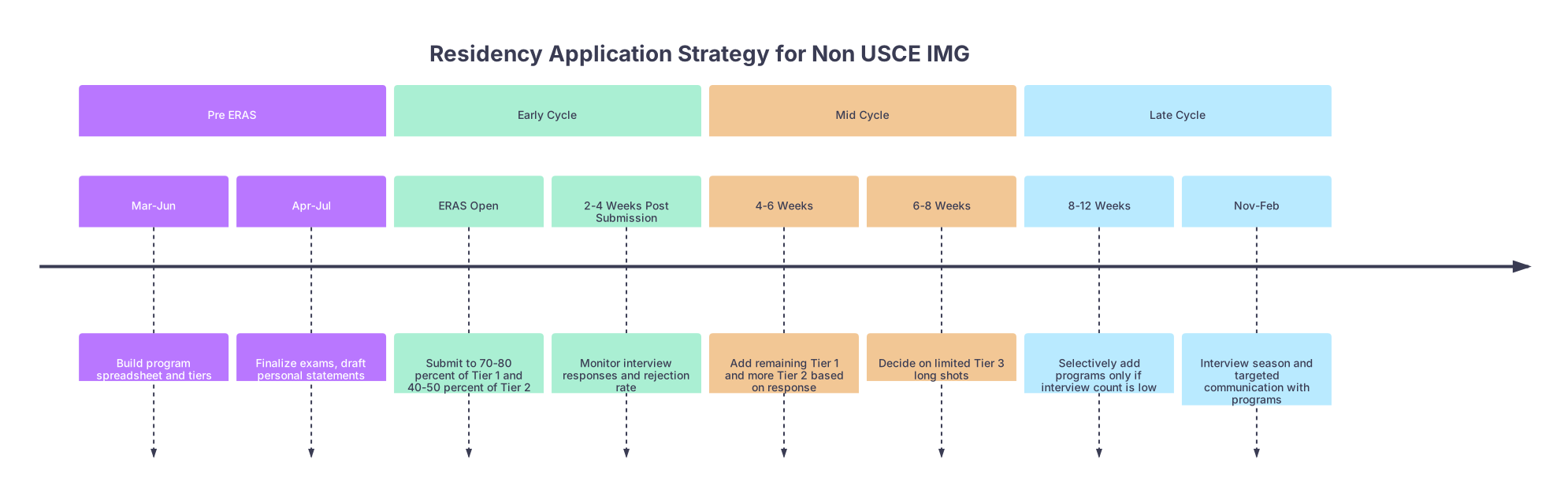
| Period | Event |
|---|---|
| Pre ERAS - Mar-Jun | Build program spreadsheet and tiers |
| Pre ERAS - Apr-Jul | Finalize exams, draft personal statements |
| Early Cycle - ERAS Open | Submit to 70-80 percent of Tier 1 and 40-50 percent of Tier 2 |
| Early Cycle - 2-4 Weeks Post Submission | Monitor interview responses and rejection rate |
| Mid Cycle - 4-6 Weeks | Add remaining Tier 1 and more Tier 2 based on response |
| Mid Cycle - 6-8 Weeks | Decide on limited Tier 3 long shots |
| Late Cycle - 8-12 Weeks | Selectively add programs only if interview count is low |
| Late Cycle - Nov-Feb | Interview season and targeted communication with programs |
Why this works:
- You front‑load the programs most likely to interview you.
- You preserve budget to react if your first wave underperforms.
- You are not guessing. You are watching your interview rate and adjusting.
Key benchmarks
By:
2–3 weeks after ERAS release:
- If you have 0–1 interviews from 80–100 applications → your list is too aspirational. Add more Tier 1, scale back Tier 2/3.
- If you have 3–6 interviews → you are on the lower edge but still alive. Increase volume.
- If you have 8+ interviews early → you can be more selective with adding long shots.
End of October:
- Aim for 10–12+ interviews for IM/FM/Psych/Peds as a non‑USCE IMG.
- If you are under 8, every additional realistic program is still worth considering.
6. Optimize Within Programs: What You Can Still Control
You cannot change that your rotations were all international. You can change how the rest of your application lands.
6.1. Maximize everything that substitutes (imperfectly) for USCE
You want to show:
- You know how real hospitals work.
- You can function in a U.S. team setting.
- You are not a documentation or communication liability.
Concrete moves:
Letters of recommendation
- Choose letter writers who:
- Supervised you closely.
- Can describe specific clinical scenarios.
- Comment on your communication, reliability, and work ethic.
- Push them (politely) for narrative depth. “She is hardworking” is useless. “He consistently managed 15+ ward patients, presented concisely, and wrote clear notes” is gold.
- Choose letter writers who:
Tele-rotations / observerships
- If you can do even short‑term U.S. observerships or virtual electives, do them.
- Not as good as cores, but better than nothing.
- Have those supervisors mention:
- Your ability to adapt quickly to U.S. systems.
- EMR familiarity, if applicable.
- Participation in team discussions, sign‑outs, and case presentations.
Explain your setting in the personal statement
- 1–2 concise sentences in your PS or experiences describing:
- Patient volume.
- Acuity level.
- Your role (were you just shadowing, or writing notes, presenting, following patients).
- 1–2 concise sentences in your PS or experiences describing:
You are making the case: “Yes, my rotations were international, but they were real, demanding, and directly relevant.”
6.2. Eliminate optional red flags
With no USCE, programs scrutinize everything else more harshly. Do not give them reasons to say no.
Address:
- Gaps with clear, short explanations (family, health, exam failure → followed by what you changed and how you improved).
- Any failed attempts on board exams with a concrete improvement narrative.
- Extra degrees or research years honestly (not disguised as clinical time).
Clean up:
- ERAS application typos, unclear descriptions, vague duties (“helped” vs “managed”, “assisted” vs “performed under supervision”).
- Experience descriptions that sound passive or observational.
You want the reader thinking: “We are missing USCE, but everything else looks clean and serious.”
7. Money, Sanity, and When To Stop Adding Programs
Let me be blunt: applying to 200+ programs is expensive and exhausting. But if your only clinical experience is international and your goal is a U.S. residency soon, this is the reality.
You still need guardrails.
7.1. Know your financial ceiling beforehand
Before ERAS opens, define:
- Absolute maximum you can afford in application fees.
- Estimated cost of:
- ERAS fees at high program counts.
- Tours / travel (if doing in‑person interviews).
- Exam and transcript fees.
Then back into numbers:
- Example: You can realistically spend $4,000 total.
Calculate:
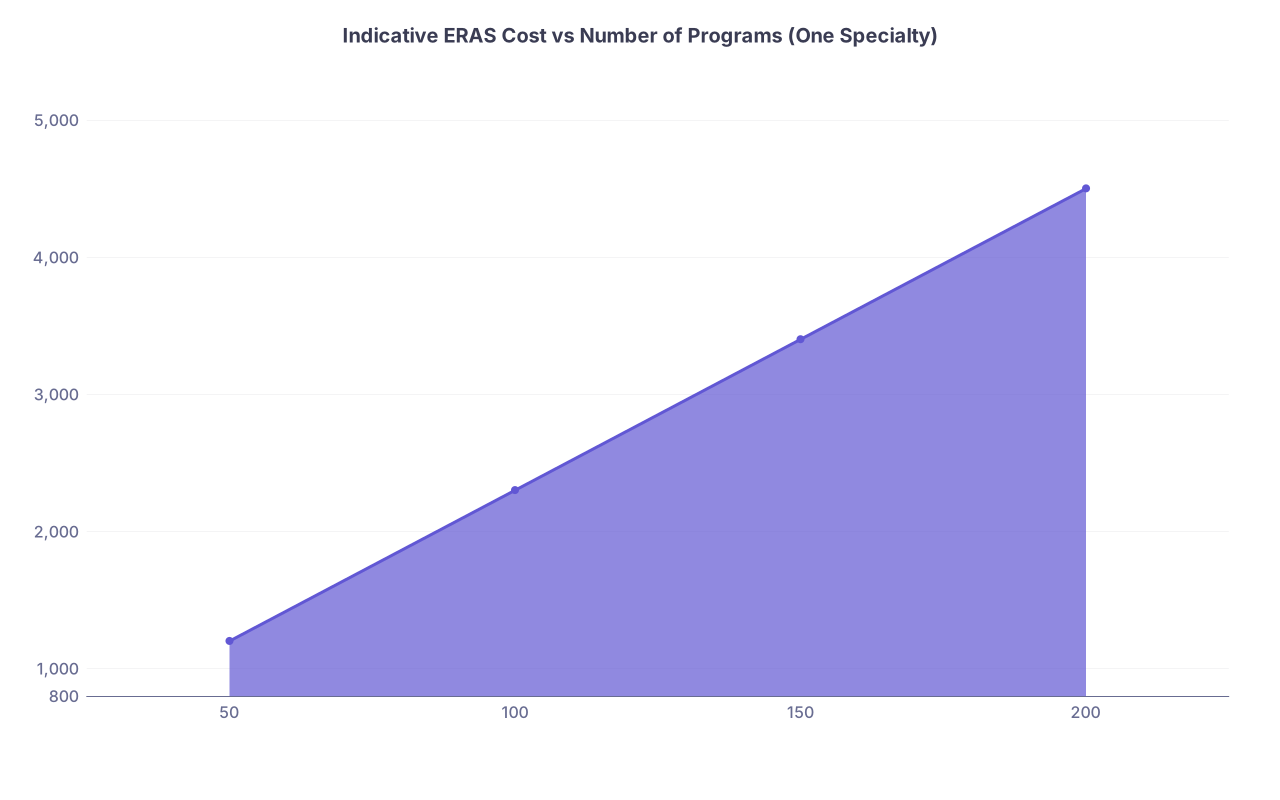
| Category | Value |
|---|---|
| 50 | 1200 |
| 100 | 2300 |
| 150 | 3400 |
| 200 | 4500 |
These are rough but directionally accurate. Your exact total depends on specialty count and extras, but this gives you a sense of the slope. The more you apply, the more each additional program costs.
Set:
- Target programs: e.g., 160.
- Stretch maximum: e.g., 200 if your early result is poor.
7.2. Define stop conditions
You should not be adding programs blindly into December.
Reasonable stop line:
- If by late November you have:
- ≥ 10–12 interviews for IM/FM/Peds/Psych → stop. Prepare hard for those.
- 8–9 interviews → maybe add a small number of highly realistic programs if financially possible, but focus mostly on interview prep.
- ≤ 5 interviews → adding programs is low-yield this late. Consider it, but also start planning contingencies (SOAP, reapplication with better research/observerships).
Your additional money in December rarely changes the outcome materially. Programs have largely finished initial screening and interviews by then.
8. Targeted Communication Without Being Annoying
You are in a weaker position on paper. You need to be visible without being desperate.
What you can do:
- Targeted emails to:
- Program coordinators.
- Occasionally PDs or APDs if the program is very IMG‑friendly and your profile is strong.
What to include, briefly:
- Who you are (name, IMG, graduation year).
- Step scores and visa need.
- 1–2 unique strengths (research at X institution, strong background with Y patient population, language skills).
- A clear, short statement of interest specific to their program (not copy‑paste fluff).
- ERAS AAMC ID for quick lookup.
What not to do:
- Weekly follow-ups.
- Long stories about hardship in the first email.
- Attachments they did not ask for.
Will this magically convert no interest into interviews everywhere? No. But for borderline applications at IMG‑friendly programs, it sometimes moves your file from pile B to pile A for a second look. You need every marginal gain you can get.
9. If You Strike Out: How To Fix It For Next Cycle
You might do everything above and still not match. With no U.S. rotations, the odds are just harder. The question is: do you repeat the same pattern or actually fix the core problem?
If you go unmatched:
Assess honestly
- How many interviews did you get?
- Did you get ranks at multiple programs or none?
- Did you use mock interviews? Did feedback highlight communication or confidence issues?
Decide on the core deficit to attack If you had:
0–3 interviews: your application screen failed.
- You need:
- Some form of U.S. clinical exposure (observerships, externships, volunteer clinical work).
- Stronger networking with IMGs at target programs.
- Potentially a research or clinical fellowship year in the U.S.
- You need:
4–8 interviews but no match: your on-paper profile is good enough. The problem is:
- Interview performance.
- Rank order strategy.
- Program list too top-heavy.
Stop pretending you can win purely on volume next time
- Fixing the “no USCE” problem even partially (e.g., 2–3 months of observerships, research in a U.S. hospital with some shadowing) gives you more leverage than adding 40 more random ERAS applications.
10. A Concrete Example: Turning a Weak Position Into a Real Shot
Let me give you a realistic scenario.
- IMG, graduated 3 years ago.
- All clinical rotations in home country.
- Step 1: Pass (no score), Step 2: 244.
- No research.
- Visa required (J‑1 OK).
- Wants Internal Medicine.
What I would tell this person:
- Goal: 12+ interviews in IM.
- Program volume:
- Aim for 180–200 IM programs total.
- List structure:
- 120–140 Tier 1: midwest/south/state community programs with 30–80% IMGs and history of J‑1.
- 40–50 Tier 2: university-affiliated community, some IMGs, USCE preferred.
- 10–20 Tier 3: lower-tier university programs that still take some IMGs.
- Timeline:
- Submit ERAS on opening day with ~130–150 programs (mostly Tier 1 + some Tier 2).
- After 3 weeks:
- If <4 interviews → add remaining Tier 1 + more Tier 2 quickly to hit 180–200.
- If 6–8 interviews → increase to 160–180, but be selective with Tier 3.
- Application strength:
- Squeeze maximum clarity out of international rotations in ERAS descriptions.
- Letters from your most clinically detailed attendings, not just “famous” names.
- One strong IM-focused personal statement, slightly customized for a few programs where you have a specific interest.
- Communication:
- Email 30–40 of your top Tier 1/Tier 2 programs after submission with a concise interest note and your ERAS ID.
- Backup:
- If by mid‑November you have ≤5 interviews:
- Prepare SOAP plan.
- Start lining up U.S. observerships or research for next year.
- Do not just double applications next year without changing your profile.
- If by mid‑November you have ≤5 interviews:
Is this comfortable? No. Is it overkill? For someone with only international rotations, no. This is baseline.
The Short Version: What You Actually Need To Do
You only have international rotations. You do not get the luxury of a “lean” application strategy. If you want a fair shot at the Match:
Win with volume in the right places
Apply to 150–220+ realistic, IMG‑friendly programs in less competitive specialties, not 60 random ones. Kill the obviously dead programs from your list.Structure your cycle like a project, not a gamble
Tier your programs, apply in waves, monitor interview yield, and adjust. Do not just “apply everywhere on day one” and pray.Fix every controllable weakness around your lack of USCE
Strong, detailed letters. Clear descriptions of your real clinical responsibilities. Minimal unexplained gaps. Targeted communication to programs where you truly fit.
If you cannot change the fact that your experience is all international, you compensate with ruthless targeting, high program volume, and zero wasted moves.