
You are probably applying to too many programs. And wasting money you do not have.
The residency application machine is built on fear: “Apply to 80+ just to be safe,” “Everyone in my class is doing 100,” “You cannot be too careful.” That advice is lazy, expensive, and often wrong—especially if your budget is tight.
You do not need a magic number. You need a system. A ruthless, data‑driven way to build an application list that you can actually afford and that still gives you a real shot to match.
That is what I am going to give you.
Step 1: Get brutally honest about your real budget
You cannot “right-size” anything until you know your ceiling in dollars, not vibes.
1. Map the actual costs
Pull out a sheet of paper (or spreadsheet) and write down:
- ERAS base fee + per program fees for your specialty
- NRMP registration fee
- USMLE transcript fee
- COMLEX transcript fee (if DO)
- Potential travel / lodging (if any in-person interviews remain)
- Interview attire (if you truly need anything new, keep it minimal)
Now force yourself to translate “number of programs” into “real money.”
| Programs | Approx Cost (1 Specialty) |
|---|---|
| 20 | $400–$500 |
| 40 | $800–$1,000 |
| 60 | $1,200–$1,500 |
| 80 | $1,600–$2,000 |
| 100 | $2,000–$2,500 |
These are ballpark numbers and depend on exact ERAS fee tiers, but you get the point. Doubling your list is not “a little more.” It is sometimes rent.
2. Set a hard cap
Decide on a non-negotiable total budget for the entire application cycle. For example:
- “I can spend $1,200 total, including NRMP and transcripts.”
- “I can spend $800 max. That is it.”
Then subtract “fixed” stuff you cannot avoid:
- NRMP registration: ~$80–$100
- USMLE transcript: ~$80
- COMLEX transcript: ~$80 (if applicable)
Whatever is left is your application and interview budget. That is what you are optimizing.
If you skip this and “see how it goes,” you will overspend. Every time.
Step 2: Define how competitive you actually are (not how you feel)
You right-size your list relative to risk. Risk depends on your competitiveness. You cannot copy your classmate’s numbers blindly.
Here is the blunt framework I use when advising students:
A. Core competitiveness factors
- Step 2 CK (or Level 2) score
- Number of exam failures (Step/Level/CS old era)
- Class ranking / AOA / school reputation
- Number and quality of letters
- Research / publications (for competitive specialties)
- Red flags (LOA, professionalism issues, gaps, career change, visa needs)
Ignore your feelings. Look at the objective stuff.
B. Rough tiers (for most specialties)
This is crude, but helpful:
Strong applicant
- Step 2 CK at or above recent mean for the specialty
- No failures, no major red flags
- Decent letters, at least one from the specialty
- For competitive fields (Derm, Ortho, Plastics) – solid research record
Middle-of-the-pack
- Step 2 CK within ~5–10 points below specialty mean
- No exam failures, or one early pass/fail hiccup with a clean explanation
- Letters fine but not stellar, research average or light
At-risk / needs to be cautious
- Step 2 significantly below mean for competitive fields
- Exam failure(s)
- No home program, weak letters, or generic letters only
- Visa requiring, or major school interruptions
C. Accept that risk = more programs, but not infinite
If you are strong, you can get away with fewer well‑targeted programs.
If you are middle, you need a moderate number with smart distribution.
If you are at-risk, you sometimes need a larger list, but not 120+ unless your advisor with actual data tells you to. There is a point of diminishing returns where the extra programs are so misaligned that they almost never yield interviews.
Step 3: Use data, not fear, to pick your target range
You want a target number of programs before you start browsing websites like they are Zillow.
1. Look at match data trends
Use:
- NRMP “Charting Outcomes in the Match” (for US MD, DO, IMGs separately)
- NRMP “Program Director Survey”
- Your specialty’s society guidelines (some have match guides)
They often show:
- Average number of programs ranked by applicants who matched
- Score distributions
- Interview counts
Remember: people who rank, say, 12 programs did not apply to 12. They might have applied to 40–60. But that gives you a reality check.
2. Ballpark ranges by competitiveness tier
These are typical ranges for a single specialty, for US MD/DO applicants. Adjust upward by 20–40% if you are an IMG or need a visa.
I am grouping non-ultra-competitive specialties together (IM, FM, Peds, Psych, Anesthesia, some Path, etc.). Surgical and ultra-competitive fields need more padding.
| Applicant Type | Primary Care / IM | Surgical / Competitive |
|---|---|---|
| Strong | 20–35 | 40–60 |
| Middle-of-the-pack | 35–55 | 60–80 |
| At-risk / Red flags | 55–80 | 80–100+ (case-specific) |
I have seen people match IM with 15 applications. I have also seen people go unmatched after 90 poorly chosen ones. Raw quantity does not save a bad strategy.
3. Fit it to your budget
Now connect money → number.
Example:
- Your realistic spend on ERAS + NRMP + transcripts + interview costs: $1,200
- Fixed costs (NRMP + USMLE + maybe COMLEX): say $250
- Remaining for applications: ~$950
You run an ERAS fee calculator and discover:
- At 60 programs: ~$1,050 in ERAS fees alone (too high)
- At 45 programs: ~$750–$850 (fits better)
So your new hard cap might be:
45 total programs, not “whatever my anxiety wants.”
Now we design your list to fit 45. Not 72. Not “maybe 80 if I panic in October.”
Step 4: Build a tiered target list instead of a random one
You do not want 40 copies of the same program. You want deliberate tiers based on your competitiveness.
1. Create three tiers of programs
Use your stats compared with program means (from Residency Explorer, FREIDA, program websites, or old Charting Outcomes):
- Reach – your stats are clearly below their average or they are hyper‑competitive academic programs
- Target – your stats roughly align with their average ranges
- Safety / conservative – your stats are clearly above their usual averages; community or less competitive programs, prelims if needed
The mistake poor students make: 80% dream programs, 20% random low tier. Or worse, 80% random.
2. Rough tier distribution by risk level
As a baseline:
Strong applicant
- 20–30% Reach
- 50–60% Target
- 20–30% Safety
Middle-of-the-pack
- 10–20% Reach
- 50–60% Target
- 25–40% Safety
At-risk
- 0–10% Reach (if they are realistic geographic or institutional fits)
- 40–50% Target (where your story makes you competitive)
- 40–60% Safety, including community, rural, and less desirable locations
Example: You are middle-of-the-pack aiming for IM, cap 45 programs:
- 6–8 Reach
- 22–25 Target
- 12–15 Safety
That forces discipline. You cannot waste 25 applications on Northeast dream academic programs if your Step 2 is 215.
Step 5: Do a fast but focused program screen
Blindly scrolling FREIDA and adding programs is how you go broke.
You need a rapid triage system. Here is what I recommend:
1. Decide your absolute “no” filters
Before you look at a single program:
- Geographic hard stops (e.g., “I will not live in Alaska or the Dakotas”)
- Visa needs (if they do not sponsor your visa type, they are out)
- Specialty specifics (e.g., you need categorical, not just prelim)
Do not lie to yourself. If you know you absolutely will not move to a region, do not apply “just in case.” You are paying hundreds of dollars to waste everyone’s time.
2. Quick screen workflow (15 minutes per program max)
For each potential program:
Check minimum score / exam requirements
- If the program website or Residency Explorer shows minimum Step 2 above your score → likely a no.
- If they explicitly say “no visa sponsorship” and you need one → no.
Look for true red/green flags
- Red: Chronic unfilled positions, poor board pass rates, toxic word of mouth, consistently horrible reviews from recent grads.
- Green: Accepts applicants from schools like yours, has residents similar to you (IMGs, DOs, etc.), reasonable call schedule, training you can survive.
Estimate your alignment
- Does your profile resemble their residents? Check current resident bios when available.
- Are your interests compatible (community vs academic, research heavy vs clinical heavy)?
If after this check the program seems like a total long shot + bad fit, do not add it. Even if it is in your desired city.
Step 6: Use data tools instead of vibes
This is where people either get efficient or burn money.
1. Residency Explorer (if available for your specialty)
You can:
- See distribution of past applicants who interviewed and matched at a program.
- Compare your scores and experiences with theirs.
If you look wildly off their usual ranges, that is Reach or maybe No.
2. FREIDA + program websites
Look at:
- Number of positions vs interview numbers (if they share)
- Compensation / cost of living (you do not want to match where you cannot afford to exist)
- Whether they take DOs/IMGs historically
3. Simple “matchability score” worksheet
Build a rough scoring system out of 10 for each program:
- 0–2 = Almost no alignment
- 3–5 = Possible, but weak fit
- 6–8 = Solid match
- 9–10 = Very strong fit
Focus your list on 6–10s. You would be shocked how many people throw hundreds of dollars at programs that are 2/10 fits because they recognize the hospital name.
Step 7: Single specialty vs multiple—when money is tight
Applying to more than one specialty gets expensive very fast. But for some at-risk applicants, it is smart insurance.
1. When a backup specialty makes sense
- You are applying to a very competitive field (Derm, Ortho, ENT, Plastics, Neurosurgery) and your application is mid or low tier for that field.
- You have exam failures or other flags that make your primary specialty high risk.
- Your specialty has highly unpredictable match patterns and you cannot afford to go unmatched.
2. How to split applications when on a budget
You must protect your backup. That means:
- Do not send 80 dreamy primary specialty applications and 8 token backup ones.
- Think in percentages.
Typical split for someone at real risk in a competitive field:
- 40–60% primary specialty
- 40–60% backup specialty (typically less competitive)
If your absolute cap is 60 programs:
- 30–35 to your dream specialty, chosen extremely carefully
- 25–30 to your backup specialty, focused on solid target/safety programs
If you cannot afford that many in both, you probably need to scale back primary specialty apps further or delay the cycle and strengthen your profile.
Step 8: Plan for interview season costs from day one
Even with mostly virtual interviews, money leaks out fast.
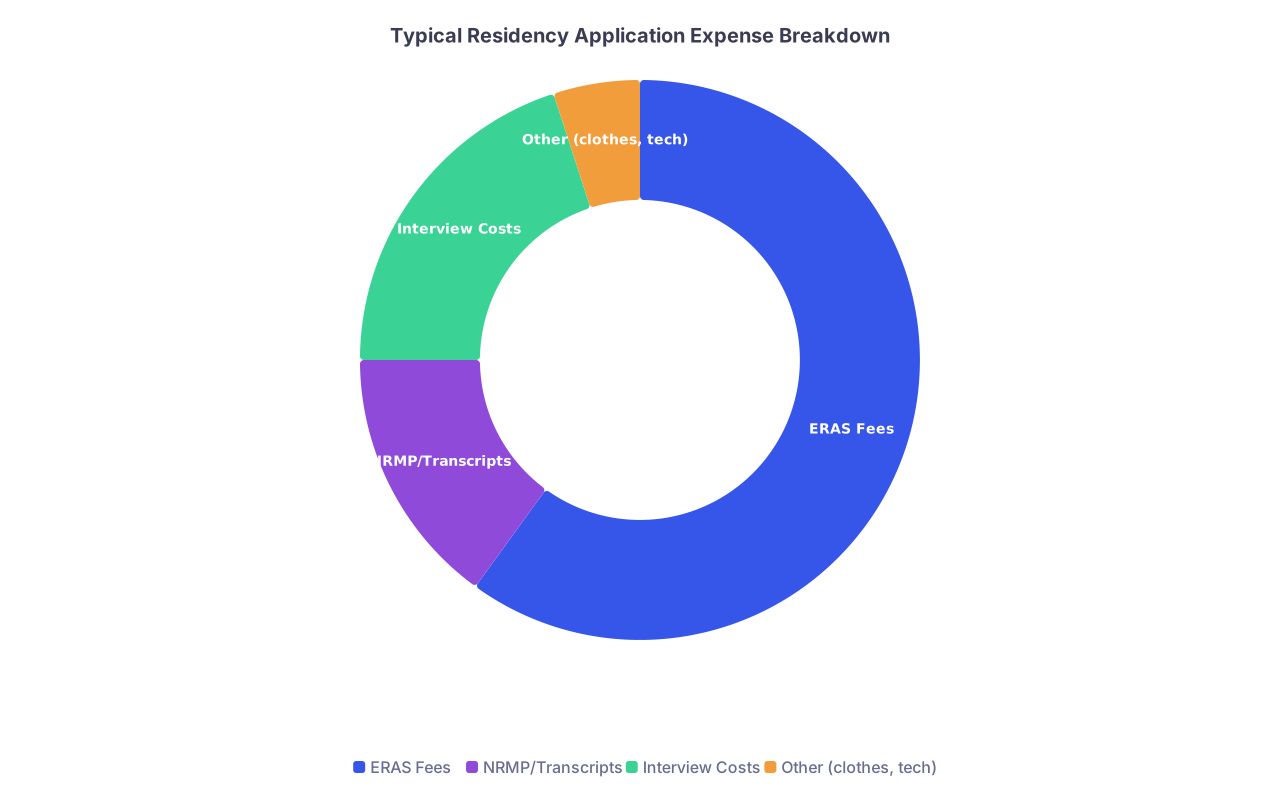
| Category | Value |
|---|---|
| ERAS Fees | 60 |
| NRMP/Transcripts | 15 |
| Interview Costs | 20 |
| Other (clothes, tech) | 5 |
A bloated application list does not just cost you ERAS fees. It also sets up:
- More interview offers than you can realistically attend
- Higher decision stress about cancelling
- Possible last‑minute travel (if your specialty or program insists on in‑person)
Build this into your budget now
- Decide how many interviews you can realistically attend (time + money).
- Allocate a set amount for tech (webcam, lighting) if your setup is terrible.
- If in‑person interviews occur, look at average travel cost to farthest likely region and budget at least 1–3 trips.
If your budget can realistically support 12–15 interviews total, there is little reason to apply in a way that would generate 30 interview offers. It will not. You will just overspend on the front end.
Step 9: Adjust your list in real time—using interview feedback
This is where most people completely fail. They treat their initial list as a sacred text, instead of a first draft.
1. Track interviews by program tier
Set up a simple spreadsheet:
| Program Name | Tier (Reach/Target/Safety) | Invite? (Y/N) | Date |
|---|---|---|---|
| Program A | Reach | Y | 10/5 |
| Program B | Target | N | — |
| Program C | Safety | Y | 10/12 |
| Program D | Target | N | — |
2. Use early response patterns
If by late October / early November:
You have many interviews from safety and none from targets or reaches
→ You are on the conservative side. Do not add more reaches. If you need to supplement, add a few more safety / conservative‑target programs that still accept applications.You have zero or 1–2 interviews total, even from safety
→ You may have deeper issues: application quality, letter problems, red flag not well explained. In this case, adding 30 more random programs typically does not fix it. Get an advisor to dissect your application first.
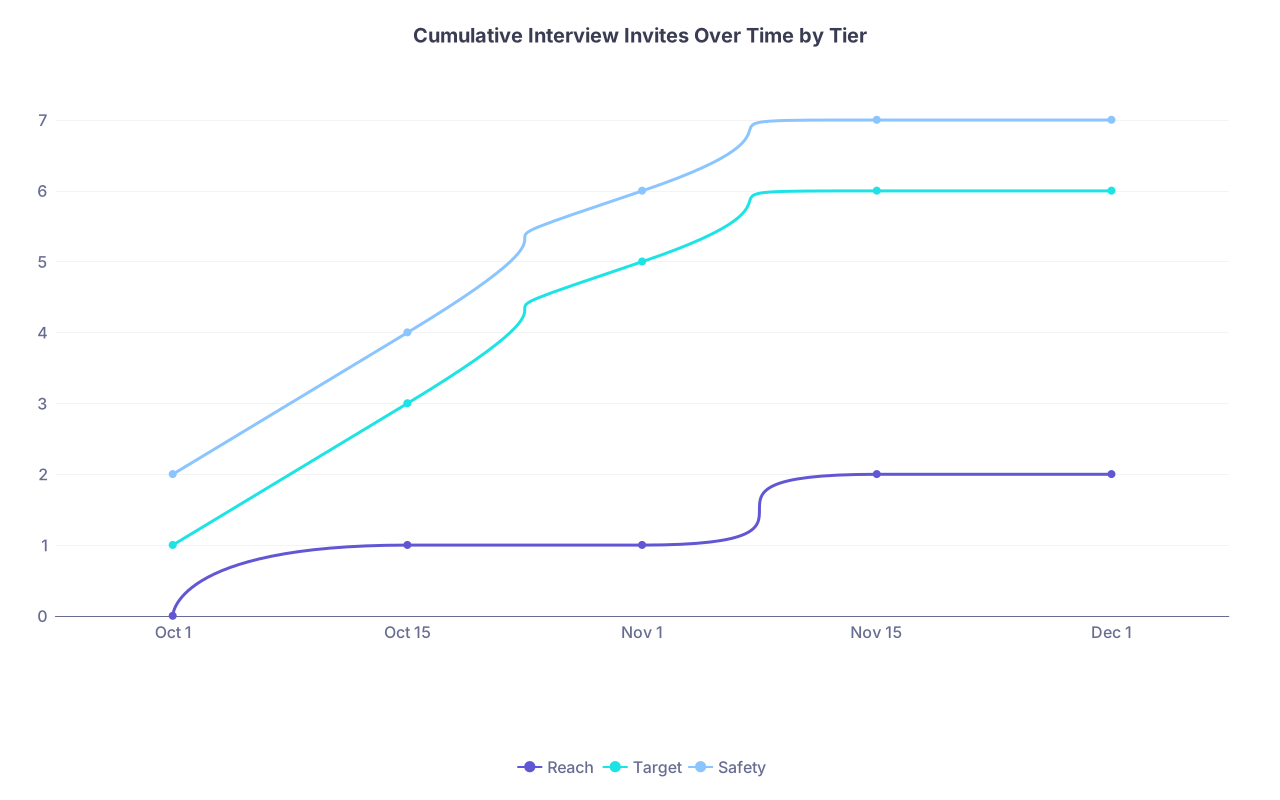
| Category | Reach | Target | Safety |
|---|---|---|---|
| Oct 1 | 0 | 1 | 2 |
| Oct 15 | 1 | 3 | 4 |
| Nov 1 | 1 | 5 | 6 |
| Nov 15 | 2 | 6 | 7 |
| Dec 1 | 2 | 6 | 7 |
The main point: do not blindly throw more money at the problem. Make targeted additions only if your pattern suggests you slightly under‑applied to safeties or certain geographic areas.
Step 10: Use fee assistance and cost-cutting moves aggressively
You are not “gaming the system” by using what is available. You are surviving it.
1. AAMC Fee Assistance → ERAS Fee Waivers
If you qualified for AAMC Fee Assistance (FAP), you get:
- Waiver of certain ERAS fees for a limited number of programs within one specialty.
People routinely leave this unused or partially used because they do not plan their list carefully. If you have fee waivers for, say, 30 programs in IM, then:
- Apply to your best 30 IM programs (mix of reach/target/safety) under the waiver.
- Any additional programs beyond that number cost full price, so choose them surgically.
2. Shared resources and cost splits
A few low‑tech tricks I have seen students use:
- Share interview attire among friends with similar sizes.
- Use one decent shared webcam / light setup in a quiet room if your roommates are synchronized.
- Use university or hospital offices after hours for stable internet and background.
3. Avoid unnecessary extras
You do not need:
- A $500 “application review package” from a random company if your school has advisors or residents willing to help.
- New furniture or elaborate backgrounds. Clean wall, decent lighting, done.
Focus money where it actually meaningfully affects your chances: high‑yield applications and being able to attend interviews.
Concrete example: Two sample strategies
Let me make this painful math more real.
Scenario 1: US MD, middle‑of‑the‑pack, Internal Medicine, tight budget
Profile:
- Step 2 = 226
- No failures
- Mid‑tier US MD school
- 1 IM letter from faculty who knows you well
- Wants Midwest / South, open to community and academic
Budget: $1,000 total. After fixed costs, ~$750 for ERAS.
Strategy:
- ERAS calculator shows:
- 40 IM programs ≈ within budget
- 60 programs blows the budget
Plan:
- Target: 40 IM programs total
- Distribution:
- 6 Reach (strong academic centers in desired region, where your stats are slightly low but not absurd)
- 22 Target (mixed academic/community where your stats fit)
- 12 Safety (community-heavy, some rural, your stats higher than their means)
No backup specialty. You are not risky enough for that to be mandatory if list is well‑built.
Scenario 2: US DO, at-risk, Ortho primary + IM backup, very tight budget
Profile:
- COMLEX 1 pass, Level 2 = 520s, no USMLE
- No failures
- DO school with no strong Ortho presence
- Solid letters but light research
- Realistic enough to know Ortho is an uphill battle
Budget: $1,500 all‑in. After fixed costs, ~$1,250 for apps.
Strategy:
- If he did 60 Ortho + 40 IM = financially insane for this budget.
- Needs to protect his backup, because going unmatched is worse than not doing Ortho.
Plan: Total cap: ~70 programs, split 30 Ortho / 40 IM
30 Ortho:
- 5 true Reach (where DOs occasionally match, even if tough)
- 15 Target for his stats in DO‑friendly programs
- 10 Safety‑ish (if such a thing exists in Ortho: smaller community programs, DO‑heavy)
40 IM:
- 5 Reach (teaching hospitals in cities he likes)
- 20 Target
- 15 Safety (community / rural, lots of DOs, high interview rates)
His Ortho application is a swing. His IM list is his safety net. Perfect? No. But realistic given his budget.
One last thing: talk to actual humans who know your numbers
There is a limit to what any written guide can do. A few high‑yield conversations can save you thousands:
- Your school’s residency advising office
- Recent graduates in your specialty from your school
- Residents at programs similar to those on your list
Bring them your budget, your scores, and your preliminary tiered list. Ask three blunt questions:
- “Given my budget, am I over- or under‑applying?”
- “Which 10 programs on this list are clearly a waste?”
- “Where am I missing obvious safety or target programs?”
Then adjust.
Quick recap: right-sizing when money is tight
- Start with a dollar cap, not a program count. Decide what you can spend, subtract fixed fees, and let the remainder define your maximum number of applications.
- Build a tiered, data‑driven list. Classify programs into Reach/Target/Safety based on your stats and their history, then force yourself into a disciplined distribution that fits your cap.
- Adapt to reality, not fear. Track interview responses by tier, make small targeted tweaks if needed, and stop believing that 30 extra random applications will fix fundamental problems.
You do not need to out‑apply everyone. You need to out‑plan them.