
It is September 25th. Your classmates are counting interview invites in the group chat. You are staring at your transcript and that ugly “Fail” on a clerkship or course. You know it will come up. You know programs will see it. Now you are trying to answer the question that actually matters:
How many programs do I have to apply to so that this does not sink my Match?
Let me be blunt: one failed course or rotation will not automatically kill your chances. But pretending it does not matter is naïve. You need a deliberate, numbers-driven strategy for expanding your application. Not panic-spamming 200 random programs. Smart expansion.
Below is the playbook I use with students every year who had a fail, remediation, or repeat and still matched. Some into solid university programs. A few into very competitive places. The common thread: they stopped hand-wringing and started planning like statisticians.
Step 1 – Get Completely Honest About Your Risk Profile
You cannot decide “how many programs” until you understand who you are statistically.
Take 20 minutes. No emotion. Just data.
Write down:
USMLE/COMLEX performance
- Step 1: Pass? First attempt?
- Step 2 CK: Score and any fails or low scores
- COMLEX Level 1/2: Pass, fail, or multiple attempts
The fail itself
- What was failed?
- Preclinical course
- Core clerkship (IM, Surgery, Peds, etc.)
- Elective / sub-I
- Was it remediated successfully on first repeat?
- Any professionalism / conduct component? That is a bigger red flag than a knowledge gap.
- What was failed?
Specialty competitiveness
Rough buckets:- Lower risk: FM, IM (non-competitive), Peds, Psych, Neurology, Pathology
- Moderate: OB/GYN, EM, Anesthesiology, General Surgery, Mid-tier IM
- High: Derm, Ortho, ENT, Plastics, Neurosurgery, Rad Onc, IR, highly academic IM
Supporting strengths
- Strong Step 2 (e.g., > 240 / > 250)
- Research output (abstracts, pubs, posters)
- Strong home institution department support
- Away rotations with solid letters
- Leadership or unique experiences
Then classify yourself brutally:
- Mild risk: One failed preclinical course, remediated, with no other red flags, decent exams.
- Moderate risk: Failed a core rotation or Step 1/COMLEX 1, now passed, Step 2 OK, otherwise solid.
- High risk: Multiple fails, professionalism issue, or low Step 2 with a failed core clerkship.
This classification will drive your application volume.
Step 2 – Understand Baseline Application Numbers (Without a Fail)
You need a baseline. What do average applicants for your specialty apply to?
Here is a simplified starting point (MD + DO combined, assuming average risk, no major red flags):
| Specialty Category | Example Specialties | Typical Range of Applications |
|---|---|---|
| Less Competitive | FM, Psych, Peds, Neuro, Path | 20–40 |
| Moderate | IM, OB/GYN, EM, Anesthesia, Gen Surg | 35–60 |
| More Competitive | ENT, Ortho, Derm, Plastics, NSurg | 60–100+ |
These are ballpark ranges, not rigid rules. But they give you the starting line.
Your fail pushes you above these typical numbers. The question is: how far above?
Step 3 – Apply a “Risk Multiplier” to Your Program Count
Now we translate your risk profile into something actionable.
Start from the baseline range for your specialty. Then multiply:
Mild Risk (e.g., preclinical fail, clean after that)
- You: Good Step 2, no clerkship fails, one early academic stumble, clearly explained.
- Strategy:
- Less competitive specialties: baseline + ~25%
- Moderate competitive: baseline + ~30–40%
- More competitive: honestly, with any red flag here, you already are in dangerous territory.
Example:
- Planning Peds (less competitive). Baseline 20–40.
- New target: ~30–50 programs.
Moderate Risk (e.g., single core fail OR Step 1 fail now passed)
- You: Failed IM rotation, remediated, Step 2 decent, honest explanation.
- Strategy:
- Less competitive: baseline + ~50–75%
- Moderate competitive: baseline × 2
- More competitive: you must have an aggressive backup plan.
Example:
- Planning OB/GYN (moderate). Baseline 35–60.
- New target: ~70–100+ programs.
High Risk (multiple fails or professionalism flags)
Here the question is less “how many” and more “should you apply this cycle or consider a delay”. But if you are going ahead:
- Less competitive specialties: 80–120+
- Moderate: Easily 120–150+ with strong backup specialty
- More competitive: For most applicants with multiple fails, gunning for Derm/Ortho/etc. without a year or two of repair work is fantasy. You would be paying thousands of dollars for lottery tickets.
Step 4 – Break Down Your List by Tier, Not Just Quantity
Dumping 120 “random” IM programs into ERAS is lazy. Programs are not interchangeable.
You want a portfolio.
Think in three tiers:
Safety / likely
- Community programs
- Newer programs
- Programs with historically high fill rates with IMGs or DOs
- Less desirable locations (rural, smaller cities)
Target / realistic
- Mid-tier university or university-affiliated programs
- Bread-and-butter clinical training, not hyper-academic
Reach
- Brand-name academic centers
- Highly desirable locations (NYC, SF, Boston, Chicago core programs)
A smart distribution for someone with a fail usually skews toward more safety and target:
Mild risk:
- 20% reach, 50% target, 30% safety
Moderate risk:
- 10–15% reach, 50–60% target, 25–30% safety
High risk:
- 0–10% reach, 40–50% target, 40–60% safety
Stop treating “prestige” as the only metric. A solid community program that will actually rank you high is far more valuable than another big-name place that screens out anyone with a fail.
Step 5 – Specialty-Specific Expansion Tactics
Let us get concrete.
1. Family Medicine / Psychiatry / Pediatrics / Neurology / Pathology
These fields are relatively forgiving. One fail, remediated, is often survivable if you show:
- Upward trend
- Solid letters
- Clean explanation
Program count guidance (with a fail):
- Mild risk: 30–50
- Moderate risk: 50–80
- High risk: 80–120+
Key moves:
- Prioritize community-heavy programs in the Midwest, South, and less popular regions.
- Include a healthy chunk of newer programs. They often build their classes with more “non-traditional” candidates.
- If FM: Add a few FM/Sports Med–friendly programs if that is your angle, but only after meeting your safety count.
2. Internal Medicine
Internal Medicine is weird. It has everything from hyper-competitive academic powerhouses to rural community hospitals desperate for applicants.
You can use this to your advantage if you are smart.
Program count guidance (with a fail):
- Mild risk: 45–70
- Moderate risk: 70–110
- High risk: 100–140+
Core tactics:
- Build a very wide geographic spread. If all your programs are coastal academic centers, that is not a safety-heavy list.
- Look at programs with a track record of taking DOs and IMGs—often more open to a stumble if you bring strong letters and Step 2.
- Balance your list: some university, many community, multiple geographic regions.
3. EM / OB/GYN / Anesthesia / General Surgery
These sit in the middle. Your fail will sting more here, depending on the story.
Program count guidance (with a fail):
- Mild risk: 50–80
- Moderate risk: 80–120
- High risk: often need backup specialty consideration
Tactics:
- Prioritize programs where you have rotated or have home department support. Your letters and direct advocacy matter more when there is a blemish.
- Broaden aggressively by geography: Midwest, Southeast, non-major cities.
- For Gen Surg: one failed surgery rotation will hurt. You must crush your sub-I and secure a strong letter to counterbalance.
4. Highly Competitive Specialties (Derm, Ortho, ENT, etc.)
Here is where I am going to be blunt.
If you have:
- A failed core clerkship, and
- Average board scores, and
- No high-level research in that field
…then applying to 80 Derm programs is just lighting money on fire.
That does not mean you must give up. It means you need realistic strategy:
- Consider a dedicated research year and re-evaluate.
- Build a dual-application strategy (e.g., Ortho + prelim/TY + backup in IM or FM).
- Talk with your specialty’s advisors honestly. And listen when they tell you the odds.
If you are still applying this year:
- You will likely be looking at 100+ programs + a solid backup specialty where you apply another 40–80.
Step 6 – Use Data, Not Feelings, to Select Programs
Too many students pick programs like they pick restaurants: “feels good, nice location, heard the name once.”
You need a more ruthless filter.
Here is how to build your list:
Start from wide databases
- FREIDA
- Program websites
- Your school’s historic match lists
- Word-of-mouth from upperclassmen
Quick-screen using hard data
For each program, look at:- Do they take DOs / IMGs? If yes, more likely flexible with non-perfect applicants.
- Class size: larger classes = more spots for “non-perfect” applicants.
- Location: big coastal city or ultra-popular place? Treat as more competitive.
- New or established? Newer often more flexible.
Look for “red-flag tolerance” proxies
You rarely see “we love fails” on websites. But you do see:- “We review applications holistically.”
- “No minimum board score requirement.”
- “We do not automatically filter for attempts.”
- Or, the opposite: explicit language about first-attempt passes only → remove them from your list.
Aim for a diversified final list
- Minimum 3–4 geographic regions
- Mix of academic, community, and hybrid programs
- Multiple program sizes
You are not looking for programs that cannot get good applicants. You are looking for programs that understand that one bad semester or rotation does not define someone.
Step 7 – Fix What You Can This Cycle (Beyond Just More Programs)
You are not just a number with a fail. Programs will read how you talk about it.
Smart expansion is not only about quantity. It is about presenting yourself as someone who:
- Took responsibility
- Corrected the problem
- Is now consistently performing
Key levers:
1. Personal statement
Do not pretend the fail does not exist if it appears on your MSPE or transcript. Briefly:
- One paragraph
- Own it: “I failed X during Y because…”
- No victim narrative. No six excuses.
- Show what changed: study strategies, time management, mental health treatment, whatever is true.
- Close with evidence: honors later rotations, strong Step 2, faculty comments.
2. Dean’s letter / MSPE
Talk to your dean’s office. Sometimes they will include a contextual explanation. Make sure your story is consistent across documents.
3. Letters of recommendation
You want at least one letter that implicitly counters the fail:
- “X is one of the most prepared students I have worked with this year.”
- “Despite an early academic setback, X has performed at or above the level of peers.”
If your fail was in Internal Medicine, a glowing IM letter from a sub-I helps more than you think.
4. Step 2 CK (or COMLEX 2)
If you have not taken it yet and have a fail on record, you need a solid Step 2. It is your redemption exam.
If your Step 2 is already low on top of a fail, you need to lean even harder on your application volume and safety-heavy list.
Step 8 – Build a Realistic Budget and Cut Emotionally Useless Programs
ERAS fees climb fast. Expanding blindly from 50 to 150 programs without a budget is how you end up several thousand dollars down with no clear gain.
Estimate your cost:
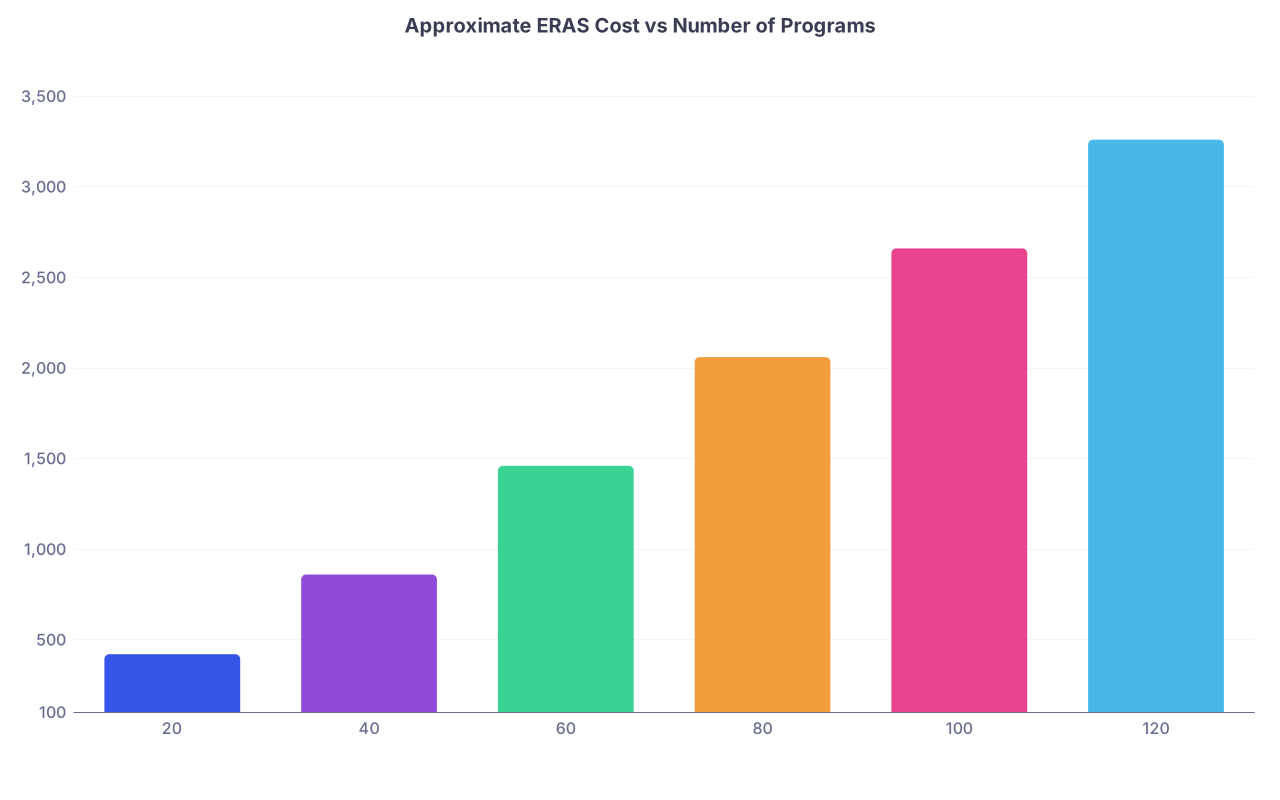
| Category | Value |
|---|---|
| 20 | 419 |
| 40 | 859 |
| 60 | 1459 |
| 80 | 2059 |
| 100 | 2659 |
| 120 | 3259 |
(These are rough, change year-to-year, but the pattern holds: steep increase with volume.)
Now, do this:
Set a hard upper budget ceiling.
For some that is $800. For others, $2500. Be explicit.Prioritize # of serious applications over total count.
A “serious” application means:- You would actually rank the program.
- You meet at least basic requirements.
- The location and setting are acceptable.
Cut programs that only appeal to ego.
If you have:- A fail
- Average scores
- No research
And you are adding multiple top-10 name-brand programs just for “maybe”, you are probably wasting money. Keep 2–3 if you must. Not 15.
Better to drop 10 prestige reaches and use that money to double down on solid community programs that might actually rank you.
Step 9 – Time Management: More Programs Means More Work
You expand to 100 programs. You still have to:
- Track interview invitations
- Reply to scheduling emails quickly
- Manage virtual or in-person logistics
- Send post-interview communications (if appropriate)
So apply your expansion strategically based on your staffing (you) and time.
Use a simple system:
- Spreadsheet or Notion table with:
- Program name
- Tier (reach/target/safety)
- Location
- Interview status (invited, scheduled, completed)
- Impressions
Do not be the applicant who applies to 130 programs and then double-books interviews or forgets to respond.
Step 10 – When to Add a Backup Specialty (and How Many There)
Sometimes the smartest way to expand is not just “more of the same specialty,” but “add a second specialty.”
Who should seriously consider a backup:
- You have a core fail in the specialty you want
- You have a fail and below-average Step 2 for that specialty
- Multiple advisors have raised serious concern about Match chances
Example structures:
Gen Surg primary + IM backup
- 60–80 Gen Surg programs
- 40–80 IM programs (heavily community)
EM primary + FM backup
- 50–80 EM programs
- 30–60 FM programs
Ortho primary + prelim + FM/IM backup
- 60–80 Ortho
- 20–40 prelim surgery/TY
- 40–80 FM/IM
If you are doing a dual-application, be honest with yourself. If the primary does not work out, could you be happy in the backup? If the answer is absolutely not, re-think the entire plan.
Example Scenarios
Let me walk through three realistic composites.
Scenario 1 – Preclinical Fail, Applying to Pediatrics
- MS2: Failed cardio block, remediated, passed.
- Clinical: All passes, 1 honors, no fails.
- Step 2: 245.
- Specialty: Peds.
Risk: Mild
Plan:
- Target 35–45 Peds programs.
- Mix: ~5 reach, 20–25 target, 10–15 safety.
- Emphasize upward trajectory in PS.
- Apply widely across regions, add several community and mid-tier academic programs.
Scenario 2 – Failed Internal Medicine Clerkship, Applying to IM
- M3: Failed IM clerkship due to shelf + borderline eval. Remediated, passed second time.
- Step 2: 230.
- Letters: Strong from Surgery, decent from IM sub-I later.
- Specialty: IM.
Risk: Moderate
Plan:
- Aim for 80–100 IM programs.
- Heavy emphasis on community and university-affiliated community programs.
- At least 4–5 different states, including Midwest and South.
- One paragraph in PS explaining fail, highlight improved performance on sub-I and strong faculty comments.
- Absolutely crush sub-I and make sure that letter directly speaks to reliability and clinical skill.
Scenario 3 – Multiple Fails, Wants EM
- M2: Failed one preclinical course, remediated.
- M3: Failed Surgery clerkship, remediated.
- Step 2: 220.
- Specialty: EM. Really wants it.
Risk: High
Plan:
- Needs harsh reality. EM is competitive and currently contracting in some markets.
- Strongly consider adding FM backup or delaying a year to repair profile.
- If proceeding this year:
- 80–120 EM programs (very wide geographic spread)
- 40–60 FM programs
- Heavy tilt toward community EM and FM programs, newer residencies, and non-coastal regions.
- Meet with EM faculty to see if they will realistically support the application.
Simple Flow: How To Decide Application Volume
Here is the quick logic in visual form:

| Step | Description |
|---|---|
| Step 1 | Have course or rotation fail |
| Step 2 | Assess specialty competitiveness |
| Step 3 | Assess risk level - Mild, Moderate, High |
| Step 4 | Pick baseline range for specialty |
| Step 5 | Apply risk multiplier |
| Step 6 | Build tiered list - reach, target, safety |
| Step 7 | Add backup specialty or consider delay |
| Step 8 | Finalize program count within budget |
| Step 9 | Submit applications and track interviews |
| Step 10 | High risk or very competitive specialty |
Tape this logic to your wall if you need to. It keeps you honest when panic pushes you to hit “add 40 more random programs.”
FAQs
1. Is one failed rotation automatically a red flag that will keep me from matching?
No. One failed rotation or course is a yellow flag, not a permanent scarlet letter. I have seen plenty of applicants with a single fail match into solid programs. What matters:
- How you responded after the fail (subsequent performance, Step 2, letters).
- How you explain it (owning responsibility vs blaming everyone else).
- Whether programs see a consistent, reliable trajectory after that point.
You will likely need to:
- Apply to more programs than a “clean” applicant in your specialty.
- Prioritize less-competitive locations and community or newer programs.
- Make sure at least one strong letter directly or indirectly counters any doubt about your reliability or clinical ability.
2. What is worse for my chances: a failed course or a low Step 2 score?
Both hurt, but how they hurt is different.
- Low Step 2 can trigger automatic filters at many programs. You may never even be read. That is a gating problem.
- A failed course/rotation will be seen by most programs, but many will still read your file, especially if the fail is isolated and old. That is a context problem.
If you have to pick one to “fix” or compensate for:
- A strong Step 2 can partially offset a prior fail by showing current competence.
- Another ace rotation with an excellent letter can also help.
But a poor Step 2 plus a fail is rough. In that situation, the smart move is aggressive application expansion, honest advising, possibly a backup specialty, and very careful program selection.
Key takeaways:
- One fail is survivable, but you must adjust your program volume upward using a realistic risk multiplier.
- Do not just add more programs blindly. Build a tiered, data-informed list: reach, target, safety, with broad geography and plenty of community and newer programs.
- Use this cycle to show clear recovery—strong Step 2, strong letters, and a concise, accountable explanation—while maintaining a budget and, for higher risk profiles, a serious backup plan.