
The comparison game about application numbers is toxic—and mostly meaningless.
You’re not crazy for spiraling about it, though. I’ve watched people absolutely wreck their mental health in September because their friends applied to 120 programs and they “only” applied to 45. Or someone in a group chat casually drops, “Yeah, I ended up sending to like 90, just in case,” and suddenly you’re staring at your 35 programs like you’ve basically pre-matched to unemployment.
Let’s walk straight into that anxiety and sort out what’s real and what’s just fear in a lab coat.
The Panic: “Did I Doom Myself by Applying to Too Few Programs?”
You know that sick feeling in your stomach when:
- A friend says, “My advisor told me to apply to at least 80.”
- Someone in your specialty Discord posts, “100+ or bust this year.”
- You see a Reddit spreadsheet where the average is 2–3x what you did.
And then you start re-running the same questions in your head on loop:
“Did I underestimate how competitive this is?” “Did I screw myself trying to save money?” “Is everyone going to match except me?”
I’ve seen this play out every single year:
- One person applies to 100+ because they’re terrified.
- Another applies to 35–40 carefully chosen programs.
- Guess which one sometimes doesn’t match?
The answer is: either. Because the raw number isn’t the full story.
Let me be blunt: “More programs” is not a strategy. It’s an emotion.
It feels safer to shotgun your application across the country. It feels like insurance. But past a certain point, it’s just expensive noise.
Reality Check: What Numbers Actually Matter
Let’s get concrete for a second. Program directors don’t care how many programs you applied to. They care if you’re a reasonable candidate for their program.
What actually matters:
- Your specialty’s competitiveness
- Your Step 2 / COMLEX 2 score (or lack of red flags)
- Your school type (MD / DO / IMG), geography, red flags
- Whether your list had enough realistic places
The nightmare thought you probably have is:
“My 35 is actually like 15 realistic + 20 reach, and my friend’s 90 includes 50 realistic. So they’re safe, and I’m not.”
Sometimes that’s true. Sometimes your list really is too short.
But just as often, you’re fine and your brain is just catastrophizing.
Here’s a simplified way to think about it:
| Specialty Type | Typical Range (US MD) | Typical Range (US DO/IMG) |
|---|---|---|
| Very competitive | 60–100+ | 80–150+ |
| Moderate competitive | 30–60 | 50–90 |
| Less competitive | 20–40 | 40–70 |
This isn’t gospel. But if you applied to, say, 40 internal medicine programs and you’re a solid US MD with no disasters on your record, you’re not “way too low” just because a classmate went wild and applied to 120.
Now, if you’re:
- An IMG or DO going for something competitive
- Someone with multiple fails/remediations
- Switching specialties late in the game
…then yeah, you probably need more programs than your classmates. But notice: that’s still about fit and risk level, not just “everyone else went big so I should have too.”
The Ugly Truth About “Everyone Applied to More Than Me”
Here’s the thing no one likes to say out loud: people lie and exaggerate about application numbers all the time.
I’ve literally sat in a study room and heard:
- Person A: “I ended up at like 100+ apps.”
- Same person, to a close friend 10 minutes later: “I actually did 68. 100 just sounded better when everyone was freaking out.”
Or:
- “I applied everywhere.”
Translation: 40 programs in 3 states.
Plus, no one brags out loud about under-applying. So your data is skewed from the start.
Then there’s this fun psychological trick: you don’t notice the 10 people who applied to fewer programs and matched. You only notice the loud 2–3 who maxed their credit card and posted their entire spreadsheet like a war medal.
So you end up comparing:
- Your actual list
- To other people’s inflated or selectively presented numbers
And then wondering why you feel behind.
The Point Where More Programs Stop Helping
There’s this quiet line people cross where they’re no longer increasing their chances—just their credit card bill and their burnout.
Especially if you’re applying realistically. Here’s what I mean.
If you’re a reasonable candidate and you’ve got:
- A broad geographic spread you’d actually move to
- A majority of programs where your stats are in range
- A mix of academic/community, big/small, etc.
Going from, say, 40 → 60 can help. But going from 60 → 100 often changes nothing except:
- You now have 40 more program websites to skim
- 40 more sets of requirements to check
- 40 more potential interview dates to juggle that you might never even receive
There’s also a time factor nobody talks about. Every extra application you add in a panic is time you’re not:
- Improving your personal statement
- Customizing your experiences section
- Reviewing common interview questions
- Actually taking care of your own sanity
A rushed, generic app sent to 90 programs is not automatically better than a thoughtful, organized, strategic app sent to 40–50.
But What If I Really Did Undershoot?
Let’s not sugarcoat. Sometimes the fear is justified.
If you’re looking at your situation and thinking, “No, this isn’t just anxiety; my list is actually too small for my risk profile,” then you don’t need vibes, you need a plan.
Here’s the kind of situation that makes me nervous:
- Competitive specialty (derm, ortho, plastics, ENT, etc.)
- You’re not a strong applicant on paper
(below-average score, weak home support, limited research) - And you applied to like… 20 programs “just to see”
In that case? Yeah. That’s not “bold,” that’s dangerous.
Same if:
- You’re an IMG / DO in a moderately competitive specialty and only applied to 25–30
- You have failed exams or significant gaps and didn’t compensate with a larger net
- You limited yourself to one or two regions for non-critical reasons (“I like the weather there”)
If you’re reading this early enough in the season and applications are still open, you can absolutely add more programs. People quietly do this. They don’t talk about it in group chat, but they do it.
If you’re later in the cycle, what you can do shifts:
- Be extremely responsive to any program communication
- Use signals (if your specialty has them) very strategically
- Ask mentors honestly: “Based on my list, should I add more next cycle if I don’t match?”
- Start mentally preparing a reapplication plan as a backup—not because you’ll definitely need it, but so your brain stops picturing “nothingness” if things go wrong
The Emotional Side: Watching Friends Hoard Interviews
This is where it really hurts.
Your friends are posting:
- “Another invite!! :)”
- “Now I have to cancel some, it’s too many, ugh.”
And you’re sitting there with 1–2 interviews… or zero. And the story in your head is brutal:
“They applied to more. They were smarter. I was cheap and stupid. And now I’m not going to match.”
Let’s slow that down.
First, the timing is incredibly variable. I’ve watched applicants go from 0 to 6 invites in 48 hours after a slow start. I’ve watched people with early invites plateau and never go above 5. There’s no clean “if you don’t have X by Y date, you’re dead” rule.
Second, more applications does not necessarily equal more interviews.
I know someone who applied to 110 programs in EM and got 3 interviews.
Another who applied to 45 and got 10.
The first person didn’t fail because they didn’t apply to enough. The issue was their underlying stats + letters + timing + specialty chaos. The extra 65 applications did basically nothing.
What I’m saying is: don’t confuse cause and effect.
Your friend’s 20 interviews are not automatically because they applied to 80 programs. It might be because they:
- Have a 260+ Step score
- Did an away at a huge-name institution
- Are couples matching and told everyone
- Are from that region and have every connection possible
You only see the surface (“They applied to more than me”). You don’t see the full context.
What You Can Still Do If You’re Freaking Out Right Now
Let’s say you’re mid-cycle, your friends applied to way more programs, and you’re spiraling.
Here’s what’s actually under your control right now:
Audit your list with someone honest.
A mentor, advisor, program director, someone who will actually tell you if your list was too short or unbalanced. Don’t ask them to comfort you. Ask them to assess your risk.If applications are still open, add strategically.
Not random padding. Programs that:- Have historically taken applicants like you
- Aren’t in hyper-competitive cities
- Don’t require things you obviously don’t have (like heavy research if you have none)
Clean up your communications.
Make sure your ERAS is pristine, your email is professional, and you’re not missing messages. A surprising number of people lose opportunities to pure sloppiness.Prepare like interviews are coming.
This feels insane when you have 0 invites, I know. But if one hits and you’re unprepared, that hurts more. Practicing gives you back a tiny bit of power.Quiet the noise.
Mute the group chat if it’s just “I got another interview!!!” every day. You are not obligated to consume other people’s highlight reels while you’re hanging onto sanity.
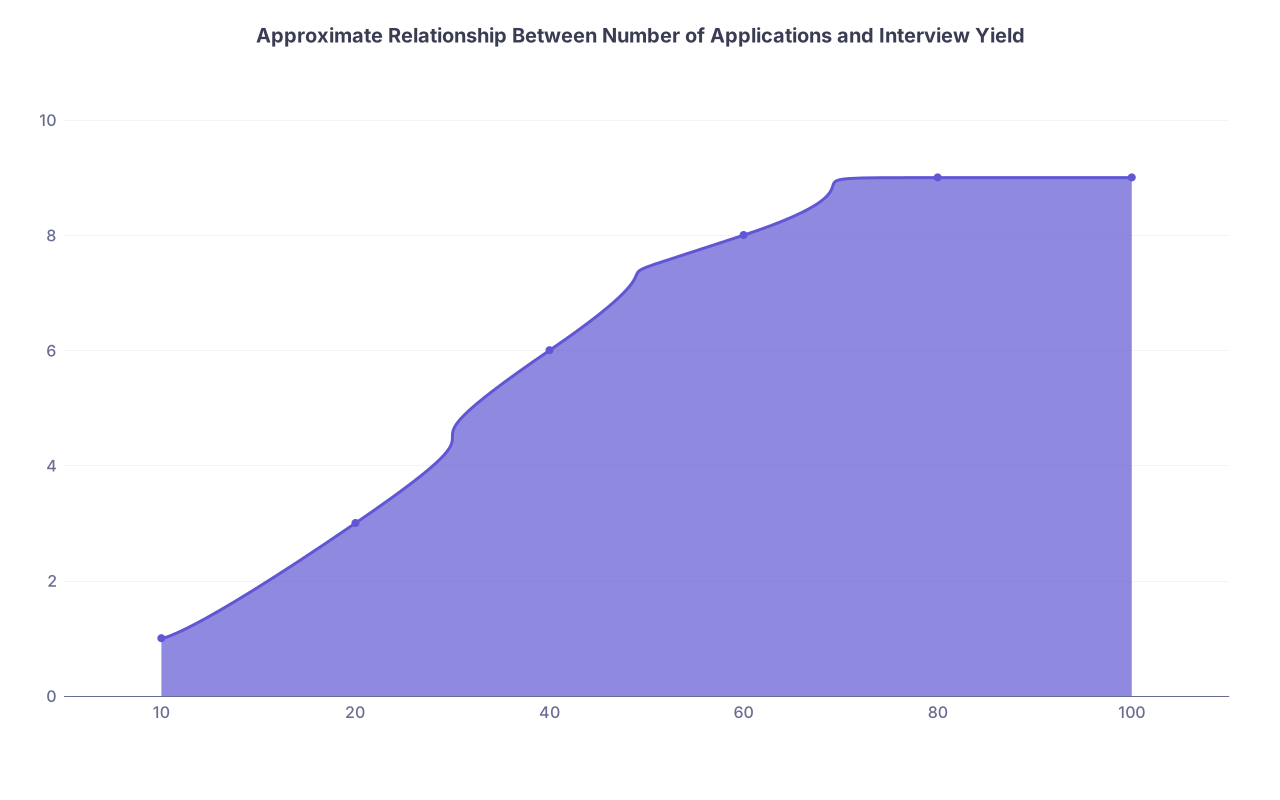
Quick Reality Snapshot: Applications vs Interviews
Here’s a rough, emotionally grounding view:
| Category | Value |
|---|---|
| 10 | 1 |
| 20 | 3 |
| 40 | 6 |
| 60 | 8 |
| 80 | 9 |
| 100 | 9 |
This is not real data, it’s a concept:
At some point, the curve flattens. Going from 20 to 40 can help a lot.
Going from 60 to 100? Often not so much.
That’s why your friend with 90 apps and 7 interviews is not actually in a fundamentally different boat than you with 45 apps and 5 interviews. But your anxious brain insists they are.
A Tiny Bit of Harsh Honesty (Because You Deserve That Too)
There is a non-zero chance you under-applied.
There is a non-zero chance you’ll need to reapply.
Both of those can be true without it meaning you’re lazy, stupid, or doomed. It might just mean:
- You didn’t get good guidance early enough
- You misjudged your risk level
- You tried to be optimistic in a system that punishes optimism
If that happens, the move isn’t “I ruined everything by applying to fewer programs than my friends.” The move is:
- Next cycle: bigger list, smarter distribution, earlier planning
- Use this year’s experience for better letters, stronger personal statement, some kind of concrete growth
I have seen plenty of people not match on a first try, come back with a more realistic list and slightly stronger app, and match just fine. It’s not the end of the story. It’s a brutal chapter, but it’s not the end.

| Stage | Activity | Score |
|---|---|---|
| Before Submission | Building list | 3 |
| Before Submission | Comparing to friends | 1 |
| After Submission | Watching others apply more | 2 |
| After Submission | Waiting for invites | 1 |
| Interview Season | First invite | 4 |
| Interview Season | Ongoing comparison | 2 |
| Match Week | Fear of not matching | 1 |
| Match Week | Outcome and next steps | 3 |
FAQ – Exactly the Stuff You’re Afraid to Ask Out Loud
1. Is there a magic minimum number of programs I need to be “safe”?
No. And anyone who says “Apply to at least X and you’re fine” is guessing. A strong US MD with 40 carefully chosen internal medicine programs might be safer than a below-average IMG who applied to 100 random programs. It’s about fit and realism, not a magic number.
2. Did I ruin my chances by not applying to as many programs as my classmates?
Almost certainly not by that fact alone. If your list was balanced, realistic, and aligned with your risk level, you’re probably okay. The people who truly hurt themselves are the ones who apply to 10–15 in a competitive field “just to see” or only to brand-name places they’d “love to go to.” If your list isn’t like that, take a breath.
3. Is it too late to add more programs?
If ERAS is still open and programs are still accepting apps, you can add. It won’t erase a fundamentally weak application, but if you genuinely undershot and you’re still early enough, it can help. If you’re deep into interview season, late additions rarely change much, but you can still try tactically if an advisor suggests it.
4. My friends are getting way more interviews than I am. Is that because they applied to more?
Not necessarily. It might be their scores, home program connections, research, geography, or sheer randomness. Application volume and interview volume are related, but not in a clean 1:1 way. Plenty of high-volume applicants still end up with few interviews, and mid-volume applicants with strong profiles do fine.
5. I only have a few interviews. Should I start planning for not matching?
You can do two things at once: treat every interview you do have like gold and prepare like you will match, while quietly gathering information about backup plans (SOAP, preliminary year, research, reapplying). Making a contingency plan isn’t “manifesting failure.” It’s giving your brain less to catastrophize about.
6. If I have to reapply, should I just double or triple my program list next time?
Not blindly. You should expand, yes—but deliberately. Understand why you didn’t match: were you too competitive for your profile, too narrow geographically, weak letters, exam issues, late scores? Then build a broader, smarter list around that, instead of just throwing your app at 200 places hoping something sticks.
Key points to hang onto:
- Your friends’ application numbers are not a grading scale for your chances.
- Past a certain point, more programs add anxiety and cost—not safety.
- If you truly undershot, you can adjust—either this cycle, or next—without it being the end of your career.