

It’s 1:17 a.m. Your ERAS is submitted, your emails are refresh-refresh-refresh, and you’re staring at your CV thinking: “What if they take one look at my med school and toss my application?”
You keep imagining some program director in a U.S. academic center, scrolling quickly through a list of schools. They see “XYZ Medical University” in a country they’d have to Google. You imagine them raising an eyebrow, muttering “never heard of it,” and moving on.
And the thought that sits in your chest like a rock:
What if they think my entire home training is weak… and that’s it? Game over.
Let’s walk straight into that fear and tear it apart a bit. Because the fear isn’t random. Parts of it are real. But it’s not the whole story—and it’s absolutely not the only story you can tell.
The Ugly Truth You’re Afraid Of (And What’s Actually Going On)
Here’s the part no one likes saying out loud:
Yes, some program directors see unfamiliar international schools and immediately feel skeptical. Not always maliciously. Just… lazy pattern recognition.
They’ve seen:
- Variable clinical exposure
- Some schools with weak exam prep
- Letters that sound generic or inflated
- Grading systems they don’t understand
So an IMG school they don’t recognize feels like extra work to figure out. Extra uncertainty. And programs hate uncertainty.
But here’s the other side you’re not giving enough weight to:
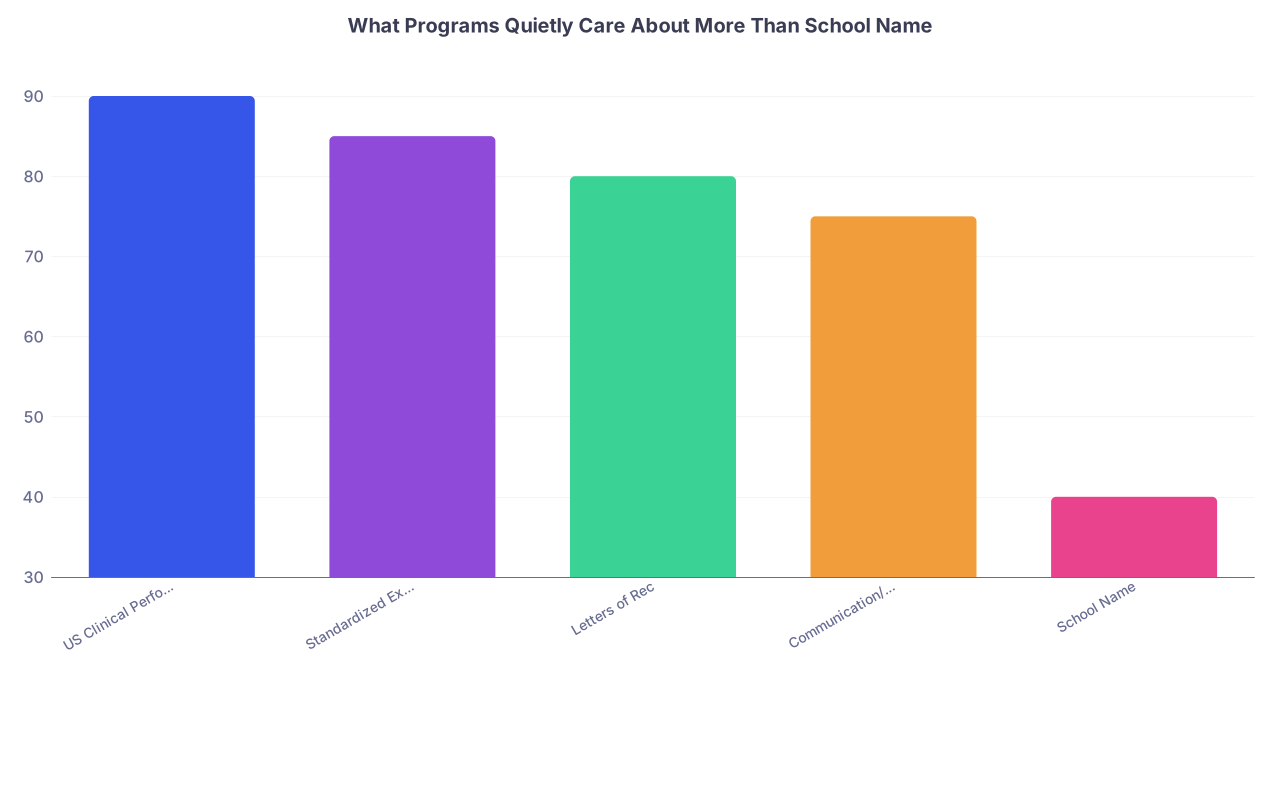
| Category | Value |
|---|---|
| US Clinical Performance | 90 |
| Standardized Exams | 85 |
| Letters of Rec | 80 |
| Communication/Professionalism | 75 |
| School Name | 40 |
No program will say, “We don’t care about school name at all.” But in practice, once you’re past whatever basic screening filters they use, there are four things that routinely outweigh “this school isn’t Harvard”:
- How you actually performed in U.S. clinical settings
- Your USMLE/COMLEX performance (if applicable)
- The credibility of people vouching for you (letters, calls, advocacy)
- How you come across in interviews: clear, safe, teachable, not a headache
So yes, the fear has a root. But you’re acting like school name is the whole tree. It’s just one branch.
How Programs “Read” Your Home Training (Even If They Don’t Know Your School)
Let me be blunt: nobody is going to sit down and research your curriculum map. They’re not cross-referencing your pharmacology contact hours with a U.S. LCME standard.
They’re doing something much lazier—and much more human.
They’ll infer your training quality through proxies:
- Did you pass Step 1 / Step 2 / OET without drama?
- Did you function like a normal intern on your U.S. rotations?
- Do your letters sound like you’re safe and reliable, or like you’re a liability?
- Did you do anything that suggests you can handle complex systems (research, QI, leadership)?
Your med school is part of the picture, but it’s the background, not the main character—unless you let it become the main character by never reframing it.
That’s on you.
Reframing “Weak Home Training” Without Lying To Yourself
Right now, your internal script is something like:
“My school isn’t well known, our hospital is under-resourced, our curriculum wasn’t as strong, so obviously I’m behind U.S. grads.”
Let me rephrase that the way a program director might actually respect:
“I trained in a resource-limited setting where we saw high volumes and had to think clinically first, with less reliance on technology. Because of that, I had to build strong clinical reasoning, adaptability, and independence early. I’ve since validated that with strong performance on U.S. exams and in U.S. clinical rotations.”
See the shift?
Same reality. Different story.
You’re not denying any limitations. You’re contextualizing them. You’re turning them into:
- Evidence of resilience
- Evidence of adaptability
- Proof that you can bridge two systems, not just function in one
Programs don’t expect IMGs to have the exact same training environment as U.S. grads. They expect:
- Enough baseline knowledge that they’re not teaching you from zero
- Proof that you can adapt to their system
- Someone who won’t fall apart under pressure or get defensive when corrected
Your job is to connect those dots for them, not silently hope they guess.
Concrete Ways To Reframe Your Training In Your Application
Let’s go piece by piece—personal statement, ERAS experiences, and interviews—because you can either let “weak home training” haunt each part, or you can quietly flip it.
1. Personal Statement: Stop Apologizing, Start Owning
Bad approach:
“Coming from a small, less-known medical school, I often feared my training wouldn’t be enough…”
You’ve already planted the seed: “I’m not enough.” And you think you’re being honest. You’re just feeding your worst narrative.
Better approach:
- Acknowledge context, briefly.
- Pivot immediately to what you gained and how you proved yourself in the U.S. system.
Example structure (adapt this, don’t copy):
- 1–2 sentences: Context – resource-limited or lesser-known school
- 3–4 sentences: What that environment forced you to become (hands-on, thoughtful, patient-centered, scrappy)
- 3–4 sentences: How you then tested yourself in U.S. settings (rotations, exams, research) to make sure your foundation is solid
- Close that paragraph with a confidence statement, not insecurity
Something like:
“Training at a high-volume public hospital where CT scans were a luxury rather than a default forced me to rely on careful history taking and physical exams. I learned to make decisions with incomplete data and to work closely with nurses and families to monitor subtle changes. When I came to the U.S. for clinical rotations, I was initially worried whether my training would translate. But the feedback I received—from being trusted with increasing responsibility to earning strong letters from U.S. faculty—confirmed that my foundation was solid and that I could adapt quickly to a new system.”
Notice what you’re telling them indirectly:
“My home training wasn’t a handicap. It was my boot camp.”
2. ERAS Experiences: Translate, Don’t List
Listing “Internal Medicine Rotation – XYZ Hospital” with generic bullet points like “participated in patient care” just screams: “I did the bare minimum and don’t know how to explain it.”
Instead, show what your context demanded of you.
Bad:
“Completed 8-week internal medicine clerkship. Took histories and presented patients.”
Better:
- Show responsibility level
- Show volume/complexity
- Show how you compensated for limited resources
- Show anything that looks like initiative
Example:
“Internal Medicine Clerkship – XYZ Teaching Hospital
- Managed daily follow-up on 15–20 complex inpatients under supervision, presenting assessments and plans on morning rounds.
- Practiced resource-conscious care in a setting with limited imaging and subspecialty availability, focusing on careful history, physical exam, and close monitoring.
- Developed early comfort with managing common conditions (CHF, COPD exacerbations, uncontrolled diabetes) in a high-volume government hospital serving low-income patients.”
Same rotation. Completely different story.
3. Interviews: Prepare A Direct, Calm Answer To “Tell Me About Your School”
You’re terrified of this question. Which means you’ll ramble if you don’t script it.
Your answer should hit 4 things:
- One-line description of the school/hospital
- What exposure you actually got
- What limitations existed
- How you filled those gaps and proved yourself in the U.S.
Example:
“My medical school is a mid-sized university in [country], and I did most of my clinical training at a large public hospital that sees very high volumes of medicine and emergency patients. We didn’t always have access to advanced imaging or subspecialty services, which meant I learned to rely heavily on clinical reasoning and close patient follow up. I realized I wanted to practice in a more resource-rich, system-based environment, so I sought out U.S. rotations and research to challenge myself in that context. Those experiences, along with my exam performance, reassured me that my foundation was strong and transferable.”
Calm. Honest. Not defensive. No “sorry my school isn’t famous.”
Proof You Can Show That Your Training Isn’t “Weak”
Let’s get practical. Here’s what actually reassures programs that your training is fine, even if they’ve never heard of your school.
| Signal Type | Why Programs Care |
|---|---|
| Strong Step 2 score or OET | Standardized, comparable signal of knowledge |
| Solid US clinical evaluations | Shows you can function in their system |
| Letters from known U.S. faculty | Transfers their trust onto you |
| Research or QI work in U.S. | Shows engagement with academic/clinical standards |
| Clear, confident storytelling | Signals insight and professionalism |
And you don’t need all of these to shift the narrative. Even 2–3 strong signals can override “unknown school” for many programs.
If you’re weak in one area (say, Step score isn’t amazing), then double down on:
- Clear, strong narratives from U.S. rotations
- Powerful, specific letters
- Being a ridiculously prepared and grounded interviewer
You’re not trying to pretend your background is identical to a U.S. MD from a big-name school. You’re showing you can stand toe-to-toe with them in actual performance.
The Reframe You Need To Practice (Like A Script)
Right now, you probably default to self-sabotage when anyone asks about your school:
- “Well, we’re not that well known…”
- “We don’t have as many resources…”
- “I know I’m not as well-trained as U.S. grads, but…”
You are doing the program’s job for them—arguing against yourself.
You need a different default script. Literally write it out and practice it aloud.
Try a template like:
“My training background is different from U.S. students in some ways. I trained in [type of environment], which meant [challenge]. Because of that, I developed [specific strength]. To make sure my knowledge and skills met U.S. expectations, I [took these exams/got this experience] and was able to [concrete outcome]. Altogether, I think this gives me a solid foundation and a bit of a broader perspective that I bring to residency.”
Don’t wing this in the moment. You’ll panic and revert to apology mode.
A Quick Reality Check: You’re Not Fooling Anyone By Pretending This Fear Isn’t There
Programs know IMGs worry about this. They’ve heard the shaky-voiced answers. They’ve seen the apologetic personal statements.
The applicants who stand out aren’t the ones with the “perfect” pedigree. They’re the ones who:
- Understand their context
- Can talk about it without flinching
- Show they’ve already done the work to bridge the gap
They’re not asking programs for faith. They’re presenting evidence.
Your school name will always be part of your application. But how you talk about it will decide whether it feels like a liability or a foundation.
You can’t change where you trained. You can absolutely change what it means in your story.

| Step | Description |
|---|---|
| Step 1 | See Unknown School |
| Step 2 | Move On or Screen Out |
| Step 3 | Look Deeper |
| Step 4 | Review Exams and US Rotations |
| Step 5 | Invite to Interview |
| Step 6 | Any Reliable Signals? |
| Step 7 | Concerns Resolved? |
Your job is to stuff the “Reliable Signals” box with as much clear evidence as you can—and then talk about it like an adult who understands their own journey.
FAQ (You’re Not The Only One Spiraling About This)
1. My school really is low-resourced and disorganized. Am I supposed to spin that as a positive?
You’re not spinning. You’re contextualizing. You don’t need to say, “My school was amazing,” if it wasn’t. You say, “My environment had X limitations, which pushed me to develop Y skills. To make sure I met U.S. standards, I did Z.” The honesty is in naming the gaps. The power is in showing what you did next.
2. What if my Step scores aren’t strong enough to “prove” my training was good?
Then focus harder on the other signals: rock-solid U.S. letters, clear evidence of growth over time, honest reflection on your test performance, and an interview presence that shows maturity, insight, and teachability. Weak scores are not automatically equal to weak training. Programs care if you’ll struggle to pass in residency. Show them how you’re addressing that risk.
3. Should I explicitly say in my personal statement that my school is not well known?
Usually, no. You don’t need to advertise perceived weaknesses. Mention your context if relevant—public hospital, resource-limited, high volume, etc.—but you don’t need to say “less prestigious.” They already know it’s not Harvard. Spend your real estate on what you became in that environment, not on beating up your background.
4. How do I know if programs are actually worried about my school or something else?
You often won’t know for sure. That’s the frustrating part. But in most rejections, “unknown school” is just one factor piled on top of others: late application, generic personal statement, weak letters, mediocre interviews. Assume your school puts you at an initial disadvantage and act accordingly: over-clarify your strengths, be surgically specific in your storytelling, and collect as many objective signals (exams, letters, evals) as you can.
Open your personal statement right now and find the first place you talk about your background or training. Ask yourself: “Does this sound apologetic or confident?” Then rewrite that one paragraph so it tells a story of resilience and adaptation instead of inferiority. Start there.


