
Already Holding a Non‑US License: Using It Strategically in Your Application
You already have a medical license outside the US. So why do you feel like ERAS treats you the same as a fresh grad who has never touched a patient?
Here is the blunt truth: your non‑US license can either be a powerful asset or dead weight in your application. It depends entirely on how you use it. Programs will not connect the dots for you. You have to weaponize it.
Let’s go step by step.
1. How Programs Actually See Your Non‑US License
First, understand what you’re fighting against.
Most US program directors have a mental default setting for IMGs: “Good? Maybe. Trained? Sort of. Risky? Possibly.” They do not deeply understand your country’s training structure. They do not know what “Senior Resident in Internal Medicine – Pakistan” or “Medical Officer – Nigeria” or “SHO – UK” really means.
Here’s what they do know and pay attention to:
- Are you safe?
- Can you handle responsibility?
- Can you work in a system with rules and oversight?
- Will you embarrass or harm the program?
Your non‑US license is proof of this: another government and another medical council looked at you and said, “This person is safe enough to treat our population.” That’s not a small thing. But if you just list your license on ERAS and move on, it becomes background noise.
You have to translate that license into US‑program language:
- supervised practice
- independent decision-making
- accountability
- systems familiarity
- continuity of care
- volume and complexity
Do that, and suddenly you’re not “random IMG #482.” You’re a doctor with proven track record in real clinical responsibility.
2. Decide Your Narrative: What Role Does Your License Play?
Before you start typing anything, decide how this license fits into your overall story. There are only a few good narrative roles your non‑US license can play:
Proof of maturity and readiness
“I’m not a student anymore. I’ve practiced independently, managed complications, and I’m ready for high responsibility.”Bridge through a graduation gap
“I graduated in 2017. I have not been idle. I’ve been practicing medicine under a license, staying clinically sharp.”Evidence of commitment to a specialty
“I’m applying to Internal Medicine. I’ve worked as a licensed GP/internist for 3 years, managing adult medicine every day.”Foundation for a specific strength
“My license allowed me to run TB/HIV clinics in rural areas, which is why I’m strong in chronic disease management and resource-limited care.”
Pick 1–2 of these. Not all four. If your story is “I’ve done everything: surgery, pediatrics, psych, OB, public health, admin, research, leadership, teaching…” you sound scattered.
Let me be direct: unfocused = risk. Focused = valuable.
3. Where to Use Your License in the Application (And What to Say)
You have four main places to leverage your non‑US license:
- ERAS Experiences section
- Personal statement
- Program-specific communications (emails, PS tweaks)
- Interviews
Let’s break those down.
A. ERAS Experiences: Turn “Licensed Practitioner” into Evidence
Do not just write “General Practitioner – saw patients in clinic.”
You need to unpack what your license actually allowed you to do.
Example 1 – Internal Medicine–oriented GP (applying IM):
Position: General Practitioner (Licensed Physician)
Setting: District Hospital, Punjab, Pakistan
Description (this is the part most people waste):
Wrong version:
- Outpatient and inpatient care.
- Prescribed medications.
- Worked with a team.
Better version:
- Independently managed 25–35 adult patients per day in clinic, including diabetes, hypertension, CAD, COPD, and acute infections, under hospital protocols.
- Admitted and managed 5–10 inpatients daily with attending oversight; wrote admission notes, daily progress notes, and discharge summaries.
- Led rapid assessment for acute presentations (chest pain, sepsis, DKA) before senior review, initiating initial workup and stabilization.
- Coordinated follow‑up for chronic patients; tracked lab abnormalities and adjusted therapy according to national guidelines.
Notice the difference? The second version screams: “I already live in a world of notes, volume, triage, and responsibility.”
Example 2 – Licensed surgeon/non-categorical surgery applicant:
Position: Medical Officer – General Surgery
Setting: Tertiary Care Hospital, Lagos, Nigeria
Better description:
- First assistant in 150+ major surgeries (lap chole, colectomies, hernia repairs, thyroidectomies); primary operator for 80+ minor procedures (I&D, biopsies, simple hernia repairs).
- Took primary overnight call 4–6 times/month; evaluated 10–15 emergency consults per call shift and presented to the attending with focused plans.
- Managed pre‑ and post‑operative care for 20–30 inpatients, including pain control, fluid management, early detection of complications, and discharge planning.
Key rule: translate your license into tasks that mirror US residency.
If I can read your description and see “this person already lives in a residency‑like workflow,” you win.
B. Personal Statement: Put Your License in the Right Place
Your license should not hijack your whole personal statement. It should anchor your credibility.
Common mistakes:
- Spending 70% of the PS narrating everything you did as a licensed doctor.
- Writing it like you’re already done training and are reluctantly going back to “residency because US rules.”
The tone should be: “I have valuable experience, but I understand I’m joining a new system and I respect that.”
Simple structure that works:
Paragraph 1–2:
Why this specialty + a specific patient or experience that hooked you.
Paragraph 3–4:
How your licensed practice deepened that interest and gave you skills.
Example snippet for IM:
After earning my medical license in Jordan, I spent three years as a general practitioner in a busy urban clinic. Most days I was the first and only physician my patients saw. That experience forced me to become efficient with limited resources while still thinking broadly. Managing uncontrolled diabetes without immediate access to endocrinologists, or triaging chest pain without rapid cardiology backup, taught me to prioritize, communicate clearly, and own my decisions. Those years of licensed practice cemented my desire to train in Internal Medicine in a system where I can combine that front‑line responsibility with the structure and depth of US residency training.
Then:
Paragraph 5+:
Why US training now + what you’re looking for + how your prior licensure will help you contribute (not dominate).
Important: explicitly acknowledge that US residency is still training, not a step down from your “real doctor” life.
C. Emails and Program-Specific Materials
If you’re doing any targeted outreach (which you should, selectively), your non‑US license can be the hook.
Subject line ideas:
- “IMG applicant with 4 years licensed GP experience in rural clinics”
- “Licensed surgeon in [country] applying to [Program Name] categorical position”
But keep outreach brief and surgical:
Dear Dr. [PD Name],
I’m an IMG from [Country] applying to your [Specialty] program this season. For the past five years I’ve practiced as a licensed [GP / surgeon / internist] in [setting], managing [type of patients]. I’m particularly drawn to your program’s focus on [X – e.g., underserved care, academic IM, community-based training] because it aligns with my experience leading [brief example].
I know your time is limited, but I wanted to highlight that I’m not coming straight from school; I’ve been functioning as an independent physician and am eager to bring that maturity and work ethic to structured US training. I would be grateful for any consideration of my application.
Sincerely,
[Name, AAMC ID]
No begging. No life story. Just: here’s my license-backed experience, here’s why I fit.
D. Interviews: How to Talk About Your License Without Sounding Arrogant
This is where people blow it.
If you walk into the room with “I’ve been a doctor for 8 years; this internship will be easy,” you’ve already failed. US programs are allergic to that attitude.
You want: confident, not cocky. Mature, not stuck in old habits.
Common questions you’ll face and how to frame your license:
- “Tell me about your clinical experience since graduation.”
Bad:
I’m a fully licensed GP and I basically ran the clinic by myself.
Better:
I’ve been working as a licensed GP in a district hospital for the last 4 years. I typically see 30–40 patients a day, mostly adult medicine, and I’m responsible for their initial assessment and ongoing care, with backup from a senior when needed. It has given me a lot of independence, but also taught me when to ask for help.
- “You’ve already been a licensed physician. How do you feel about going back into a training role?”
Bad:
I don’t really need training, but I know the US system requires residency.
Better:
I understand that US residency is not just a formality; it’s a structured way to learn a specific healthcare system, with high expectations and supervision. My licensed practice gave me comfort with clinical responsibility and decision‑making. I see residency as an opportunity to apply that maturity while learning US standards and systems. I’m used to being accountable, and I’m very comfortable being taught and getting feedback again.
- “What strengths from your prior practice will help you as an intern?”
Strong examples:
- Managing high patient volume without losing track of details.
- Being calm with sick patients because you’ve seen sick patients—many.
- Communicating with low‑health‑literacy patients.
- Owning your decisions instead of waiting passively for orders.
If you cannot name concrete strengths from your licensed work, then you are wasting it.
4. Using Your License to Offset Weaknesses (Gaps, Old Grad, Average Scores)
Here’s where your license can really save you.
There are three classic “red flags” for IMGs:
- Old graduation year
- Gaps in clinical activity
- Average/low‑ish scores (but not catastrophic)
Your license can directly attack all three.
A. Old Grad Year
If you graduated in 2014 and are applying in 2026, the question is: “What have you been doing all this time?”
“Licensed physician with continuous practice” is the ideal answer.
You must show:
- Each year you were actively practicing with your license (dates, roles).
- No big unexplained voids.
- Increasing responsibility, if possible (e.g., from junior to more senior roles).
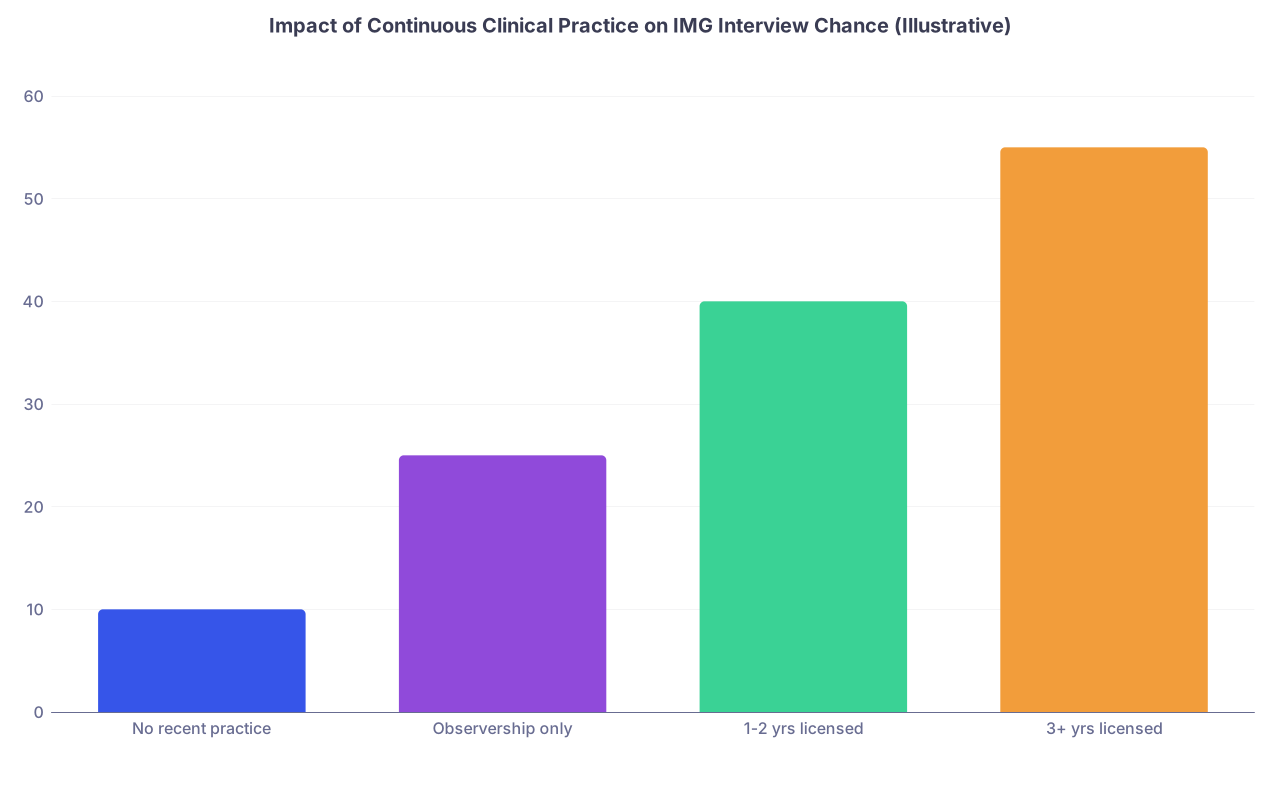
| Category | Value |
|---|---|
| No recent practice | 10 |
| Observership only | 25 |
| 1-2 yrs licensed | 40 |
| 3+ yrs licensed | 55 |
This chart is illustrative, but the pattern matches what I’ve seen: long-term, consistent, licensed practice beats “I did a few US observerships two summers ago” every time.
B. Gaps
If you’ve had interruptions, your license can help, but only if you’re honest and organized.
Example:
- 2016–2019: Licensed GP, full time
- 2019–2020: Family situation, part‑time locums
- 2020–2022: Full‑time licensed cardiology clinic physician
Explain this clearly in your ERAS experiences and, if needed, a short Additional Information note. Programs fear unexplained disappearance. They are much calmer when they see you stayed under a license, even part-time, instead of fully stepping away.
C. Average Scores
You will not score your way into super-competitive programs. That’s fine. Your play is: “I am low risk because I’ve done this in real life.”
Phrase it like this in interviews and statements:
My [Step score] is not in the top percentiles, but I’ve spent the last five years proving in practice that I’m safe, reliable, and thorough. I’ve managed real patients, faced real complications, and maintained my license without incident. That practical track record is something I’m proud of and something I bring to residency.
Is that magic? No. But it changes how PDs read your file: less “unknown,” more “tested.”
5. Avoiding Pitfalls: How Your License Can Actually Hurt You
Yes, your license can backfire. I’ve seen this more than once.
Here are the main ways:
Coming across as inflexible
“In my country we did it like this…” repeated seven times in one interview. Dead on arrival.
You must show curiosity about US practice, not nostalgia for your old hierarchy.Overstating independence
If you say “I was completely independent” and then later mention frequent supervision, you look dishonest. US PDs know every system has some oversight.
Phrase it like: “I was usually the first physician to see the patient and made initial decisions, but had attendings available for consultation and shared decisions for complex cases.”Fuzzy or exaggerated scope
“I did brain surgeries as a GP” sounds like fiction.
Or “I ran the ICU” when you were actually taking first call and presenting to a consultant.
You will be caught in details at interviews. Do not oversell.Licensing problems you try to hide
If you had a suspension, complaint, or investigation around your license, you need to know how and when to disclose it. Trying to bury it is the worst strategy.
This is a more complex, individual situation; consider getting real legal/ethical advice if this applies to you.
6. Aligning Your License with the Specialty You Are Targeting
Your license is most powerful when it directly feeds your chosen specialty.
If you’re all over the place—licensed in OB, applying to Radiology, with recent work in dermatology clinics—you’ll be questioned.
Let me map it out simply:
| Your Licensed Role | Strongest US Specialty Fit |
|---|---|
| General Practitioner / Family Doctor | IM, FM, Psych (with narrative) |
| Internal Medicine specialist | IM, Nephro/GI later, cards track |
| Surgical Medical Officer | General Surgery, Prelim Surgery |
| OB/GYN licensed | OB/GYN, FM with OB focus |
| Pediatrician | Pediatrics |
| Emergency Physician | EM (hard as IMG), IM, FM |
You can absolutely pivot, but you’ll need a very clear explanation. And more US-relevant exposure (observerships, electives) in the new field.
7. Integrating Non‑US License with US Clinical Experience (USCE)
Your license is not a substitute for US clinical experience. It’s a multiplier.
The ideal combo:
- Recent licensed work in your home country
- Recent, hands-on USCE (sub‑internship, externship, at minimum strong observerships)
Here’s a clean, compelling timeline:
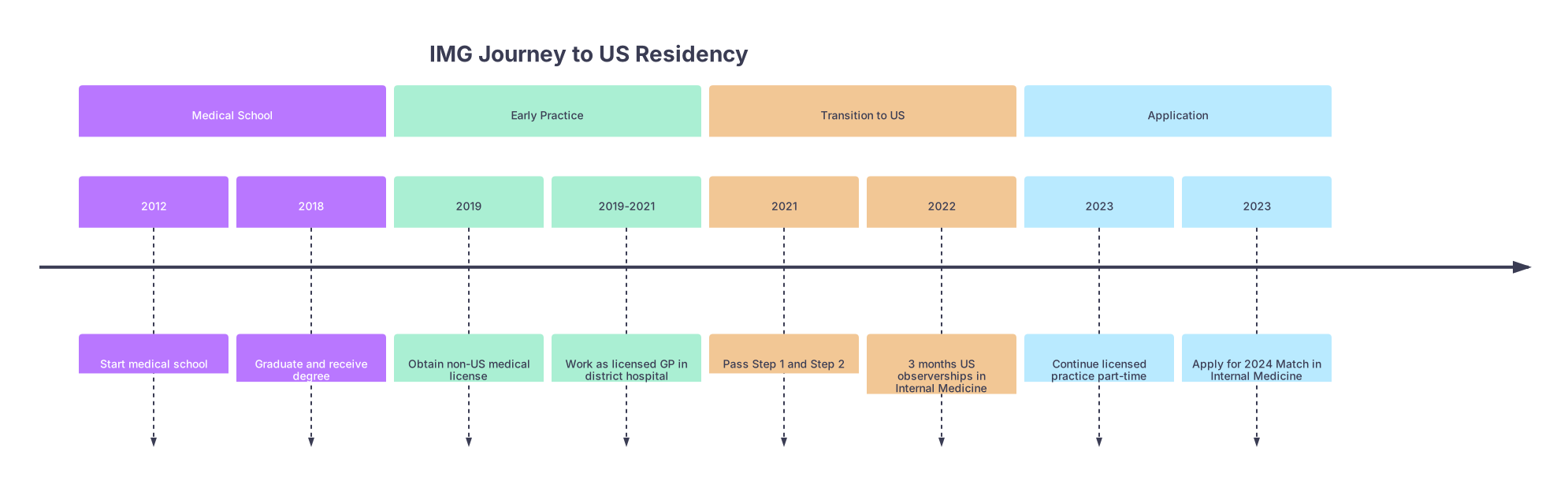
| Period | Event |
|---|---|
| Medical School - 2012 | Start medical school |
| Medical School - 2018 | Graduate and receive degree |
| Early Practice - 2019 | Obtain non-US medical license |
| Early Practice - 2019-2021 | Work as licensed GP in district hospital |
| Transition to US - 2021 | Pass Step 1 and Step 2 |
| Transition to US - 2022 | 3 months US observerships in Internal Medicine |
| Application - 2023 | Continue licensed practice part-time |
| Application - 2023 | Apply for 2024 Match in Internal Medicine |
That reads as: continuous, relevant, stable, and oriented towards IM.
If instead your timeline is chaotic, sit down and rewrite your experiences so the logic is visible: “I did X, then Y, then targeted Z for this specialty.”
8. One More Level: Using Your License to Show System-Level Thinking
If you want academic or leadership-oriented programs, do not stop at “I saw patients.” Use your licensed role to highlight:
- Protocols you helped implement
- Quality improvement you were involved in
- Teaching you did for juniors or nurses
- Coordination with public health or community programs
Example:
As a licensed GP in a rural clinic, I noticed frequent readmissions for poorly controlled diabetes. With our small team, I helped design a simple follow‑up system using paper registries and reminder calls. Over 6 months we saw a noticeable reduction in emergency visits for hyperglycemia. That experience sparked my interest in system‑level quality improvement, which I hope to pursue further in residency.
Now your license is not just “I existed and worked.” It’s “I understood the system and tried to improve it.” That’s catnip for some PDs.
9. If You Haven’t Used Your License Recently: Damage Control
What if you got licensed but haven’t truly used it for years?
Then you must be honest. Do not inflate short-term or minimal practice into “long-standing licensed clinician.”
Here’s how to handle it:
- Be precise with dates; if you worked 6 months, say 6 months.
- Emphasize any ongoing part‑time, locum, or volunteer clinical work.
- Add recent structured USCE or home‑country supervised clinical experience to show you’re not rusty.
- Own the gap with a clear reason: exams, research, family, immigration, etc.—plus what you did to stay clinically engaged (courses, CME, limited practice).
Your non‑US license still matters. It shows that at least at one point, a system cleared you as safe to practice. Just don’t pretend you’ve been a full‑time front‑line doctor if you haven’t.
10. What You Should Do Today
Do not overthink this into paralysis. Your next moves are concrete:
- Open your ERAS (or draft) and find every experience related to your licensed practice.
- Rewrite one of those entries right now so that it clearly shows:
- volume
- responsibility
- supervision structure
- skills that translate to US residency
If that one rewritten description doesn’t make you look more like a ready-to-train resident and less like a vague “doctor abroad,” keep editing until it does.