
You’re here
You already finished training in your home country. Maybe you’re a fully qualified surgeon, anesthesiologist, OB/GYN, or psychiatrist. You’ve done call, you’ve had your own patients, you probably supervised juniors.
But in the US? You’re applying for a different field.
The anesthesiologist from India applying to Internal Medicine.
The ENT surgeon from Egypt applying to Family Medicine.
The pediatrician from Brazil applying to Psychiatry.
And you keep getting the same skeptical questions in your head—because you’ve heard versions of them from program coordinators, attendings, other IMGs:
- “Why are you switching fields?”
- “Are you going to leave us for a fellowship?”
- “If you’re already a trained surgeon, are you really going to be okay being a PGY‑1 again?”
This article is for that situation.
You’re not just an IMG. You’re a previously trained specialist (or at least partially trained) whose home-country field doesn’t match what you’re applying for in the US.
Let’s walk through what to do—step by step—so you don’t unintentionally tank your application.
1. Get clear what you look like to a US residency program
Before you fix anything, you need to understand how programs see you.
They’re not seeing your life story. They’re seeing a risk profile.
Here’s what’s running through a program director’s mind when they see: “Completed General Surgery residency in Pakistan, applying to Internal Medicine.”
“Why is this person switching?”
Are you running toward medicine or away from surgery? Burnout? Could you bail again?“Will they be happy as an intern?”
Taking orders from a fresh grad, doing scut, night float, cross-cover notes. After you’ve been an attending (or near-attending) somewhere else.“Is this person going to be a disciplinary problem?”
People who feel overqualified sometimes argue more. Push boundaries. Ignore protocols.“Is their ‘experience’ even relevant?”
Surgical training with minimal outpatient continuity? That’s not a perfect fit for psych or family medicine.“Visa + age + previous training = will they complete the program?”
If you’re older, on visa, and switching fields—PDs will silently calculate your risk of burnout, family pressure, health issues, etc.
None of this is personal. But it’s real. And if you pretend it’s not there, your personal statement and interviews will sound naïve or evasive.
Your job is to pre‑answer these concerns so convincingly that you flip from “risk” to “mature, motivated, already proven under pressure.”
2. Decide: how hard are you “owning” your previous field?
You have to make one big decision up front:
Are you going to lean into your prior specialty training…
or de‑emphasize it and present yourself more like a generalist with broad clinical experience?
There’s no single right answer. It depends on:
- How different the fields are
- How long and how deep your prior training was
- What your current target specialty is
Use this grid as a reality check:
| Prior Training vs New Field | Example | Recommended Approach |
|---|---|---|
| Closely related | Internal Medicine → Neurology | Lean in, show continuity |
| Some overlap | General Surgery → Radiology | Selective emphasis |
| Very different | OB/GYN → Psychiatry | De-emphasize technical identity |
| Procedural → non-procedural | Ortho → Family Med | Focus on patient care over procedures |
| Non-core → core (e.g., Path → IM) | Pathology → IM | Reframe as insight, not misfit |
If you were a fully trained specialist (e.g., 4–5 years completed, job as attending), you can’t hide that. You have to own it—but with a very clear “here is why I’m switching and why it makes sense” narrative.
If you only did 1–2 years of training and then left, you have more flexibility. You can frame it as early-career exploration, or circumstances, or visa issues—but you still must be consistent and honest across ERAS, personal statement, and interviews.
Bottom line: before you write a single sentence, decide:
- Am I “the former surgeon turned internist”?
- Or “a clinician with strong acute care experience who’s committed to internal medicine now”?
Pick one identity. Stick with it.
3. Rewrite your story: why this new field, now?
If your home-country training is in a different field, your personal statement is not optional fluff. It’s your damage-control and repositioning document.
You need a narrative that does three things simultaneously:
- Explains the prior field without sounding flaky or bitter
- Shows a genuine, specific pull toward the new field
- Reassures them you’re committed—and okay starting over
Here’s the structure that actually works.
A. Start with the present, not your old title
Do not open with “I completed my OB/GYN residency in…”
That locks them into the wrong frame: “Why is this OB/GYN here?”
Open with a moment or experience that clearly belongs to your target field.
- For IM: an ICU case you managed that required deep medical decision‑making.
- For psych: a patient whose mental health determined their entire course.
- For FM: a continuity clinic story that shows long-term, cradle‑to‑grave care.
Only then mention your original specialty as context.
B. One clean paragraph on “why I trained in X first”
You get one paragraph. Don’t write a three-page saga of how you chose surgery at 22.
Keep it tight:
- What drew you to it originally
- What you gained from it (skills, mindset)
- Very brief hint at the limit/shift that pushed you toward the new field
Example, former general surgeon → Internal Medicine:
I chose general surgery for the immediacy of intervention and the discipline of operative care. Those years taught me decisiveness, procedural skill, and how to manage acutely ill patients. Over time, however, I realized that the part of my work I found most meaningful was before and after the operation—optimizing comorbidities, managing complex medical problems, and following patients through their recovery.
Not: “I didn’t like doing night calls” or “Surgery was too hard.” Never trash your old field. It makes you look unreliable.
C. Then go heavy on: why the new field is the right final fit
Now you explain why you’re not just running away; you’re landing where you belong.
Specific, field‑linked reasons:
- For IM: complexity, diagnostics, continuity with chronic disease
- For Psych: interest in behavior, trauma, mind‑body connection, etc.
- For FM: breadth, community, whole-family approach, preventive care
- For Neuro: fascination with neuroanatomy, localization, neuro-ICU, etc.
Tie your prior field in as a strength that improves your fit.
D. Explicitly address “starting over”
Don’t hope they won’t notice you’re 35 and were an attending back home. They already noticed.
Say it out loud, like a grown-up:
- “I understand that training in a new system and a new specialty means beginning again as an intern. I welcome that. I want to learn US medicine correctly from the ground up.”
- “I have no expectation of shortcuts or advanced standing; my prior experience is an asset, but I fully accept the responsibilities and hierarchy of residency.”
I’ve seen PDs visibly relax when applicants say this directly.
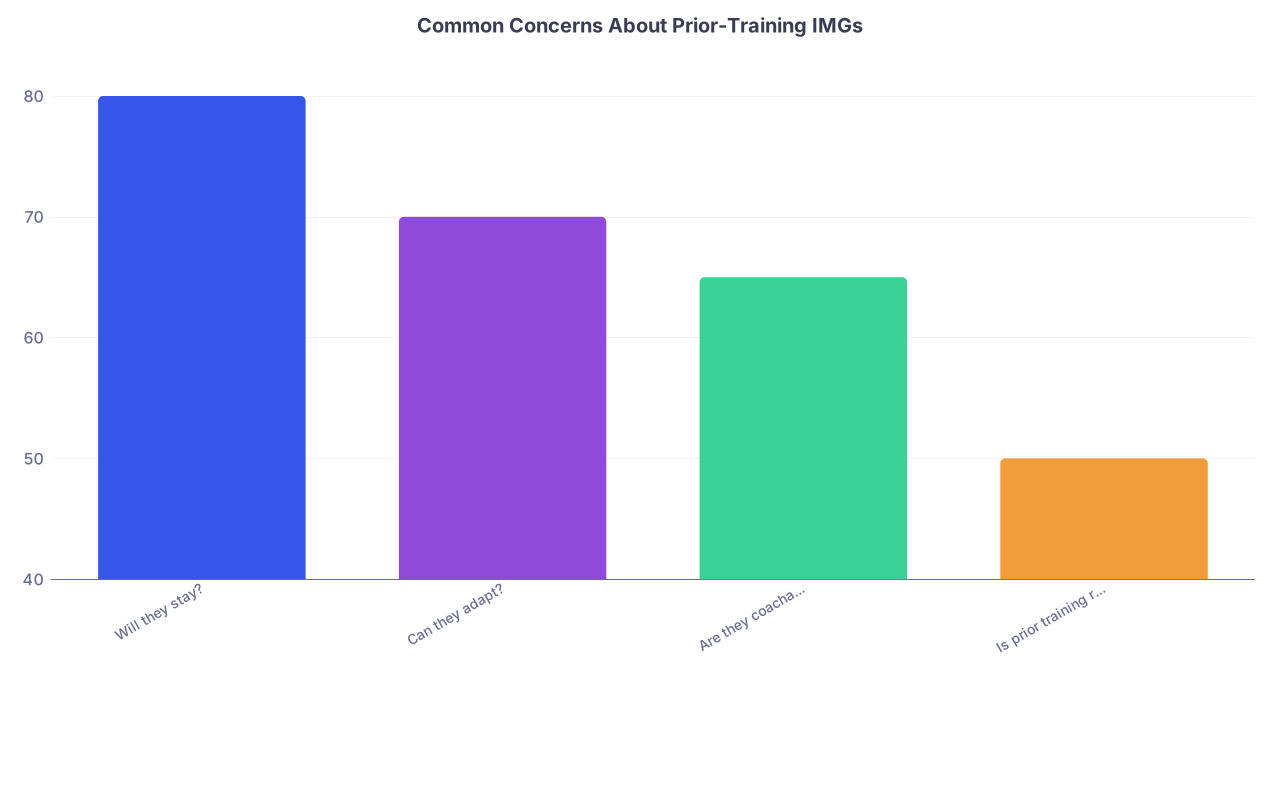
| Category | Value |
|---|---|
| Will they stay? | 80 |
| Can they adapt? | 70 |
| Are they coachable? | 65 |
| Is prior training relevant? | 50 |
4. Tailor your CV so it doesn’t look like you’re still in the old specialty
Your ERAS CV can either reinforce your new story—or totally contradict it.
If you look like “a disappointed cardiologist who couldn’t get a cardiology spot,” you’re done.
Here’s how to align it.
A. Reorder experiences to highlight target-field relevance
You don’t have to list everything chronologically in the “Experience” section if ERAS allows categorization and emphasis. But even when chronological, you control descriptions.
For each role, rewrite bullets to emphasize:
- Overlapping skills (acute care, chronic disease, communication, teaching)
- Exposure to your new field within your old role (pre‑ and post‑op management, psychiatric comorbidities in OB, etc.)
Two versions of the same job:
Bad (neurosurgeon applying to psych):
- “Performed craniotomies and assisted with complex spinal surgeries.”
Better:
- “Managed perioperative care for patients with severe depression, anxiety, and cognitive disorders, requiring close collaboration with psychiatry for medication management and delirium prevention.”
Same job, different emphasis.
B. Be intentional about research
If 90% of your research is in laparoscopic techniques but you’re applying to psychiatry, you have choices:
- Still list it (you can’t erase your past), but don’t spend half the interview talking about trocar placement.
- Add at least some US or home‑country experiences that touch your new field: quality improvement, case reports, chart reviews.
If you absolutely have nothing in the new field, that’s a problem. You fix it with observerships and targeted projects (we’ll get to that).
C. Titles: don’t inflate, don’t undercut
If you were an attending anatomically but functionally working like a senior resident, be honest. US programs are used to variable titles abroad.
But do not call yourself “Consultant in Cardiology” if you were still in training. The moment someone senses title inflation, trust is gone.
Clarify it in parentheses if needed:
- “Registrar (postgraduate trainee) – General Surgery”
- “Junior Consultant (equivalent to senior resident) – Pediatrics”
Trust beats impressive words.
5. Fix the clinical experience gap in your new field
If your old and new specialties are very different, you must close the credibility gap with actual exposure in the target field. Otherwise, you look like you woke up last month and picked “psychiatry” off a list.
You do that with US clinical experience (USCE) targeted to your new field.
Priority order for USCE
For most programs, this is roughly the hierarchy:
| Type of Experience | Strength for Applications |
|---|---|
| US hands-on residency-level inpatient/outpatient | Very strong |
| US observership/externship in target specialty | Strong |
| Home-country experience in target specialty | Moderate |
| Research only (no patient contact) | Weak alone |
| Old specialty experience (different field) | Background only |
Concrete steps:
Get at least 1–2 observerships or externships in the new field
- Apply directly to community hospitals, non-university programs, and private practices.
- Cold email: concise, targeted, and explicitly mention your switch and why.
Make sure your letters of recommendation are from the new field
Ideal letters for a field-switching IMG:- 2–3 US letters from attendings in the new specialty
- Optionally 1 letter from your old field that speaks to work ethic / professionalism, not just technical skill
Ask your US letter writers to explicitly validate the switch
You can’t script their letters, but you can tell them your story. The best letters for you will say things like:- “Despite prior surgical training abroad, Dr. X embraced the role of learner and fit seamlessly into our medicine team.”
- “Dr. Y’s background in pediatrics enhanced, rather than interfered with, his ability to engage in adult psychiatry training.”
Those sentences are pure gold.
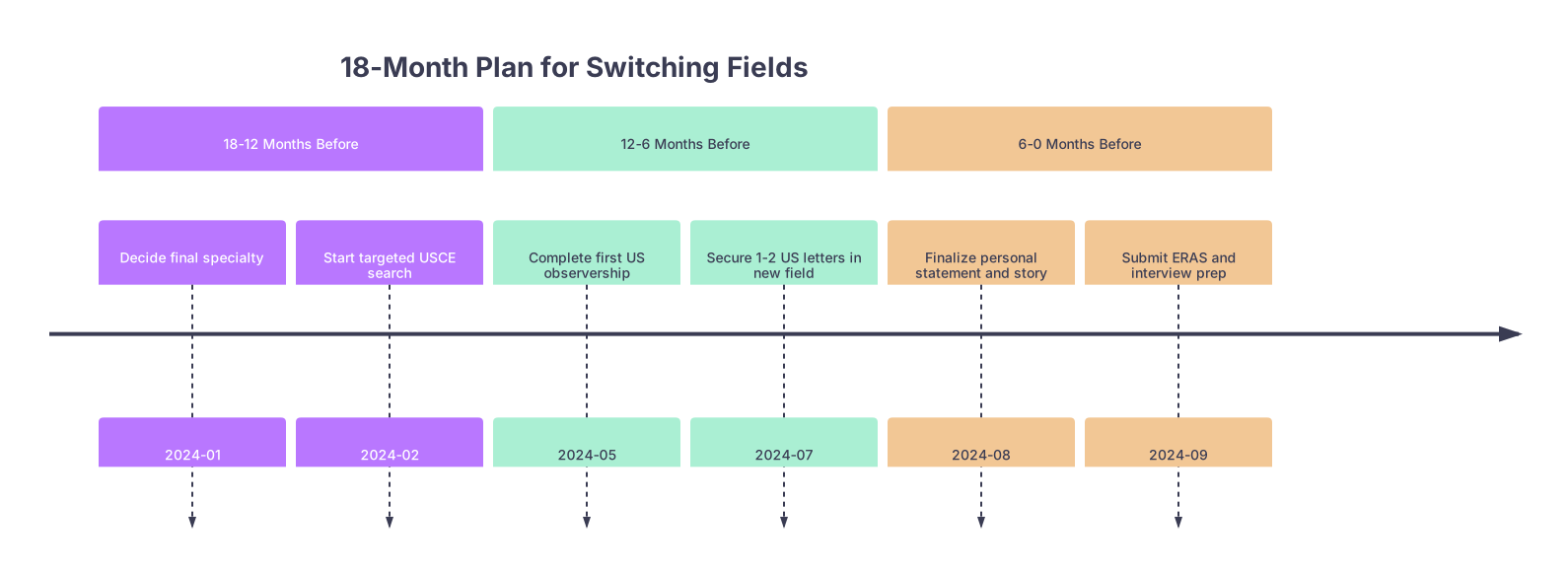
| Period | Event |
|---|---|
| 18-12 Months Before - Decide final specialty | 2024-01 |
| 18-12 Months Before - Start targeted USCE search | 2024-02 |
| 12-6 Months Before - Complete first US observership | 2024-05 |
| 12-6 Months Before - Secure 1-2 US letters in new field | 2024-07 |
| 6-0 Months Before - Finalize personal statement and story | 2024-08 |
| 6-0 Months Before - Submit ERAS and interview prep | 2024-09 |
6. Interview day: how to answer the hard questions without tripping yourself
You will get asked variations of:
- “Why did you leave your previous specialty?”
- “Are you sure you won’t go back to surgery/OB/etc.?”
- “How will you handle being supervised by younger residents?”
If you stumble here, all the written work collapses.
A. “Why did you leave X and choose Y?”
You want an answer that is:
- Brief
- Specific
- Positive (toward both fields)
- Final
Template that works:
“I chose [old specialty] because I was drawn to [X]. Over time I realized that what I enjoyed most was [overlap that leads to new field]. I started seeking more experiences in [new field] and found that the focus on [specific aspect] is a much better fit for how I want to practice long term. So for me this isn’t leaving something behind; it’s aligning my career with where I’m best suited. That’s why I’m fully committed to [new field] here.”
What you never say: “I couldn’t get into that field here,” even if it’s true. That goes in the “things we think, not things we say” box.
B. “How will you handle being an intern after being an attending?”
Don’t be defensive. Don’t joke about “I’ll teach them everything.” Red flag.
Try something like:
“I’ve already experienced being a junior doctor once, and I know how important each level of training is. In the US, the systems, documentation, team structure, and even the disease patterns are different. I don’t see this as a demotion; I see it as learning a new system correctly. I’m comfortable taking direction from younger colleagues and focusing on doing my role well.”
If you have a story where you were happily supervised by someone younger, use it.
C. “Do you plan to subspecialize?”
This is delicate. You can have ambitions without sounding like you’re just using residency as a visa or a stepping stone.
Good:
“I’m open to fellowship if, during residency, I find a subspecialty I truly connect with. Right now my priority is becoming an excellent general [internist/psychiatrist/FP] in the US system. If fellowship comes later, that will be built on a strong core.”
Bad:
“Yes, I definitely want GI/cardiology/fetal medicine/etc.”
Why? Because for a community IM program drowning in service needs, you just branded yourself as someone who will vanish to a hyper-competitive subspecialty at first chance.

7. Strategy by specific combinations (examples)
Let’s get concrete. Different pairings require different framing.
Example 1: General Surgery (home) → Internal Medicine (US)
Core message: “I loved the acuity, but I care more about the comprehensive medical care than the operation itself.”
What to highlight:
- Pre‑ and post‑operative medicine, ICU work, sepsis management
- Running lists, working in teams, night calls, cross‑cover
- Comfort with procedures that are relevant to IM (lines, chest tubes, etc.)
What not to do:
- Talk only about OR time and technical prowess. They’re not hiring you to operate.
- Sound like you’re burned out from call and think IM is easier. Program directors know better.
Example 2: OB/GYN (home) → Psychiatry (US)
Core message: “The mental health of my patients became the center of what I cared about.”
What to highlight:
- Perinatal mood disorders, trauma, domestic violence, anxiety in pregnancy
- Managing cultural and family dynamics, counseling, long conversations
- Any rotations or courses touching psych, even if small
What not to do:
- Overplay the procedural aspects from OB (C‑sections, surgeries). Irrelevant.
- Sound like you picked psych because “lifestyle is better.”
Example 3: Pediatrics (home) → Family Medicine (US)
Core message: “I want lifelong, whole‑family care, not just children.”
What to highlight:
- Comfort with chronic disease in kids—translate that to families
- Preventive care, vaccination, growth/development counseling
- Any experience seeing adult patients (even informally, clinics, rural work)
What not to do:
- Make it sound like you “settled” for FM because peds positions were fewer.
- Ignore the adult and geriatric care part of FM—programs will doubt fit.
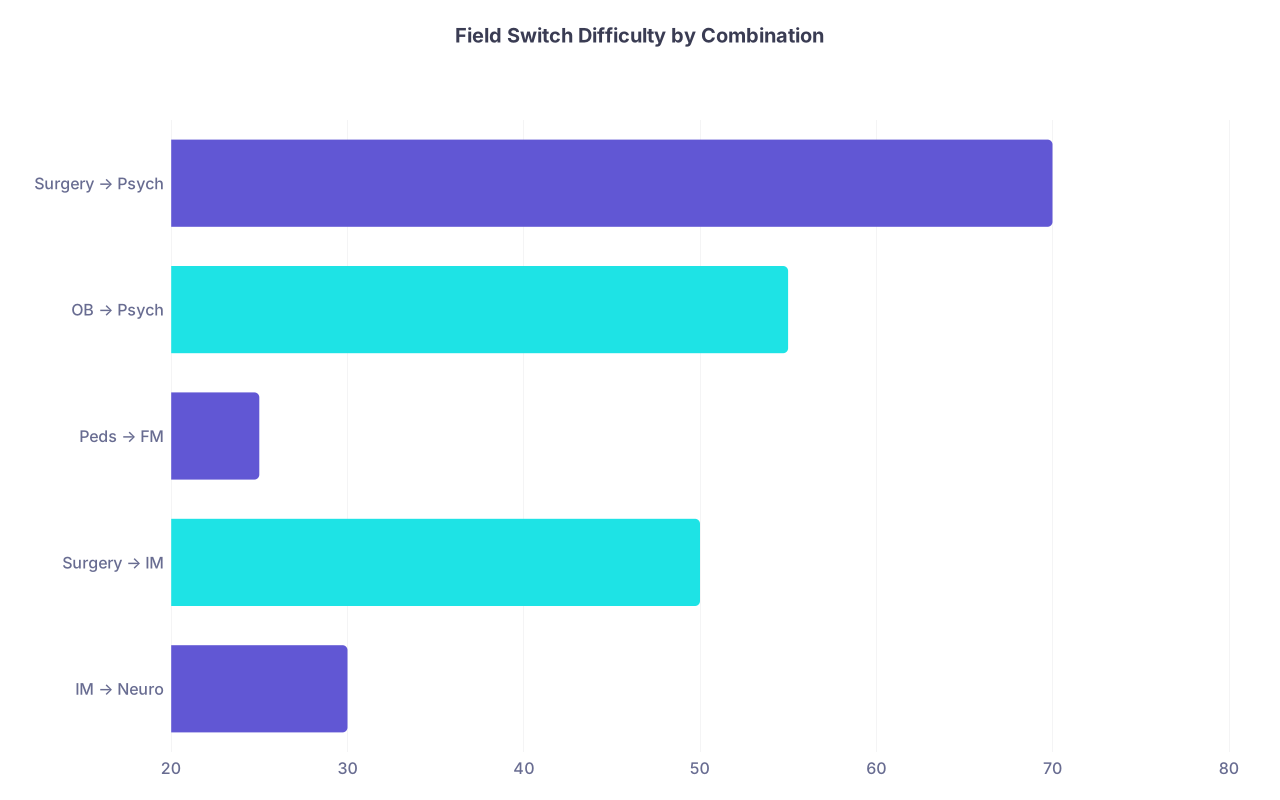
| Category | Value |
|---|---|
| IM → Neuro | 30 |
| Surgery → IM | 50 |
| Peds → FM | 25 |
| OB → Psych | 55 |
| Surgery → Psych | 70 |
(Lower value = easier to explain to programs; higher = harder sell.)
8. Red flags you must avoid (these kill applications)
I’ve seen these sink otherwise strong candidates:
Mixed messaging between documents
Personal statement says you love psychiatry because of patient stories, but your CV is 90% interventional cardiology research, and your LOR says, “He is an excellent future interventional cardiologist.” That’s fatal. Align everything.Bitterness about your home-country field or system
“I hated the hierarchy.” “Surgery culture is toxic.” Even if it’s true in your experience, saying it in an interview brands you as negative, not self-aware.Over‑insistence on your prior rank/status
“Back home I was the head of unit…” repeated five times. You’re telling them you may have an ego problem. Let them discover your status; don’t keep announcing it.Failure to answer the “why this field” question clearly
Vague: “I like medicine in general and want to help people.” At your level? That sounds like a premed answer. You need specific reasons tied to the field’s actual work.Appearing desperate or scattered
Applying IM, psych, FM, and neuro in the same cycle with four different personal statements floating around, and you accidentally talk about the wrong one on interview day. They will smell that chaos.
Pick a lane per cycle.

9. If you already applied and did it “wrong” this year
If you’re reading this mid-cycle and realizing: “I already messed up my narrative,” don’t panic. You can still salvage pieces.
Here’s what you can do now:
For upcoming interviews:
Clean up your verbal story, even if your personal statement isn’t perfect. People will believe what you say face-to-face more than the generic statement they skimmed.For next cycle (if you don’t match):
- Add targeted USCE in your new field.
- Rewrite your personal statement with one clear narrative.
- Fix your LOR mix so at least 2 are from the new field.
- Decide if you’re going to reduce emphasis on your old specialty in future versions of your CV.
Use this cycle as data, not as a verdict on your potential.

| Step | Description |
|---|---|
| Step 1 | Unmatched |
| Step 2 | Analyze feedback & interview patterns |
| Step 3 | Clarify final specialty choice |
| Step 4 | Secure targeted USCE in new field |
| Step 5 | Obtain new LORs aligned with story |
| Step 6 | Rewrite PS & adjust CV emphasis |
| Step 7 | Reapply with consistent narrative |
10. Final reality check: should you switch fields at all?
One uncomfortable question you need to face:
Is switching fields genuinely right for you, or are you:
- Chasing perceived “easier” competitiveness?
- Reacting to not matching in your original specialty?
- Letting visa pressure push you into any spot?
Sometimes the honest answer is: yes, you’re switching partly for pragmatic reasons. That’s okay. People change paths because of family, money, geography, politics. You just can’t present it that crudely to programs.
But you do owe yourself a gut-check:
- Can you picture yourself happily doing this field for 20–30 years?
- Will you respect the work enough that you won’t always think, “I should’ve been a surgeon”?
- Are you truly ready to re-enter a rigid hierarchy and be teachable?
If the answer is yes, then your “different-field” history can become a strength: you bring maturity, perspective, resilience.
If the answer is no, you may be better off delaying, strengthening your original-field application, or exploring alternative career paths (non-clinical, research, etc.) than forcing a mismatch you’ll regret.
Key takeaways
- Programs see prior training in a different field as a risk unless you proactively turn it into a coherent, credible story that explains why the new specialty is your final, deliberate choice.
- Everything must align—personal statement, CV, US clinical experience, and letters—all pointing toward the new field, not clinging to the old one.
- In interviews, own your history without ego, show you’re ready to start over, and make it obvious you’re running toward this new specialty, not just escaping the old one or using residency as a visa or placeholder.