The most common mistake IMGs make with observerships and externships is getting the timing wrong, not the program wrong.
You can have the perfect US hospital, glowing letters, strong cases – and still sabotage yourself by doing them at the wrong point in the Match cycle.
Let me walk you through the ideal timing, step by step, month by month, so you are not that person emailing programs in October saying, “My letter will be ready in November, is that okay?” (It is not.)
Big Picture: How Observerships and Externships Fit Into the Match Year
At this point, you need a clear mental model of the calendar.
For a typical Match year (for entry July 2026, for example), your ERAS cycle looks like this:
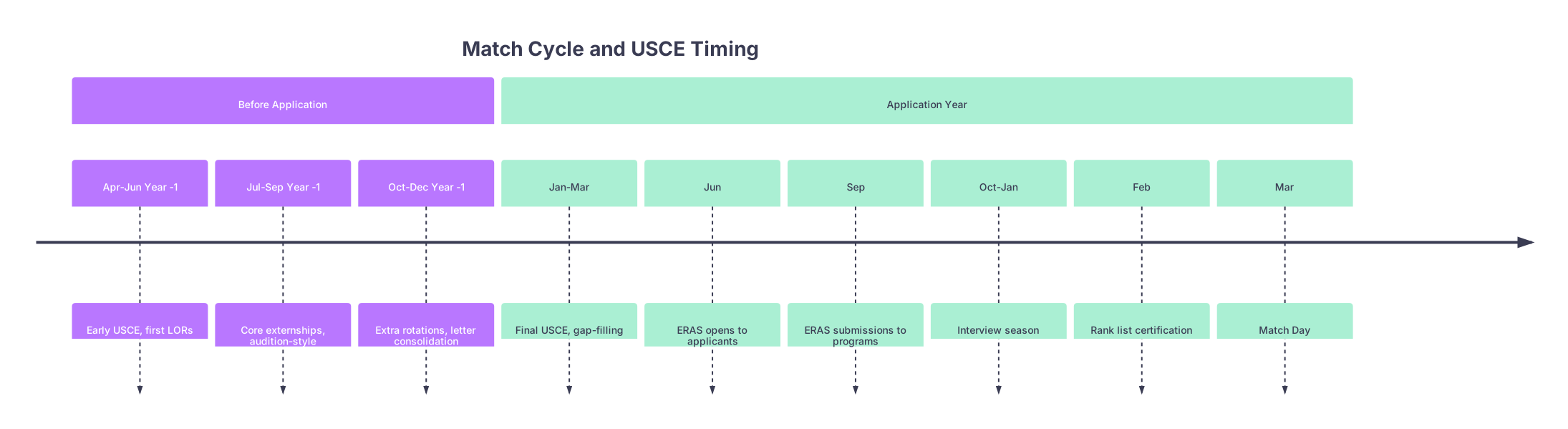
| Period | Event |
|---|---|
| Before Application - Apr-Jun Year -1 | Early USCE, first LORs |
| Before Application - Jul-Sep Year -1 | Core externships, audition-style |
| Before Application - Oct-Dec Year -1 | Extra rotations, letter consolidation |
| Application Year - Jan-Mar | Final USCE, gap-filling |
| Application Year - Jun | ERAS opens to applicants |
| Application Year - Sep | ERAS submissions to programs |
| Application Year - Oct-Jan | Interview season |
| Application Year - Feb | Rank list certification |
| Application Year - Mar | Match Day |
Rough rules you cannot ignore:
- ERAS opens to applicants: mid-June
- Programs can see your application: around September 15
- Interviews: roughly October to January
- Match Day: mid-March
Your observerships and externships (US clinical experience / USCE) must be positioned so that:
- You have strong letters of recommendation ready by early September, and
- The rotations you advertise in your application are completed or at least in progress by the time programs review you.
Everything else is details.
Definitions: Observership vs Externship – Why Timing Is Different
At this point, you must be very clear on what you are planning:
- Observership – Shadowing only. No direct patient care. Often for graduates who cannot perform hands-on work due to licensing / insurance limits. Weaker for letters, but still useful if timed correctly.
- Externship – Hands-on clinical rotation, usually for IMGs still eligible as “students” or in structured IMG externship programs. Stronger for letters and “USCE” credibility.
Timing implications:
- Externships should be positioned as “audition” style – close enough to application season that attendings remember you, but early enough that letters are uploaded by September.
- Observerships can be more flexible but still need to produce letters before ERAS submission to be maximally useful.
12–18 Months Before Match: Early Planning Window
You are here if you are 1 to 1.5 years away from the Match you want.
Example: Planning to apply in September 2026 → You are now between March 2025 and March 2026.
At this point you should:
- Decide your target Match year.
- Clarify visa and graduation status. Are you still a student? Already an IMG graduate?
- Research the USCE requirements of target specialties and programs.
Many competitive programs in Internal Medicine, Family Medicine, and Pediatrics explicitly state:
- “At least 3 months of USCE preferred”
- “Hands-on experience required; observerships alone not sufficient”
- “US clinical experience must be within 2–3 years of application”
So if your only plan is a 2-week observership three years before applying, you already know you are underpowered.
Scheduling logic in this phase
Your goal 12–18 months out:
- Reserve prime externship months (April–September of the year before your application) at teaching hospitals or reputable community programs.
- Fill earlier months with:
- Remote observerships or tele-rotations (if reputable)
- Home-country clinical work that you can still reference

9–12 Months Before Application: Core USCE Block (Ideal for Externships)
Timeline: October – December of Year -1 (using Match Entry July 2026 example → Oct–Dec 2025)
At this point you should be:
- Confirming and locking in externship rotations for March–July of your application year.
- Applying aggressively to teaching hospitals, community programs, and structured IMG externship companies.
Why this window matters:
- Programs often fill externship slots 6–9 months in advance.
- If you wait until May to find a July rotation, you will end up in lower quality sites or overpaying for poorly structured experiences.
Ideal externship timeline relative to ERAS
| Period | Recommended Activity |
|---|---|
| Mar–Apr (app year) | 1st major externship, 1 LOR |
| May–Jun | 2nd major externship, 1 LOR |
| Jul–Aug | Backup / extra externship, LOR |
This timing ensures:
- 2–3 strong US letters are ready to be uploaded by early September.
- Your experiences are recent and relevant when programs read your application.
6–9 Months Before ERAS Submission: Prime Time for Externships
Timeline: March – May of your application year
Using the same example: You apply in September 2026 → This is March–May 2026.
At this point you should:
- Be physically in the US (if possible) doing hands-on externships.
- Target 4–12 weeks of solid, continuous USCE in your intended specialty.
- Start asking for letters in the final week of each rotation.
Why this period is ideal
- Attendings and residents remember you well.
- Your performance reflects your current clinical ability, not something from years ago.
- Letters can be written and uploaded to ERAS before programs look at your file in September.
I have seen this pattern repeatedly:
- IMG A: Did externships in March–May, had 3 fresh US letters by August → multiple interviews, especially community programs.
- IMG B: Did one externship in September, letter arrived in October → fewer interviews, several programs never saw that strong late letter.
The difference was not intelligence. It was calendar control.
3–6 Months Before ERAS Submission: Final Externships + Key Observerships
Timeline: June – August of application year
At this point you are very close to ERAS launch. Your strategy shifts slightly.
June (ERAS Opens to Applicants)
- ERAS opens for you to start filling out the application.
- Programs cannot see it yet, but you should already:
- Have at least 2 USCE experiences completed or in progress.
- Have requested letters from at least 2 US attendings.
June is not the time to start planning USCE. It is the time to be using the USCE you already completed.
July – August (Last-minute but still useful)
Externship during this window:
- Pros:
- Can give you an extra letter, especially if you had weaker earlier letters.
- Shows ongoing clinical engagement (“Currently in US clinical experience at X Hospital” looks good).
- Cons:
- Letter might be tight to arrive before mid-September.
- There’s risk: if the attending delays, that letter might not be part of the first impression.
Observership during this window:
- Good for:
- Filling specific specialty gaps (e.g., you have only IM letters, want one in Neurology for a dual application).
- Networking at programs you hope will interview you.
- Weaker for:
- “Audition” impact compared to a full externship.
ERAS Submission Timing
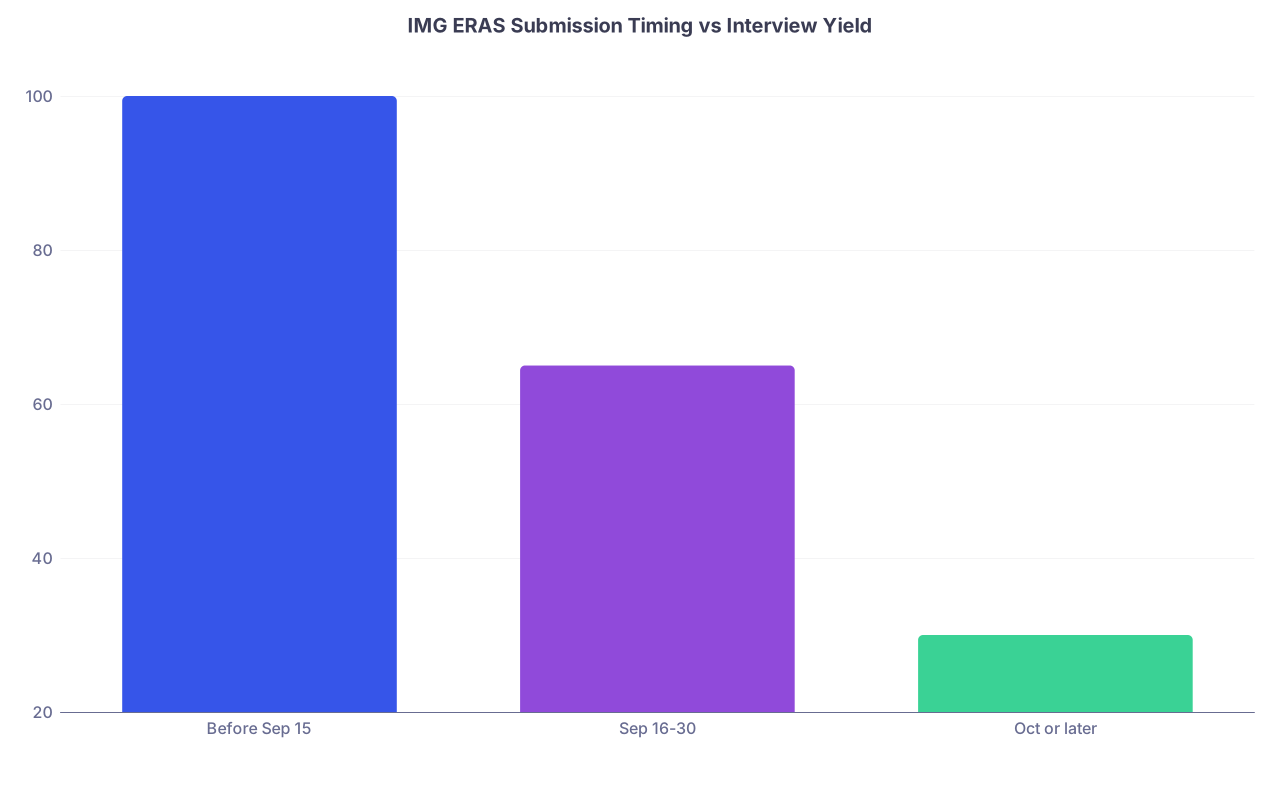
| Category | Value |
|---|---|
| Before Sep 15 | 100 |
| Sep 16-30 | 65 |
| Oct or later | 30 |
(Rough pattern I have seen with IMGs in community IM/FM programs – early, complete apps get the bulk of interview invites.)
Your goal:
- Submit a fully loaded application as close to opening as possible (around Sep 15).
- That means: letters from March–June rotations are already uploaded.
- July–August rotations are “bonus,” not the foundation.
0–3 Months Before ERAS: What If You Are Late?
Timeline: July – September of application year, and you are only just getting USCE.
This is damage control mode.
At this point you should:
- Still do the rotation if it is reasonably strong. Some letter > no letter.
- Push for a mid-rotation letter if you cannot finish before September 15. Tell the attending clearly you are up against ERAS deadlines.
- Submit ERAS on time anyway, even if one letter will come later.
Strategy:
- In your application, you can list “Current rotation: X Hospital, dates”, even if no letter yet.
- When the late letter arrives (October, November), programs that have already downloaded your app may or may not re-check, but some do before offering interviews.
This is not ideal. But if you are here, do not make it worse by delaying your whole application.
After ERAS Submission: Should You Still Do Observerships / Externships?
Short answer: yes, but with a different goal.
Timeline: September – February (interview season and ranking period)
At this point you should be:
- Using rotations for:
- Networking – making sure attendings know you are in the current Match.
- Interview talking points – “I am currently rotating at X, where I am seeing Y type of patients.”
- Backup planning – if you do not match, these become recent USCE for your next application.
Letters written during this period:
- Often too late to influence the current application significantly, unless:
- A program is about to rank you and specifically asks for an updated letter.
- You are applying to SOAP after an unmatched result.
I have seen unmatched IMGs rescued by strong January–February rotations that set them up for the next cycle. But that is long-game planning.
Special Situations: Late Graduates, Large Gaps, Visa Issues
If you graduated >3 years ago
Programs start worrying you are “stale.”
At this point you should:
- Front-load longer, continuous USCE blocks:
- 3–6 months of back-to-back externships or high-quality observerships.
- Make sure your most recent clinical work (US or home country) is within 6–12 months of application.
If you have a big clinical gap
You do not cover a 3-year non-clinical gap with a 2-week observership.
You need:
- Multiple months of consistent USCE starting at least 6–9 months before application, and
- To time them so your “last rotation end date” is close to ERAS submission.
If you are visa restricted
This often delays your ability to enter the US.
At this point you should:
- Consider remote observerships / tele-rotations early in the cycle for at least some exposure.
- Line up immediately-start externships the moment your visa is approved, even if that means using June–August aggressively.
Month-by-Month Sample Timeline (For a September Application)
Let us build a practical template.
Assume:
- You are an IMG graduate.
- You want to apply September 2026 to Internal Medicine.
- You need 3 strong USCE-based LORs.
January – March 2026 (9–6 months before submission)
At this point you should:
- Finalize all USCE bookings.
- If financially and logistically possible:
- Do 1 month of USCE already (externship or strong observership).
- Start drafting your personal statement and CV.
April 2026
- Externship 1 (Internal Medicine at teaching or community program).
- Perform like this is an audition. Because it is.
- End of month: request LOR #1.
May 2026
- Externship 2 (preferably same specialty, different site).
- Focus on different skills: procedures, team communication, notes.
- End of month: request LOR #2.
June 2026
- Either:
- Externship 3, or
- High-quality observership with strong teaching attendings.
- ERAS account opens:
- Enter all your experiences (these rotations included).
- Give attendings your ERAS letter request forms.
- End of month: request LOR #3.
July 2026
- Optional:
- Another short rotation only if you can still realistically request and receive a letter by early September.
- Refine personal statement using stories from your USCE.
August 2026
- No new rotations unless already arranged.
- Focus:
- Finalize ERAS entries.
- Confirm your letters have been uploaded.
- Email letter writers politely if they have not submitted.
September 2026
- Early September:
- Verify at least 3 US letters attached to ERAS.
- Lock final list of programs.
- Around September 15:
- Submit ERAS.
October – January
- If interviews are slow:
- Consider brief observerships at programs in regions where you applied.
- Let coordinators know in your updates: “I am currently doing an observership at X and remain very interested in your program.”

Common Timing Mistakes That Hurt IMGs
I will be blunt. I see these constantly.
- Doing all USCE after ERAS submission.
- Looks like you decided to get serious only after applying. Weak impression.
- 2-week observership in September as the “main” USCE.
- Too short. Too late. Not persuasive for most programs.
- Relying on home-country letters when USCE was possible.
- You will be outcompeted by IMGs who managed to secure strong US letters.
- Not asking for letters at the end of each rotation.
- Waiting 2–3 months to ask guarantees a weaker, more generic letter.
- Stacking all rotations in July–September.
- Leaves no buffer for delays. Letters arrive October–November when the interview calendar is already half full.
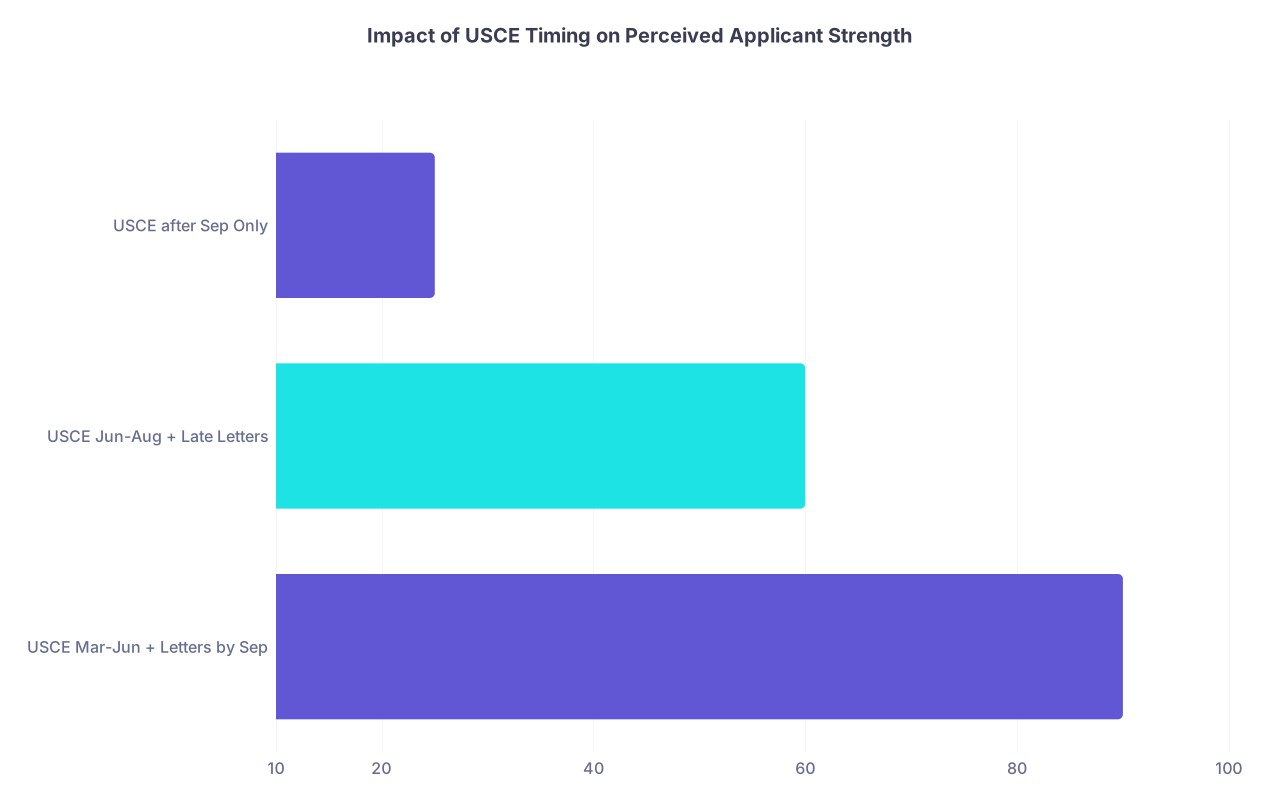
| Category | Value |
|---|---|
| USCE Mar-Jun + Letters by Sep | 90 |
| USCE Jun-Aug + Late Letters | 60 |
| USCE after Sep Only | 25 |
Quick Specialty Notes
Internal Medicine / Family Medicine / Pediatrics:
- Timing rules above fit well. 2–3 months USCE before September is realistic and effective.
Neurology / Psychiatry:
- Often more open to observerships, but hands-on externships timed in spring–early summer before application still give you a major edge.
Surgery and Surgical Subspecialties:
- USCE timing is even more critical. Aim for audition-style externships in late spring / early summer at programs where you actually plan to apply.
FAQ (Exactly 2 Questions)
1. Is it better to delay my ERAS application to wait for a strong letter from a late externship?
No. Submitting late is usually worse than missing one letter. Programs front-load their reviews and interview invites. Submit on time with the letters you have. Upload the late letter as soon as it is ready, but do not hold your whole application hostage for it.
2. If I can only afford 1 month in the US, when in the Match cycle should I schedule it?
Schedule it between March and June of your application year. That window maximizes your chances of getting a strong, timely letter and gives you fresh, recent USCE to showcase in your ERAS application and interviews. If March–June is impossible, prioritize May or June over chaotic July–August.