The biggest mistake IMGs make is starting their ERAS prep when ERAS opens. By then, you are already late.
If you are an IMG aiming for the Match, your real application year starts a full 9–12 months before ERAS opens. At each point on the calendar, there are specific moves that separate people who match from people who scramble around WhatsApp groups in March asking what went wrong.
Below is a practical, month‑by‑month guide for IMGs in the cycle leading up to ERAS opening (assume ERAS opens for editing in early June and submission in early September; adjust by a few days as NRMP changes dates).
Month -12: Big Picture & Non‑Negotiables
At this point you should stop “thinking about” applying and decide if you are actually going for the upcoming Match cycle.
Your priorities this month:
- Decide your target Match year
- Lay out USMLE status and gaps
- Rough‑cut your specialty choices
Week 1–2: Reality check and decision
List your current situation:
- Medical school year or graduation year
- USMLE status: Step 1 / Step 2 CK / OET / Step 3
- Previous attempts / failures
- Gaps since graduation
- Current visa / citizenship status
Decide: apply this year vs delay one year.
If you still need both Step 1 and Step 2 CK, have no U.S. experience, and you graduated >5 years ago, applying this cycle is usually a bad idea. I have seen that movie. It ends with 100+ applications and zero interviews.
Week 3–4: Choose realistic specialty paths
At this point you should narrow—not finalize, but narrow.
Typical IMG‑friendly options:
- Internal Medicine
- Family Medicine
- Pediatrics
- Psychiatry
- Neurology
- Pathology
More competitive or IMG‑hostile without exceptional stats:
- Dermatology
- Plastic surgery
- Ortho
- Ophthalmology
- ENT
- Radiation oncology
| Specialty | IMG Friendliness | Typical Step 2 CK Goal |
|---|---|---|
| Internal Med | High | 230–240+ |
| Family Med | High | 220–230+ |
| Pediatrics | Moderate | 225–235+ |
| Psychiatry | Moderate | 225–235+ |
| Neurology | Moderate | 230–240+ |
Pick:
- 1 main specialty
- 1 backup (if needed) that you are actually willing to train in
Months -11 to -9: USMLE & Credential Foundations
At this point you should lock in exam dates and clear logistical landmines.
Month -11: USMLE timeline and ECFMG plan
Book any remaining exams:
- Step 2 CK date (non‑negotiable to have score by late August)
- OET Medicine (if required for ECFMG certification)
- Step 3 (optional but helpful for some specialties/visas)
Map backward:
- You need your Step 2 CK score reported by early–mid September.
That usually means test no later than late July / very early August, depending on NBME reporting windows.
- You need your Step 2 CK score reported by early–mid September.
Start ECFMG account clean‑up:
- Make sure your name exactly matches your passport.
- Confirm your medical school is in the World Directory with ECFMG eligibility.
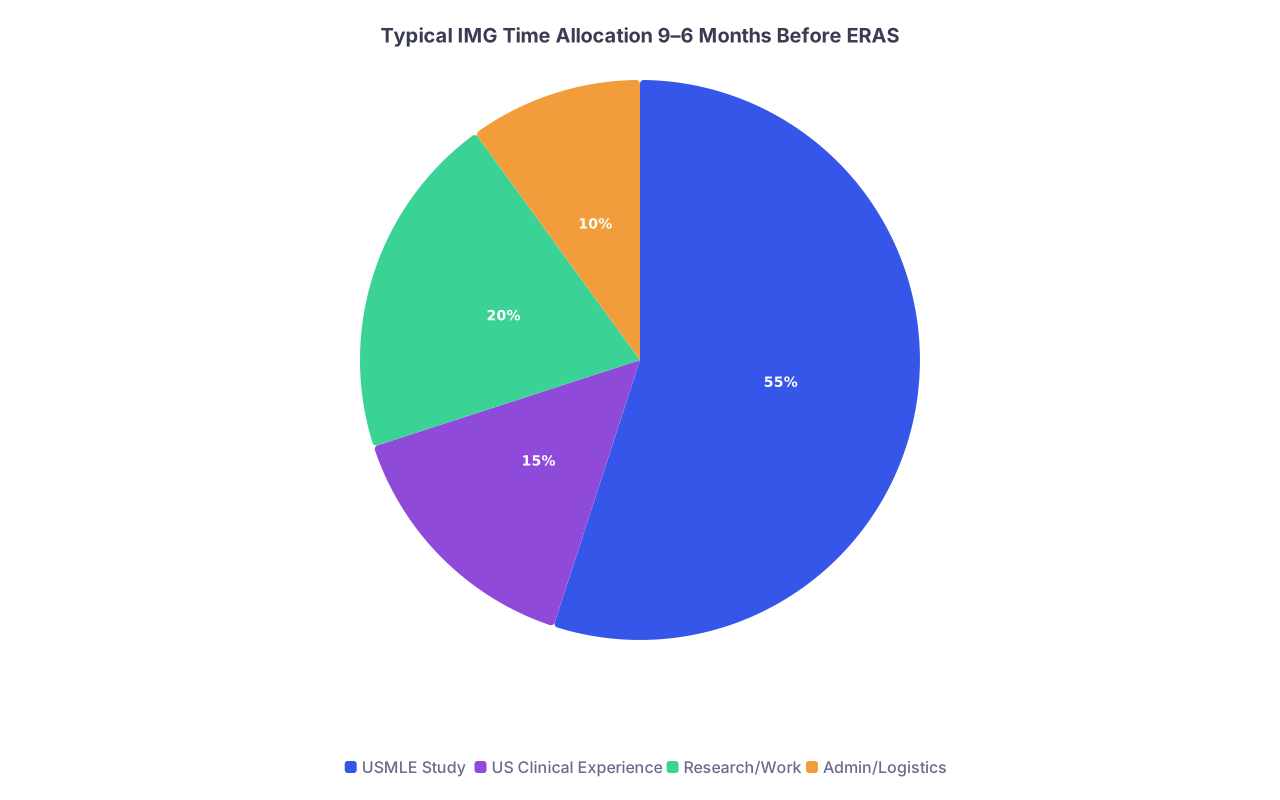
| Category | Value |
|---|---|
| USMLE Study | 55 |
| US Clinical Experience | 15 |
| Research/Work | 20 |
| Admin/Logistics | 10 |
Month -10: Step 2 CK focus and transcript planning
If you still do not have Step 2 CK:
This month should be:
- 5–6 days/week of dedicated study
- UWorld blocks every day
- At least one NBME / UWSA to set baseline
Contact your medical school:
- Confirm how they send transcripts to ECFMG.
- Ask how long it typically takes (some schools take 6–8 weeks to stamp and mail anything).
Month -9: Clinical experience scouting
At this point you should start locking in U.S. clinical experience (USCE) for the months closer to ERAS.
- Start applying for:
- Observerships at academic centers that list IMG programs
- Hands‑on externships (if you are a recent grad and visa status allows)
- Community hospital rotations with IM/FM residency programs
You want at least 2–3 months of U.S. experience total, with:
- At least 2 letters from U.S. physicians
- Preferably in your chosen specialty
Months -8 to -6: USCE, LOR Strategy, and Exam Finish Line
Now the calendar starts to squeeze. Each month matters.
Month -8: Lock exam date and rotation slots
At this point you should:
Finalize your Step 2 CK date.
- Do not keep “pushing back” unless your NBMEs are a disaster.
- Program directors prefer a solid score on time over a perfect score that arrives in October.
Confirm at least:
- 1 rotation between Month -5 and -3
- 1 rotation around Month -3 to -1 (close enough that the attending remembers you when writing a letter)
Start a letter strategy list:
- Target 4 LORs total:
- 2 from U.S. physicians in your chosen specialty
- 1 from another U.S. physician (or strong home institution letter if no more USCE)
- 1 backup (home faculty or research PI)
- Target 4 LORs total:
Month -7: Draft early CV and personal statement skeleton
You are not writing the final personal statement yet. But you should not start from zero in August.
This month:
Build a master CV document with:
- Education and dates
- Exam scores and dates
- Research: titles, journals, roles
- Presentations, conferences
- Leadership, teaching, volunteer
- Employment (clinical/non‑clinical) after graduation
Draft a personal statement outline:
- Why this specialty
- 2–3 concrete clinical stories
- Your strengths and weaknesses
- Long‑term career goals (and yes, they need to sound believable)
Do not panic about style yet. Structure first.
Month -6: Finish Step 2 CK / Begin USCE
By now:
- Step 2 CK should be either:
- Done, or
- In the final 4–6 weeks of prep with strong practice scores
If finished:
- Shift focus to:
- USCE performance
- Building relationships for letters
- Cleaning up your application materials
If you are starting a rotation:
At this point you should:
- Arrive early. Every day. No excuse.
- Volunteer for notes, follow‑up calls, family updates.
- Ask for feedback mid‑rotation: “What can I improve so you would feel comfortable writing me a strong letter for residency?”
Months -5 to -3: LORs, Personal Statement, Target List
This is where well‑prepared IMGs break away from the rest.
Month -5: First LORs and targeted specialty prep
If you are in a rotation now:
In the final week, formally request a letter:
- Ask in person if possible.
- Provide:
- Draft CV
- Personal statement outline
- Brief bullet list of your cases and contributions
Confirm:
- That they are willing to write a strong letter.
- Whether they know how to upload to ERAS (if not, explain ECFMG’s instructions later).
On the academic side:
- Refine your specialty choice with data:
- Look at FREIDA for:
- Programs that sponsor visas
- Programs with high IMG percentages
- Identify:
- “Reach” programs
- “Target” programs
- “Safety” programs
- Look at FREIDA for:
Month -4: Build program list draft
At this point you should have a working spreadsheet of programs.
Columns to include:
- Program name
- City / state
- Specialty
- Visa status (J‑1, H‑1B, none)
- IMG friendliness (% IMGs or “IMGs welcome” from websites)
- Step score requirements (if listed)
- Past experiences:
- Alumni from your school?
- Known to your mentors?
| Program | Visa | IMG Friendly | Notes |
|---|---|---|---|
| Univ Hospital IM | J‑1 | Yes | Alumni present |
| City Med Center FM | J‑1/H‑1B | High | Community program |
| Regional Peds | J‑1 | Moderate | Prefers recent grads |
Aim for:
- IM: 120–180 programs if average IMG profile
- FM: 60–120 programs
- More competitive fields: slimmer but still broad list
Month -3: Personal statement draft and ERAS profile planning
Now we get closer to ERAS editing opening.
This month:
Write the first full draft of your personal statement:
- 1 page, not more than ~750–800 words
- One central theme (e.g., continuity of care in FM, diagnostic reasoning in IM)
- Specific cases, not vague “I like helping people”
Start ERAS section mapping:
- Clinical experience entries
- Research experiences
- Volunteer work
- Teaching
- Awards
Decide which 8–10 experiences will be your “most meaningful” and which 3 will be highlighted (for specialties that still emphasize this structure).
Months -2 to 0: ERAS Opens, Final Polish, and Submission
Here I will assume:
- Month 0A = Early June (ERAS opens for editing)
- Month 0B = Early September (ERAS first submission day)
We will walk from Month -2 through submission.
Month -2: Letters, documents, and narrative polish
At this point you should:
Have requested all 4 LORs:
- Check in politely with any writer who has not acknowledged.
- Offer to send instructions and deadlines.
Tighten your personal statement:
- Cut clichés.
- Check that each paragraph has a reason to exist.
- Remove every sentence that could apply to any other IMG.
Finalize your experience descriptions offline:
- Strong action verbs.
- Clear outcomes.
- Avoid fluff like “I learned a lot.”
If you are still in USCE this month, this is your last chance for a strong, recent letter.
Month -1: Pre‑ERAS readiness and verification
You are one month from ERAS opening for editing.
Checklist now:
ECFMG:
- Degree verification in progress or completed
- All exam results released (Step 1, Step 2 CK, OET)
- Certificates or expected timeline known
Documents:
- Updated CV
- Final personal statement v3/v4
- List of programs in your spreadsheet, grouped by tier
LOR status:
- At least 2 U.S. specialty‑specific letters confirmed
- Third letter (home or research) identified and requested
- Optional 4th letter as backup

This is also a good time to:
- Clean up your online presence:
- LinkedIn picture professional
- Remove questionable social media content
- Create simple, neutral email address just for applications
Month 0A: ERAS Editing Opens (Early June)
At this point you should treat ERAS like a full‑time project for at least 1–2 weeks.
Week 1: Build the skeleton
- Register for ERAS and log in through ECFMG.
- Fill in:
- Personal Information
- Medical Education
- USMLE scores (they will import once released)
- Experiences (use your offline drafts)
- Publications and presentations (with consistent citation style)
Do not rush. Typo in your name or wrong dates on your degree will haunt you.
Week 2: Upload documents
Upload:
- Personal statement(s)
- Specialty‑specific versions if you are applying to more than one field
- Photo
- Professional headshot, neutral background, formal attire
- Assign LORs to each specialty (as they become available)
- Personal statement(s)
Double‑check:
- Every experience has:
- Clear title
- Institution
- Supervisor name
- Start/end dates that make sense (no gaps you cannot explain)
- Every experience has:
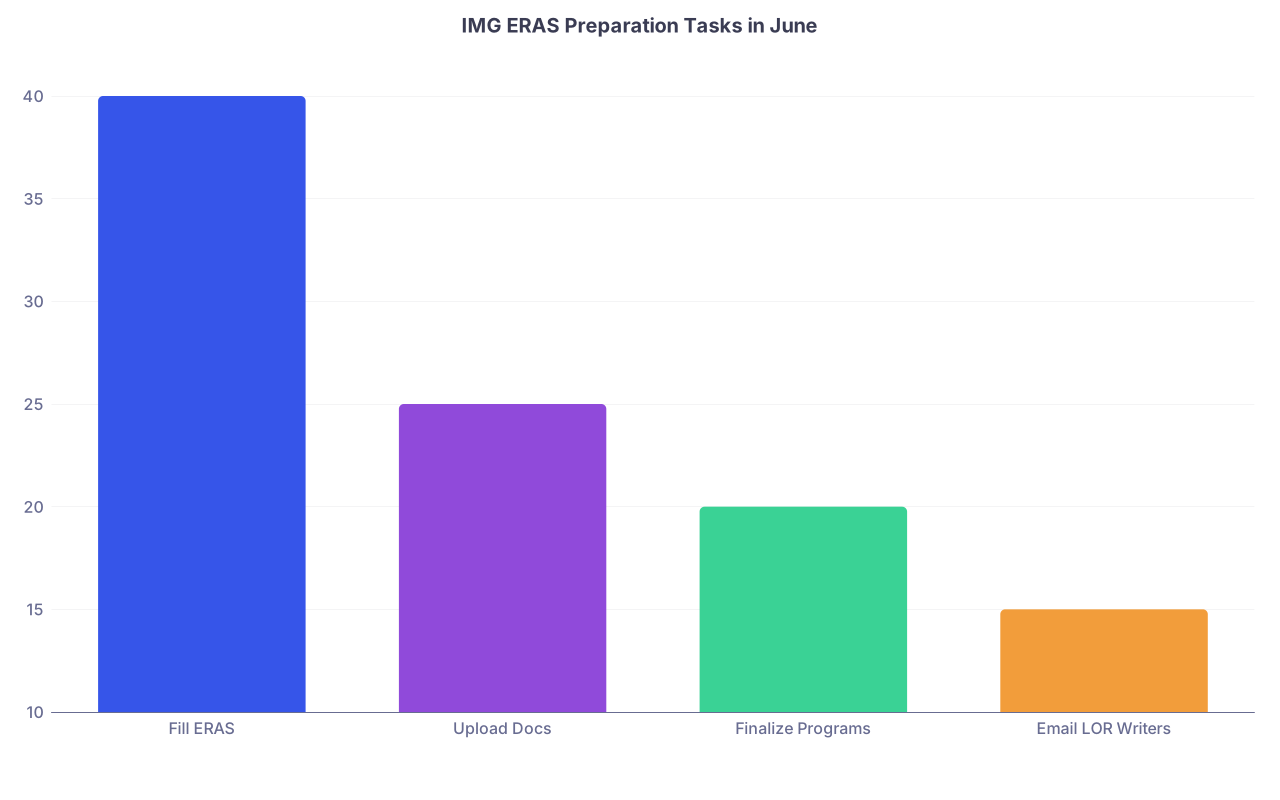
| Category | Value |
|---|---|
| Fill ERAS | 40 |
| Upload Docs | 25 |
| Finalize Programs | 20 |
| Email LOR Writers | 15 |
Week 3–4: Program list finalization
You have a draft list. Now refine it:
Remove:
- Programs that explicitly say “no IMGs” or “must be U.S. grad”
- Programs with strict year‑of‑graduation cutoffs you do not meet
- Programs that do not sponsor your needed visa
Add:
- Programs with high IMG presence that you initially missed
- Community programs in less popular locations (these often interview more IMGs)
Sort your spreadsheet into:
- Tier 1: Dream / reach
- Tier 2: Solid realistic
- Tier 3: Safety / IMG‑heavy
Month 0B‑1: Final Month Before ERAS Submission (August)
The clock is loud now. At this point you should be in polish and confirmation mode, not building from scratch.
Week 1–2: LOR and application audit
Check LOR upload status in ERAS:
- If a letter is missing, politely remind the writer with:
- The ERAS deadline you are targeting (early September)
- The link or instructions again
- If a letter is missing, politely remind the writer with:
Read every section of your ERAS:
- Look for:
- Inconsistent dates
- Repeated phrasing
- Vague descriptions (“various tasks,” “etc.”)
- Look for:
Run your personal statement by:
- One trusted U.S. clinician or academic
- Not 10 random friends on Telegram; too many cooks will ruin it
Week 3: Program selection lock‑in
By now, your program list should be essentially final.
Assign:
- Correct personal statement to each specialty
- Correct set of LORs to each specialty (e.g., 3 IM letters for IM, mix appropriately for FM if applying there too)
Check:
- You are not accidentally applying to the wrong track (e.g., Preliminary vs Categorical) unless that is deliberate.
- You are not wasting money on programs that clearly will not rank you.
If you are very late with Step 2 CK and your score will come after September:
- Decide whether to:
- Delay application a year (often smarter if your profile is already weak)
- Apply to a very targeted list of IMG‑friendly programs who will consider you with pending scores (rare but possible)
ERAS Opens for Submission (Early September): Execution Day
On the first day ERAS accepts submissions, strong IMGs submit. You should be one of them.
Submission day checklist
At this point you should:
Confirm:
- All exam scores present (unless you have a deliberate pending strategy)
- At least 3 LORs uploaded and assigned to each program you will submit to
- Program list final and cross‑checked
Submit applications:
- Ideally on day 1 or within the first 3–5 days
- Earlier submission will not guarantee interviews, but later submission absolutely hurts you as an IMG
Save:
- PDF copy of your entire application
- Final program list with dates submitted

After Submission (Weeks +1 to +4): Early Interview Positioning
You did not ask about this window, but ignoring it would be malpractice.
At this point you should:
Set up:
- Professional voicemail with your name
- Email notification on your phone that actually works
Prepare:
- 2–3 versions of a concise “Tell me about yourself”
- Clear explanation for any gaps or failures
Consider:
- Targeted, short, professional emails to programs where:
- You have a strong connection (alumni, mentor contact)
- You rotated there
- Not spammy generic “I am very interested” emails to 150 programs. Programs see those and ignore them.
- Targeted, short, professional emails to programs where:
Key Takeaways
- A successful IMG ERAS application is built 9–12 months before the portal opens, not in August.
- At each month, you should have specific, concrete goals: exams booked, USCE scheduled, letters requested, program lists refined.
- Early, accurate, and realistic planning beats last‑minute “hustle” every time—submit on the first ERAS day with a complete, coherent, and IMG‑savvy application.