
It is late March. You are an IMG in your clinical year, or maybe doing an observership in the U.S. You keep hearing the same line from program coordinators and older residents: “For IMGs, we want to see Step 2 CK before we rank.” Your Step 1 is in the books. The Match feels both close and far. And you are stuck on the real question:
Exactly when should you take Step 2 CK so it actually helps you match, not hurt you?
Let me walk you through this in the only way that makes sense: chronologically. Month-by-month, then tighter as the exam gets close.
Big Picture: What Programs Actually See, and When
Before timing, you need the frame.
For the typical ERAS cycle:
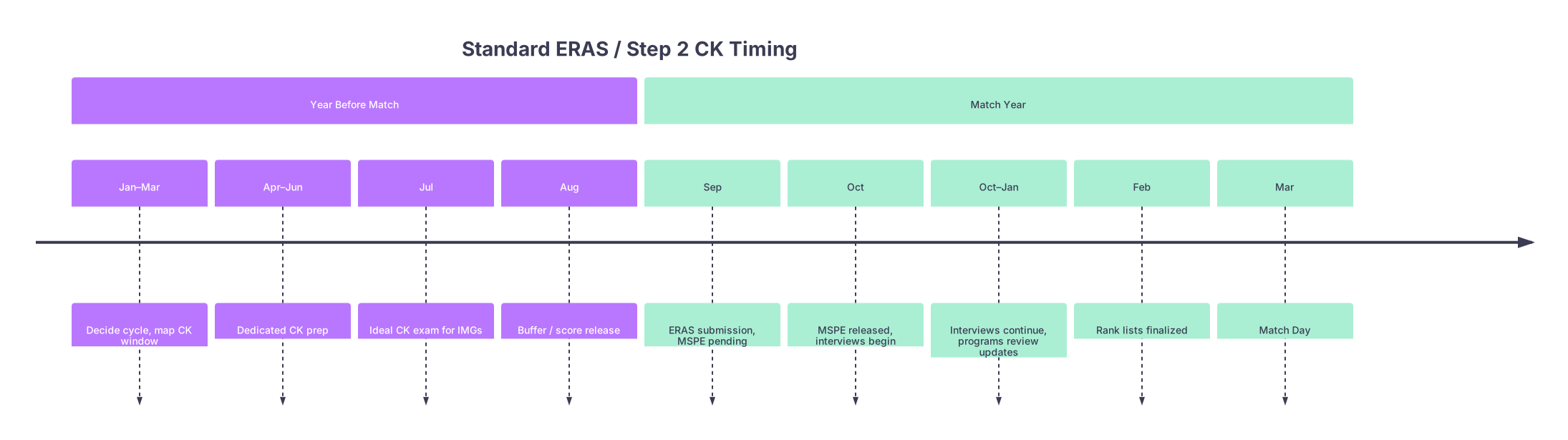
| Period | Event |
|---|---|
| Year Before Match - Jan–Mar | Decide cycle, map CK window |
| Year Before Match - Apr–Jun | Dedicated CK prep |
| Year Before Match - Jul | Ideal CK exam for IMGs |
| Year Before Match - Aug | Buffer / score release |
| Match Year - Sep | ERAS submission, MSPE pending |
| Match Year - Oct | MSPE released, interviews begin |
| Match Year - Oct–Jan | Interviews continue, programs review updates |
| Match Year - Feb | Rank lists finalized |
| Match Year - Mar | Match Day |
Key program-side facts:
- ERAS opens for submission: early September
- Programs start downloading apps: mid-September
- MSPE released: October 1
- Most interview invites: October–December
- Rank lists certified: February
USMLE score reporting:
- Step 2 CK score usually posts 2–4 weeks after your test date.
- Occasionally it spills to 5–6 weeks if you are unlucky or hit a reporting delay week.
So for maximum impact, Step 2 CK needs to be:
- Visible by the time programs seriously screen and invite (Oct–Dec)
and - Early enough that if something goes wrong, you have a small repair window.
For most IMGs, there is one ideal window:
Take Step 2 CK between mid-June and late July of the application year
(so the score is back before or right as programs start heavy screening).
Now let us break it down by scenario and timeline.
Year-By-Year Planning: Which Match Cycle Are You Targeting?
At this point you should decide: Which Match year is yours?
If you are 18–24 months before your planned Match
You are early. Good. You have options.
You should:
Aim to take Step 1 → Step 2 CK within 6–12 months of each other.
Too long a gap and your test-taking muscles atrophy. I have seen this derail people.Map out your intended Match year and work backward:
- Example: You want to Match in March 2027
- ERAS submitted: Sept 2026
- Ideal CK date: Jun–Jul 2026
- Earliest reasonable CK date: Mar–Apr 2026 if you are truly ready
- Example: You want to Match in March 2027
Your priority right now: finish Step 1 if you have not, then block off a 3–4 month CK study window that ends no later than July of your application year.
Month-by-Month: The 12 Months Before Your ERAS Submission
Assume your ERAS submission is September of Year X. Here is how the 12 months prior should look if you want CK to help you, not haunt you.

October–December (Year X-1): 9–11 months before ERAS
At this point you should:
- Confirm:
- Your target Match year
- Whether your visa situation pushes you to be stronger (it usually does for IMGs)
- Take stock of:
- Step 1 status (strong, average, or weak)
- Clinical workload, internship, rotations
- Obligations in your home country (exams, service, contracts)
Decision you must make now:
- Are you going to be ready for CK by June–July of Year X?
If not, you either:- Push CK earlier (risky if underprepared)
- Or accept that your CK may not be in your file when programs first screen you.
If your Step 1 is marginal (e.g., low pass or just above cutoff), you cannot afford to delay CK into late fall. Programs will assume the worst.
January–March (Year X): 6–8 months before ERAS
At this point you should:
Lock in your dedicated CK prep start date.
For IMGs, most solid performances come from:- 8–12 weeks of serious focus if you already have strong clinical base
- 12–16 weeks if you are rebuilding after a mediocre Step 1
Sketch a first-pass calendar:
- CK exam target: Between June 15 and July 31
- Score release: 2–4 weeks later → July–August
- ERAS submission: mid-September
| CK Test Date | Score Back (Approx) | ERAS Impact |
|---|---|---|
| Early May | Late May–Early Jun | Safely in file before screening |
| Late June | Mid–Late July | Ideal: fresh score during early review |
| Late July | Mid–Late Aug | Still in time for initial invites |
| Late Aug | Mid–Late Sep | Some programs will decide before seeing it |
| Late Sep | Mid–Oct | Mostly affects late invites / waitlist movement |
April–June (Year X): 3–5 months before ERAS
This is where IMGs either do this right… or ruin it.
At this point you should:
- Be deep in Qbanks (UWorld, AMBOSS) with a clear sense of your trajectory
- Start NBME practice exams and treat them seriously
Your timing decision hinges on practice exam behavior:
- If NBME or UWSA scores are comfortably above your target (e.g., 245+ when you want ≥240) by early June:
- Book your exam for late June or early July.
- If practice scores are:
- 220–230 and you are aiming to show a big improvement over a weak Step 1
- Or 230–235 and you have a strong Step 1 but fear dropping
- Then either:
- Push the exam slightly later in July and tighten study
- Or accept that you may be better off pushing your application cycle.
Yes, I am saying the quiet part out loud:
It is better to skip a cycle than to apply with a fresh, weak Step 2 CK as an IMG.
Programs will not ignore it. They rarely “wait to see improvement” for Step 3. They just do not interview you.
The Ideal Window: Why June–July Works Best for IMGs
Let me spell out why this is the sweet spot, with no fluff.
At this point you should understand:
Visibility during initial screening
Programs filter IMGs hard. Many have automatic filters such as:
- “No IMGs without both Steps completed”
- “Step 2 CK ≥ 230” for IMGs
- “Stronger of Step 1 / Step 2 CK ≥ X, but no score < 215”
If your CK is not in your file by mid-September, some programs will:
- Never see it.
- Not re-open your application later.
Freshness of knowledge and momentum
- You just came off clinical work or Step 1 prep.
- Retention of UWorld and NBMEs is at its peak.
- You still have a few months before the chaos of interviews, personal statements, and LOR chasing.
Damage control if something goes wrong
If you take CK in late June and:
- Get an unexpectedly low score in late July:
- You still have August to:
- Adjust your application list (more community / IMG-friendly programs)
- Line up more U.S. clinical experiences
- Strengthen other parts (letters, personal statement, research)
- You still have August to:
If you take CK in late September and bomb it:
- That bad score hits your ERAS file in October, while invites are going out.
- No time to pivot.
- Get an unexpectedly low score in late July:
What If You Are Late? August–October CK For IMGs
Let me be blunt. CK in September or later for the same-cycle Match is usually a bad idea for IMGs, unless you have a very specific strategy.
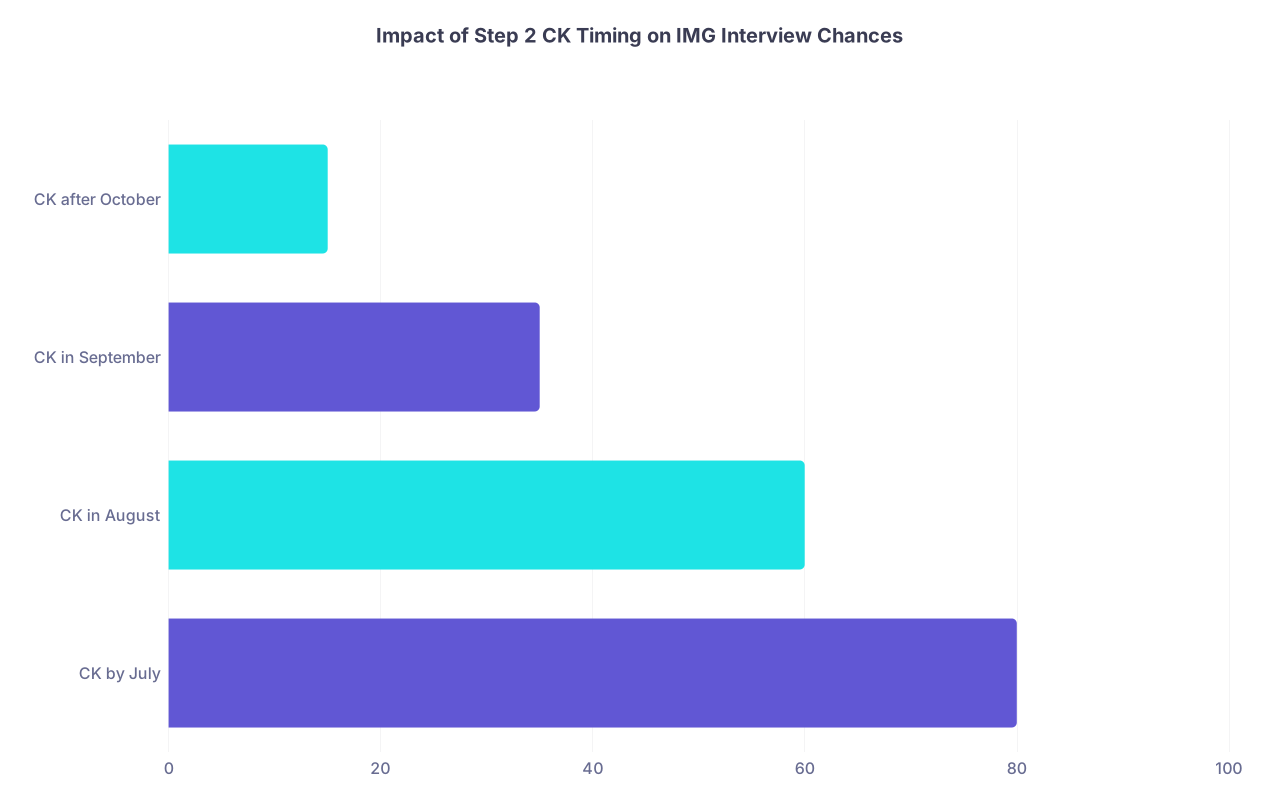
| Category | Value |
|---|---|
| CK by July | 80 |
| CK in August | 60 |
| CK in September | 35 |
| CK after October | 15 |
Those percentages are representative, not official data. But they match what I have repeatedly seen in real IMG cohorts.
CK in August
At this point you should accept:
- Some programs will review your file before your CK arrives.
- Many community programs start serious screening in early–mid September.
If:
- Your Step 1 is strong
and - You expect CK to be similar or slightly higher
Then August can still work. Your Step 1 will carry your initial screening, and your CK will “update” your file by the time most invites are rolling.
If:
- Your Step 1 is weak
and - You were counting on CK to rescue you
Then August is borderline too late. You are essentially asking programs to give you the benefit of the doubt. Many will not.
CK in September
This is salvage territory, not optimal.
At this point you should:
- Realize your CK will not influence early invites.
- Expect that:
- Academic, competitive, and U.S.-IMG-heavy programs may finish most of their IMG shortlists before your CK hits.
- You will depend on late-cycle invites, waitlist movement, and programs that review in waves.
You consider September CK if:
- You are not ready in July or August and your practice tests are poor.
Taking it underprepared is worse. - You are seriously considering skipping this cycle but still want a CK score for next year.
In that specific case, September CK is more about next cycle, not this one.
CK After October
For the same-cycle Match as an IMG?
No. That is almost always wasted effort for this year’s Match. It might help:
- For SOAP (rarely, and not consistently)
- For next year’s Match
But if you are aiming for this September ERAS, CK after October is essentially a next-cycle move.
Special Situations: Weak Step 1, Strong Step 1, and Gap Years
At this point you should identify which bucket you are in. Your optimal CK timing is not identical for everyone.
Scenario 1: Weak or borderline Step 1 (IMG)
Examples:
- Old-style score in the low 210s or below
- Pass / Fail with failed attempts before passing
- Multiple attempts
Your Step 2 CK is not optional for programs. It is your repair tool.
For you:
- CK must be:
- Earlier and
- Clearly higher than a bare minimum
- Ideal:
- Exam in May–June of application year
- Score ≥ 235 (higher is obviously better)
- Why earlier?
- If your CK is mediocre, you want to know before you pour time and money into a doomed cycle.
- You may decide to delay your Match year, do more U.S. clinical experience, research, or improve English/communication skills.
If your NBME practice scores are not trending significantly higher than your Step 1 level by late April, you should consider:
- Pushing the exam a few months (but still before the application year if possible), or
- Delaying your targeted Match cycle.
Scenario 2: Strong Step 1, worried about dropping on CK
Examples:
- Step 1 ≥ 240 (old scores)
- Or a strong narrative around a high performance / strong transcript
You can afford slightly more flexibility. Programs already see you as academically capable.
At this point you should:
- Not rush CK so much that you significantly underperform.
- Still avoid taking CK after September of your application year if possible.
Your worst-case scenario is:
- You delay CK to “study more”
- You then burn out, cram poorly, and end up with:
- Step 1 245, CK 228
Programs will absolutely question this. I have seen good IMGs lose interviews because of this exact pattern.
For you, a more conservative timing:
- Dedicated prep finishing by mid-July
- CK in late July or early August
- Accept a slightly narrower ERAS sweet spot, but protect against a huge drop.
Scenario 3: Gap year / research year before Match
If you have a research or observership-heavy year before you apply, you can:
- Take CK earlier, even 12–15 months before ERAS
- Showcase:
- CK early
- Then stack U.S. clinical experience and letters on top
But do not push CK so far away from your application that you forget material or appear to be in “limbo” for too long.
Week-by-Week: The 10–12 Weeks Before Test Day
Once you have your target month (June–July), you need to handle the micro-timing.
At this point you should structure the final stretch roughly like this (assuming a 10-week dedicated period, adjust if longer):
Weeks 1–4
- Heavy Qbank use (40–80 questions/day)
- Start weak systems/subjects first
- Light review of high-yield Step 1 concepts that feed CK (cardio, renal, neuro, endocrine)
Week 4–5
- First NBME or UWSA:
- If significantly below your target (e.g., < 220 when you need ≥ 235), re-evaluate test date now.
- Adjust plan, double down on weak areas.
- First NBME or UWSA:
Weeks 5–8
- 2nd and 3rd practice exams spaced 1.5–2 weeks apart.
- You are looking for:
- Stability or upward trend
- Not wild fluctuations
Week 8–9
- Final practice test
- Decision point:
- Within ~5–8 points of your realistic target → proceed
- Way below target → consider:
- Pushing exam 2–3 weeks if you are still within the safe June–July window
- Or rethinking this Match cycle if you are already at late July
Week 10 (Exam week)
- Light review
- No marathon new material
- Sleep schedule and logistics squared away
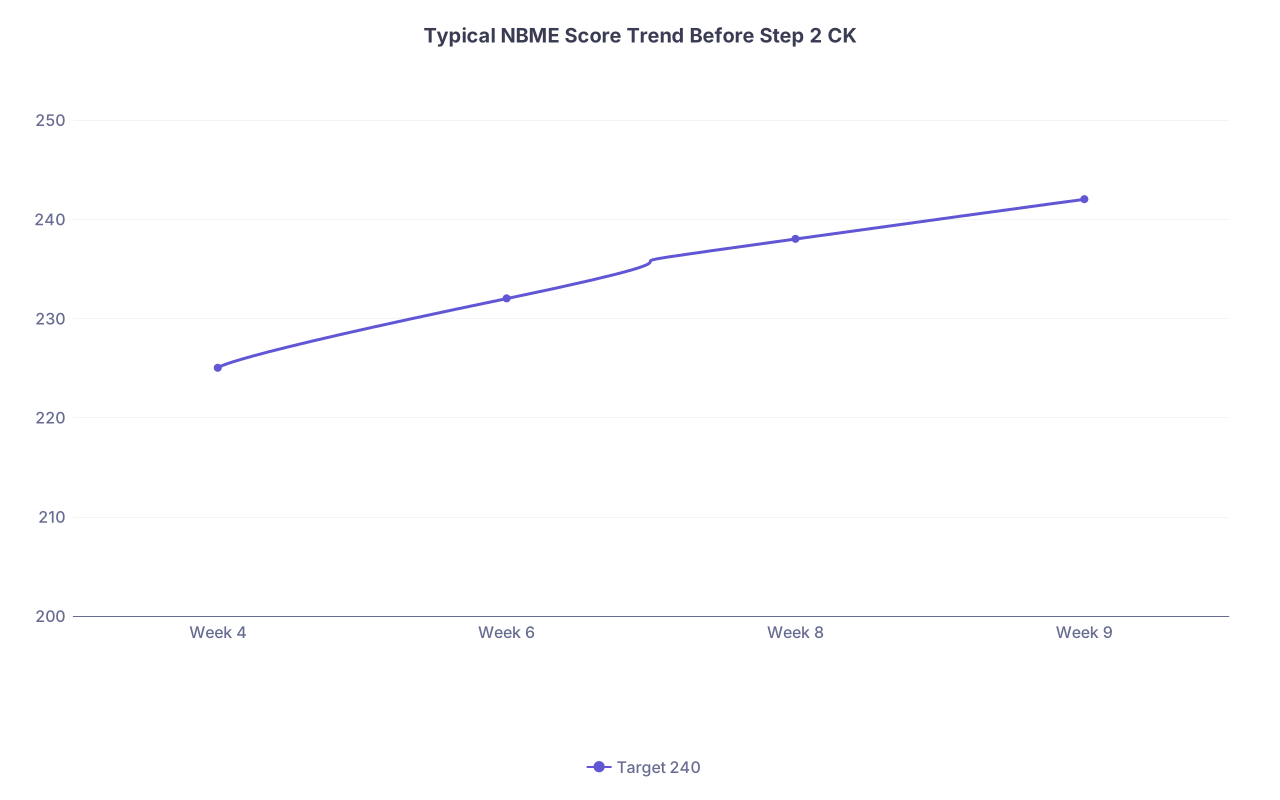
| Category | Target 240 |
|---|---|
| Week 4 | 225 |
| Week 6 | 232 |
| Week 8 | 238 |
| Week 9 | 242 |
If your line looks nothing like this and you are flat at 215–220 with 3–4 weeks left, you are not in an “IMG with strong Step 2” profile. You are in “risk of a damaging score” territory.
Day-by-Day: The Final 7 Days Before CK (Timing-Sensitive Mistakes)
By this point, your timing is locked. What you can still mess up is execution.
At this point you should:
7–5 days before
- Do timed blocks (40–80 questions/day), focus on stamina.
- Briefly review your highest-yield errors.
- Do not overhaul your entire strategy.
4–3 days before
- Switch to:
- Mixed review of weaknesses
- Quick passes through notes / flashcards
- Limit any full-length simulation to 1–2 weeks before, not 2 days before.
- Switch to:
2 days before
- Half day of light review.
- Clarify logistics:
- Test center route
- Required documents
- What you will eat
- Then stop. You are not going to fix your knowledge base in 48 hours.
1 day before
- Very light: a few flashcards if you must.
- Aim for a full night’s sleep.
- This is where disciplined people separate from panickers.
Quick Summary: When IMGs Should Take Step 2 CK
If you are applying this September:
- Best IM G window: CK between mid-June and late July
- Acceptable: Early May to early August
- Risky / late: Late August to September (only if no better option)
- Too late for this cycle: October and beyond
If Step 1 is weak:
- CK needs to be earlier and clearly higher
- Consider May–June, or even earlier in the year, to decide whether to apply this cycle at all.
If Step 1 is strong:
- Protect against a big drop.
- You can afford CK in late July / early August but do not delay beyond that without a very good reason.
FAQ (Exactly 2 Questions)
1. I am an IMG with no U.S. clinical experience yet. Should I delay Step 2 CK until after observerships or take it earlier?
If your knowledge is fresh and your Step 1 was recent, do not delay CK just to “wait for observerships.” Step 2 CK is a knowledge and problem-solving exam, not a U.S.-system etiquette test. Take CK in that June–July ideal window if you can, then use the months after for observerships and letters. Delaying CK into the fall while chasing observerships usually backfires for IMGs.
2. If I am not ready for Step 2 CK by July, should I push to September or skip this Match cycle altogether?
If your practice scores are weak in July and you are clearly far from your target, it is usually smarter to skip the cycle than to panic-study and sit in September with a mediocre score. A low CK as an IMG is an anchor on your file for years. A missed cycle is painful, but survivable. I would rather see an IMG apply one year later with a solid 240+ CK than rush a 220 in September and spend the next few years fighting an uphill battle.
Action step for today:
Open a calendar and mark your intended ERAS submission month. Count backward and block a 4–6 week Step 2 CK window ending no later than July of that year. Then write down three things you must adjust in your current schedule to make that study block real.