
It’s late October. You’re an IMG, checking your email for the 37th time today. A few interview invites have finally trickled in. One is in New York, another in Texas, one in a small community hospital you’d never heard of. You open Google Flights and your stomach drops. Those “congratulations” emails might as well say: “Congrats, you’re about to go broke.”
You’ve got limited savings, maybe some help from family, maybe not. Credit card limit isn’t huge. You absolutely cannot attend every interview that shows up. But you also cannot afford to guess wrong about which ones matter most.
This is where you’re stuck:
How do you decide:
- Which interviews to accept?
- Which to decline?
- Where to travel in person vs ask for virtual?
- How much you can safely spend without sabotaging yourself or your visa situation?
Let me walk you through this like we’re sitting with a spreadsheet together.
Step 1: Know Your Real Financial Ceiling (Not the Fantasy One)
Before you click “accept” on a single interview, you need a hard number.
Not “I’ll try to keep it low.”
A number. In your currency and in USD.
You’re going to answer three questions:
- How much cash do you have right now that you can actually spend on this season?
- How much can you access safely (family help, small loan, reasonable credit card usage) without wrecking yourself?
- What do you absolutely need to keep untouched (emergency fund, Step 3 fees, visa fees, first month rent if you match)?
Your interview budget = (1 + acceptable part of 2) – 3.
If that number is negative, you are in “hyper-conservative” mode. You will be doing everything virtual when possible and saying no more often.
To make this less abstract, put it in a quick table.
| Category | Amount (USD) |
|---|---|
| Current savings | 3,000 |
| Reasonable family help | 1,000 |
| Safe credit use | 1,000 |
| Subtotal | 5,000 |
| Reserve for emergencies | -1,000 |
| Step 3 / visa / deposits | -1,500 |
| Real interview budget | 2,500 |
If your “real interview budget” is $2,500 and you’re thinking about 10+ in‑person trips, you’re already in fantasy land. Most IMGs I’ve seen on a tight budget realistically can afford 3–6 in‑person trips if they plan ruthlessly, sometimes fewer.
Step 2: Sort Your Programs by Priority, Not Ego
You cannot treat all interviews the same. You also cannot chase “brand names” if they’re horrendous fits for you as an IMG on a budget.
You’re going to tag each program with three scores:
Fit score (1–5):
- 5 = strong IMG presence, visa friendly, your Step scores close to or above their average, your interests line up with their strengths.
- 1 = low IMG presence, vague about visas, way above your stats.
Visa friendliness (1–5):
Check:- Do they clearly say they sponsor J-1 / H-1B?
- Do they list “US citizens / green cards only”?
- How many IMGs currently in the program? (Website, alumni, resident photos.)
Geographic priority (1–5):
- 5 = place you’d be happy to live and can afford (state with lower cost of living; where you have family/friends/housing).
- 1 = very high cost of living, no support system, low interest.
You don’t need this perfect. Just honest.
Then you categorize invites into buckets:
- Tier A: High match potential + high priority (Fit ≥4, Visa ≥4)
- Tier B: Maybe (Fit 3, Visa 3–4)
- Tier C: Long shots or low interest (Fit ≤2 or Visa ≤2)
When the invites start coming, you don’t say yes to everything. You always check the tier first.
Step 3: Decide Where In‑Person Actually Matters
If a program offers virtual, that’s a gift for your wallet. Many community programs still like in‑person, but some are hybrid.
General rule I tell IMGs with limited money:
Protect in‑person travel for these:
- Tier A programs that:
- Are visa friendly
- Are in locations where you could actually see yourself staying
- Historically rank IMGs highly (you can see multiple IMG residents per year)
- Tier A programs that:
Push for virtual or decline for these:
- Tier C programs, unless you’re very low on interviews
- Programs in extremely expensive cities where 1 trip = 2–3 cheaper trips
- Programs vague about visas or with 0 current IMGs
If they only offer in‑person but you’re interested, you can still ask. Something like:
Dear Dr. [Name],
Thank you very much for the interview invitation. I’m an international medical graduate currently located in [country/state], and long-distance travel is financially challenging for me.
Would it be at all possible to attend the interview virtually? I’m very interested in your program, particularly [specific thing], and I’d be grateful for the opportunity to meet with you in whatever format is feasible.
Sincerely,
[Your Name]
Some will say no. Fine. You keep that in mind when you compare to other invitations.
Step 4: Cluster Your Travel or You’ll Bleed Money
The most expensive way to interview:
Single trips. One program, one city, back home. Repeated.
You want clusters.
Look at your current and potential invites:
- Do you have (or might you get) multiple in the same region?
Example: three in New York / New Jersey, two in Ohio, two in Texas.
You then try to:
- Schedule those same‑region interviews within a 5–10 day window
- Book one roundtrip flight to that region
- Use buses/trains/rideshare between nearby cities
- Stay in one base location if possible (relative’s house, cheap long-stay, hostel)
This is where a basic map and calendar save you hundreds.
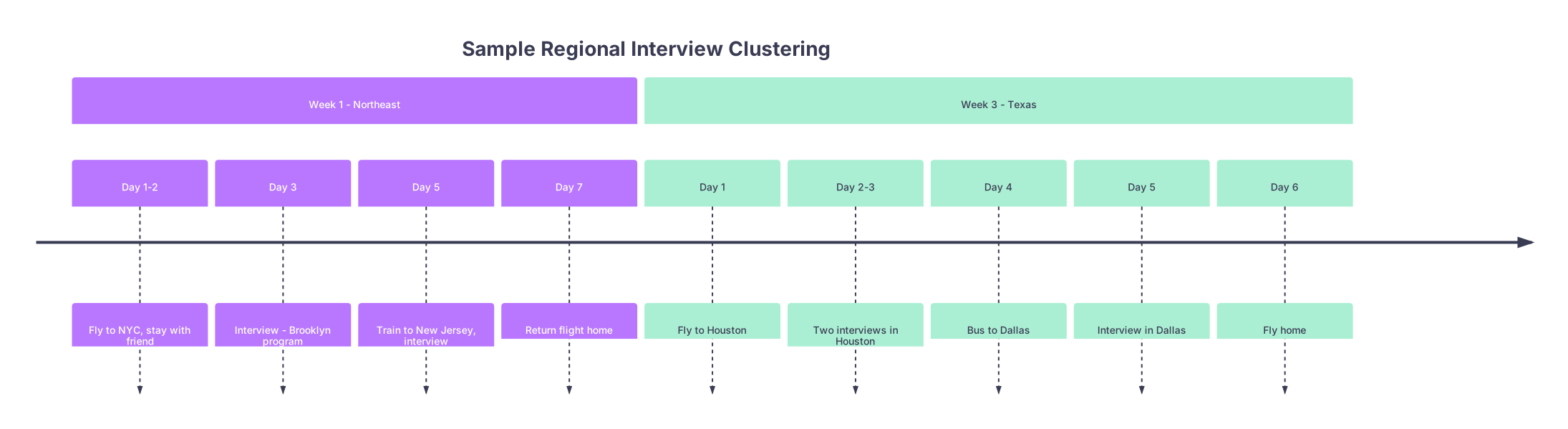
| Period | Event |
|---|---|
| Week 1 - Northeast - Day 1-2 | Fly to NYC, stay with friend |
| Week 1 - Northeast - Day 3 | Interview - Brooklyn program |
| Week 1 - Northeast - Day 5 | Train to New Jersey, interview |
| Week 1 - Northeast - Day 7 | Return flight home |
| Week 3 - Texas - Day 1 | Fly to Houston |
| Week 3 - Texas - Day 2-3 | Two interviews in Houston |
| Week 3 - Texas - Day 4 | Bus to Dallas |
| Week 3 - Texas - Day 5 | Interview in Dallas |
| Week 3 - Texas - Day 6 | Fly home |
If you can’t cluster because dates don’t line up, you choose ruthlessly. Maybe you pick 2 interviews in a cheap region over 1 in an overpriced city.
Step 5: Build a Per-Trip Budget (Not Just Overall)
Your “season” budget is not enough. You need a per-trip ceiling.
Take your total interview budget and divide it based on how many in‑person trips you think you can afford. Not interviews. Trips.
Example:
Budget: $2,500
Goal: 4 in‑person trips + all others virtual
Rough allowance: about $500–600 per trip.
Now reverse engineer each trip:
- Flight/bus/train: cap it. If flights are $800 to one city, that city probably dies unless it’s a dream Tier A program.
- Housing: aim for free first (friends, relatives, alumni, Couchsurfing cautiously, program-arranged options), then cheap.
- Local transport: public transit > Uber where possible.
- Food: supermarket + simple meals, not restaurants.
On a very tight budget, a realistic bare-bones per‑night cost in the US can be:
| Option | Typical Range (USD) |
|---|---|
| Stay with friend/family | 0 |
| Resident/medical host | 0–30 |
| Hostel/shared room | 30–60 |
| Budget motel (suburban) | 60–90 |
| City Airbnb / budget hotel | 90–140 |
If one city forces you into the $140+ range for two nights plus expensive flights, that single interview could eat 30–40% of your total budget. You have to ask: is this program that good for you?
Most IMGs overspend on one “dream” place instead of securing more realistic options elsewhere. That’s how they end the season with 8 interviews instead of 12 because they ran out of cash.
Step 6: Accepting, Declining, and Waitlisting Interviews Strategically
You don’t have to answer invites instantly.
If you’re on a budget, you use three responses:
- Immediate accept: Tier A + affordable travel or virtual.
- Polite delay / ask for flexibility: Tier B where you’re not sure yet, especially if travel is expensive.
- Early decline: Tier C or clearly unaffordable.
You can actually “waitlist yourself” a bit at lower priority programs. Something like:
Thank you very much for the interview invitation. I’m very interested in your program. At the moment I’m working through some travel and scheduling constraints.
Would it be possible to schedule an interview date in [later month] if there are still open spots? If not, I completely understand and will do my best to adjust.
Sometimes programs will offer you later dates. Sometimes they won’t. But you’ve bought yourself time to see what other invites appear without burning the bridge.
Do not hoard every date though. Programs get irritated if you schedule and then cancel last minute. If you cancel, do it as early as possible with a short, respectful email.
Step 7: Actual Cost-Saving Tactics That Aren’t Just “Be Cheap”
You already know “find cheaper flights” and “don’t eat out.” Let’s talk about stuff IMGs actually use that works.
Flights / Transport
- Use Google Flights or Skyscanner “calendar” to see cheapest days. Shift the interview if the program is flexible even by 1 day if that saves $150–200.
- Check nearby airports. For example, flying into Newark instead of JFK. Or even flying into a city 2–3 hours away and taking a bus.
- For short regional trips: Greyhound, Megabus, FlixBus can turn a $250 flight into a $40 ride. Less comfortable, but you’re not a tourist right now.
Housing
Ask the program’s coordinator directly:
“Do any of your residents host visiting applicants, or does the program have arrangements with local housing?”
A lot of IM programs do. They just don’t advertise it loudly.Use your community. WhatsApp IMG groups, FB groups, country‑specific networks (“Egyptian doctors in USA,” “Pakistani doctors in US residency”). People do host each other for a night or two. I’ve seen this routinely.
Do one base city, multiple interviews. For example, stay in New Brunswick and train to programs in northern and central New Jersey over several days.
Food and Local Spending
- First stop when you land: grocery store. Bread, yogurt, fruit, ready‑made salads, microwave meals if kitchen available.
- Say no to the pressure of social dinners if you really cannot afford it. “I’d love to, but I need to catch up on some personal things tonight. Thank you so much for the invite.” No one cares as much as you think they do.
Step 8: Re-Evaluating Mid-Season (The Hard Reset)
You might start with a plan and then mid‑November your finances are wrecked and you still have invites coming. That’s the “hard reset” point. It’s better to be brutal and strategic than to just keep burning money.
Here’s what you do mid‑season:
- Recalculate what you have left. Don’t guess. Write the number.
- Count the interviews you’ve already done and how many are upcoming (virtual vs in-person).
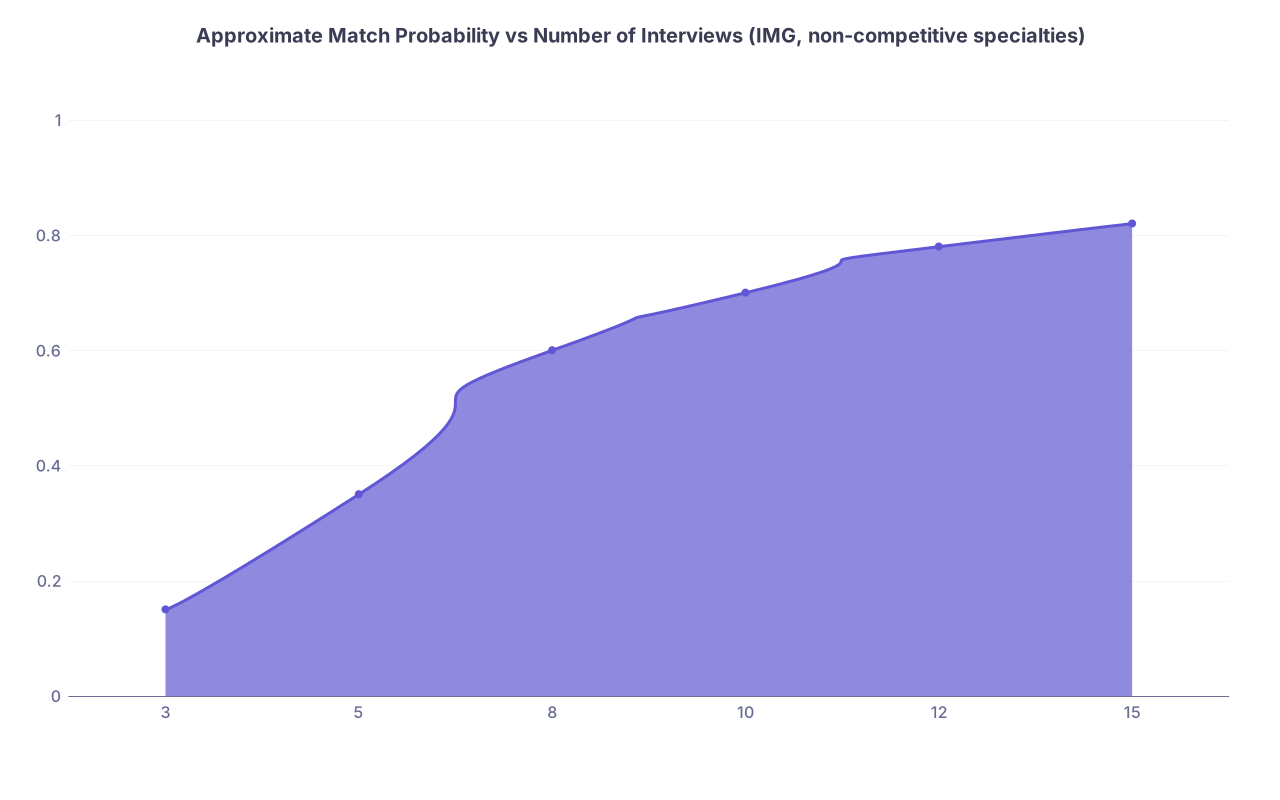
- Estimate your match probability band:
- 5–7 interviews: fragile. You should lean towards accepting more if affordable.
- 8–12: okay, especially for IMGs in IM/FM/psych.
- 13+: diminishing returns, especially if low yield programs.
| Category | Value |
|---|---|
| 3 | 0.15 |
| 5 | 0.35 |
| 8 | 0.6 |
| 10 | 0.7 |
| 12 | 0.78 |
| 15 | 0.82 |
This is rough, but the principle holds: more interviews help, but each new one has smaller benefit.
- Based on that, you decide:
- If you’re under 8 interviews and still have money: accept more, including some B-tier, but only if travel can be clustered.
- If you’re already above ~10 and basically broke: start declining or switching to virtual aggressively, especially for C-tier programs.
Do not blow your last $700 on interview #14 if the previous 13 already include several strong, visa-friendly, IMG‑heavy programs where you did well.
Step 9: When You’re Truly Broke but Still Need Interviews
Sometimes, the reality is ugly. You might have 4–5 interviews, be nearly out of money, and still not feel safe.
In that case you move into “maximize virtual + ask for help” mode.
Ask every remaining program for virtual if they’re not already offering it. It’s humbling. Do it anyway.
Look for local/regional programs you can reach by bus within 4–6 hours instead of flights.
Tap your networks explicitly:
- Seniors from your med school now in US residency
- Country‑specific IMG groups
- Religious/community organizations near the city (yes, people sometimes host visiting students)
Be honest but professional if you must decline:
- “Due to financial limitations related to international travel, I’m unfortunately unable to attend in person. If a virtual option becomes available, I’d be very grateful to be considered.”
Also: do not destroy your post‑match life for one more interview. You’ll need money for:
- Visa fees / SEVIS / consular fees
- Medical exams, vaccination updates, titers
- Security deposit and first month’s rent
- Initial transport and basic living costs before your first paycheck
I’ve seen IMGs match and then panic because they literally cannot afford to start residency. That’s worse than not going to a marginal interview.
Step 10: Emotional Side – Not Letting Money Make You Feel “Less Than”
You’ll meet applicants staying at $250/night hotels, flying business because parents are paying, booking Ubers everywhere. You’re on the bus, staying in a tiny room, eating supermarket sandwiches.
That doesn’t mean you’re a weaker candidate. It just means the game is more expensive for you.
A few grounding points:
- Programs care about how you interview, not your hotel.
- No PD is asking, “Did you fly economy?”
- Many current residents, especially IMGs, have done exactly what you’re doing now: shared rooms, slept on couches, bussed between cities overnight.
You keep your clothes neat, show up on time, stay present during interviews. No one sees your bank balance.
And if you’re feeling shame because you can’t accept every invite: that’s a luxury others might have. You don’t. You’re allowed to run your season like a serious adult with limited resources.
A Concrete Example: Two Competing Trips
Let’s say you get these two options:
Program A: New York City community IM program, IMG-heavy, J‑1 sponsored, strong fit. Estimated cost:
- Flight: $550
- Housing (2 nights): $240
- Local transport/food: $80
- Total: ~$870
Program B: Two programs in Ohio (one mid-tier university affiliate, one community), both IMG-friendly, also J‑1. You can cluster them in one trip:
- Flight to Ohio: $320
- Bus between cities: $30
- Housing (4 nights cheaper area): $240
- Local transport/food: $120
- Total: ~$710
One NYC program for $870 vs two solid Ohio programs for $710.
On a tight budget, I’d pick B unless A is clearly your absolute dream and you’re willing to sacrifice other potential interviews for it. That’s the level of trade‑off you need to consciously decide, not accidentally drift into.
Final Tight-Budget Rules to Keep You Sane
If you’re lost, come back to these:
- Your real interview budget comes first. Not your ego, not FOMO.
- Protect in‑person travel for programs where you actually have a good chance and that actually support IMGs and visas.
- Cluster interviews by region. One flight, several programs.
- Aim for enough interviews (often 8–12 for IMGs in non-competitive specialties), not infinity. After that, extra interviews have shrinking returns.
- Don’t bankrupt your future self. You still need money to actually start residency if you match.
You’re not trying to win a “most interviews” contest. You’re trying to spend just enough, in the right places, to give yourself a real shot at matching—without blowing up your finances for the next five years.