
What do you actually do when you are an IMG couple, different specialties, and the NRMP just… does not care if you end up 2,000 miles apart?
You are not dealing with a theoretical “couples match problem.” You are dealing with:
- Two different competitiveness levels
- Two different sets of program filters
- Visa issues layered on top
- Geography that may not be kind to IMGs
So let’s treat it like what it really is: a strategy problem under constraints. I’ll walk you through how to think, decide, and act—step by step—like a couple that wants to match together and not spend three years waving on FaceTime between night shifts.
1. First Reality Check: Can You Afford To Truly Couples Match?
Let me be blunt: not every IMG couple should couples match in the NRMP sense.
NRMP “Couples Match” is a technical tool that links your rank lists. But the concept of matching together can be done three ways:

| Approach | What It Means | Who It Fits Best |
|---|---|---|
| True NRMP Couples Match | Technically link rank lists | Both reasonably competitive |
| Soft Coordinated Strategy Only | Apply same regions, no linking | One partner significantly weaker/visa risk |
| Staggered Match (Different Year) | One applies first, other later | Big competitiveness gap or visa mess |
Here’s the quick litmus test:
If both of you are reasonably competitive IMGs (e.g., strong scores, no major failures, decent USCE, some interviews likely):
Using the official NRMP Couples Match probably helps you.If one of you is much weaker (failed attempts, low scores, no visa flexibility, switching specialty late) and the other is chasing a competitive field (Derm, Ortho, Ophtho, PM&R at top places, etc.):
A strict couples match can quietly kill the stronger candidate’s chances and still not save the weaker one.If one is US citizen/GC and the other needs H‑1B/J‑1, and you’re both IMGs:
You need to be extra careful. Visa policies narrow your overlapping list fast.
Be honest here. If the weaker partner would struggle to match even without being tied to you, you might be better off with:
- The stronger partner applying first, casting wider net, anchoring somewhere decent
- The weaker partner optimising to get any match near that anchor the following year
Harsh, yes. But long-term, that can be much better than both missing or both ending up in a region that destroys your future options.
2. Map Your Combined Risk: The 5 Big Variables
Before you get lost in ERAS spreadsheets, define your battlefield.
You need to look at five variables together, not separately:
- Specialty competitiveness
- Individual competitiveness
- Visa status
- Geography (IMG-friendliness)
- Program size density in regions
Let’s say:
- Partner A: IMG, applying Internal Medicine, 237/245, 1 US letter, needs J‑1
- Partner B: IMG, applying Pediatrics, 223/230, 2 US letters, GC holder
This is a very different picture than:
- Partner A: IMG, applying Neurology, 250+, strong US research, H‑1B okay
- Partner B: IMG, applying Family Medicine, 220s, J‑1 only
To stop hand-waving, sit down together and literally do this:
- Rank your specialties by competitiveness (for IMGs, not US grads).
- Rank each of you (honestly) as: Strong / Average / At-Risk for that specialty.
- Define visa constraints: H‑1B vs J‑1 vs no visa.
- Identify 3–5 regions that are:
- Relatively IMG-friendly
- Have both specialties with multiple programs in driving range
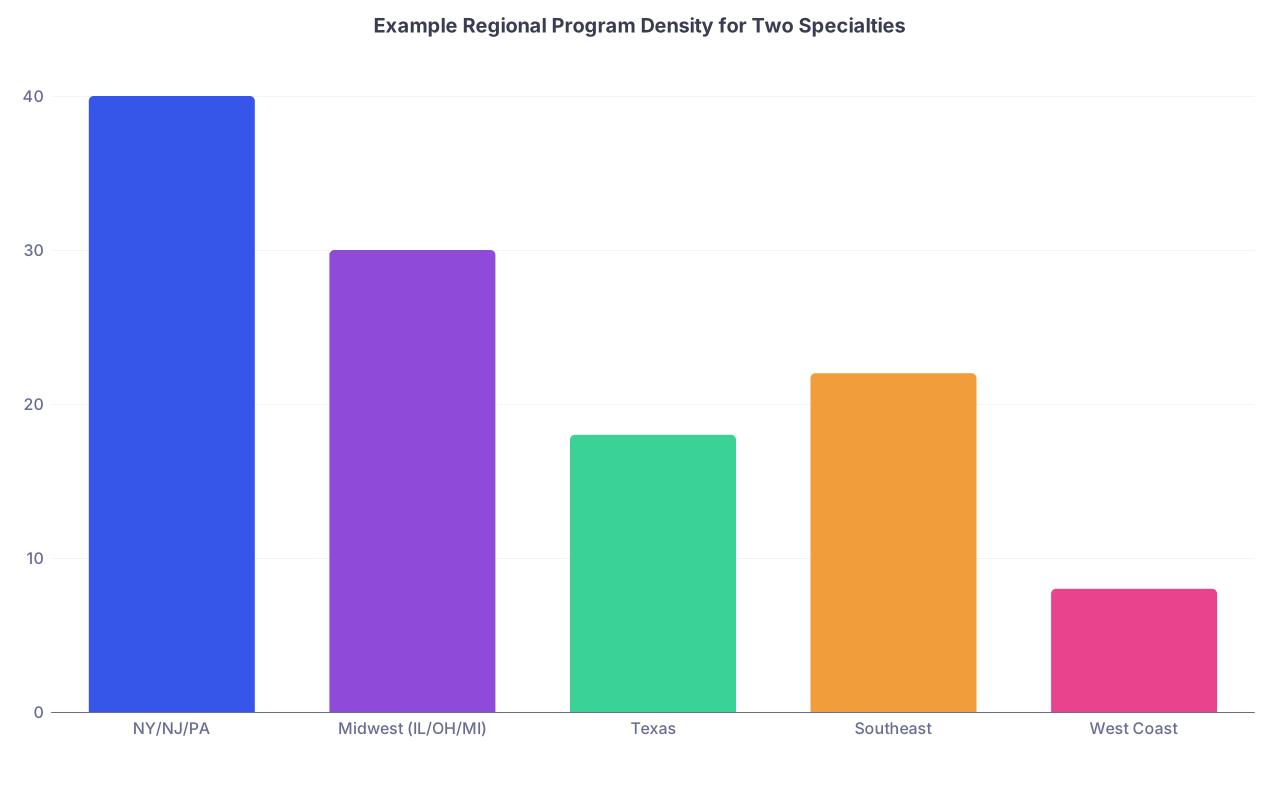
| Category | Value |
|---|---|
| NY/NJ/PA | 40 |
| Midwest (IL/OH/MI) | 30 |
| Texas | 18 |
| Southeast | 22 |
| West Coast | 8 |
(Those numbers are example combined counts of IM + FM or IM + Peds—your pair will differ, but the pattern is usually similar: Northeast and Midwest save IMG couples.)
If your dream is “We both end up in California as IMGs, different specialties, and visas,” I’ll be straight: that’s a fantasy in most cases. You need to pick where the math works, not where your Instagram memories are.
3. Decide: True Couples Match vs Coordinated But Separate
Now the key question: Should you formally couples match through NRMP?
True Couples Match (Linked Rank Lists)
Use it if:
- Both of you are at least average for your specialties as IMGs
- Your primary target region(s) have multiple programs in both specialties
- You’re willing to accept a slightly lower-tier program if it means being together
- You understand that your combined outcome is the one that matters
Do not use it if:
- One of you would be forced to rank a bunch of programs where you have essentially zero shot (e.g., Derm at Mass Gen + Peds at MGH style combos as IMGs)
- One partner is ultra-competitive and the other is barely viable
- Your overlap region list is tiny (e.g., 3–4 city pairs only)
Soft Coordinated Strategy (No Ranked Couples in NRMP)
This is where many IMG couples land, and it’s often smarter.
You:
- Apply to the same states/regions as much as possible
- Build ERAS lists with heavy overlap in geography
- Target hospital systems with many residencies (IM, FM, Peds, Psych, etc.)
- During interviews, you verbally communicate that your spouse is also applying in X specialty and Y region
- But your NRMP rank lists are independent
This avoids the “lowest common denominator” problem, where the weaker partner drags down the stronger partner’s odds.
4. Constructing a Joint Program List Without Losing Your Minds
You can’t just say, “We’ll apply broadly and pray.” That’s not a strategy.
You need a joint spreadsheet. Stop resisting it.
Columns for each row (program pair):
- City
- Hospital system
- Program A (specialty 1) – name, type (community/university), visa policy
- Program B (specialty 2) – same data
- IMG-friendliness indications (check FREIDA, program websites, past match lists)
- Whether they have multiple prelim/ty tracks that might help with flexibility
Then classify cities into three tiers:
Tier 1: High-density couples targets
Many programs in both specialties within same city/nearby suburbs.
Example: NYC metro, Chicago, Philly, Houston, Detroit, Cleveland, etc.Tier 2: Moderate options
One large academic center + a few community hospitals reasonably close.Tier 3: Solo-program towns
One IM + one FM program in a small city, 2–3 hours away from any other teaching hospital.
Your primary couples strategy should lean heavily on Tier 1 and Tier 2. Tier 3 becomes backup “at least we’re in the same state/region” options.
5. Using NRMP Couples Match Properly (If You Go That Route)
Most couples mess this up. They either:
- Only rank “perfect” pairs and end up with super short lists, or
- Create totally irrational pairings that make zero mathematical sense
Here’s how to build a rational couples rank list.
Think of each rank entry as a pair:
- [City A: Program A – City A: Program B]
- [City B: Program A – City B: Program B]
- [City C: Program A – No match for B]
- [No match for A – City D: Program B]
NRMP lets you do all of that.
Basic strategy:
Top of list – ideal pairs
Same city, both decent programs, IMG-friendly, correct visas.Middle of list – tolerable trade-offs
One partner slightly better program, other slightly worse, but same city or close.Lower list – “one matches, one doesn’t” scenarios
Where at least one of you gets something instead of both unmatched.Very bottom – If you’re truly willing:
“Only A matches somewhere” / “Only B matches somewhere” entries
(Many couples skip these, but then complain when both end up unmatched.)
The subtle but critical point: you can decide whether you prefer:
- Both matching anywhere vs
- One matching in a decent spot vs
- Both unmatched and reapplying together
There is no “right” answer. But don’t accidentally default into the worst outcome because you never talked about it openly.
6. Visa Layer: The Invisible Constraint That Changes Everything
If either of you needs a visa, your overlapping program pool shrinks quickly.
Common patterns:
- Many community programs sponsor J‑1 only
- H‑1B is more selective and expensive; a lot of small programs quietly avoid it
- Academic centers sometimes prefer J‑1 because of obligations and cost structures
What this means for you as an IMG couple:
Filter your spreadsheets by visa policy early.
If your spouse is H‑1B only and your target region is mostly J‑1, you have a problem.Do not assume same hospital will treat both specialties the same.
Example: IM at a university hospital might sponsor H‑1B, FM at the same system might be J‑1 only.Ask directly (professionally) if the website is unclear.
A single email can save you 20 wasted applications.
7. How To Talk About Your Spouse With Programs (Without Hurting Yourself)
People overcomplicate this part.
You do not need to write a tragic love story in your personal statement about how you’re “desperate to be in the same city.” That usually sounds needy.
Better framing:
In your ERAS experiences or geographic preferences section (if a program uses it), you can mention:
“My spouse is also applying to residency training in [Specialty] this cycle, so I’m particularly interested in regions with multiple training opportunities.”During interviews, if they ask: “Do you have geographic preferences?”
You answer:
“Yes. My spouse is also applying to [Specialty] and we’re focusing on [regions] where there are good opportunities for both of us. That’s why I’m excited about programs in [City/Region].”
Notice what you’re not doing:
- You’re not saying, “I’ll only rank you if my spouse interviews nearby.”
- You’re not saying, “If I match here but my spouse does not, I’ll be miserable.”
You’re simply giving context for coherent geographic prioritization.
8. Managing Different Competitiveness Levels Between You
This is usually the emotional core of the problem.
Classic situation:
- One is applying IM with excellent CV (let’s say 250 Step 2, publications, US research)
- The other is applying Psych or Peds with a 218–222 Step 2 and failed Step 1 attempt
If you pretend you are “equal” in this process, you will make bad decisions.
Better approach:
The stronger partner’s job: anchor the family’s future trajectory.
They should not tank their long-term career completely just to be in a specific city for 3 years. That sounds romantic. It’s often just short-sighted.The weaker partner’s job: maximize odds of any match near that anchor.
That might mean:- Applying to an even less competitive specialty
- Considering prelim + re-apply routes
- Extra year of USCE, research, or observerships near the anchor city
Jointly decide your red lines:
Are you okay with:- Same state, but 2–3 hours apart?
- Same region (e.g., Midwest) but 5–6 hours apart?
- Or is it “same city or nothing”?
If your line is “same hospital or bust,” expect a brutal match year as IMGs in different specialties.
9. Timeline and Process: How To Actually Work Through This Together
Do not wait until ERAS is open to “discuss things.” That’s how couples end up passive and resentful.
Here’s a loose but functional timeline:
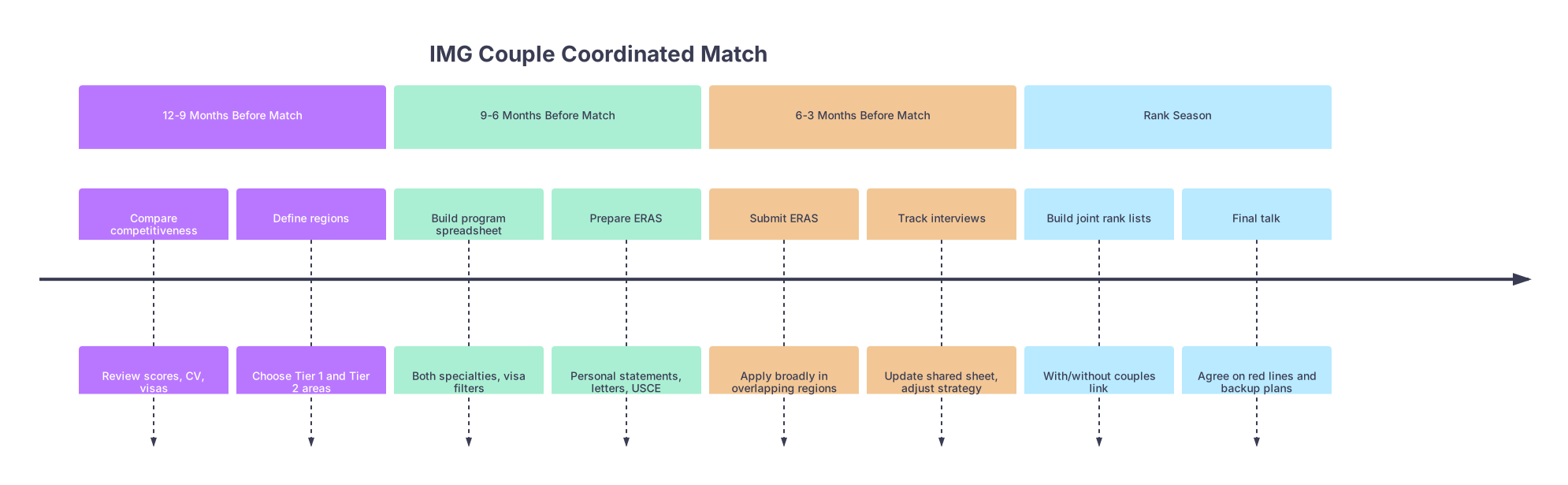
| Period | Event |
|---|---|
| 12-9 Months Before Match - Compare competitiveness | Review scores, CV, visas |
| 12-9 Months Before Match - Define regions | Choose Tier 1 and Tier 2 areas |
| 9-6 Months Before Match - Build program spreadsheet | Both specialties, visa filters |
| 9-6 Months Before Match - Prepare ERAS | Personal statements, letters, USCE |
| 6-3 Months Before Match - Submit ERAS | Apply broadly in overlapping regions |
| 6-3 Months Before Match - Track interviews | Update shared sheet, adjust strategy |
| Rank Season - Build joint rank lists | With/without couples link |
| Rank Season - Final talk | Agree on red lines and backup plans |
During interview season:
- Track invitations in your shared file
- If one of you gets many interviews in Region A, the other should urgently email/update preferences and, if possible, try to pick up late invites in the same region
- Don’t be shy to tell programs:
“My spouse has interviewed at [Hospital X] across town, so this city has become a top priority for us.”
Some PDs are surprisingly willing to help nudge within their network if they like you.
10. What If You End Up Matched Apart?
You have to plan for this before rank list certification. That way your decision is not driven purely by panic on Match Week.
Have this conversation:
- If we’re in:
- Same metro area → we find a way and commute, no question.
- Same state or within 3–4 hours → we probably live in the middle or accept long commutes/alternate weekends.
- Different states/regions → is anyone willing to reapply? After PGY-1? After visa secured?
Also, know the hidden truth:
Lots of couples who match apart initially are together by PGY-2 or PGY-3 because:
- One transfers into the same system
- One changes specialty or moves after prelim year
- One reapplies strategically once they have US experience and a PD advocating for them
Your first match is not the last word on your marriage or your career. But you improve your odds massively by being honest with each other now, not “seeing what happens.”
FAQ (Exactly 3 Questions)
1. As IMGs in different specialties, is it safer to avoid formal NRMP Couples Match?
Often yes—especially if your competitiveness or visa situations are very different. Formal couples matching ties your outcomes together; the algorithm will treat you as a unit, which can drag a stronger candidate down or still fail to rescue a much weaker one. Many IMG couples do better with a coordinated but unlinked strategy: same regions, overlapping hospital systems, clear communication to programs, but separate rank lists. The exception is when both of you are solid candidates with plenty of overlapping city options—then the couples feature can help reduce the risk of being separated.
2. We’re both IMGs, different specialties, and both need visas. Should we still target big academic centers or mostly community programs?
Target both, but be ruthless with filters. Community programs are often more open to IMGs, but may be J‑1 only; academic centers sometimes offer H‑1B but are more competitive and may not be IMG-friendly for certain specialties. Build your list starting with cities where you can find multiple programs in both specialties that explicitly mention sponsoring your visa type. If that yields too few options, expand geographically—do not simply lower competitiveness and chase any program with a visa if it strands one of you alone in a tiny city with zero options for the other.
3. How many overlapping cities or program pairs do we need to have a realistic shot of matching together?
There’s no magic number, but if you only have 3–4 realistic city pairs where both of you have a credible chance, you’re in dangerous territory. For most IMG couples in different specialties, I like to see at least 10–15 cities with multiple overlapping programs across your specialties and 20–30+ realistic “pairs” when building a couples rank list. If, after visa and IMG-friendliness filters, you can’t get close to that, I’d strongly consider skipping formal couples matching and using a softer coordination strategy instead.
Open a blank spreadsheet right now and list your top 5 target regions down the left and both your specialties across the top. Start filling in actual program counts and visa policies. If you cannot fill that grid with real options, your current “plan” is not a plan—it’s just hope dressed up as strategy.