Your chances are not ruined. But they are also not “basically the same next year.” Both of those common beliefs are wrong.
If you are an international medical graduate who went unmatched, you are now in one of the most brutally data-driven situations in medicine. Emotion does not decide what happens next. Numbers do. And the numbers are a lot more nuanced than the horror stories (and the false reassurance) you hear in WhatsApp groups and hospital cafeterias.
Let me walk through what the actual data says, how programs really think about prior unmatched attempts, and what moves the needle versus what is just performative “gap-filling.”
The Hard Truth: Being Unmatched Once Matters — But It’s Not a Death Sentence
Here’s the core myth: “If you go unmatched as an IMG, programs will blacklist you. It’s over.”
Wrong. But the opposite myth is just as dangerous: “Just reapply next year and you’ll be fine if you apply to more programs.”
Also wrong.
The NRMP and ECFMG data, plus what I’ve heard directly from program directors, say this:
- A prior unsuccessful attempt absolutely lowers your odds.
- The size of that penalty depends heavily on what you do between cycles.
- Many IMGs do match on a second (or even third) try — but they don’t do it by repeating the same failed strategy.
Let’s put some structure on this.
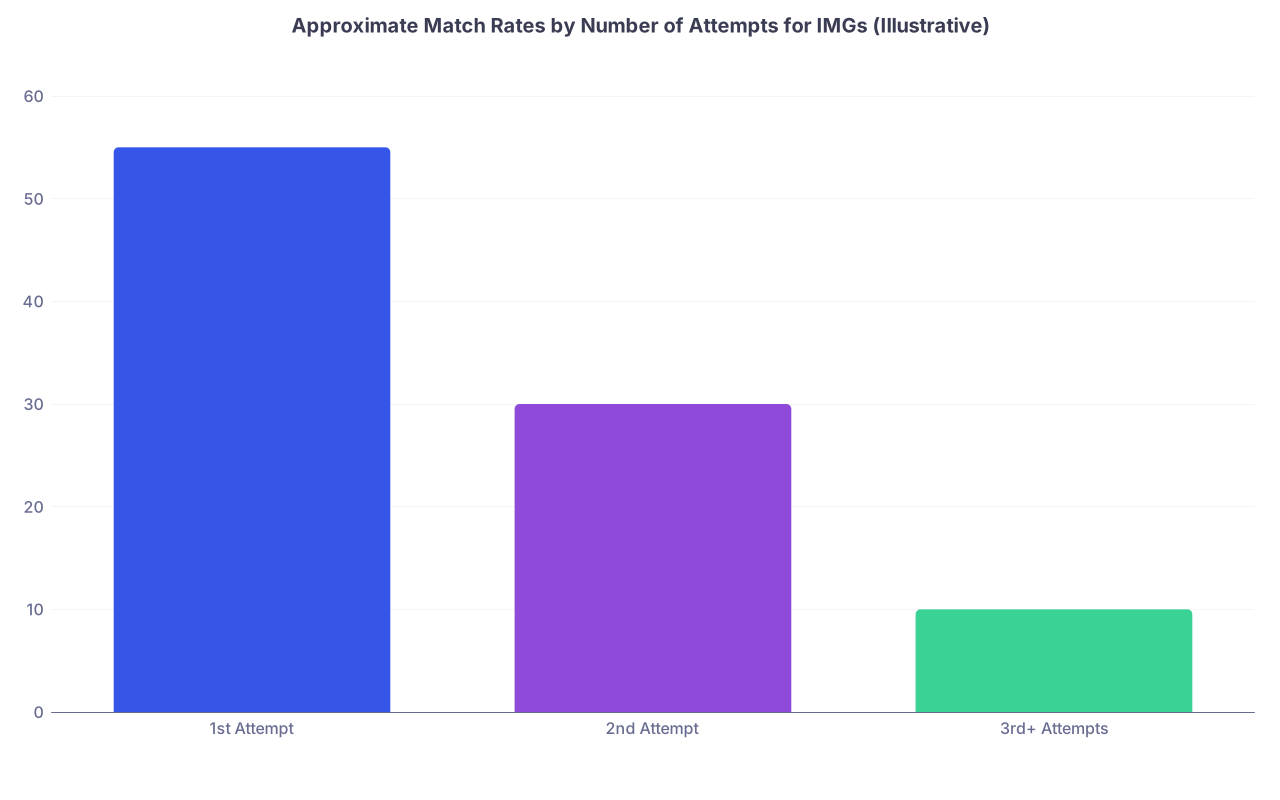
| Category | Value |
|---|---|
| 1st Attempt | 55 |
| 2nd Attempt | 30 |
| 3rd+ Attempts | 10 |
These are not official NRMP numbers for “unmatched IMGs,” because NRMP doesn’t publish a clean table just for that subgroup. But program directors I’ve spoken to consistently estimate something in this ballpark when they look across their applicant pool and the SOAP lists. First attempt: decent shot. Second: possible, but tougher. Third+: you’re in long-shot territory unless something about your application is radically different.
So no, your chances are not “ruined forever.” They are just no longer average. You’re now playing a game on hard mode — and pretending you’re still on easy mode is how people burn three cycles and end up angry and broke.
What Programs Actually Think When They See “Previously Applied”
Let’s kill another myth quickly: “Programs don’t even know if you applied before.”
They do. Many track this explicitly in their internal databases. ERAS also lets them see prior applications in various ways year-to-year within their program. At minimum, if you applied to the same program again, they remember frequent names, especially if you interviewed or emailed them.
Here’s the internal monologue of a program director or APD when they see a reapplicant’s file. I’ve heard versions of this almost verbatim:
- “Did this person get better since last year, or are they the same applicant who was not competitive enough to match?”
- “Did they do anything meaningful with the gap, or did they just sit and wait?”
- “Why didn’t they match the first time — and is that problem actually fixed?”
They are not inherently biased against reapplicants. But they do assume that if nothing has changed, the outcome will be the same.
So your entire strategy boils down to this: your second (or third) application must answer those three questions clearly and favorably in under 30 seconds of reviewing your file.
That means:
- Objective upgrades (Step 3, fresh strong US clinical experience, publications).
- Coherent story (not random observerships scattered everywhere).
- A believable trajectory (you look sharper, more clinically active, more aligned with the specialty than last time).
If you just slap a “reapplying with great passion!” line into your personal statement and hope they don’t notice you’re essentially the same candidate… they notice.
The Data That Actually Matters Post-Unmatch
As an unmatched IMG, you are not playing the same game as an MS4 in the US. You’re playing a filtered game where several variables now dominate your fate.
Let’s strip it down to the core factors that actually move the dial after an unmatched cycle.
| Factor | First-Time IMG Impact | Reapplicant IMG Impact |
|---|---|---|
| USMLE Step 1 (P/F now) | Moderate | Low (unless failed) |
| USMLE Step 2 CK Score | High | Extremely High |
| USMLE Step 3 | Optional | Very Helpful |
| US Clinical Experience | Helpful | Critical if lacking |
| Time Since Graduation | Important | Very Important |
| Meaningful Gap Activity | Nice-to-have | Mandatory |
Scores: You Cannot “Spin” Them
The fantasy: “If I just rewrite my personal statement better, I’ll be fine.”
No. If you were unmatched with a weak Step 2 (say low 220s or below for IMGs in internal medicine / FM, or below mid-230s for more competitive fields), your single biggest leverage point is usually:
- Step 2 CK retake (if that’s an option and realistic)
- Or more commonly: taking and doing well on Step 3
A strong Step 3 (think 230–240+ as an IMG, depending on specialty) does two things:
- Signals you can pass high-stakes exams without hand-holding.
- Lowers risk for visa-heavy programs that like candidates able to get licensed more easily.
But let’s be blunt: Step 3 will not rescue a disaster profile. It’s a booster, not a resurrection.
Time Since Graduation: The Silent Killer
Another myth: “If I just keep applying every year, something will eventually work.”
For IMGs, time since graduation (YOG) is a hard filter at many programs. I’ve seen internal medicine programs with a firm cutoff at 5 or 7 years since graduation. They won’t say this publicly, but they absolutely filter on it.
Every year you sit idle, your competitiveness decays.
That is why “doing something real” during your gap is not optional. Which brings us to the most abused piece of bad advice.
The Observership Trap: Why Most IMGs Waste Their Gap Year
You’ll hear this from a senior at your med school or in a Telegram group: “Just stack some observerships and reapply. PDs just want USCE.”
Partly true. Mostly wrong.
Programs care about recent and relevant US clinical experience (USCE) that actually shows:
- You can function in a US healthcare system.
- Someone took responsibility for you and is willing to vouch for you in a strong letter.
- You weren’t just silently standing in the corner while attendings rounded.
An endless list of 2-week observerships, all in random places, with weak letters: nearly worthless.
A single 3–6 month focused experience, where you actually built relationships and got 1–2 detailed, specific, enthusiastic letters: much more valuable.
This is why “I did 5 observerships this year” does not impress anyone who matters. They’ve read enough letters that say “Dr. X observed in our clinic and was punctual and professional.” That’s code for: “I barely knew them.”
What Actually Improves Your Odds as an Unmatched IMG
Let me be very explicit here. There are only a few levers that reliably improve your chances on a second attempt. Everything else is noise.
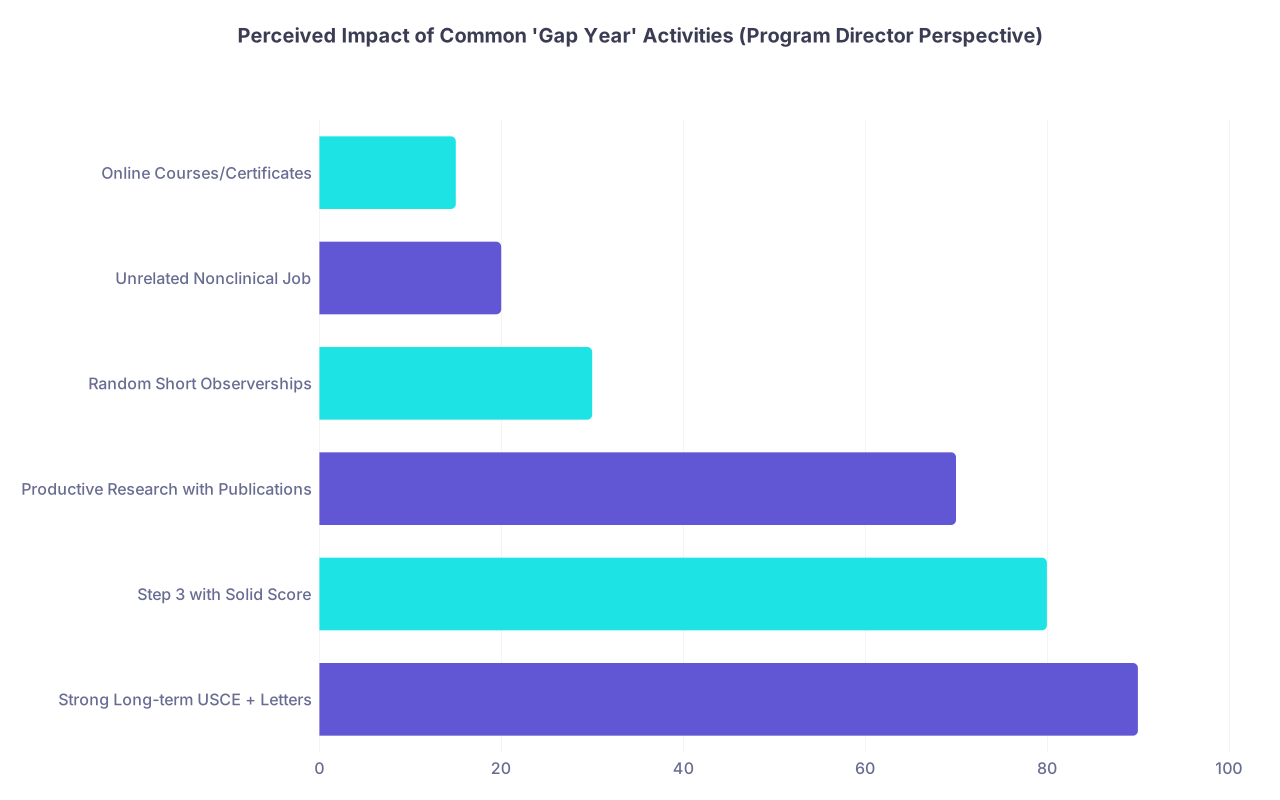
| Category | Value |
|---|---|
| Strong Long-term USCE + Letters | 90 |
| Step 3 with Solid Score | 80 |
| Productive Research with Publications | 70 |
| Random Short Observerships | 30 |
| Unrelated Nonclinical Job | 20 |
| Online Courses/Certificates | 15 |
Values are conceptual “impact scores,” not exact numbers, but they reflect what I consistently hear behind closed doors.
High-Impact Moves
Longitudinal USCE with strong letters
Not just being there. Being remembered. A 3–6 month role as a research fellow with clinic time, a sub-intern-style externship, or a structured hands-on experience can single-handedly change how your file reads.
When I hear: “We know this person, they worked here for months, and I’d trust them with our interns,” that overrides a lot of static noise about YOG or being a reapplicant.
Step 3 passed with a solid score
Particularly if your Step 2 was average or slightly below the bar. Many community programs and visa-heavy programs quietly like Step 3 done before residency. It makes you lower risk.
Real research with output
Not “assisted with data collection for 2 months.” I mean: your name on a paper, abstract, or poster. Ideally in the specialty you’re applying to.
Is it mandatory for primary care specialties? No. But as an unmatched IMG, you are not playing the same game. You are trying to outcompete fresh applicants. Any serious productivity that screams “driven and reliable” helps.
Medium-Impact Moves
Teaching, tutoring, or structured clinical roles in your home country
Better than nothing, especially if you can spin it as ongoing clinical exposure and responsibility. But US-based activity usually beats it.Targeted networking that leads to real advocacy
Not mass-emailing PDs. I mean working under someone who then calls or emails PDs on your behalf. That kind of networking actually matters.
Low-Impact or Cosmetic Moves
- Short observerships with generic letters.
- Online certificates (Coursera “Clinical X”, random leadership courses).
- “Shadowing” that doesn’t lead to real relationships.
These things might fill a gap on your CV, but they rarely turn a rejection into an interview.
Should You Switch Specialties After Going Unmatched?
This is where people really lose the plot.
There’s a lazy narrative: “If you went unmatched in internal medicine, just try family medicine or pediatrics. They’re easier.”
Sometimes that’s strategically smart. Sometimes it’s just surrender wearing a lab coat.
Here’s the honest breakdown:
- If you applied to something brutally competitive as an IMG (derm, ortho, neurosurgery, etc.) and went unmatched, yes — unless your profile is extraordinary, you probably need to pivot to a realistic specialty.
- If you applied to internal medicine or family medicine with very low scores, minimal USCE, and old YOG, and went unmatched, you likely did not miss by “just a hair.” Switching to another primary care specialty does not magically erase the underlying weaknesses.
- A specialty switch helps when the only real problem was that your choice was misaligned with your profile competitiveness, not when your entire application was weak.
Ask yourself two questions:
- Was my profile at least average for matched IMGs in that specialty? (Score, YOG, USCE, etc.)
- Did I get any interviews?
If you had zero interviews and your profile was objectively below the typical matched IMG in that field, simply switching specialties won’t save you unless you upgrade the fundamentals alongside the switch.
When Reapplying Makes Sense — And When It Doesn’t
Let’s be even more direct: Sometimes the healthiest, smartest move is to stop reapplying.
Programs rarely say this out loud. Your friends won’t either. But I’ve sat in rooms where PDs look at serial reapplicants with the same flawed profile and quietly say, “We’re doing them a favor by not interviewing them again.”
Reapplying can make sense if:
- You have a clear, realistic plan to improve 2–3 major areas (e.g., Step 3, long-term USCE, better letters, more applications to realistic programs).
- Your YOG is still within or near the implicit cutoffs most programs use (ideally <5–7 years for many IM specialties).
- You can afford another cycle — financially, emotionally, and in terms of lost time — without wrecking your life.
Reapplying is questionable or unwise if:
- You are >8–10 years from graduation with no strong USCE or current clinical practice.
- You cannot realistically boost any of your major weaknesses (e.g., no way to get USCE, no chance to take Step 3, no research access).
- You’re clinging to an unrealistic specialty purely out of pride.
That does not mean your career is over. It means the US residency path might be closed or extremely unlikely, and you should have a serious, cold-eyed plan B: another country, another role in healthcare, or a different track entirely.
How to Frame Your “Unmatched” Year in Your Application
Programs know people go unmatched. They are not shocked by it. What they care about is how you respond.
You need to do two things:
Own the failure without self-pity or excuse-making.
“I was unsuccessful in the 2025 Match. Looking back, my application lacked recent US clinical experience and strong letters. Over the past year, I focused on addressing this directly by…”
That is the tone. Not “due to the competitiveness of the Match” or “despite my strong application.” They see through that.Show a clear trajectory, not random noise.
Your year should look like: targeted USCE → consistent involvement in clinical or research work → clear letters and relationships → maybe Step 3 → coherent narrative about why you’re more ready now.
If your gap year narrative is: “I did some observerships, helped in a clinic for a bit, took an online course, and reapplied,” you look like someone who waited to see what would happen. Not someone who grabbed the problem by the throat.
The Bottom Line: Your Chances Aren’t Ruined — But They’re Different Now
Let’s strip it to the essentials.
Being unmatched once as an IMG is not a permanent death sentence, but it absolutely changes the math. You are no longer competing as a “normal” applicant. You’re being judged on what you did after failing the first time.
Reapplicants who match don’t just “wait and reapply.” They upgrade something real: long-term USCE with strong letters, Step 3 with a solid score, or meaningful research/clinical productivity that changes how a PD views their risk.
Blind persistence is not bravery; it is waste. If you cannot realistically improve your application in major ways — or your YOG and profile are far outside the typical matched IMG range — you owe it to yourself to seriously consider alternate paths rather than lighting more years and dollars on fire.
You are not ruined. But you are not average anymore. If you accept that and act accordingly, you still have a shot. If you ignore it, you will become another “three-time reapplicant” story whispered about by program coordinators — and not in a good way.