

It’s 10:30 p.m. You just finished a brutal call shift as an IMG resident on a J‑1 or H‑1B. Your co-resident is talking excitedly about their Roth IRA and low-cost index funds. You quietly Google “Can I invest in the U.S. on a visa?” and three minutes later you’re drowning in tax jargon, FATCA, treaty rules, and conflicting Reddit threads.
You’re worried about three things at once:
- Am I even allowed to invest here on my visa?
- What happens to my money if I have to leave the U.S. suddenly?
- How do I avoid getting destroyed by U.S. and home-country taxes?
You’re exactly who I’m talking to.
Let’s walk through what to do, practically, as an international medical graduate investing in the U.S. under visa constraints.
1. First Reality Check: What Your Visa Actually Limits (And What It Doesn’t)
Let me cut through the fear: your immigration status usually doesn’t stop you from investing. The constraints are around work authorization and presence, not around owning assets.
Common situations:
- J‑1 in residency/fellowship
- H‑1B employed as attending or senior fellow
- F‑1 on OPT, doing research or pre-residency work
- Green card pending, stuck in the queue
You need to separate three concepts in your head:
- Can I open accounts?
- Can I legally do “work” related to investments?
- How will I be taxed?
Here’s the blunt version:
- You can usually open U.S. bank accounts, brokerage accounts, and retirement accounts with a valid SSN or ITIN and proof of U.S. address.
- You cannot run an active business on the side without specific authorization. Day-trading like a full-time job starts to smell like “work.” Passive investing does not.
- You will be taxed by the U.S. on income generated here if you’re a tax resident (and often even if you’re not).
If a broker or bank says “we don’t take non-U.S. persons,” that’s their internal policy, not the law. Many mainstream firms will work with you if you have an SSN and a U.S. address.
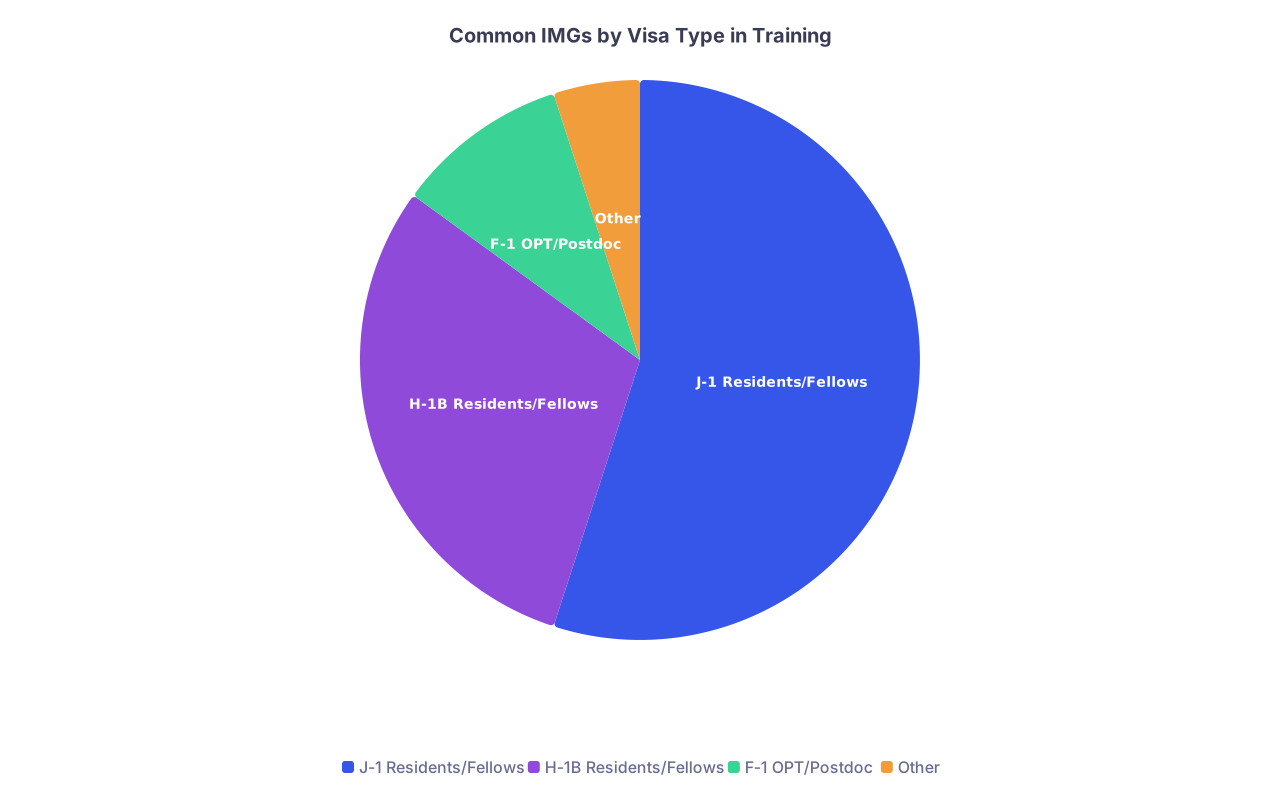
| Category | Value |
|---|---|
| J-1 Residents/Fellows | 55 |
| H-1B Residents/Fellows | 30 |
| F-1 OPT/Postdoc | 10 |
| Other | 5 |
2. Step One: Nail Down Your Tax Residency Status
Forget the visa for a moment. The IRS doesn’t care what letters are on your passport stamp; it cares about whether you’re a U.S. tax resident.
You’re usually a U.S. tax resident if you meet the Substantial Presence Test (SPT), which roughly means:
- You’re physically in the U.S. more than 183 “weighted” days over a 3-year period.
Here’s the trap:
- Many J‑1 students and researchers are exempt from counting days for a while.
- Many residents/fellows on J‑1 visas are treated as tax residents once they’re past the exempt period.
You don’t get to choose the status you like. It’s formula-based. But you must know which one you are, because:
- As a U.S. tax resident, the U.S. taxes you on worldwide income, just like a citizen.
- As a nonresident alien, the U.S. taxes you only on U.S.-source income, and different withholding/treaty rules apply.
If you’re not sure where you fall, spend an hour with a CPA who actually understands nonresident/resident alien rules. Not a random strip mall tax preparer.
This status decision affects:
- Whether a Roth IRA is allowed and sensible
- Whether PFIC rules hammer your foreign funds
- Whether your home-country pension gets U.S.-taxed
3. Opening Accounts: What You Can Realistically Use
Let’s talk practical setup. You’re in training or early attending years and you want to start.
You’ll likely use four types of accounts:
- U.S. bank account (checking/savings)
- U.S. taxable brokerage account
- Employer retirement account (401(k), 403(b), 457(b))
- IRA (Traditional or Roth) — if eligible
Most IMGs on J‑1 or H‑1B can open all four, as long as they:
- Have an SSN (or in some cases, ITIN)
- Have a U.S. address (temporary is fine—your current housing)
- Provide the usual AML/KYC documentation
Red flags and friction you might see:
- Some robo-advisors and discount brokerages don’t onboard non-U.S. tax residents or non-citizens. If one turns you away, try another. This is normal.
- Your foreign (home-country) address on file can cause problems. Use your current U.S. residence while you’re here.
- Name mismatches between passport, SSN, and HR can create delays. Fix those early.
If you can get access to a large, boring provider (Fidelity, Vanguard, Schwab, major employer plans with these custodians), use them. Resistant brokers that insist on you being a U.S. citizen are usually not worth fighting.
4. The Big Question: “But What If I Have to Leave the U.S.?”
This is the anxiety that quietly drives everything for IMGs. Because your situation isn’t:
“How do I invest for 30 years in the U.S.?”
It’s:
“How do I invest so that if I get forced out in 2–3 years, I don’t get ruined?”
You need portability.
So you design your investment life assuming three possible futures:
- You stay in the U.S. long-term and get a green card.
- You do a few years here, then leave permanently.
- You bounce between countries over your career.
Your portfolio and account choices should work reasonably well in all three.
That means:
- Avoiding products that turn toxic if you leave (e.g., foreign mutual funds as a U.S. tax resident = PFIC nightmare).
- Having a clean structure if you become a nonresident again (what to do with IRAs, 401(k)s, brokerage investments from abroad).
- Understanding if your future home country will punish U.S. retirement accounts with bad tax treatment.

5. What You Should Prioritize as an IMG on a Visa
Let’s get concrete. Assume you’re in training or early attending years, on J‑1 or H‑1B, with educational debt (maybe U.S. loans, maybe home-country loans), and you want to invest.
Here’s my actual priority list in most IMG visa situations:
Emergency fund in cash (in the U.S.)
At least 3–6 months of U.S. living expenses. If something goes wrong with your visa or job, you need runway to make rational decisions, not panic-driven ones.Employer match in retirement accounts
If your hospital offers a 401(k)/403(b) match, take it. Even if you leave the U.S., that money remains yours. You can usually leave it there or roll it into an IRA. Free match beats almost everything.Reasonable debt strategy
Understand whether your U.S. loans are eligible for PSLF or income-driven repayment, how that interacts with your visa (especially J‑1 with home requirement), and whether aggressive payoff versus balanced investing makes sense.Low-cost, boring index funds in tax-advantaged accounts
401(k/403(b), then Roth/Traditional IRA if allowed and if you expect to stay long enough that it’s worth it.Simple taxable brokerage investing only after 1–4 are handled
That’s where you put extra long-term money in U.S. index ETFs/mutual funds.
| Priority | Action |
|---|---|
| 1 | Build U.S. emergency fund |
| 2 | Maximize employer retirement match |
| 3 | Set clear debt repayment plan |
| 4 | Contribute to IRA if eligible |
| 5 | Invest via taxable brokerage |
6. Visa-Specific Landmines You Need to Watch
J‑1 Physicians
You’ve got the dreaded 2-year home-country physical presence requirement hanging over you in many cases.
The question I hear: “Should I even bother with U.S. retirement accounts if I might have to leave?”
My answer: usually yes, with eyes open.
- Your 401(k)/403(b) doesn’t vanish if you leave. You can keep it in the U.S., invested.
- Early withdrawals before age 59½ normally incur tax + 10% penalty, but if you’re overseas years later, treaty rules and status as a nonresident alien when you take distributions can change the final tax picture. That’s a planning project for later.
- Employer match + tax deferral, even for a 5–10 year horizon, usually beats just hoarding cash.
But for J‑1s who are almost certain they’ll leave and never return, I’d avoid overfunding complex retirement structures that are painful to deal with from overseas. Stick to:
- Enough in 401(k)/403(b) to get match, maybe more if your tax rate is high now.
- Extra savings in plain taxable accounts that are easy to access if you move.
H‑1B Physicians
You have more long-term U.S. potential, but your situation is still not guaranteed. Green card backlogs (looking at you, India and China) can mean a decade of uncertainty.
You should usually:
- Max your 401(k)/403(b) if cash flow permits.
- Strongly consider a backdoor Roth IRA if your income is high and you’re a tax resident.
- Invest in taxable accounts assuming you might keep them as a nonresident alien later — which can actually simplify some U.S. tax issues.
F‑1 on OPT / Pre-Residency Work
You have the most fragile immigration situation.
I’d:
- Focus on liquidity first — large emergency fund, minimal illiquid commitments.
- Use employer retirement plans if offered, but not go aggressively into structures that lock money away for decades if there’s a real chance you’ll leave after 1–3 years.
- Avoid trying to be clever with real estate or LLCs on an F‑1. Too much legal risk if it looks like you’re running a business without authorization.
7. Investing From the U.S. While You Still Have Ties Abroad
Here’s where things get messy: you’re in the U.S. on J‑1/H‑1B, but you still have:
- A bank account and maybe investments in your home country
- Rental property or land
- A pension scheme or government retirement plan
If you’re a U.S. tax resident, the IRS wants to know all about it.
Common traps:
- Foreign mutual funds / ETFs / “investment-linked insurance” products → These can be treated as PFICs. PFIC = punitive tax + reporting hell. If you don’t understand PFIC rules, assume anything that smells like a foreign mutual fund is dangerous while you’re a U.S. tax resident.
- Not reporting foreign accounts over thresholds (FBAR, FATCA Form 8938). Penalties can be ugly.
If you still want to maintain investments back home while a U.S. tax resident, you need two professionals:
- A U.S. tax advisor who knows cross-border issues.
- Someone knowledgeable in your home-country tax to avoid double taxation or missed filings.
For many IMGs, the simplest move while in the U.S. tax system is:
- Don’t add new complexity abroad.
- Gradually shift to U.S.-based, tax-efficient investments while you’re here.
- Keep necessary things (e.g., one bank account, maybe one property) but don’t build a foreign mutual fund empire while you’re subject to PFIC rules.
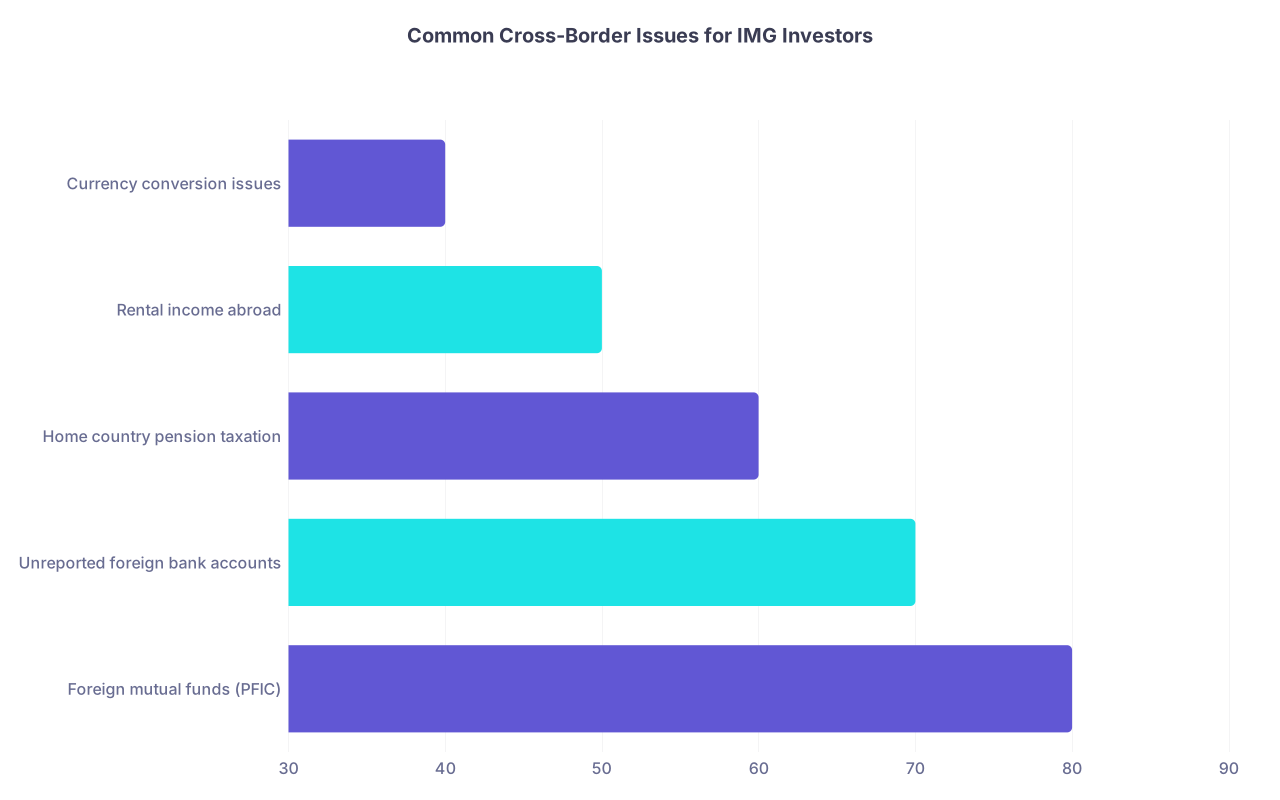
| Category | Value |
|---|---|
| Foreign mutual funds (PFIC) | 80 |
| Unreported foreign bank accounts | 70 |
| Home country pension taxation | 60 |
| Rental income abroad | 50 |
| Currency conversion issues | 40 |
8. U.S. Real Estate: Should You Buy a House on a Visa?
Short answer: often no, occasionally yes, almost never early in training.
If you’re on a time-limited J‑1 with possible home-return requirement and you’re thinking about buying a house during residency because “rent feels like throwing money away,” stop. The risk isn’t just money; it’s mobility.
You should only seriously consider buying U.S. real estate if:
- You have strong reason to believe you’ll be in that city or region for at least 5–7 years.
- You have a substantial down payment and reserves (not just scraped-together 3–5%).
- You understand landlord rules and tax treatment if you end up moving and keeping the property as a rental.
For an IMG with visa uncertainty, flexibility is an asset. Real estate is a giant ball and chain.
If you’re an attending on H‑1B with an I‑140 approved, long-term job contract, and no looming move, then a primary residence can make sense. But don’t treat it as an “investment strategy” first. It’s primarily housing. Investments go in securities.
9. If You Have to Leave the U.S.: What Happens to Your Investments?
Let’s say worst case or just different path: visa issues, no waiver, or you just decide to go back home or to a third country.
What usually happens to your U.S. investments?
- Bank accounts – Often can be kept as long as you keep address/contact updated. Some institutions kick out nonresident clients; others don’t care.
- Brokerage accounts – Many U.S. brokers will restrict new account openings for non-U.S. residents but may let existing clients keep accounts with limited trading. Some may force liquidation. You need to ask your broker before you leave.
- Retirement accounts (401(k), 403(b), IRA) – You don’t have to cash them out. You can usually leave money invested in the U.S. and take distributions later. Taxes become a mix of U.S. withholding + your new country’s tax rules + any treaties. This is where a real cross-border advisor earns their fee.
So do you need to liquidate everything before you leave? Not usually. In fact, panic liquidation can trigger big capital gains taxes at exactly the wrong time.
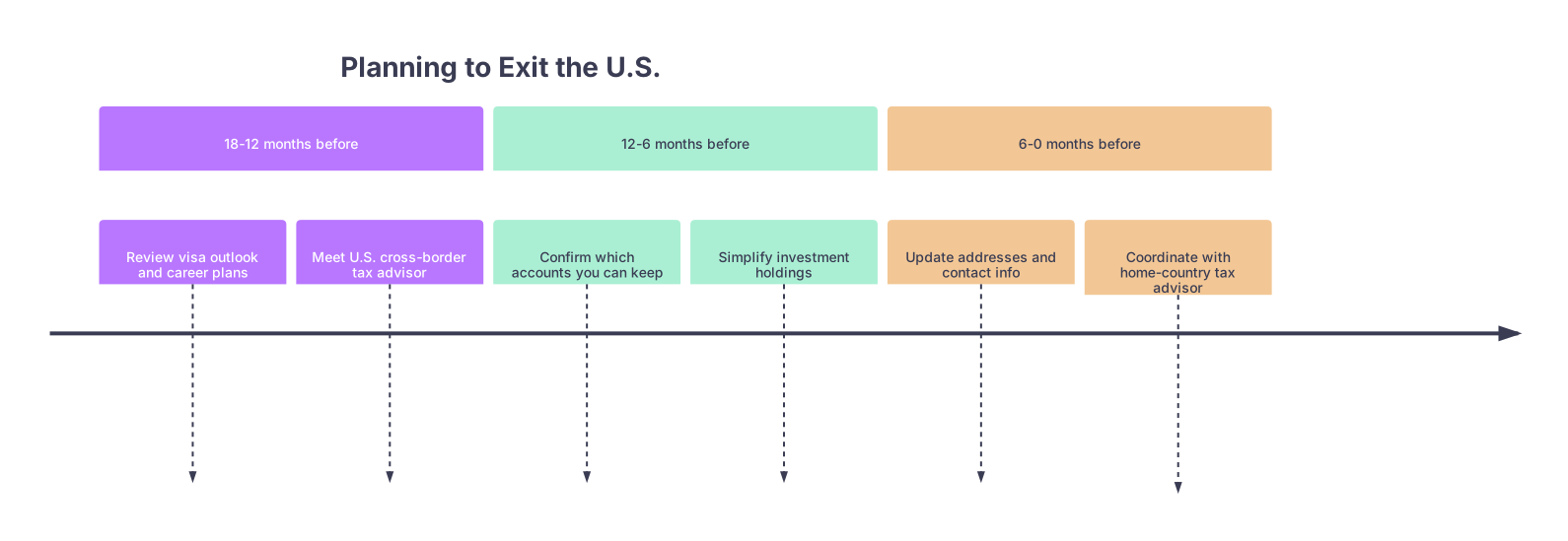
Better plan:
- 12–18 months before a possible move, start consulting tax pros in both jurisdictions.
- Clarify which institutions will continue to serve you as a nonresident and under what rules.
- Gradually simplify holdings (fewer funds, avoid esoteric products) so that post-move tax reporting is straightforward.
10. What to Avoid: Common IMG Investing Mistakes
I’ve seen the same self-inflicted problems over and over:
- Ignoring tax residency and just copying what U.S. co-residents do. Your friend from Ohio doesn’t have PFIC risk from their home-country funds. You might.
- Over-committing to illiquid assets (house, complex business structures) when your visa could collapse with one policy change.
- Trying to side-hustle actively (trading like crazy, running a short-term rental, “consulting”) without checking how it interacts with visa work restrictions.
- Using random advisors who don’t understand visas or cross-border tax. They’ll tell you things that are technically correct for citizens but wrong or dangerous for you.
- Letting fear paralyze you so you keep everything in checking accounts “until my status is stable.” Five “just one more year” decisions later, you’ve lost a decade of compounding.

11. A Simple, Reasonable Strategy for Most IMGs on Visas
If I had to give you a default plan, assuming you’re a typical IMG resident/fellow or young attending on J‑1/H‑1B:
- Confirm your current U.S. tax residency status with a competent tax professional.
- Open/maintain:
- U.S. checking + savings.
- Employer retirement account (401(k)/403(b)).
- One low-cost brokerage account with a major provider.
- Build:
- 3–6 months emergency fund.
- Contribute to employer account up to the match at minimum.
- Invest:
- Inside retirement accounts: low-cost U.S. stock and bond index funds.
- In brokerage (once you have emergency fund + match): U.S. total stock market or S&P 500 ETFs, maybe one bond fund if you want lower volatility.
- Avoid:
- Foreign mutual funds while a U.S. tax resident.
- Real estate purchases until your immigration and geographic plans are clearer.
- Complex “tax schemes” or fancy products pitched to “wealthy professionals.”
This is boring. That’s the point. Boring travels well.
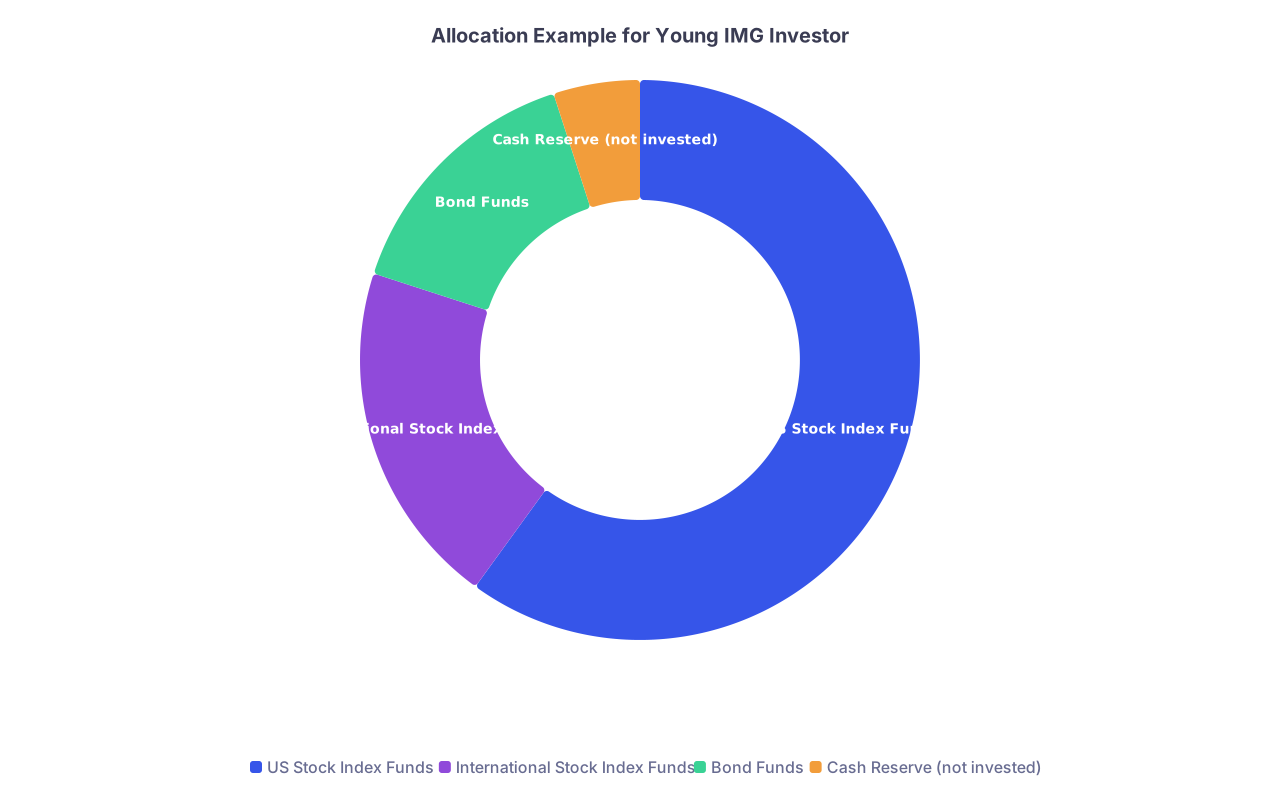
| Category | Value |
|---|---|
| US Stock Index Funds | 60 |
| International Stock Index Funds | 20 |
| Bond Funds | 15 |
| Cash Reserve (not invested) | 5 |
FAQ (Exactly 4 Questions)
1. Can I open a U.S. brokerage account on a J‑1 or H‑1B visa?
Yes, in most cases. If you have a Social Security Number, a U.S. address, and pass the broker’s identity checks, you can open a brokerage account. Some firms won’t onboard non-citizens or non-permanent residents due to their own policies, but that’s not a legal ban. If one broker refuses, try another large, reputable institution. Always answer tax residency and citizenship questions honestly on the application.
2. Should I still invest in a 401(k)/403(b) if I might have to leave the U.S. in a few years?
Usually yes, at least up to any employer match. Employer contributions are essentially free money, and tax deferral still helps even over a mid-length horizon. You don’t lose the account if you leave; you can leave it invested in the U.S. or roll it to an IRA later. Before making huge contributions beyond the match, think about your likely time in the U.S. and whether tying up money in tax-advantaged accounts fits your flexibility needs.
3. What happens to my U.S. investments if I become a nonresident again or move back home?
Generally, your U.S. accounts don’t automatically close. Bank, brokerage, and retirement accounts can often remain open, but some institutions impose restrictions or stop serving nonresident clients. You may face U.S. withholding taxes on investment income as a nonresident, and your new country might tax the same income again, depending on treaties. A year or so before moving, talk to cross-border tax professionals and your financial institutions so you can simplify holdings and avoid forced, taxable sales at bad times.
4. Is day-trading or active stock trading risky for my visa status?
Yes, it can be. Immigration rules care about unauthorized “work.” Passive investing (buying long-term index funds, occasional rebalancing) is fine. But if you’re day-trading at high frequency, treating it like a side business, or generating substantial self-employment-like income, you risk drifting into activity that could be viewed as unauthorized work, especially on F‑1 or J‑1. Even on H‑1B, it can complicate things. Keep your investing clearly passive and long-term while your visa status is sensitive.
Key Takeaways
- Your visa almost never forbids passive investing, but it absolutely shapes how you should structure it and how much flexibility you need.
- Get your tax residency status correct, use simple U.S.-based accounts and low-cost index funds, and avoid foreign mutual funds and unnecessary complexity while you’re under the U.S. tax system.
- Plan as if you might leave in 3–5 years, but invest as if your money needs to work for 30–40 — boring, portable, and tax-aware beats both panic and paralysis.


