
The idea that “low-competition” specialties have weaker clinicians is lazy thinking dressed up as career advice. It’s wrong, and in some cases, it’s spectacularly backwards.
Let me be direct: lower USMLE cutoffs and fewer applicants per spot do not equal lower clinical standards. They equal different selection pressures. You’re confusing test-score arms races with actual patient-care competence.
You see this all the time on the trail: third-years whispering that “people who can’t match derm just do family” or that “psych is for people who hate medicine.” An attending shrugs and says, “Well, the best and brightest go into competitive fields.” The implication is always the same—if a specialty doesn’t demand a 260+ Step 2, the clinical bar must be lower.
Here’s what the data, structure, and day-to-day reality actually show.
What “Low-Competition” Really Means (And What It Doesn’t)
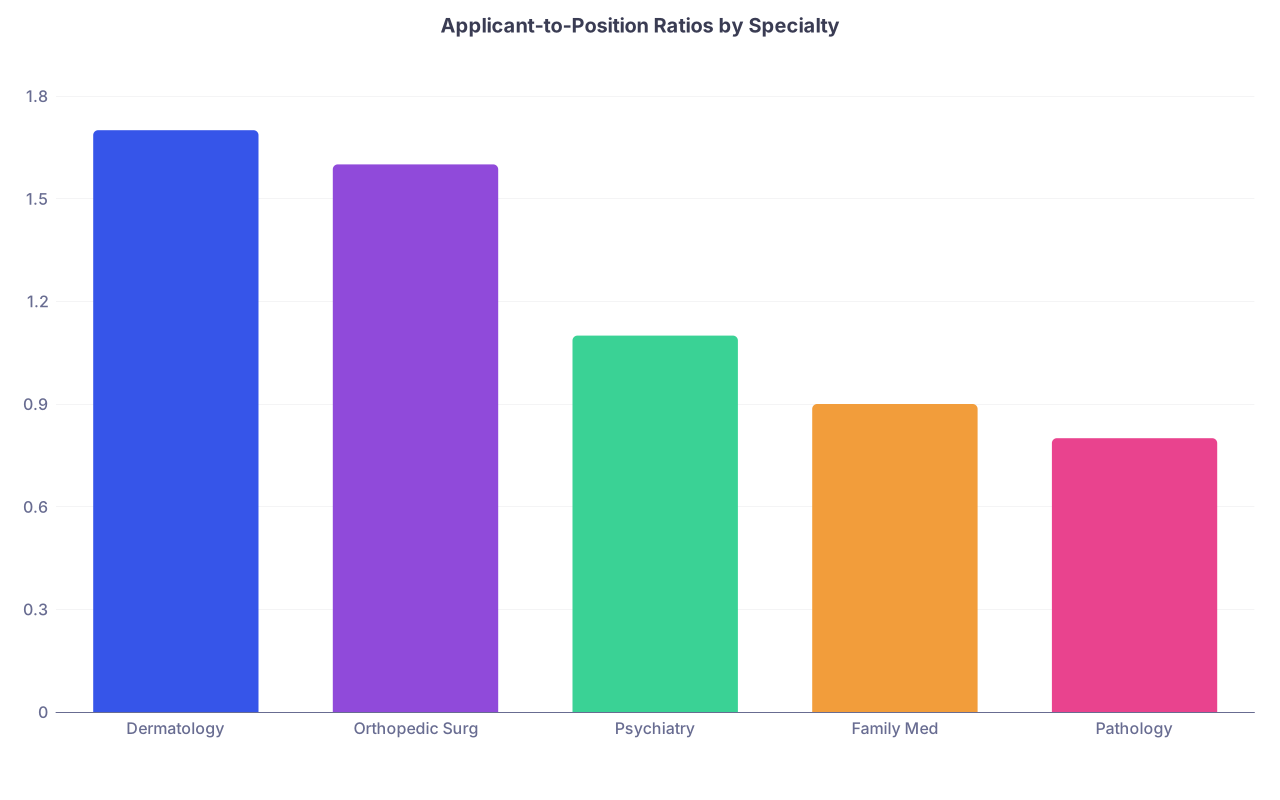
First you have to stop using “competitive” as a proxy for quality. NRMP match data defines competitiveness in terms of supply and demand, not “clinical excellence.”
| Category | Value |
|---|---|
| Dermatology | 1.7 |
| Orthopedic Surg | 1.6 |
| Psychiatry | 1.1 |
| Family Med | 0.9 |
| Pathology | 0.8 |
Those ratios tell you how many people are chasing each slot. That’s it. They don’t tell you:
- Which specialty has more decision-heavy days
- Which requires more longitudinal judgment
- Which has higher stakes for missed pathology
They just tell you where the crowd is.
Here’s the blunt truth: “low-competition” in the match usually reflects one or more of these:
- Lower lifestyle prestige among students (call, pay, glam factor)
- Geographic distribution (lots of community programs, rural sites)
- Misaligned incentives (reimbursement ignoring cognitive work, mental health, prevention)
- Less research hype or fewer academic chairs loudly selling the specialty
None of these have anything to do with how clinically sharp the practicing docs must be to not hurt people.
People conflate Step scores with competence because they’re easy to measure. Program directors can slap a 250 cutoff into ERAS and feel like they’ve “ensured quality.” But the correlation between test performance and real-world clinical skill is moderate at best and declines rapidly once you’re out of training. Smart enough matters; “smarter on paper than your peers” has diminishing returns.
The Hidden Reality of “Low-Competition” Work
Walk through the day of a family medicine attending at a busy FQHC, a psych resident on an inpatient unit, or a general internist managing a complex panel in a safety-net hospital. Compare that to the average day of a PGY-4 in a hyper-competitive, highly procedural niche clinic. Both hard. Just hard in different axes.
Family medicine, internal medicine primary care, psych, PM&R, even pathology in many settings—all carry a specific kind of clinical demand students massively underestimate.
You don’t get narrow.
You’re exposed to chaos, multimorbidity, and bad social determinants every single day. Low-competition fields often mean:
- Less pre-filtering of patient complexity
- Fewer guardrails and fewer consultants
- Wider breadth of problems per hour
- Much more uncertainty, with fewer labs, images, or procedures to "solve" the problem quickly
That’s not lower standards. That’s higher tolerance for ambiguity.
Evidence: Outcomes Don’t Collapse in “Less Competitive” Fields
If the myth were true—that these specialties have systematically lower clinical standards—you’d expect to see it somewhere measurable. Worse mortality. More complications. More malpractice. Something.
You don’t.
Take primary care. Multiple large studies show:
- Primary care supply is strongly associated with lower overall mortality and better population outcomes.
- Regions with more family physicians have lower rates of hospitalizations for chronic diseases and lower healthcare costs, without worse clinical outcomes.
If family med were full of “weaker” clinicians, you’d see that in hospitalization rates and mortality. You see the opposite.
Psychiatry? Every meta-analysis that looks at collaborative care and specialty mental health involvement shows improved treatment response and functioning. Bad psychiatry is very visible—failed safety planning, missed mania, inappropriate polypharmacy. Yet when systems invest in psychiatrists and integrated care, outcomes improve. That’s not “low standards” territory.
Pathology? These are the people whose “low-competition” field literally decides whether the surgeon cuts more tissue or closes. If pathology standards were lower, malpractice and re-excision rates would be exploding. They’re not. When errors do happen, they’re investigated ruthlessly because the entire downstream care chain depends on that call being right.
So where’s the evidence of lower standards in so-called less competitive specialties? It’s not in patient-level outcomes. It’s not in system-level metrics. It’s mostly in med student gossip and prestige narratives.
Training Standards: Accreditation Doesn’t Care About Your Step Score
Here’s the part students almost never think about: the training environment is regulated, heavily, and the bar for minimal competence is not meaningfully different across specialties.
Every ACGME-accredited residency, whether it’s neurosurgery or outpatient-heavy family medicine, must:
- Demonstrate a curriculum that hits defined milestones
- Perform regular resident evaluation and remediation
- Show graduates meet specialty board eligibility standards
- Maintain adequate supervision, case volume, and diversity of pathology
The family medicine resident still has to manage septic shock on nights. The psych resident still has to recognize NMS and serotonin syndrome and get emergency medicine involved. The path resident still has to correctly classify malignancies according to rapidly evolving criteria and molecular markers.
Yes, filters to get into each pipeline differ. But once inside, the expectation at graduation is not “be ok-ish because your field is chill.” Board exams in these specialties don’t say, “Well, you’re just psych, so partial credit for missing catatonia.” The bar is specialty-specific but very real.
Board pass rates across specialties tell another story. The supposed “low-standard” fields are not failing people left and right. They sit in the same general range as the “elite” specialties. Where someone starts (USMLE score) and where they need to end up for safe independent practice are not the same thing.
Why Students Misjudge “Clinical Standards”
You get a warped sample.
Your strongest day-to-day exposures to a specialty during med school are:
- Large academic centers
- Subspecialty clinics
- Settings where procedures and technology dominate
Those are exactly the settings that favor high-board-score applicants and high-research-output specialties. They’re also the places where students see a very narrow slice of real clinical work. The outpatient psych attending doing quiet, precise longitudinal work in a community clinic? You might never rotate there. The FM doc in a rural town juggling OB, inpatient, clinic, and ER coverage? You might see that life for one week, if at all.
So you extrapolate from your local derm or ortho attendings (who are, granted, often brilliant and technically outstanding) and assume: “Oh, this is what ‘high standards’ looks like.” Meanwhile, you see a tired community IM or FM attending drowning in volume and conclude “lower standards” because they’re not quoting NEJM every 10 minutes.
I’ve watched students absolutely botch complexity judgments:
- Calling outpatient psych “easy” after watching 45 minutes of med management in a well-resourced private clinic, having no clue what a 20-bed public inpatient unit looks like at 3 a.m.
- Assuming family medicine is “simple colds and diabetes” while not noticing the subtle risk stratification, careful follow-up planning, polypharmacy unwinding, and social navigation happening in each short visit.
- Dismissing PM&R because “it’s like fancy PT,” ignoring the neuroanatomy, spasticity management, cardio-respiratory considerations, and device/prosthetics decisions driving the care plan.
You’re not good at judging what’s clinically hard yet. That’s not a character flaw. It’s just stage of training. But you shouldn’t build your specialty hierarchy on your own miscalibration.
A Hard Look: Where Standards Actually Erode
Let me be unfairly honest: yes, clinical standards can slip. In any specialty. Competitive or not.
Where does that more often happen?
- Overstretched community settings with high volume and low support
- Undersupervised environments, especially nights/weekends
- Systems that reimburse throughput over thought
Those risk factors hit “low-competition” and “high-competition” fields differently, but they exist across the board. An overworked hospitalist on night float, signing out 40 patients while managing cross-cover, is under the same type of cognitive pressure as a surgical resident in a busy trauma center.
The problem isn’t “this field is low competition so everyone is mediocre.” The problem is “this system is understaffed and burning people out, so corners get cut.”
If you want to be serious about clinical standards, this is the axis you should be looking at: workload, supervision, culture, feedback loops. Not NRMP fill rates.
The Pathology of Prestige: How Myths Hurt Patients and Trainees
This myth doesn’t just annoy me. It does real damage.
I’ve seen strong students who are naturally suited for psychiatry or primary care talk themselves out of it because they “don’t want to waste their scores.” Or worse, they match something procedurally sexy, are miserable, and then quietly burn out. Not because they’re weak, but because they’re in a field that doesn’t match their actual strengths.
On the patient side, when the culture tells you that some fields are full of “lesser” clinicians, you get:
- Delayed referrals (“It’s just psych, they won’t do much”)
- Less respect for outpatient notes from FM/IM (“We’ll re-do everything inpatient”)
- Fragmentation, because the “high-prestige” services don’t see those clinicians as full partners
Meanwhile, the supposedly low-standard clinician is often the only one who knows that patient well enough to prevent disaster.
What Actually Predicts High Clinical Standards
If you insist on a heuristic, here’s a better one than “specialty competitiveness = quality.”
Look at:
- Program culture. Do attendings know their residents’ weaknesses and actively address them, or do they just complain at faculty meetings?
- Feedback quality. Are you getting vague “good job” comments or specific, behavior-focused input?
- Case mix and responsibility. Are residents shielded from hard decisions, or are they progressively trusted while supervised?
- System support. Does the environment make it possible to do the right thing, or does it punish anything that slows throughput?
You can find programs with excellent standards in “low-competition” specialties and programs with surprisingly lax standards in “elite” fields. I’ve seen both. Repeatedly.
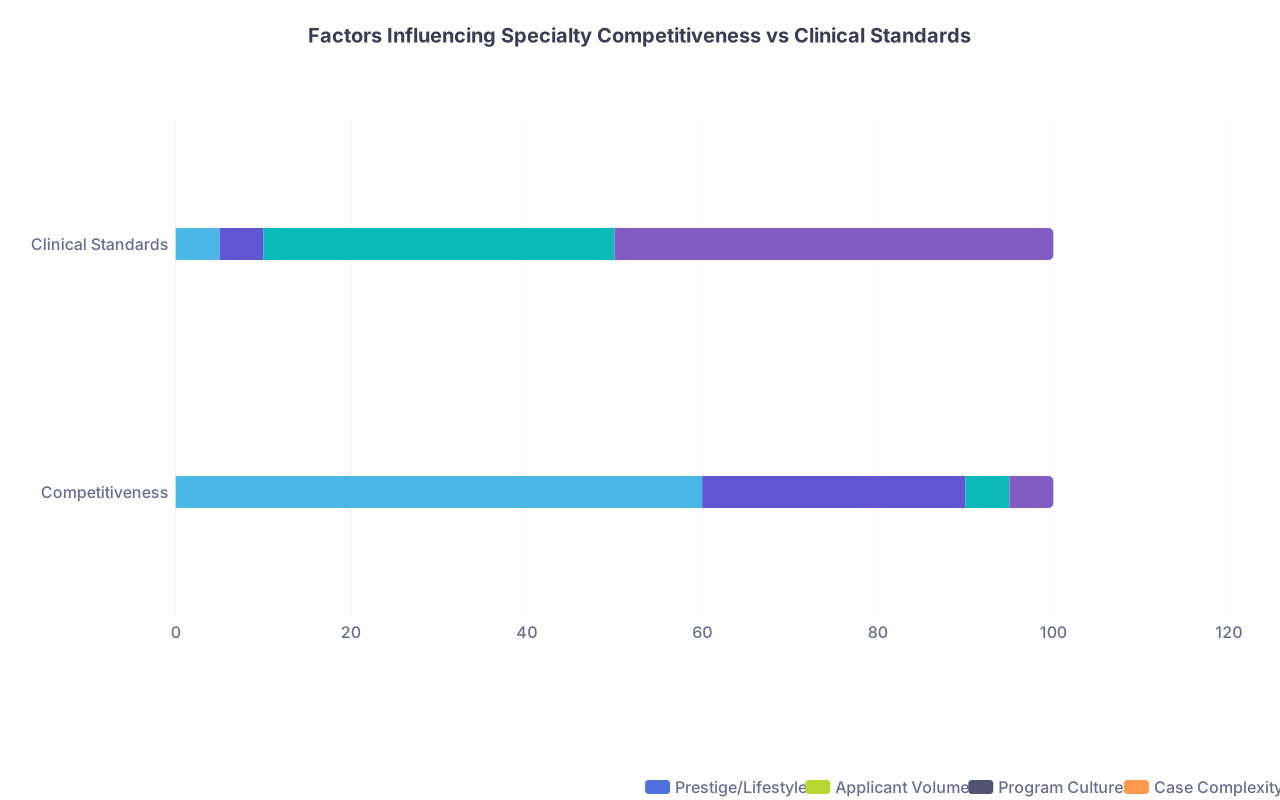
To sharpen this, here’s a quick comparison of what students think matters versus what actually tracks with quality clinicians:
| Factor | Student Assumes It Predicts Quality | Actually Predictive of Quality |
|---|---|---|
| Average Step score | High impact | Modest at best |
| Specialty competitiveness | High impact | Very limited |
| Procedural intensity | High impact | Specialty-specific only |
| Program feedback culture | Rarely considered | High impact |
| Case complexity exposure | Underestimated | High impact |
Specialty Examples: Where the Myth Cracks Fast
Family Medicine / General Internal Medicine
Students fixate on “low Step cutoffs” and “unfilled spots.” Then they rotate in a good FM or IM clinic and watch:
- A 20-minute visit where the doc addresses CHF, CKD, depression, medication costs, and food insecurity.
- A resident quietly catching early pancreatic cancer because “that abdominal pain isn’t behaving right.”
- Complex anticoagulation management, vaccine counseling, goals of care, and safe deprescribing choices—back-to-back.
That’s not low standards. That’s a different skill set than “can I take out a gallbladder in 30 minutes,” but no less technically demanding once you understand the difficulty.
Psychiatry
People assume “just talking” equals low rigor. Then they see:
- A single missed detail in a history that separates unipolar depression from bipolar II and completely changes the safe medication list.
- The difference between recognizing lingering psychosis versus personality-driven behavior.
- Managing metabolic syndrome, QTc, pregnancy, substance use, and suicide risk all at once.
You can coast and be mediocre in psych, same as any field. But the best psychiatrists are doing clinical reasoning as complex as any “competitive” internal medicine subspecialist. Just in a different domain.
Pathology
Med students barely rotate here, then walk around declaring it low competition = low standards.
These are the folks whose call on margins, grade, and stage often decides:
- Whether a surgeon goes back
- Whether a patient gets chemo, radiation, both, or neither
- How aggressive follow-up needs to be
One misclassified lymphoma or misread frozen section can change everything. Path boards and fellowship expectations are not casually letting underpowered clinicians sign out cases.
So What Should You Actually Do With This?
If you’re choosing a specialty, stop using “it’s competitive so the standards are higher” or “it’s easy to match so the standards are lower” as a proxy. It’s an intellectually lazy shortcut and it will push you toward the wrong field.
Instead, when you’re on rotation, ask:
- Who here is truly excellent, and what do they actually do all day?
- Do I like the kind of thinking this specialty rewards?
- Can I see myself caring about getting better at this type of work for decades?
Then look at programs, not just specialties:
- Who trains residents to think deeply instead of just move fast?
- Who supports feedback, reflection, and growth instead of worshipping Step scores and prestige?
“Low-competition” specialties often have more space for mentorship, growth, and customization because they’re not drowning in hyper-filtered egos and research metrics. But that depends on the program, not the NRMP match rate.
Bottom Line
Three takeaways, without the fluff:
- “Low-competition” specialties do not have inherently lower clinical standards; they have different selection filters and different kinds of difficulty.
- Real clinical quality tracks far more with program culture, supervision, case mix, and system support than with average Step scores or applicant-to-position ratios.
- If you choose or avoid a specialty based on its match competitiveness instead of the actual work and your fit for it, you’re buying into a myth that helps nobody—not you, and definitely not your future patients.
| Category | Prestige/Lifestyle | Applicant Volume | Program Culture | Case Complexity |
|---|---|---|---|---|
| Competitiveness | 60 | 30 | 5 | 5 |
| Clinical Standards | 5 | 5 | 40 | 50 |