
The brutal truth: you can absolutely match without research or honors. You just cannot match anywhere or in anything. And pretending you can is how people end up SOAPing into things they never wanted.
If you’re sitting there with:
- No research
- No AOA / no honors grades
- Maybe a very average Step 2
- And panic creeping in
…this is for you. Not to shame you. To give you a salvage plan.
1. Stop fantasizing about long-shot specialties
You’re not trying to “beat the odds.” You’re trying to not blow up your career.
Fields where “no research, no honors” is a near-death sentence for matching at all (barring very specific connections):
- Dermatology
- Plastic surgery (integrated)
- Orthopedic surgery
- Neurosurgery
- ENT
- Radiation oncology
- IR (integrated)
- Competitive EM programs in big academic centers (with weak apps)
- Many university anesthesia, rads, and GI-track prelim IM spots for people aiming up-specialties
Could you get lucky? Sure. Somebody wins the lottery. But planning your future on “someone did it once” is not strategy. It is denial.
You’re in damage control mode. That means you pivot early to fields where:
- Research is optional, not expected
- Honors are nice, not required
- Being solid, reliable, and teachable actually matters more than an academic trophy shelf
We’re going to walk through those options and exactly how to play them.
2. What “no research, no honors” actually signals to programs
You need to understand what programs think when they see this. Otherwise you’ll fight the wrong battle.
When your app has:
- No publications/posters
- No significant research activity
- Mostly passes or high passes, no honors in core rotations
- Average Step 2
Programs don’t think “this person is doomed.” They think:
- Probably not an academic superstar
- Probably not gunning for a hyper-competitive fellowship
- Maybe slower learner or weaker test-taker
- Or maybe just not super engaged in the academic/hustle culture
For a lot of specialties, that’s not a dealbreaker. Some PDs actually prefer the solid, low-drama, show-up-on-time resident over “CV rockstar who melts down at 3 a.m. codes.”
But there are consequences:
- Big-name academic centers are harder to crack
- Ultra-competitive programs within even “easy” specialties will be skeptical
- You must prove competence and reliability in other ways: letters, clinical performance, rotation behavior
Your mindset needs to shift from “I lack research/honors” to “I must show them I’m safe, hardworking, and pleasant to train.”
3. The usual “easier match” suspects: realistic fields you should actually consider
Let’s sort out which specialties genuinely offer a softer landing. Not because they’re “easy.” Because they’re less credential-obsessed.
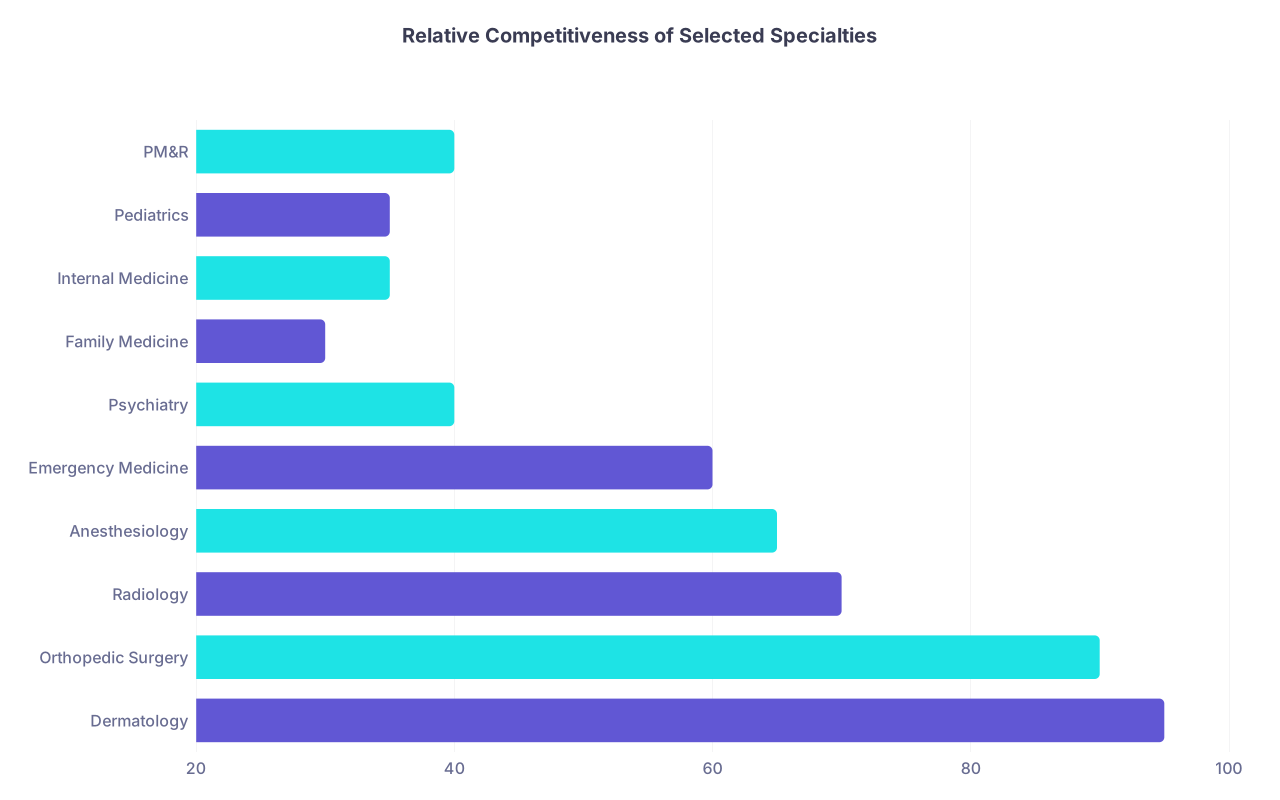
| Category | Value |
|---|---|
| Dermatology | 95 |
| Orthopedic Surgery | 90 |
| Radiology | 70 |
| Anesthesiology | 65 |
| Emergency Medicine | 60 |
| Psychiatry | 40 |
| Family Medicine | 30 |
| Internal Medicine | 35 |
| Pediatrics | 35 |
| PM&R | 40 |
Numbers are illustrative, not exact NRMP data. Point is: there are strata.
Let’s go through the main “salvage” categories.
Family Medicine (FM)
This is the safety net of American medicine. That’s not an insult. It’s reality.
Why it still works with no research / honors:
- Huge number of positions
- Community programs that care more about work ethic than CV sparkle
- Many programs used to training non-superstars into solid physicians
What still matters:
- No major professionalism red flags
- You can function on the wards without chaos
- Decent letters from FM or IM attendings who say “I’d let them take care of my family”
Who should seriously consider it:
- You’re risk-averse about matching
- Your Step 2 is marginal or borderline
- You have geographic flexibility
- You’d rather do broad-spectrum outpatient/inpatient care than chase prestige
Internal Medicine (Community / Mid-tier)
Academic IM at top 20 places? Very competitive. Community IM in non-coastal or non-urban locations? Much more forgiving.
Good fit for:
- People who might want cards, GI, heme/onc but know they’re not competitive for top fellowships
- Or people happy with hospitalist / primary care roles
- IMG-friendly, DO-friendly in many regions
Keys without research:
- Strong IM letters: “gets along with nurses, shows up early, follows through”
- Show genuine interest in IM (sub-I, clinic experience, some QI if possible)
- Be realistic about program tier. You’re not matching MGH with a blank CV.
Pediatrics
Peds still has plenty of spots where research is optional.
Pros:
- Many community and mid-level university programs are very open to average applicants
- Less Step-score obsessed than surgery and radiology
- Personality and empathy matter more than a poster at ASCO
Cons:
- Some academic peds programs do care a lot about research, especially for subspecialty pipelines
- The income and lifestyle picture is not for everyone
Without honors/research:
- Peds letters need to show warmth, patience, teamwork
- Your narrative should clearly explain “why kids,” not “I landed here by default”
Psychiatry
Psy was once a backup. It’s not anymore in big coastal cities. But it’s still relatively accessible broadly.
Where it’s easier:
- Midwest, South, smaller cities, newer programs
- Community or hybrid university/community programs
What helps you:
- Any real exposure to psych (rotation, inpatient, outpatient, addiction, etc.)
- Personal statement that sounds believable, not “I love the brain” fluff
- No research? Then you better have at least some coherent story showing you know what psych actually looks like
Physical Medicine & Rehabilitation (PM&R)
Quietly competitive at name-brand places; accessible at many others.
Good salvage option if:
- You like MSK, neuro, functional medicine, interdisciplinary teams
- You’re OK applying widely and explaining why PM&R specifically
Where your weak CV hurt less:
- Community-heavy PM&R programs
- Newer or less famous university programs
- Places outside the coastal metros
But you still need:
- At least one PM&R letter if you can swing an elective
- Clear understanding of what residents actually do (not “they do sports medicine and that’s it”)
4. Fields that look easy but can burn you if you’re sloppy
There are specialties where people assume they’re safe. Then end up unmatched because they underestimated the market.
Emergency Medicine (post-2024 reality)
EM used to be wide open. Now:
- Some areas are saturated
- Certain programs shutting down or shrinking
- Applicant interest dipped, then PDs became picky about fit and commitment
If you have no research/honors:
- You must crush your EM rotations
- SLOEs (standardized letters) are everything
- Show reliability, not just “I like adrenaline”
Bad idea:
- Applying EM as your only specialty with a weak app and no geographic flexibility
- Thinking EM = easy because your senior from 2018 said so
Anesthesiology & Radiology
These have become more popular again. Not derm-level, but not softballs either.
For a no-research, no-honors student:
- You can match anes or rads at many community and some mid-tier programs
- But you will likely need:
- Decent Step 2
- At least one rotation in the field (home or away)
- Solid letter from that department
If your Step 2 is weak and your CV is blank, these are not safe. They’re gambles.
5. Decide: do you want maximum safety or maximum upside?
You need to pick a lane: “I must match somewhere” vs “I want this specific field enough to risk more.”
Think of it like a spectrum:
| Strategy Type | Primary Goal | Typical Specialty Mix |
|---|---|---|
| Ultra-Safe | Just match | FM, community IM, Peds |
| Balanced | Match + some preference | Psych, PM&R, mid-tier IM/FM |
| Higher-Risk | Preferred field first | EM, Anes, Rads, selective Psych |
If you’re in real danger (low Step 2, failed exam, remediation history, bottom of class), you’re in Ultra-Safe territory. That usually means:
- Primary anchor: Family Medicine or community Internal Medicine
- Secondary: Consider Peds or Psych where realistic
- Apply very broadly (50–80+ programs)
- Geographic ego goes in the trash
If your only issues are no research and no honors, and Steps are OK, you can live in Balanced/Higher-Risk territory:
- Example: 40–60 psych apps + 30–40 FM as backup
- Or 40 anes apps + 30–40 IM or FM
- Or 30 PM&R + 40 IM/FM
Do not apply to 25 rads programs with no backup and call it a “plan.” That is how you end up SOAPing.
6. How to rebuild your application this year without research
You’re not going to suddenly manufacture a first-author JAMA paper. So stop trying. You have limited time and energy. Put it where it moves the needle most.
Priority 1: Clinical performance and letters
Letters can rescue a thin CV. I’ve watched it happen.
Target:
- At least 2 strong specialty-aligned letters
- 1 strong IM/FM letter regardless of specialty (shows baseline clinical competence)
How to behave on those rotations:
- Be early. Not just “on time.” Early.
- Volunteer for notes and follow-up, but don’t be needy
- Read on your patients and drop 1–2 actually useful things on rounds
- Be kind to nurses and consults; attendings notice
- Tell your attending explicitly: “I’m very interested in [specialty], would really appreciate feedback to help me be competitive.”
Then actually ask if they’re comfortable writing a “strong letter” for you. Yes, say the word “strong.” If they hesitate, thank them and move on. You cannot afford lukewarm LORs.
Priority 2: Specialty-specific exposure
You don’t have research. Fine. Show engagement through experience.
Examples:
- Psych: inpatient psych, CL psych, addiction clinic, community mental health
- FM: community clinic, rural rotation, underserved primary care
- PM&R: inpatient rehab, MSK clinic, SCI/TBI rehab
- Peds: NICU, PICU, outpatient general peds, school clinics
- IM: hospitalist service, subspecialty rotations (cards, pulm, ID)
Write those up clearly in ERAS. Talk about what you learned and how it shaped your interests. Not fluffy reflection nonsense, but specific skills or insights.
Priority 3: Replace “research” with “project”
Programs like to see that you can take initiative and complete something. That doesn’t have to be bench research.
You can do:
- Quality improvement project on your clerkship
- Simple chart review leading to a poster case report
- Educational project: building a workshop, small curriculum, patient handout initiative
Keep it small and finishable. One QI project completed beats five half-starts.
Document it:
- Role: what you actually did
- Outcome: protocol implemented, poster presented, process changed
- If possible, submit as a poster locally (hospital day, regional meeting)
7. Applying smart: where and how many
If your app is weak, your safety is in the volume and type of programs you apply to, not a miracle essay.
Here’s a rough sanity check for a no-research, no-honors applicant with average Step 2:
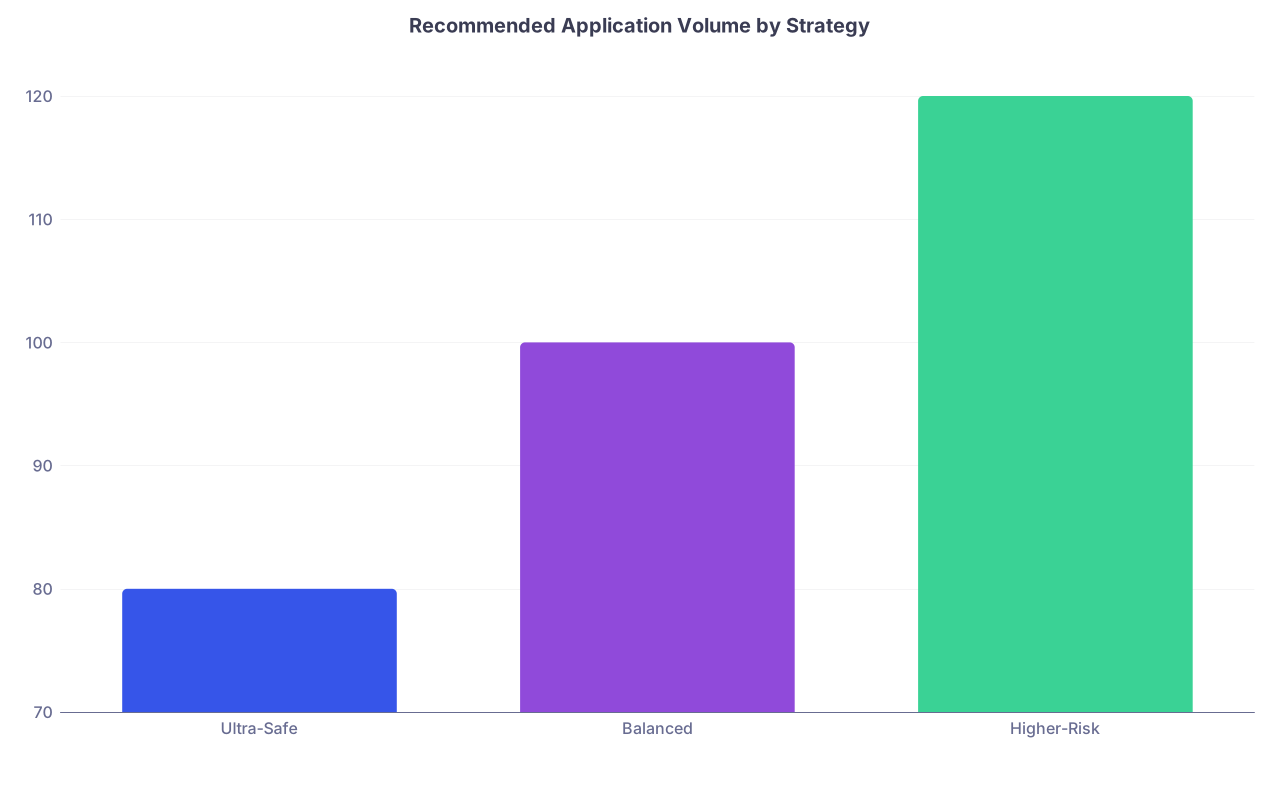
| Category | Value |
|---|---|
| Ultra-Safe | 80 |
| Balanced | 100 |
| Higher-Risk | 120 |
Interpretation:
- Ultra-Safe (FM/IM/Peds/Psych in broad areas): 60–80 programs total
- Balanced (Psych/PM&R + FM/IM backup): 80–100 programs
- Higher-Risk (EM/Anes/Rads strongly preferred with true backup): 100–120 programs
And within each:
- Include plenty of community programs
- Don’t cluster only in glamorous cities (NYC, LA, SF, Boston)
- Mix some newer or lesser-known university programs with strong community hospitals
Red flags to avoid:
- Applying only to your state or region if that region is competitive (California, Northeast corridor)
- Applying only to “top” names you recognize
- Not checking if a program historically takes DOs/IMGs if you’re one of those
8. Interview season: how to talk about your lack of sparkle
You will get asked, explicitly or implicitly: “So…tell me about your academic performance” or “What challenges did you face in med school?”
You don’t dodge. You own it cleanly, without self-pity.
Example script if you lack honors/research:
“I didn’t come into med school with much research experience, and I made a conscious choice to lean into my clinical training instead. My transcript reflects consistent, solid performance rather than top-of-class honors. On the wards I focused on being reliable, teachable, and thorough. That’s carried into my sub-Is and letters, and that’s how I’d show up as a resident here.”
If you had rough preclinical years:
“My early preclinical performance wasn’t where I wanted it, partly from taking too much on outside of studying and not having great systems. I adjusted—changed how I studied, used fewer but better resources, and leaned heavily on practice questions. The improvement in my later clerkships and Step 2 reflects that. I feel much more confident in how I learn now, which matters more for residency.”
No excuses. No ranting about unfair grading. Program directors can smell that a mile away.
9. Back-up of the back-up: SOAP and “what if I still don’t match?”
I’ve watched students with weak apps match nicely because they were realistic early. The ones who get crushed are the ones who cling to fantasy until February.
Your job:
- Monitor interview invites by late November / early December
- Compare your invite count to your specialty norms (ask seniors, mentors, not Reddit doomsayers)
- If you’re clearly below water, expand applications to safety programs mid-season (yes, that can help)
If March rolls around and you don’t match:
- DO NOT randomly SOAP into any open spot with no thought.
- Prioritize fields that you could be content in long term (FM, IM, Peds, Psych, PM&R, transitional years tied to a realistic future plan).
And if you truly miss completely:
- A research year is not automatically smart for someone who has never done research and hates it
- But a year working as a prelim, or in a clinical job, or in a role tied to your target field with better letters can set you up to reapply more strategically
Don’t rush into a desperation decision that locks you into misery. But don’t hold out for a miracle in derm, either.
10. Bottom line: how to salvage this without lying to yourself
Here’s what this really comes down to.
You can absolutely build a good life and a solid career in fields that are not hyper-competitive. I’ve seen FM docs who love their work and make more money than some subspecialists. I’ve seen community IM hospitalists who have fantastic lifestyles and job security. I’ve seen psych, PM&R, and peds folks genuinely happy they didn’t chase prestige.
Your situation:
- No research, no honors, maybe mediocre scores
- Limited time before ERAS
- A choice between fantasy and strategy
Do this:

| Step | Description |
|---|---|
| Step 1 | Assess Record |
| Step 2 | Anchor in FM or IM |
| Step 3 | Choose target field |
| Step 4 | Add strong backup specialty |
| Step 5 | Apply broadly to mix of programs |
| Step 6 | Secure strong letters |
| Step 7 | Apply widely and monitor invites |
| Step 8 | Any serious red flags |
| Step 9 | Field highly competitive |
You don’t need to become someone you’re not. You just need to stop pretending you’re competing in a lane you were never actually in.
2–3 key points to walk away with
- No research and no honors do not doom you—but they do take the top 10–20% of programs and specialties off the table. Accept that and move on.
- Your safest path runs through less credential-obsessed fields (FM, community IM, Peds, Psych, PM&R) plus strong clinical performance, excellent letters, and wide, realistic applications.
- The earlier you pivot from prestige fantasy to an actual plan, the more control you’ll have over where you land, not just whether you land at all.