As a DO graduate navigating the residency match, your letter of intent can feel like one of the few tools left to influence programs late in the cycle. Used thoughtfully, it can clarify your commitment, reinforce your fit, and keep you on a program’s radar. Used poorly, it can raise ethical concerns or simply be ignored.
This guide breaks down practical, evidence-informed strategies specifically for DO graduates: when and how to send a letter of intent residency programs will take seriously, how to tailor content for osteopathic-friendly programs, and how to avoid common pitfalls that can damage your credibility.
Understanding the Letter of Intent in the Residency Match
A residency letter of intent (LOI) is a brief, targeted communication to a program—typically to the program director—stating that you plan to rank that program highly, and sometimes that you intend to rank it #1.
For a DO graduate residency applicant, the LOI can serve several purposes:
- Clarify strong interest in an allopathic or osteopathic residency match program
- Reaffirm fit after an interview, especially if you feel your DO background needs context
- Update programs on new accomplishments or changes since your interview
- Signal genuine commitment to training in their environment and community
However, it is not a magic bullet. There is no guarantee that an LOI will move you up a rank list. Programs vary in how much they weight these communications, and some may ignore them entirely. Your goal is to write an LOI that is honest, strategic, and professional—one that can help, and will not hurt.
Ethical Ground Rules
Before you write anything, understand the ethical and NRMP-related expectations:
Do not lie
- If you say “You are my #1 choice,” it must be true at the time you send it.
- Avoid implying you are making the same promise to multiple programs.
You may express enthusiasm
- It is acceptable to say “I will be ranking your program highly” or “I can clearly see myself thriving in your program.”
Programs cannot ask you to disclose rank order
- If asked (explicitly or subtly), you may respond with genuine enthusiasm without revealing your exact plans.
Your LOI is not a contract
- You are not legally bound by an LOI—but your professional reputation is real. Violating stated intentions can have downstream consequences, especially in small specialties.
For DO graduates, professional integrity in these communications is critical. Your interactions may be noticed by both osteopathic and allopathic faculty who talk with each other across institutions and specialties.
When to Send a Letter of Intent (and When Not To)
Timing and intent are just as important as content. Understanding when to send LOI can make the difference between a letter that is helpful and one that is ignored or seen as noise.
General Timing Principles
Most residency programs focus on LOIs in the post-interview, pre-rank list window. A typical sequence:
Interview season (Nov–Jan, varies by specialty)
- Take notes after each interview: program strengths, culture, people you connected with, and how they support DO graduates.
Post-interview weeks (Dec–Feb)
- Send targeted thank-you emails within 24–72 hours (this is separate from an LOI).
- Reflect on your preferences and gather more information (current residents, alumni, mentors).
Approaching rank-list certification deadlines (late Feb–early Mar)
- This is usually the ideal window for a formal letter of intent residency programs can act on.
- Programs are actively constructing and finalizing rank lists.
After rank lists are certified
- An LOI loses most of its usefulness; programs often cannot change anything.
Specific Timing for Different Scenarios
1. Strongly favored #1 program
- Send your LOI 10–21 days before rank list deadlines when you are confident it will remain your true top choice.
- Earlier than that, your preferences may still be evolving.
2. Multiple programs you like but no clear #1 yet
- Hold off on an LOI that names a #1.
- Instead, send:
- Short, personalized “continued interest” emails to a few top programs (stating you will rank them highly).
- Then, once you genuinely decide on a #1, send a single LOI.
3. Late interview invitation
- If you receive a late interview at a program you realize is your true top choice, you may send your LOI sooner—within 1–2 weeks after the interview—to capitalize on fresh impressions.
4. Post-Interview Waitlist Vibes
If you sense (based on tone, comments, or numbers) that you’re not near the top of a program’s list, a well-crafted LOI can still:
- Demonstrate persistence and professionalism
- Clarify your strong interest despite a perceived weaker interview
- Provide relevant updates or address concerns (e.g., explaining a board score anomaly, showing new research productivity)
It won’t guarantee movement, but it shows maturity and motivation.
When Not to Send an LOI
Avoid sending an LOI if:
- You have not yet interviewed at that program
- A pre-interview LOI often looks like generic pleading and is rarely effective.
- You are uncertain about ranking them highly
- Use neutral “thank you” or “interest” emails instead.
- You are tempted to tell more than one program that it is your #1
- This is ethically problematic and risky.

What Programs Actually Look For in a DO Applicant’s LOI
As a DO graduate entering the integrated osteopathic residency match landscape, your letter of intent should address both your fit as a resident and your identity as a DO.
Core Elements Program Directors Value
Most PDs reading LOIs—whether at university programs, community hospitals, or osteopathic-focused sites—are looking for:
Signals of Authentic Fit
- Why their program, specifically, aligns with your goals.
- How your background and interests match their patient population, training style, or mission.
Commitment and Reliability
- If you say “You are my top choice,” they want to believe that.
- They are assessing your professionalism, maturity, and clarity.
Evidence You Understand the Program
- References to specific features: curriculum, tracks, call structure, osteopathic recognition, community outreach, or scholarly activity.
- Reflection on how you would contribute to and benefit from these features.
Concise Professional Communication
- Clear organization and respectful tone.
- No excessive flattery, melodrama, or desperation.
DO-Specific Considerations
For a DO graduate residency application, your LOI can also:
- Reassure allopathic programs about your comfort in a mixed DO/MD environment
- Emphasize your osteopathic training as a strength in:
- Holistic, patient-centered care
- Understanding of musculoskeletal medicine and OMT/OMM
- Preventive care and continuity, especially in primary care fields
- Highlight your successful navigation of both COMLEX and possibly USMLE, if applicable
Example DO-specific framing:
“My osteopathic training has shaped a holistic, systems-based approach to patient care that I am eager to bring to your interdisciplinary inpatient teams. During my sub-internship, I frequently integrated OMT to support pain control and mobility, in close collaboration with anesthesia and rehabilitation services.”
or
“As a DO graduate, I’m particularly drawn to your program’s osteopathic recognition and the opportunity to both refine my OMT skills and collaborate with MD colleagues in an environment that truly values diverse training backgrounds.”
How to Structure a Strong Residency Letter of Intent (With LOI Template for DO Graduates)
Below is a framework and LOI template tailored for DO graduates. You should adapt it to your specialty, unique experiences, and the specific program.
Optimal Length and Format
- Length: 3–5 concise paragraphs; typically 250–400 words
- Format:
- Professional email OR attached PDF (follow any program-specific directions)
- Clear subject line:
- “Letter of Intent – [Your Name], [Specialty] Applicant”
- or “Expression of Strong Interest – [Program Name], [Your Name]”
Step-By-Step Structure
1. Greeting and Purpose (1 short paragraph)
- Address the Program Director (and optionally APDs or committee).
- Clearly state why you are writing.
Example:
Dear Dr. [Last Name] and the [Program Name] Residency Selection Committee,
I am writing to express my strong interest in the [Program Name] [Specialty] Residency and to share that I plan to rank your program as my top choice for residency training.
If you are not ready to promise #1, adjust:
…to express my strong interest in the [Program Name] Residency and to let you know that I will be ranking your program very highly on my list.
2. Why This Program? (1–2 paragraphs)
Provide 2–4 specific reasons this program is the right fit. Avoid generic statements.
Focus especially on:
- Features you learned from the interview or rotation
- Unique aspects that match your values and goals
- Connections with faculty or residents, especially DO mentors
- Opportunities relevant to your career path (e.g., fellowship, community practice, rural medicine)
Example:
During my interview day on January 10th, I was impressed by how closely your mission aligns with my goals as an osteopathic physician. Speaking with Dr. Smith about your longitudinal continuity clinic confirmed that your program offers the kind of comprehensive, community-based care that I hope to practice. I was particularly drawn to your robust exposure to underserved patient populations and the strong emphasis on resident wellness and mentorship.
3. Why You Are a Good Fit (Including Your DO Identity)
This is where you connect your background, strengths, and osteopathic training to what the program offers.
Consider including:
- Clinical strengths, rotation feedback, or sub-I experiences
- Osteopathic manipulative medicine integration, where relevant
- Research, leadership, or community outreach
- Your work ethic, team orientation, or communication skills
Example:
As a DO graduate from [Your COM], I have trained in settings that emphasize whole-person, relationship-centered care. On my [Specialty] sub-internship at [Institution], I consistently received feedback on my reliability, thoroughness, and ability to communicate effectively with patients and colleagues. I also integrated OMT for hospitalized patients with back pain and respiratory compromise, which reinforced my belief in the value of a multimodal approach to patient care—something I would be excited to bring to your inpatient teams.
4. Restate Your Commitment and Close
Conclude with a clear, professional reaffirmation.
Example for a true #1 program:
Based on everything I have learned, I am confident that [Program Name] is the best place for me to grow into a compassionate, skilled [specialty] physician. I will be ranking your program as my number one choice. Thank you again for your time and for the opportunity to interview. Please let me know if I can provide any additional information that would be helpful during your ranking process.
Sincerely,
[Your Full Name], DO
AAMC ID: [#######] | ERAS ID: [if separate]
[Email] | [Phone]
Example for “highly ranked” but not necessarily #1:
I am certain that I would be honored to train at [Program Name], and I will be ranking your program very highly on my list. Thank you again for your consideration and for the opportunity to interview.
Sincerely,
[Your Full Name], DO
...
LOI Template (Copy/Customize)
You can use the following LOI template as a starting point:
Dear Dr. [Last Name] and the [Program Name] Residency Selection Committee,
I am writing to express my strong interest in the [Program Name] [Specialty] Residency and to share that I plan to rank your program as my number one choice for residency training.
During my interview day on [date], I was particularly impressed by [specific feature(s): e.g., your commitment to osteopathic training, your diverse patient population, the collegial atmosphere among residents, or your structured curriculum in X]. My conversations with [Dr. ___ / residents ___] reinforced my sense that your program fosters a supportive learning environment where residents are both challenged and well-mentored.
As a DO graduate from [Your College of Osteopathic Medicine], I have been trained to approach patients holistically and to consider their physical, emotional, and social needs. On my [specialty] rotations at [institution(s)], preceptors consistently commented on my work ethic, team-focused mindset, and communication with patients and staff. I have also enjoyed integrating osteopathic manipulative techniques, when appropriate, to improve comfort and function in my patients. I am confident that this background would allow me to contribute meaningfully to your inpatient and outpatient teams.
Based on everything I have learned, I believe that [Program Name] is the ideal environment for me to grow into the kind of [specialty] physician I aspire to be. I will be ranking your program as my top choice. Thank you again for your time, for the opportunity to interview, and for your continued consideration. Please let me know if I can provide any additional information.
Sincerely,
[Your Full Name], DO
AAMC ID: [#######]
Email: [your email]
Phone: [your phone]
Be sure to tailor the specifics for each program and avoid sending anything that feels copy-pasted or generic.

Common Mistakes DO Graduates Make with LOIs (and How to Avoid Them)
Even strong applicants can misstep with letters of intent. Being aware of frequent errors will keep your communication clear and credible.
1. Over-Promising or Misrepresenting Rank Intentions
Problem:
- Telling multiple programs they are your “#1 choice” or “top priority.”
- Using ambiguous phrases that sound like a #1 promise when that’s not true.
Impact:
- Damages your professional reputation if discovered.
- Contradicts the integrity expected of a physician.
Solution:
- Reserve “number one” language for one program only.
- For others you like, use:
- “I will be ranking your program very highly.”
- “I can easily envision myself training at your program.”
2. Sending LOIs to Too Many Programs
Problem:
- Sending similar LOIs to 5–10 programs dilutes authenticity.
- Programs can detect generic content that just swaps names.
Impact:
- Your letter blends into the background.
- You risk sounding insincere or scattershot.
Solution:
- Send one true LOI (with #1 language) and at most a few strong interest letters.
- Focus on quality and specificity over quantity.
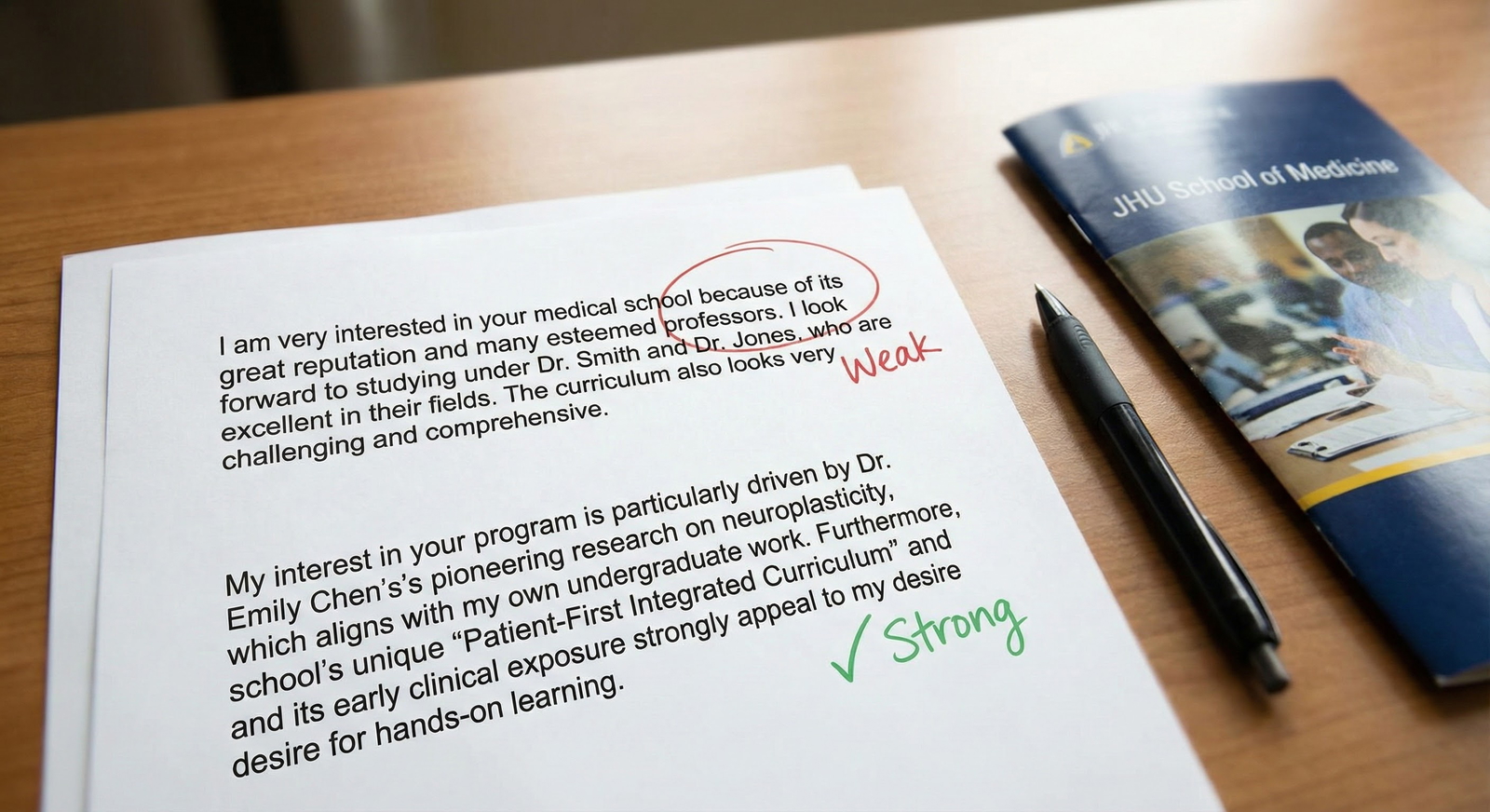
3. Being Vague and Generic
Problem:
- “I love your program’s strong curriculum and supportive environment.”
- “You have great teaching and a diverse patient population.”
Impact:
- Gives no evidence that you seriously understand the program.
- PDs read dozens of such statements every cycle.
Solution:
- Reference concrete details from your interview or their website:
- Specific rotations, tracks, or clinics
- The program’s osteopathic recognition, if applicable
- A unique call schedule structure, wellness initiative, or scholarly opportunity
4. Treating the LOI as a Personal Statement 2.0
Problem:
- Including your entire life story, motivations for medicine, or lengthy trauma narratives.
Impact:
- Overwhelms the reader and distracts from your main message: your commitment.
Solution:
- Focus on your relationship to that program, not your entire journey.
- Keep it to 3–5 solid paragraphs.
5. Poor Professional Presentation
Problem:
- Typos, incorrect program names, wrong PD name.
- Casual tone, emoticons, or overly emotional language.
Impact:
- Calls into question your attention to detail.
- Makes you appear less prepared for professional communication.
Solution:
- Triple-check names, titles, and details.
- Ask a mentor, advisor, or trusted peer to proofread.
- Use a neutral, polished tone.
DO-Specific Strategies to Strengthen Your LOI and Application Narrative
Because you are targeting a DO graduate residency path in a unified match, your letter of intent can also function as a subtle advocacy document for the strengths of your training.
Emphasize Osteopathic Training as a Value-Add
Without sounding defensive, frame your DO background as:
- An expanded lens on health (biopsychosocial, structural, functional)
- Practical skills in OMT/OMM that complement conventional care
- A culture of patient-centered communication and preventive care
Example lines:
- “My osteopathic education emphasized understanding the interplay of structure and function, which has deepened my approach to musculoskeletal complaints and chronic pain.”
- “Training in osteopathic principles has reinforced my commitment to seeing patients as whole people, not isolated diagnoses.”
Address COMLEX/USMLE Context If Needed (Briefly)
If you are concerned about how COMLEX-only scores will be interpreted in less osteopathic-focused programs, your LOI can:
- Subtly reassure them by noting:
- Strong clinical evaluations
- Strong performance in audition/sub-I rotations
- Any USMLE results (if taken)
Example:
While I completed only the COMLEX examinations, my rotation evaluations—particularly on my [specialty] sub-internships—highlighted my ability to synthesize complex clinical data, communicate effectively with patients, and excel in high-acuity settings. I am confident that my performance in your program would reflect these strengths.
Signal Long-Term Commitment to the Program’s Mission
Programs with osteopathic recognition or historically DO-friendly cultures may value:
- Commitment to community or underserved populations
- Interest in primary care or certain specialties
- Desire to teach future DO students
You can frame this clearly:
I hope to remain engaged with osteopathic medical education by teaching and mentoring future DO students on your inpatient services and in clinic, as many residents I met on interview day currently do.
This helps PDs envision your role in their residency community beyond simply “one more resident on the schedule.”
FAQs: Residency LOIs for DO Graduates
1. Do letters of intent actually help DO graduates in the residency match?
They can help, but impact varies by program. Some program directors place meaningful weight on knowing which applicants are most likely to come if ranked highly—especially for mid-sized or smaller programs and those with osteopathic recognition. Others rely almost entirely on standardized processes and may not adjust their rank list much based on LOIs.
For DO graduates, an LOI can:
- Clarify sincere interest in allopathic programs that may be less familiar with DO training.
- Reassure DO-friendly programs that you understand and appreciate their mission.
- Provide a final, professional touchpoint with a program that sees you as a close-call candidate.
2. Should I send a separate letter of intent to osteopathic-focused vs. allopathic programs?
You should individualize each LOI regardless of the program type. For osteopathic-focused or osteopathic-recognized programs, explicitly connecting your DO training to their mission is often a plus. For more allopathic-branded programs, you can still emphasize your osteopathic strengths, but also highlight how you function comfortably in mixed DO/MD teams and meet the same high standards of clinical performance and professionalism.
3. Is it okay to email my LOI, or should I upload it somewhere?
Most applicants send LOIs by email directly to the program director (and sometimes the program coordinator, copying them). If a program specifies a different communication pathway (e.g., a portal message or form), follow their instructions. A short, well-formatted email body is sufficient. In some cases, attaching a brief PDF version (with the same content) can look more formal, but it’s not required.
4. What if my preferences change after I send an LOI saying a program is my #1?
Technically, the NRMP does not enforce LOIs as binding contracts, but professionalism is the bigger issue. If your preferences change dramatically—say, a new opportunity or family circumstance arises—consider:
- Whether there is truly no way to honor your original stated intent.
- How likely it is that your change could affect your reputation if programs discover it.
Ideally, you should delay sending any LOI that declares a program as #1 until you are quite certain. If your plans change for a compelling reason, discuss the situation with a trusted advisor or dean before deciding how to proceed.
A well-crafted letter of intent can be a powerful finishing touch to your DO graduate residency application. Focus on honesty, specificity, and professionalism, and let your osteopathic training come through as the genuine asset it is.