
You can absolutely mix DO and MD mentors in the same application—what matters is the quality and relevance of the letters, not the letters after the writer’s name.
People overcomplicate this. Admissions committees aren’t sitting there with a DO/MD scoreboard. They’re asking: Does this letter prove you’ll succeed here, in this pathway (MD or DO), for this specialty direction?
Let’s walk through how it actually works, when mixing is fine, when it becomes a problem, and how to choose the right combination strategically.
The Core Answer: Yes, You Can Mix DO and MD Letters
Here’s the blunt version:
- Applying MD schools only? You can use letters from DOs, MDs, PhDs, and others. A strong letter is a strong letter.
- Applying DO schools only? You typically should have at least one letter from a DO, but having MD letters mixed in is totally normal.
- Applying to both MD and DO schools? A mixed set of DO and MD letters is not just fine—it’s common and often smart.
Where people get tripped up is not in the “mixing” but in the requirements and expectations of specific schools.
| Pathway Type | DO Letter Required? | MD Letter Required? | Flexibility |
|---|---|---|---|
| MD-only Schools | No | No (physician letter often optional) | High |
| DO-only Schools | Often Yes (1 DO) | No | Medium |
| Both MD & DO | Strongly Recommended 1 DO | No | High |
The letters you choose signal two things:
- Who actually knows you well.
- What path you seem serious about.
What Really Matters More Than DO vs MD
Admissions readers care about three things with letters:
- Strength – Is this letter detailed, specific, and clearly enthusiastic?
- Relevance – Does this person know your clinical, academic, or professional performance?
- Alignment – Does the letter make sense given your stated goals (MD vs DO vs undecided)?
If you’re applying to both MD and DO programs, a good basic structure is:
- 2 science faculty (MD/DO/PhD—doesn’t matter)
- 1 non-science / humanities / other faculty
- 1 clinical letter (this can be MD or DO)
- For DO schools: ideally one of those clinicians is a DO who explicitly talks about osteopathic medicine and your understanding of it.
Where the DO vs MD distinction does start to matter:
- Some DO schools explicitly require a DO letter.
- A lot of DO schools want evidence you actually understand osteopathic medicine, not that you shotgun-applied to every program in the country.
- A few MD schools like to see physician letters in general, but usually don’t care about DO vs MD.
When Mixing DO and MD Mentors Helps You
Mixing can actually work in your favor if you do it deliberately. Three scenarios I’ve seen work very well:
1. You’re applying to both MD and DO schools
Smart setup:
- DO physician letter: Talks about your time shadowing, your understanding of OMM, holistic care, prevention, etc.
- MD physician letter (if you have it): Highlights your work ethic, clinical reasoning, or performance in a clinical environment.
- Plus your core professor letters.
You’re signaling: “I’m serious about both paths. I’ve explored both. I’ve actually talked to people who live in these systems.”
2. You clearly understand and respect both training models
When letters show that you:
- Shadowed a DO in primary care who focused on continuity and prevention, and
- Worked with an MD in an academic hospital who commented on your ability to handle complexity and team dynamics
…that combination reads like someone who actually explored medicine thoughtfully, not someone who blindly followed Reddit checklists.
3. You’re leaning DO but want to keep MD options open
This is very common.
In that case:
- Make sure you get the DO letter, ideally from someone who actually knows you.
- Use MD or PhD letters where they’re strongest (e.g., research PI, attending from a big teaching hospital, etc.).
The mix shows you’re drawn to DO philosophy but not trapped by it. Commit enough to DO to not look fake, but keep MD options logically supported.
When Mixing DO and MD Mentors Can Hurt You
Mixing itself doesn’t hurt you. Sloppy strategy does.
Here’s where problems show up:
1. You apply DO with zero DO involvement
If your whole app is:
- MD letters only
- All MD shadowing
- No mention of osteopathic medicine in your essays
- And a DO school that asks for a DO letter gets only MD letters
That doesn’t read as “balanced.” It reads as “you ran out of MD schools and dumped DO programs on your list.”
If a DO school explicitly requires a DO letter and you don’t have one, that’s not neutral. It’s a negative.
2. Your DO letter is obviously a checkbox
This happens a lot:
- Shadowed a DO for 4 hours.
- Generic letter: “I barely know this person but they seemed nice and professional.”
- Contrasted with glowing MD letter from a real mentor.
Guess what committees think? “Their real mentor is the MD. The DO thing is just to satisfy a requirement.”
If you’re going to get a DO letter, invest the time to make it legit. Multiple days of shadowing, discussion about why they chose DO, real observation of you interacting with patients if possible.
3. The content of the letters contradicts your story
Example:
- Your primary essay screams “I’m committed to primary care and underserved communities; DO is the perfect fit.”
- But your MD trauma surgeon letter raves about how excited you are for competitive surgery and big academic hospitals.
- No DO letter. No osteopathic exposure.
That mismatch makes you look unfocused at best, dishonest at worst.
How to Choose WHO Writes Which Letters
Stop thinking “Do I need more DOs or MDs?” and start thinking “Who can convincingly vouch for me in the three arenas that matter?”
Those arenas:
- Academic ability – Can you handle med school?
- Clinical potential – Will you be safe and effective with patients?
- Professionalism and character – Are you the type of person they want to work with for four years?
Typically:
- Professors (science and non-science) → academic ability, work ethic, curiosity.
- Physicians (DO or MD) → clinical potential, professionalism, bedside manner.
- Research mentors (PhD/MD/DO) → persistence, critical thinking, teamwork.
If you have multiple physician options:
- Prioritize the one who actually knows you and can tell concrete stories.
- If you’re aiming at DO schools, lean toward using at least one DO in your final set.
- If your only DO is weak and your MD is incredibly strong, sometimes it’s better to use both but not rely solely on the DO letter to “carry” your application.
DO vs MD Letters for Different Applicant Types
Let me break down three common applicant profiles and what I usually recommend.
1. MD-leaning, applying mostly MD, a few DO “as backup”
You’re at risk of looking like you’re using DO programs as a backup bin.
Do this instead:
- Get your best possible letters from whoever knows you best (likely MD, PhD, professors).
- Get at least one DO letter if you can realistically build a relationship.
- In your DO secondaries and DO personal statement (if separate), explicitly show understanding of osteopathic principles:
- Whole-person care
- OMM/OMT (even if you’re not obsessed with it)
- Preventative / primary care emphasis at many DO programs
2. DO-leaning, but open to MD
You should:
- Absolutely secure a strong DO letter, ideally from a physician who:
- Watched you interact with patients or staff
- Talked with you about why DO fits you
- Can say you actually grasp osteopathic philosophy
- Round out with:
- 2 strong faculty letters
- 1 MD or PhD mentor if appropriate (research or hospital work)
That mix works anywhere.
3. Nontraditional applicant with few clean “premed” mentors
You might have:
- A DO PCP you’ve seen for years and recently shadowed.
- An MD supervisor from scribing or MA work.
- A boss from another industry.
- Maybe one professor from a post-bacc class.
For you, the MD vs DO label is almost irrelevant. You need anyone who can write a fierce, specific, detailed letter about your reliability and ability to succeed in a rigorous setting.
Then layer in a DO letter if you’re applying DO. Don’t force it at the expense of letter quality, but don’t ignore it either.
How Committees Actually Read a Mixed Set of Letters
Here’s what goes through their minds, whether they say it out loud or not:
- “Is there a clear core of people who know this applicant well and respect them?”
- “Are these letters consistent with the rest of the application?”
- “If they’re applying DO, did they actually meet a DO and talk about osteopathic medicine like they understand it?”
- “Is there any red flag—unenthusiastic tone, generic boilerplate, faint praise?”
What they are not doing:
- Counting the number of MD vs DO letters.
- Penalizing you for having both types.
- Assuming you’re confused or flaky just because your mentors have different degrees.
In borderline cases, though, a missing DO letter at a DO school that expects one can absolutely be the little thing that shoves you into the “no” pile.
A Simple Decision Flow You Can Follow
Use this mental flow:

| Step | Description |
|---|---|
| Step 1 | Start |
| Step 2 | Focus on strongest letters, MD vs DO doesnt matter |
| Step 3 | Get 1 DO letter + best other letters |
| Step 4 | Consider shadowing DO now, or apply DO later |
| Step 5 | Use same core set for both |
| Step 6 | Optimize for DO fit and philosophy |
| Step 7 | Applying to DO schools? |
| Step 8 | Can you get a strong DO letter? |
| Step 9 | Also applying MD? |
If you’re in that F box (no DO contact yet but applying DO now), you have work to do—fast. Short, intense shadowing can still lead to a usable DO letter if the physician is actually engaged and sees something in you.
Quick Reality Check: What You Should Do This Month
If this question is on your mind right now, here’s what I’d tell you to do without overthinking it:
- List every potential letter writer: faculty, MDs, DOs, research mentors, supervisors.
- Mark who:
- Knows you well,
- Has seen you work consistently,
- Actually likes you and your work.
- From that list, build:
- 2 strong science faculty (or committee letter if your school does that),
- 1 non-science / additional faculty,
- 1 clinical letter (if DO schools are on your list, push hard to make that person a DO).
- Confirm specific school requirements on each website. Don’t guess.
And stop obsessing about whether a single MD or DO letter is “better.” A detailed, powerful letter from either will beat a weak “checkbox” DO letter every single time.
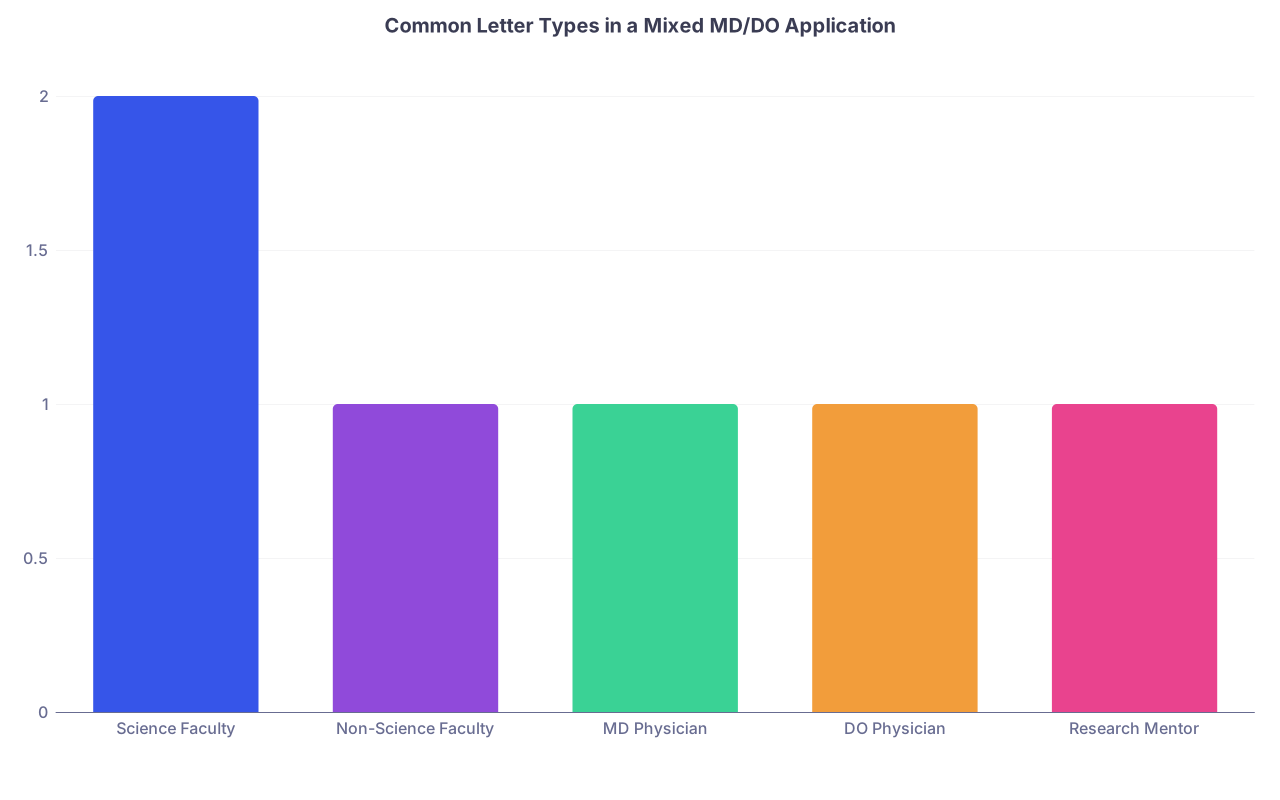
| Category | Value |
|---|---|
| Science Faculty | 2 |
| Non-Science Faculty | 1 |
| MD Physician | 1 |
| DO Physician | 1 |
| Research Mentor | 1 |
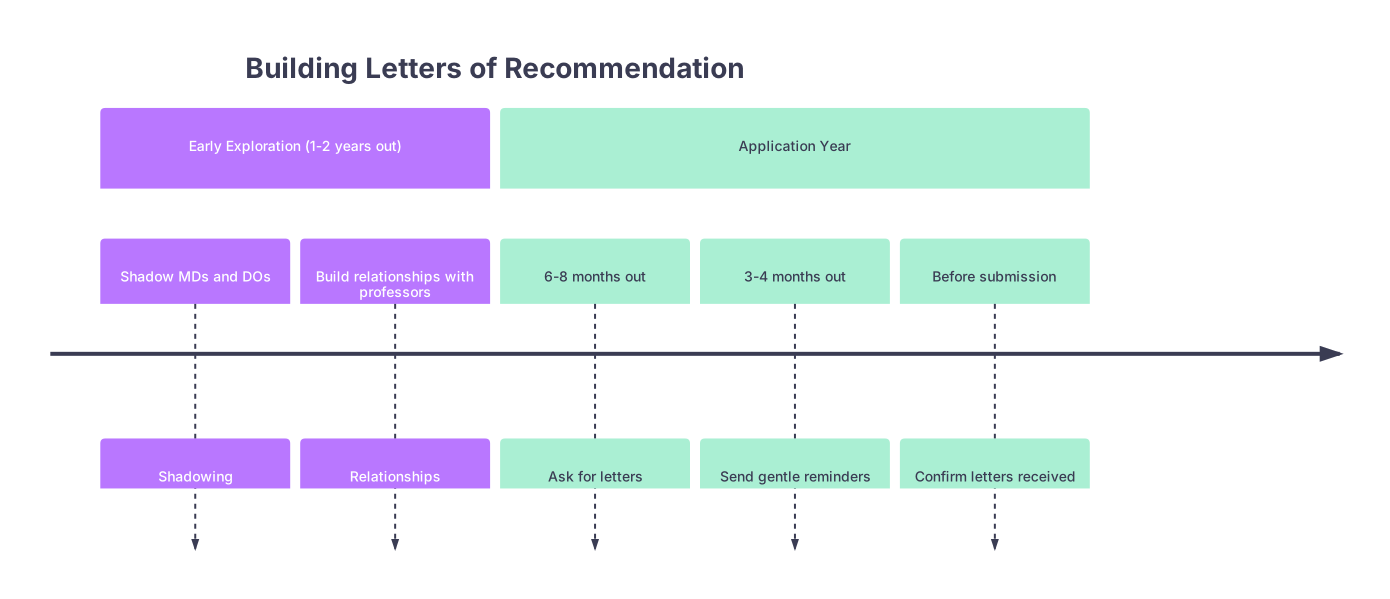
| Period | Event |
|---|---|
| Early Exploration (1-2 years out) - Shadow MDs and DOs | Shadowing |
| Early Exploration (1-2 years out) - Build relationships with professors | Relationships |
| Application Year - 6-8 months out | Ask for letters |
| Application Year - 3-4 months out | Send gentle reminders |
| Application Year - Before submission | Confirm letters received |
FAQs
1. Will MD schools care if I use a DO letter instead of an MD letter?
No. For MD programs, the degree of the physician writing your clinical letter isn’t the issue. What they care about is that the person:
- Knows you well,
- Has observed you in a clinical or professional setting,
- Writes a strong, specific letter.
A glowing DO letter will outrank a lukewarm MD letter any day.
2. Is a DO letter absolutely required for all DO schools?
No, not for all, but many strongly prefer or explicitly require one. Some schools list it as “recommended” on their website—read that as “we’ll notice if you don’t have it.” Always check each school’s admissions page. If they say “must have a letter from a DO,” don’t try to hack around it. Get the DO letter.
3. I only have time to shadow one physician. Should it be a DO or an MD?
If you’re applying to both MD and DO programs and can only pick one, go with a DO. You can still apply MD with a DO letter. You can’t always satisfy DO expectations with only MD exposure. But if you’re 100% MD-focused with zero DO applications, then it doesn’t matter—choose the person who will be a better mentor and letter writer.
4. Can I use the same set of letters for both MD and DO applications?
Yes, and most people do. ERAS/AMCAS/AACOMAS don’t require you to have separate pools of letters. Just build one strong, coherent set that includes at least one DO letter if DO schools are on your list. The rest (professors, MDs, PIs) can stay the same across both pathways.
5. My DO letter is weak but my MD letters are excellent. Should I still include the DO letter?
If a DO school requires a DO letter, you don’t have a real choice—you include it. In that case, make sure your other letters are stellar to offset the bland one. If the DO letter is only “recommended,” I’d read the specific school’s language closely. Sometimes it’s better to send 3 incredibly strong non-DO letters than 2 strong ones plus a weak, obviously checkbox DO letter—but that’s a judgment call.
6. How do I ask a DO specifically for a letter that helps my DO applications?
Be direct. After you’ve built some rapport, say something like:
“I’m applying to both MD and DO schools, and I’d love for committees to see that I actually understand osteopathic medicine and why it appeals to me. Would you feel comfortable writing a strong letter commenting on my fit for osteopathic training and what you’ve seen in me clinically?”
Then give them:
- Your CV
- A short paragraph about why DO appeals to you
- Any personal statement drafts
Make it easy for them to write a detailed, tailored letter.
Key points to walk away with:
- You can absolutely mix DO and MD mentors in the same application; quality and fit matter more than degree letters.
- If you’re applying DO, a strong DO letter isn’t optional in practice, even if some schools frame it as “recommended.”
- Don’t play DO vs MD letter games—build the strongest, most coherent set of letters from people who actually know and respect you, then layer in at least one DO letter when DO schools are on your list.