
You can sink an otherwise solid application by picking the wrong letter writers.
Not weak ones. Wrong ones.
If you’re a clinical‑light applicant and all of your strongest relationships are with research mentors, you’re walking straight into one of the most predictable—and preventable—mistakes in this whole process: submitting only research‑heavy letters of recommendation.
Let me be very clear: three glowing letters from famous PIs will not save you if committees are asking themselves a different question—“Will this person be a safe, reliable, teachable clinician?”—and your letters never touch that.
You’re about to see why.
The Core Problem: Committees Are Not Hiring Postdocs
Most premeds and early medical students misunderstand what letters are actually for.
You think: “Who knows me best? Who likes me most? Who has the biggest name?”
Admissions committees think: “Who can credibly speak to this person’s clinical potential, professionalism, and behavior under pressure?”
Those are very different filters.
Here’s the mismatch that burns people every year:
- You’ve done 2–3 years of basic science research
- You’ve barely shadowed, maybe some EMT or scribe hours, perhaps piecemeal volunteering
- Your letters all come from:
– your primary PI
– a postdoc or co‑mentor
– maybe another research faculty from a different project
On paper, your file screams: “Capable future scientist.”
But the adcom is trying to decide: “Do I trust this person with patients?”
If your letters don’t answer that question, you get silently down‑ranked. Not because they hate research. Because they can’t see you as a clinician.
I have seen it happen: 520+ MCAT, 3.9 GPA, multiple first‑author posters, and then comments in committee like:
“Great scientist, but I’m not convinced they actually want to be a doctor.”
“Not a single evaluator has ever seen them in a patient‑facing or service‑oriented context.”
That’s the cost of choosing only research mentors. It creates an obvious, avoidable gap in your narrative.
The Hidden Red Flags in an “All‑Research” Letter Set
The danger isn’t just who signs the letters; it’s what they inevitably focus on.
Research mentors, by default, talk about:
- your intellectual curiosity
- your technical skills
- your persistence through failed experiments
- your ability to analyze data and present at lab meetings
All good things. Admissions committees are happy to see them.
But if every letter says a version of that—and nothing else—you create three big red flags.
Red Flag 1: No One Has Seen You With Patients
When all your letters are from the bench and none from the bedside, reviewers start reading between the lines.
They wonder:
- Have you ever dealt with a distressed or non‑compliant person?
- Can you communicate clearly with someone who doesn’t know the vocabulary?
- Are you kind when nobody’s watching?
- Do you understand what “clinical responsibility” actually feels like?
Strong research letters often explicitly say, “I have not observed the applicant in clinical settings.” One isn’t fatal. Three is a pattern.
Red Flag 2: Your Professionalism is Context‑Limited
Here’s a subtle but deadly dynamic.
You look very professional—in the lab. You show up to meetings, you manage your experiments, you handle criticism from your PI. Great.
But adcoms care about professionalism in chaotic, emotionally loaded, high‑stakes environments: wards, ED, clinics, operating rooms. That’s where med schools live and where you’ll be representing their name.
If your letters never mention:
- reliability with schedule changes
- teamwork across hierarchies
- dealing with conflict or ambiguity
- maintaining composure with stressed people
they can’t extrapolate from “solid in the lab” to “safe with a crashing patient’s family.”
Some will guess generously. Many will not.
Red Flag 3: You Look Like You’re Avoiding the Clinic
This one stings, but you need to hear it.
When your file is research‑heavy, your experiences are research‑heavy, and your letters are only research, reviewers sometimes draw the most obvious conclusion: you prefer environments where people don’t bleed, cry, or die.
I’ve heard exact comments in committee rooms:
- “If this were an MD/PhD screen, I’d advance them without question. But for MD only, it’s thin.”
- “It’s not that they can’t be a doctor. It’s that I see zero evidence they want to be one.”
You can protest all you want in your personal statement. But if not a single evaluator can back you up on the clinical side, your words look… aspirational at best.
The Common Rationalizations That Get You in Trouble
Most people who end up with only research letters didn’t plan it that way. They drifted into it through a set of very human rationalizations.
Let’s walk through the most dangerous ones.
“My PI knows me best.”
Of course they do. You’ve spent hundreds of hours in their lab. You’ve emailed them at 2 a.m. about a broken script. You’ve sat through their long rambling digressions about grant cycles.
They should absolutely write one of your letters.
The mistake is assuming that “knows me best” automatically means “best choice for all my letters.” Knowing you deeply in one context doesn’t replace breadth across contexts.
You need someone who’s seen you:
- interact with sick or vulnerable people
- operate in a team where you’re not the smartest person in the room
- handle service, not just scholarship
Your PI cannot fake that. If they try, the letters sound generic and forced, and reviewers can sniff it out.
“Research letters will look more impressive than a volunteer coordinator.”
This is the prestige trap.
You imagine the committee will be dazzled by a “Professor of Neurobiology, HHMI Investigator, Harvard” signature and roll their eyes at “Clinical Volunteer Coordinator, Local Community Clinic.”
Reality: a concise, specific letter from a mid‑level clinician or coordinator who has seen you reliably show up for patients is often more powerful than a vague, recycled letter from a big‑name scientist who barely knows your last name.
Committees care far more about content than letterhead.
I’ve read letters from FQHC clinic staff that carried more weight than ones from Nobel‑adjacent labs, because they answered the real question: “What are you like with people who need help?”
“I’m clinical‑light; asking for clinical letters will expose that.”
No. Choosing only research mentors exposes that.
If you’re clinical‑light, what you need is at least one person who can credibly describe you moving toward patients, even if you’re early in that journey.
There’s a difference between:
- “This student has done limited clinical work but has shown strong growth and genuine engagement with patients,”
and - “I cannot comment on their clinical potential because I have not observed them in any relevant setting.”
One signals honesty and trajectory. The other signals avoidance.
“I don’t know any clinicians well enough.”
This is often true. But it’s not a reason; it’s a warning sign that you’re structuring your entire premed life around labs and ignoring the rest.
You can fix it. But not three weeks before letters are due. That’s the trap.
Who Actually Needs a Research‑Dominate Letter Set? (Hint: Not Most of You)
There’s a narrow group of applicants for whom leaning hard into research letters can make sense:
- MD/PhD applicants targeting physician‑scientist tracks
- People with extensive, high‑level research (e.g., multiple publications, gap year as full‑time RA) applying to schools that loudly prioritize physician‑scientists
- Applicants to specific research‑heavy programs that explicitly say research letters are required or strongly preferred
Even then, they still typically need at least:
- one core science faculty letter, and
- ideally one letter that touches their character and service outside the lab
For a standard MD applicant, especially one already light on clinical experiences, an all‑research LOR set is like putting more weight on the wrong side of the scale. You’re amplifying your strengths while leaving your biggest weakness undefended.
To make this concrete:
| Letter Mix Type | Risk Level for Clinical‑Light Applicant |
|---|---|
| 3 research, 0 clinical/service | Very High |
| 2 research, 1 clinical/service | Moderate |
| 1 research, 2 clinical/service | Low |
| 0 research, 3 clinical/service | Moderate (if research in app is strong) |
If you’re clinical‑light, that first row is basically asking to be questioned.
How Schools Actually Read Letters (And Where You Get Exposed)
Let me walk you through what happens on the other side.
File hits the reviewer’s screen. They see:
- GPA, MCAT
- Activities list
- Personal statement
- Letters of recommendation
They skim your activities: “3 years of neuro lab, 1,500 hours. Shadowing 40 hours. Hospital volunteering 60 hours. Some tutoring.”
Then they open the letters.
Letter 1: PI
Raves about your independence in the lab, your ability to troubleshoot, your future as a scientist. Zero mention of clinical anything.
Letter 2: Co‑mentor
Similar content. Adds that you present well at journal club. Again, only science.
Letter 3: Another research faculty
Talks about your enthusiasm for learning, your maturity, your statistical skills. No patients, no service, no hardship, no people skills.
Pattern recognized. Reviewer writes a line in their notes like:
“Very strong research profile. Limited demonstrated engagement with clinical care or patient‑facing work. Letters do not address bedside potential.”
And that note follows you into full committee.
Now imagine a slightly different file. Same stats. Same research. Still clinical‑light. But letters are:
- 1 PI letter (strong, detailed research praise)
- 1 hospital volunteer supervisor letter (talks about your reliability, kindness with anxious families, willingness to do unglamorous tasks)
- 1 course director or clinician letter (mentions your professionalism, communication, and ability to work in teams under time pressure)
Suddenly the narrative shifts:
“Research‑strong, clinically early but clearly oriented toward patient care. Letters support growth trajectory.”
Same hours. Same MCAT. Completely different story.
Specific Mistakes in How You Choose Research Mentors as Letter Writers
There are also tactical errors that make a mediocre situation worse.
Mistake 1: Picking Prestige Over Proximity
You choose the famous department chair who saw you in lab three times, instead of the junior faculty or postdoc who actually supervised you day to day.
What you get: a generic, template‑like letter that could be about any reasonably competent student.
Reviewers know this trick. A lukewarm letter from a big name feels like a quiet “no.”
Better: have the PI co‑sign or contribute to a letter primarily written by the direct supervisor who knows you well.
Mistake 2: Three Versions of the Same Letter
If all your letter writers watched you in the same environment, they will inevitably repeat the same strengths:
- “Hard worker.”
- “Curious, bright.”
- “Picks up technical skills quickly.”
It reads like a chorus, not independent corroboration.
You want non‑overlapping vantage points:
- one person sees your intellectual engine
- one sees your interpersonal style
- one sees your grit and day‑to‑day responsibility
All‑lab letters give a monocular view.
Mistake 3: Not Coaching Your Writers on What You Need
You’re allowed—actually, you’re supposed—to guide your writers.
Most students don’t. They just say, “Can you write me a strong letter?” Then pray.
If all you tell a research mentor is “I’m applying to medical school,” they’ll default to research content. That’s their entire relationship with you.
You should be saying something like:
“I know my application is heavy on research and lighter on clinical work. It would really help if you could address things like my work ethic, reliability, and how I function in a team, especially in ways that might translate to working with patients.”
Otherwise, they may unintentionally write a letter better suited for a PhD program.
How to Fix This If You’re Still Early (Premed Stage)
If you’re still 1–2 years out from applying, good. You have time to correct course.
The goal is simple: earn at least one strong, specific letter from someone who’s seen you in a clinical or service‑oriented role.
That does not require thousands of hours. It requires consistency and visibility.
Here’s how to avoid the all‑research trap:
Commit to a single clinical or service setting and show up every week for 6–12 months.
Not 10 places for 5 hours each. One place where staff actually learn your name.Introduce yourself to potential letter writers early.
“I’m premed, I really appreciate the chance to help here, and I’m hoping to grow into more responsibility over time.” People remember that.Ask for feedback mid‑way, not just at the end.
“Is there anything I could be doing better in how I work with patients or staff?” That signals maturity and gives them stories to tell in your letter.Choose someone who has seen you on both “good” and “bad” days.
If all they’ve seen is you handing out blankets on a calm Sunday, that letter will be paper‑thin.
The key is: you build the relationship on purpose, with an eye toward letters that complement your research strengths instead of duplicating them.
How to Patch the Problem If You’re Late (Application Season Now)
If you’re applying soon and already clinical‑light, you’re not going to magically invent two years of patient contact. But you can still avoid the worst version of the mistake.
Here’s your damage‑control plan.
Audit what your schools actually require or prefer.
Some insist on a certain mix: science faculty, non‑science faculty, etc. Some explicitly say a clinical letter is “highly recommended.” That is code for “we expect it.”Do not ignore a stated preference for clinical letters.
I’ve watched people shrug off that line, thinking, “My research is so strong it won’t matter.” It matters.Look for any credible person who’s seen you in a semi‑clinical context.
- Volunteer coordinator
- Scribe supervisor
- EMT supervisor
- Clinic manager
- Physician you shadowed extensively (not 6 hours)
Even if the hours aren’t huge, a concrete, behavior‑based letter is better than yet another glowing bench letter.
Have an honest conversation with your PI.
“My file is going to look very research‑heavy. Would you be comfortable briefly mentioning how you see my suitability for medicine and working with patients, based on what you know of me?”
They may not have direct patient context, but many have watched you discuss clinical topics, handle stress, or support lab mates. That still helps.Do not ask for more than two pure research letters unless a school explicitly allows and your clinical coverage is already solid.
If you can shift even one of your letters from research‑only to clinically‑aware, you’ve already reduced your risk significantly.
Visualizing Where Your Time is Going (And What It Signals)
If you’re unsure how lopsided your profile looks, quantify it.
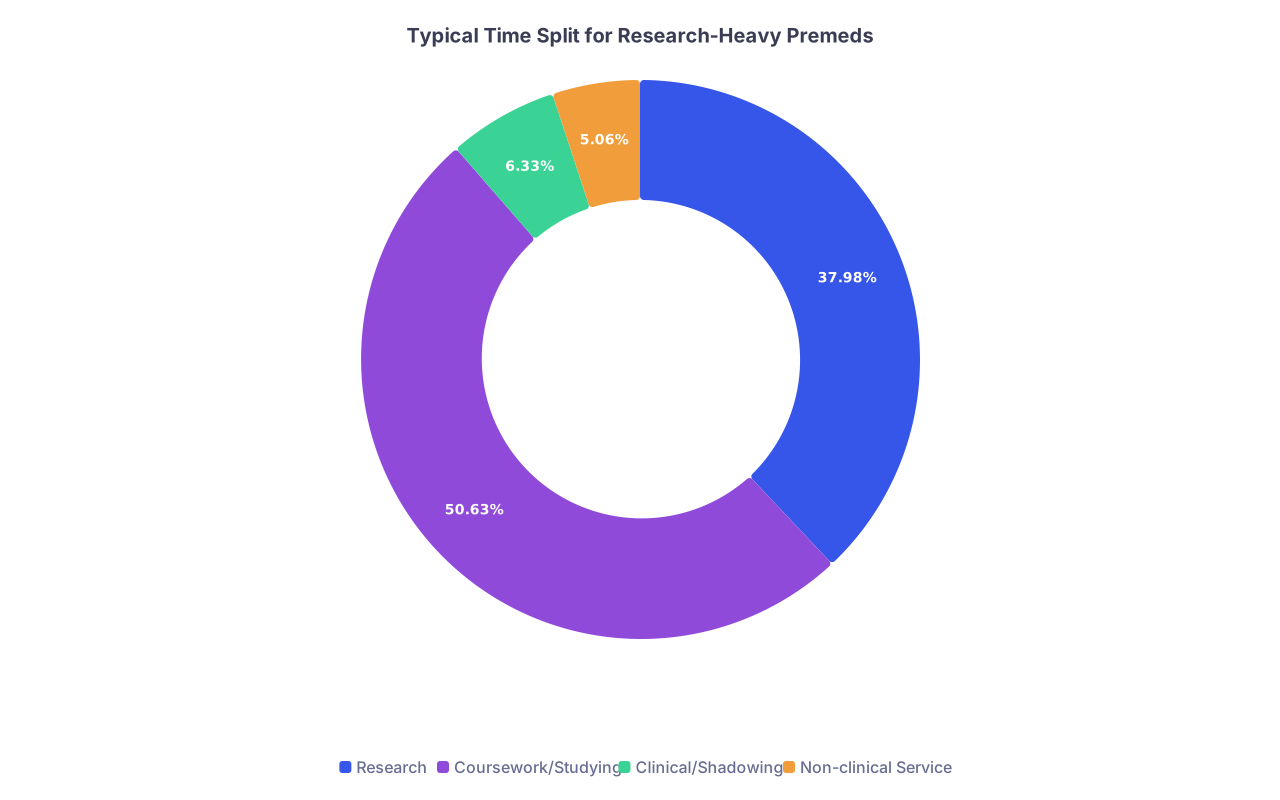
| Category | Value |
|---|---|
| Research | 600 |
| Coursework/Studying | 800 |
| Clinical/Shadowing | 100 |
| Non-clinical Service | 80 |
When that “Clinical/Shadowing” slice is tiny, and all your letters come from that big research chunk, reviewers see exactly what you’ve been prioritizing.
Your job is not to erase the research; it’s to demonstrate that you’re not only that.
A Smarter Letter Mix for Clinical‑Light, Research‑Heavy Applicants
Let’s build a rational, defensible letter strategy for someone like you.
You have:
- Strong research history
- Decent but limited clinical exposure
- Good classroom performance
You want letters that:
- showcase research (because it’s a real strength),
- prove you’re credible in academic settings, and
- at least begin to answer the “how will they be with patients?” question.
A better mix:
- 1 letter from your primary PI (deep dive on research)
- 1 letter from a science faculty member who taught you in a challenging course (academic rigor, classroom professionalism)
- 1 letter from someone who has seen you with patients or in service (clinical supervisor, volunteer coordinator, or physician)
If you have the option for a 4th letter and a school accepts it:
- use that for another distinct viewpoint (e.g., non‑science professor, long‑term volunteering mentor),
- but only if it adds something new. Don’t send four people saying “great at Western blots.”
Processes and Timing: Don’t Wait Until You’re Desperate
Here’s the part everyone underestimates: timing. You can’t fix this in two weeks.
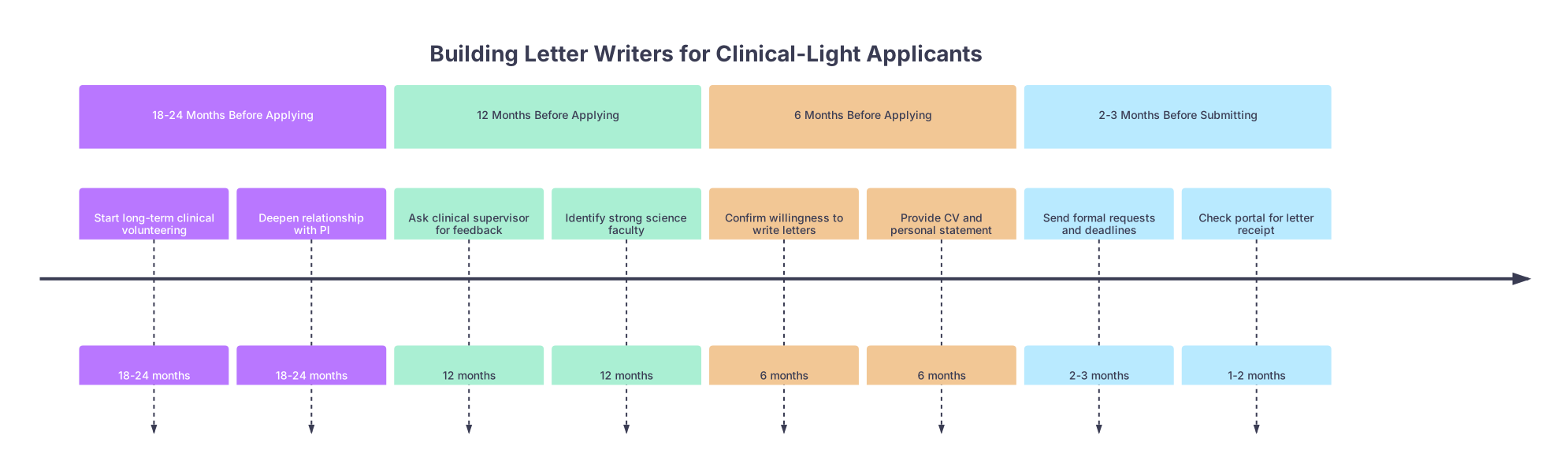
| Period | Event |
|---|---|
| 18-24 Months Before Applying - Start long-term clinical volunteering | 18-24 months |
| 18-24 Months Before Applying - Deepen relationship with PI | 18-24 months |
| 12 Months Before Applying - Ask clinical supervisor for feedback | 12 months |
| 12 Months Before Applying - Identify strong science faculty | 12 months |
| 6 Months Before Applying - Confirm willingness to write letters | 6 months |
| 6 Months Before Applying - Provide CV and personal statement | 6 months |
| 2-3 Months Before Submitting - Send formal requests and deadlines | 2-3 months |
| 2-3 Months Before Submitting - Check portal for letter receipt | 1-2 months |
If you’re reading this early, use the time. If you’re late, be brutally honest about what’s still possible and act now, not “after finals.”
Do Not Ignore This Just Because You Love Research
Let me end on the point too many bright, research‑loving applicants don’t want to accept.
Medical school is not a PhD program with occasional patient cameos.
Adcoms are not building a cohort of grad students. They’re building people who will sit at 3 a.m. at a bedside, make decisions under pressure, explain scary diagnoses, and own the consequences.
Your letters are the only third‑party documents that can say, “Yes, this person is wired for that.”
If every voice speaking on your behalf only knows you as the person who runs PCRs and writes R scripts, you’re forcing committees to guess about everything that actually matters for medicine.
Do not make them guess. They will often guess “no.”
Remember these core points:
- An all‑research letter set for a clinical‑light applicant is a giant unforced error; it amplifies your imbalance instead of correcting it.
- Prestige of the letter writer never compensates for missing clinical or service perspectives; content and context beat letterhead.
- Start early to build at least one strong relationship in a clinical or service environment—otherwise, you’ll be stuck explaining in committee‑speak why nobody who’s seen you with patients is willing to vouch for you.